" /> storytelling: March 2005 Archives

take me to the front page of the tttt weblog | back to the current weblog

« February 2005 | Main | April 2005 »

March 30, 2005

lying for fun and profit (originally posted 11/1/03)

a very early post, resurrected. because I'm busy trying to stay focused on this chapter.
listen

storytelling is about being creative, or, to put it more bluntly, lying. A successful liar storyteller is somebody who a) has a really good memory; b) knows the value of detail; c) can make the listener want to believe what he or she has to say. Suspension of disbelief is what makes storytelling work.

Here's a good exercise I use when teaching. Have people make three statements about themselves, one of which must be a huge whopper of a lie. For example, Louie writes down:

1. I once was questioned by the FBI because they thought I was connected to a cigarette highjacking gang.

2. When my mother was growing up, she lived across the street from a man who had no arms who had a wife who had no legs.

3. Last summer I got a cool job: I was a roadie for Garth Brooks.

Louie has had an interesting life, but one of these is a lie. To survive the game, he must be ready to answer questions. It's not enough to say, yeah, it was cool, when asked about being a roadie. He's got to have the details down, ala:

Well, my only job was to keep his hats in shape and ready to go. He's got this whole setup in the bus, just for the hats. Brushes, spot cleaners, molds, the whole thing. And it was my job to have them ready for him, off stage, for when he soaked through a brim -- you would not believe how that guy sweats. I almost got fired in Amarillo when a huge guy --must have been three hundred pounds, and he smelled like a dog kennel-- barged back stage waving a toilet plunger and nabbed Garth's favorite white suede ten gallon cowboy hat. I thought he was a janitor but it turns out he's this nutcase who follows the band around Texas, just begging to Garth to let him play in the band. His name is Hewey Red Dog Cross, and he makes music with that plunger, you've got to hear it to believe it.
Take a shot, it's fun. Make up a really outrageous claim and then back it up. Oh and here's a hint: if Louie knows nothing about Garth Brooks or concert tours, then setting up a lie story like this will fail unless he's willing to do a lot of research first. People who write historicals or alternate universe fiction have the most research to do; those who write what they know (and nothing else) have the least.

March 29, 2005

similes

In an earlier post I wrote something like: drifting apart like feuding sisters at a family dinner. Joshua pointed this out, because he thinks he can't write a good simile.

I happen to believe that he can write a simile, but like most people who write well and think about writing, he's afraid of them. Similes and metaphors are scary, because they go bad so easily. Without much work at all, a simile will slide into the dreaded realm of the cliché, and once you start thinking about clichés, they crowd out every other thought in your head. Fresh as a blank. Uglier than blank. Slicker than blank. Hotter than blank.

A cliché is what it is because it works. What is hotter than hell, after all? The comparison fits all our cultural conditioning so well that it seems impossible to improve on it. If you set out to top hotter than hell, you're likely to produce something awkward and contorted.

What I try to do is not think about the mechanics. I let my subconscious handle such things. Look, say I to my subconscious, how my paragraphs are getting farther and farther apart. Something is wrong with the formatting. They are scurrying away from each other on the page. At that point, my subsconscious provided the feuding sisters. If I had made a conscious effort to come up with a simile, it never would have worked.

This is not to say that it's a wonderful or perfect simile; it's just an example of how this particular comparison came into being.

Like humor, a good simile is dependent, to some degree, on lateral thinking. Edward de Bono has published most widely on this term he coined. Lateral thinking is about flexing the way your mind works; it's about the mechanics of creativity. One of the ways he illustrates the whole concept (from his website):

"You cannot dig a hole in a different place by digging the same hole deeper"
This means that trying harder in the same direction may not be as useful as changing direction. Effort in the same direction (approach) will not necessarily succeed.
When I was first reading de Bono's work on lateral thinking I noticed the best examples in the way comics work. Watch a really excellent, very fast comic like Robin Williams and you'll see it again and again. A sentence starts, and should lead, by experience and perception, to one of several possible conclusions, but the comic makes a turn. Just a slight turn, maybe no more than thirty degrees, and ends up somewhere else. The turn takes you by surprise: hence, humor. Stale old jokes show this, too.

Take my wife.

When somebody says, "Take my wife," you think of this, generally, as a conventional way of starting an anecdote, with an example. "Take my wife, for example. She never forgets a birthday." But the comic makes a 90 degree turn:

Please.

Freud said that all humor was based in the confounding of expectations, and that's what lateral thinking is about. Lateral thinking works for writers as well as for comics, and not just to be funny. It's a way to find an unusual turn of phrase or a fresh comparison.

Here's another example: he's got a mind like a steel blank. You expect the cliché steel trap, meaning something fast and sharp and merciless. If you get instead: he's got a mind like a steel sieve, you've made a 90 degree turn from the expected, escaped from the feared cliché, and hopefully made an impression on the reader.

The trick is learning how to think laterally. I'm only successful at it for a small portion of the time. If I practiced, I could probably be much more amusing at parties and write more interesting similes. So, I'm sure, could you.

March 28, 2005

why bother with the NYT Book Review...

...when you can read Ed Champion's review of the reviews?

He poses the question:

Will this week's NYTBR reflect today's literary and publishing climate? Or will editor Sam Tanenhaus demonstrate yet again that the NYTBR is irrelevant to today's needs? If the former, a tasty brownie will be sent to Mr. Tanenhaus' office. If the latter, the brownie will be denied.
Unfortunately (but not surprisingly) Sam flunks every test, the column-inch test, the hard-on test, the quirky-pairing test, etc, and must do without brownies, yet again.

An answer to my own question: I find the Sam Tannenhaus Brownie Watch far more interesting and amusing than the NYTBR. Beyond that, it includes, in suitably abbreviated form, the basics of the major reviews. So my conclusion is this: Ed should keep all the brownies for himself, and the NYTBR should bow out gracefully and allow him to take over.

March 27, 2005

odds and ends before I try to start this really resistant chapter, yet again

Recently I've been exploring unknown blogitories, as I've mentioned before. I've had suggestions of author weblogs from various folks, for which thanks.

Of course in my adventures I've run across a lot of stuff that caught my interest and a few websites I loved at first sight. Some highlights having nothing to do with writing:

Tild~ and I share political sensibilities and a love of odd graphics and good stories. She's got that perfect combination of snark and wit that I aspire to. Thanks, Robyn.

Beyond the family week at the beach this summer I had no plans for any kind of vacation. Until Cheryll at dig.it. pointed me to Dog Scout, which organizes a Dog Camp. Oh boy.

"Dog Scout Camp is like a piece of heaven on earth for anyone who loves their dog. Work, deadlines, ringing telephones are all left behind and the only care in the world is what am I going to do next with my best friends. My dogs have amazed me in this positive supportive atmosphere with their learning ability and talents...how could I have known in "real" life that my Jack Russell Terrier Rocket shines in water rescue training, painting and drug detection? "

Sad footnote: the real Dog Camp is in Michigan. Like, four days drive away from us.


And finally, a game of bingo I can really get behind.

Over at Chez Miscarriage, getupgrrl has been writing about her yoga class and a classmate she is calling Competitive Boy. You can read the post here. I'm sure you'll recognize Competitive Boy, as he seems to show up in every class ever taught. So the usual crowd is over there commenting, and as I was skimming through I came across this entry by amyesq:

...Sometimes annoying Competitive Boy can come in handy. In my first year of law school, one of my classmates made up "(Shut the Fuck Up) Bingo". Since we were with the same 100 people for all your classes, it was a great game. He made up several bingo sheets with the names of different blabbers on them. I mean it's law school. This is where Competitive Boys are made. Each card was different and we paid a dollar or two for them. The class started and a bunch of us had our cards. Once a CB spoke, we could mark him (or her) off on the card. The first one to get Bingo had to raise his or her hand, get called on, and somehow incorporate the word "Bingo" into his or her answer. This kept us all amused and busy for at least a week. I must also confess that I was on some of those cards.

Which made me laugh out loud. So, first I went to amyesq's weblog, here, and now I'm posting to bring amyesq, her weblog, and this game to your attention.

I never would have guessed there might be a bingo game I'd like. It's almost enough to make me want to go back to school. To law school, even.

Barring such a move on my part (unlikely, as it's a two hour drive to the nearest law school), I'm wondering how a short story could be made out of this, or a scene. I'll probably be thinking about it for years.

March 26, 2005

oh, to be this witty

From the radiant Robyn Bender, this Edgar Allen Poe quote:

"To speak algebraically: Mr. Mathews is execrable but Mr. Channing is (x+1)ecrable."

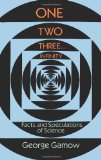
My husband, the mathematician, will appreciate this. My daughter, who tried to explain the concept of infinity to me, her math-phobic mother (when she was five, please note) will appreciate it too. For those of you who face the same challenges, I suggest One Two Three . . . Infinity : Facts and Speculations of Science by George Gamow.

a different matter entirely: cascading style sheets

I appeal to those of you who know more about css than I do (and that will not be a small number).

You'll note that my paragraphs are wandering further and further apart, like feuding sisters at a family dinner. Looking at my style sheet I can't figure out why that would be. Anybody who'd care to have a look at the stylesheet in question, here's the link: storytelling css.

I would guess it's something obvious that I'm overlooking.

March 25, 2005

once more, with feeling

Stephanie has directed me to Sarah Weinman's weblog, Confessions of an Idiosyncratic Mind (with this tag line: "A respected resource for commentary on crime and mystery fiction." -- USA TODAY), for her sidebar list of authors who keep a blog. So I went over there and was immediately drawn in. It's exactly the kind of stuff I like. Wow. Another way to procrastinate. Thanks, Stephanie.

And then I ran into Sarah's post about bodice rippers and romance novels and sex scenes where she quotes somebody else on the ridiculous nature of sex scenes in romance novels.

This blanket condemnation of a whole genre -- often by people who admit (proudly) that they don't read it -- really gets tired. It's as intellectually suspect as universal praise. How about this: There's no such thing as a badly done serial murder spree when it comes to crime novels.

Ridiculous? Of course.

Generalized romance-bashing comes in waves, it seems; Lee Goldberg got into the act, too, and his commenters joined him. There are other examples from other weblogs, but I'm going to stop there. Instead I would just like to point out that the term bodice ripper seems to have some magical power. Maybe because it is such a fantastically evocative put-down and so visual, some people (especially those who are proud never to have read a romance, or to have seen the error of their ways and turned away from the whole genre in disgust) jump at the opportunity to use it, and use it with glee, when talking about love stories with happy endings that are written by women.

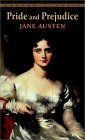
So yes, I could have left a comment on both Sarah's and Lee's weblogs with a list of well written, engaging romance novels with sex scenes that commit none of the sins mentioned. I could have, but then I reminded myself that talking people out of preconceptions is next to impossible. More than that, it's a waste of time that could be better used procrastinating elsewhere. Like right here, pointing anybody who has never read romance or who hasn't read it in a long time to novels that might want to have a look at. Those would be: Welcome to Temptation and Bet Me by Jennifer Crusie, Bliss and Dance by Judy Cuevas, Flowers from the Storm by Laura Kinsale, and of course, the ultimate romance novel: Pride and Prejudice by Jane Austen.

To be clear: I do like what I've read of Sarah's weblog and I was already in the habit of visiting Lee's once a month or so, to catch up. I also appreciate the links on both sites, because I found a few very promising blogs in a quick foray, including Wendy Duren and Smart Bitches.

March 24, 2005

would you?

I've been trying to compile a list of published novelists who keep regular weblogs rather than (or in addition to) static websites. It's been tough going, and at this point I'm wondering if it's worth it. However, I have come across a few interesting blogs, one of which I wanted to ask you about.

Douglas Clegg writes horror, fantasy and suspense. I'm not familiar with his work, but I wanted to have a look, so I went to his weblog, here. That's when I discovered (as you will, if you clickit) that he requires visitors to sign up for a free email newsletter in order to get into the site and read the weblog as well as other materials he has there.

First: no worries. I'm not going to do this, mostly because I don't want the work of maintaining the list and writing the newsletter. There are enough deadlines in my life as it is. But I am curious. Are people comfortable doing this? For my part, I decided I wasn't that interested, and so I went away. Maybe I'll go back and sign up; maybe not. So I've got a little poll going, and I put it in the right hand column. I'm truly curious.

March 23, 2005

in which I contradict myself without apology

Princess phone I do love technology, but sometimes I am baffled by its misuse. Consider, just for a moment, the telephone.

Before Ma Bell gave birth to her unruly hoarde of Baby Bells, phones were boring. Indestructible for the most part, but otherwise unremarkable. The Princess Phone, the ultimate in Marie Osmond-esque hip, was as jazzy as it got.

Fast forward to the current situation. Everybody is making phones. Not just good ole ATT and the Baby Bells: everybody. I have this sense that in back of every dry cleaners, pizza joint and shoe repair shop there's some guy with a hunk of plastic, some cheap wiring, and a screwdriver. This guy is sure he can build the phone we've all been waiting for, the one with exactly the right combination of features. He'll build it and market it and it will be out there with the 354 other models put together by people just like him. People with no common sense, and no idea what my kitchen is like.

It seems so simple, until you look at the list of possible features. Cord/cordless; speakerphone; multiple or single line; answering machine with/without call screening, with/without date stamping, with/without remote retrieval, with/without multiple boxes; caller ID; call waiting ID; spoken commands, spoken caller ID, spoken date/time; intercom system built in; expandable; dual keypads, lighted keypads, keypads that play sounds or don't; personalized ringer options.

The only guarantee is that one or more of the features on the phone I end up buying will stop working within two weeks. Almost certainly the one feature I really needed. The answering machine will go on strike, but the ringer option that sounds like chipmunks mating will be there forever.

With all the choice out there, why has nobody come up with something simple? Like this: make a list of the features you want on your phone, and we'll put it together for you and show you the price as you add or delete features. We'll stand behind our work and our materials for three years, and replace the phone if any part of it stops working. For that, I'd pay. Because you know what I want? A simple phone with three things: a cord (our power goes out on a regular basis, out here in the boondocks, and cordless phones don't work without electricity); caller ID; a simple, easy to use, clear answering machine. I don't need date stamping, a special voice mailbox for my dogs, a phone that talks to me, or a stereophonic ringer.

The reason I need a phone like this is simple: the one I bought six weeks ago, which had too many features beyond the ones I wanted, has started snarling at people, a huge rush of static instead of my usual recorded message: You've reached 555-5555. Now you say something.

If you know some technologically savvy, engineering oriented young person looking for a hole in the market, would you please steer her or him to this idea of mine? There's got to be a future in custom built, high quality phones. I'm trying to talk my daughter into it, but I'm not making much progress.

titles

Pam wrote:


I must admit though, on the title, I keep getting flashes of the TV series "Queen of Swords" - it leads to a very different impression than tarot cards, although the occult is present I guess, in the gypsy fortune teller/palm reader assistant to "the Queen." If I was a publisher, I might be concerned that there might be confusion between the TV series and the Wilderness series of books. But I wonder if cross-pollenation of imagery and ideas are really a concern to such people anyway.

There was a TV series? I never heard of it... has anyone else?

I'm sure you've thought of at least one other title that would be suitable? Is a title the first or the last thing you tend to think of? Aren't you supposed to leave title-development to the last in case the tone or plot changes dramatically, or in case the title influences the writing, you know, boxes you in, in some way? That sounds rude. I meant to say...Queen of Swords is a fine title, but have you planned for eventualities?

It's not a rude question, not at all, but the answer is simple: Nope. No other title in mind, and I won't even contemplate such a thing until I'm forced to. Titles present themselves quite early in the gestation of a novel, and I'm a little superstitious about them. I've never felt boxed in by a title, because usually they are broad enough to encompass a lot of development and change.

Is this a good thing?

I am a great fan of technology, really I am. I'm always interested in new software and updated hardware, in advancements that let me see or hear more clearly. I think the internet is the great invention of our time. But some things make me nervous, and Amazon is one of those things.


They've got some new features, in case you didn't know. The hugely powerful software they use to scan books also gathers some rather startling information. Look, for example, at the entry for Byatt's Possession. About half way down the page you'll see a heading called Citations, and under that, a list of all the books mentioned in the novel. For example:

Principles of Geology (Penguin Classics) by Charles Lyell ◦ page 298, and page 497

There is a link to the currently available edition of this book, as well, for your shopping convenience.

Amazon is also providing what they call SIPs, or statistically improbably phrases. Their definition:

Amazon.com's Statistically Improbable Phrases, or "SIPs", show you the interesting, distinctive, or unlikely phrases that occur in the text of books in Search Inside the Book. Our computers scan the text of all books in the Search Inside program. If they find a phrase that occurs a large number of times in a particular book relative to how many times it occurs across all Search Inside books, that phrase is a SIP in that book.


Here's an example of such phrases from Niven's Ringworld Engineers (click for a larger version). You'll note that you can also search inside this book -- for example, you could look up "immortality drug," ask for the page it's on, and read it in context.


Not all books have these features enabled. If you'll notice, under the picture of the cover you'll sometimes see this phrase: "Publisher: learn how customers can search inside this book." Of course, Amazon has to have permission from the publisher (and, I'm hoping, also from the author) before they run amok among the pages. My novels do not have this feature. As far as I know, my publisher just decided not to allow it, which, I guess, is good. I think.


I make a case, whenever possible, for supporting local independent bookstores, but I do use Amazon. I use it as a reference work, to look up titles and editions and availability. These new features are also promising. If I know that someplace in Novel X the author uses the phrase 'xxx' -- say I remember because it was a strong image or evocative piece of dialogue -- I have two choices if I want to find it again. I can sit down and page through the whole novel again, or ask Amazon to search for the phrase.

So yes, there are some services Amazon offers that a small independent bookstore cannot. On the other hand, nobody from Amazon has ever reached out of the computer to pet my dogs or give them a treat. Nobody from Amazon has ever asked how my daughter is doing or if I have an opinion on the neighborhood ballot to stop further construction of condominiums.


I have this sense that I'm the little kid playing on the sidewalk and Amazon is the stranger with candy. It's really good candy, too. Chocolate and hazelnuts and French nougat. I need to keep reminding myself why it's not good for me. Because it's not. I'm almost positive.

March 22, 2005

radio silence

Things have been crazy the last three or four days, but I plan to be back here tomorrow. At that time I'll answer questions that have popped up in the comments to the last post.

March 19, 2005

if I could design my own covers


...I might do something like this for Queen of Swords (click for a larger image).

The painting is "Wheel of Fortune" by Sir Edward Coley Burne-Jones. This is a detail from the painting, leaving away the naked men off to the right: a king, a poet, a slave, all of whom are waiting for Dame Fortune to spin the wheel.

I like this painting for its colors (although it's not my usual taste) and for the composition. It also resonates for me in terms of the story I'm telling. Whether the Queen of Swords is Hannah or Jennet or somebody else, and if the Queen of Swords is connected to Dame Fortune -- those are things that will make themselves clear by the time I'm done.


Of course, all of this is moot, as I don't design my own covers, and if history repeats itself, I won't be able to keep this title, either.

March 17, 2005

said: the undead (a sequel)

People are coming forward in various places to defend the list of said-bookisms some teachers have provided to encourage kids to use in place of "said" (a movement with the catchy but infuriating title said is dead). Kids don't read, goes the argument. Kids resist writing. Kids are too busy watching movies and tv and playing video games. Teachers are desperate! Anything to expand their vocabularies. Anything to get them to sit down and write.


I just don't buy this argument.

I can see the need for ways to broaden vocabulary and to get kids motivated about writing, but this said is dead approach is, in my opinion, just silly (at best) and at worst, it will teach bad habits rather than good ones.

And to really get into it: I don't believe reading is in trouble, not even for the younger generation. Of course kids spend a lot of time in front of televisions and computers and don't reach for a book first thing when they have a half hour to spend. When did they ever? When I was a growing up, kids were out in the street teasing old ladies and throwing water balloons and telling each other about the facts of life; they came in to watch television, eat dinner, do homework, and go to bed. Except me. I was a geek. I was in the house, reading. I got in trouble for reading too much.

The truth is, the kids in the neighborhood turned out fine, and so did I. Some of them are great readers; others aren't. I don't believe that you can predict long-term dedication to reading and writing from one particular set of behaviors or a particular classroom experience. There's a greater variety of ways for kids to spend their time; books have more competition, but that's true for readers of every age, and in fact, books do sell.


From Making Light and an excellent older post on literary whining

[...] by our best calculations, using every scrap of reliable data we can lay hands on, at this very moment more people are reading more books, reading a greater variety of books, continuing to read them later in life, et cetera and so forth, than ever before in the history of civilization.

Now, I don't want to minimize the challenge that comes along with teaching, especially the middle school age. Dog bless every middle school teacher a hundred fold: you have more stamina and dedication than I do, and you do what you do for less money that you deserve. And while one set of behaviors can't predict life-long reading habits, I believe one excellent teacher can make a hugely important and positive difference in the way a child goes about learning. However, that doesn't mean that every teaching method that comes down the pike is well thought out or effective. Said is dead is (I hope) a passing fad.


Fire Along the Sky

Got an email from my editor today -- Fire Along the Sky has gone back to press on the hard cover. Which is good news, of course, except I can't remember how many they printed to start with, and I hate asking questions like that because if the number is low I'll be disappointed and if it's high, I'll be worried about piles and piles of unsold books on remainder tables across the country.

Which brings me to another topic: the question people ask me most often by email:

When is the next book coming out?

And the answer:

I hope to get it to the publisher in October of this year. Then it's up to Bantam. They usually need between six and nine months to get it into bookstores.

The second most asked question:

When is Fire Along the Sky coming out in paperback?

and the answer:

the last I heard, in the fall.

March 16, 2005

said: the undead

Here's an interesting and rather disturbing post from LiveJournal, with GMTH reporting about her kid's homework assignment to write a short scene that would fit into a book they're reading (GMTH points out with glee that this is fan fiction the kids are writing). One of the instructions given by the teacher: said is dead. To help the kids beat poor old dead 'said' deeper into its grave, the teacher provided a list of about one hundred alternates, including things like brayed and warbled and vocalized. In the discussion on LiveJournal somebody else provides a link to this site that gives advice on writing Harry Potter fanfiction, where the same said is dead pronouncement comes up, with the same list. I found the original link to the LiveJournal discusson at Neil Gaiman's journal.


I am a great supporter of fan fiction, of storytelling in all its forms, and I also do really believe that anyone can learn to write a story, and write it well. Talent helps, but it's not strictly necessary. The things you do need: to be persistent, to be dedicated, to understand the process, and to read a lot. It also helps if people in positions of authority, especially teachers, don't give you bad advice before you're old enough to recognize it for the garbage it is. Can kids survive this kind of bad teaching? Sure. The point is, they shouldn't have to. The mystery is: where does this utter nonsense come from? How does it survive? I am reminded of my father, who grew up in rural Italy in the 1910s-20s. He firmly believed, no matter what kind of evidence presented to the contrary, that maggots were generated from dead meat. Flies? Nothing to do with it. He was taught this as a kid, and he never could quite let it go.

I can promise this: If my daughter ever came home with a list like this one with said is dead at the top, I would head straight for the school to have a serious discussion with the teacher.


listening to
Red Dirt Girl from the album "Red Dirt Girl" by Emmylou Harris

March 15, 2005

the error of my ways

Stephanie over at Silly Bean has an interesting and somewhat painful post (for me, at least) on some of the sins committed on author weblogs. She includes: authors who do not have a quick, easy to access, clear list of all their novels, in order of publication. I did have such a list on this weblog at one point. I will put it back, as soon as practical, I promise. In addition, Stephanie would like links to places to buy novels, without lectures on which bookstores to use or not to use. I do see the logic in this -- the easier I make it for people to find my books, the more books will be sold -- but I just can't make myself provide big, obvious links to places like Amazon and Barnes & Noble. It goes against the grain. My compromise has been to avoid the subject completely, and leave where you shop up to you. You know how to get to Amazon, if that's where you want to go; you also know how to get to a local independent bookseller, if you prefer that route. I am going to abstain from voting in this process.

There are a lot of good pointers for authors who have weblogs on Stephanie's site. I found some good links I didn't know about, for example Poppy Z. Brite's weblog -- which is beautifully put together and useful at the same time. Poppy is on Silly Bean's list of Authors Who Do it Right, in part because she provides extras, such as this character list. Poppy notes that she put it together for her more obsessive readers. I note that I have thought of doing this for a long time, but that the idea is rather daunting. It would probably be far more useful for me than it is interesting for the readers; taken at the Poppy-ish level of detail, I'm sure I'd come up with more than five hundred characters. What a great way to procrastinate about real writing: it looks like work, it feels like work, but it doesn't get me anywhere, not really. And still I think about it, even before Stephanie pointed me to Poppy, the same way I sometimes think about setting up a wikipedia for Niccolo books, where every date, historical event, piece of background information, subtle literary or political reference, character (fictional and real) is posted and all the Niccolo lovers can come in and add things and make links back and forth. I would love to do something like this for Niccolo, which would be a much more difficult undertaking than it would be for my own Wilderness series. Do I have time? No. But it's a lovely dream. Am I a geek? Absolutely.

The idea here is to be useful, and I am always very interested in constructive feedback. So if you have anything to add to Stephanie's list of things an author weblog Should Have and Should Not Have, please speak up. In the meantime I'll be putting that list of my novels together, with pub dates.

listening toDiamonds on the Soles of Their Shoes from the album "Graceland" by Paul Simon

novel love

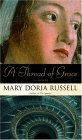
It doesn't happen often that I really fall in love with a novel. It's even rarer that I fall in love with a book on tape when the recording is flawed. In the case of Mary Doria Russell's A Thread of Grace, I am so intrigued by the story and the characters that I overcame my real dislike of the reader (more about this below) and now I can't stop thinking about the book. I'm only a third of the way through it, and it's following me around like a puppy.

is an easy sell for me, that must be clear to anybody who reads this weblog regularly or who knows my novels. Well written, carefully researched historical fiction with good, solid characters -- impossible to resist. This is one of those novels. It's not an easy read (or listen); Russell doesn't coddle her readers, and you've got to be prepared to pay attention. There are a lot of characters, and there are multiple plot lines. The opening vignette is staggering in its simple power and the way it sets up what is to come. I'm so nervous for these characters -- Jews in Italy after Mussolini handed off to Hitler -- that I sometimes get an adrenaline rush thinking about them. Because (here's the big announcement) as this is an audiobook, I can't jump ahead and read the resolutions. And it's really painful, the waiting.

Apparently Doria tossed a coin to resolve the fate of some of the characters, an idea which I find absolutely terrifying, and terribly gutsy. I couldn't do that with my characters. Impossible. Right now one of them is missing (my characters, that is). There's a penny sitting on the desk in front of me. Should I let a toss of that coin decide his fate?

Can't do it. I have no idea what this says about me, or about Doria, or about anything at all, except this: it's a rare book that puts me into this state. I keep finding excuses to go run errands so I can listen some more. Normally I do just the opposite. I'm fighting with the urge to go buy a hard copy.

One of the rationalizations for buying that hard copy would be this: I dislike the reader's approach. She decided that whenever a character would logically be speaking language x, she would read that character's dialogue (but not the internal monologue or narrative) in English with the accent of that language. As we are dealing here with characters from Belgium, France, Germany, the Ukraine, Austria, a whole range of Italian dialects, I find this very distracting. A grandmother who is a native speaker of Ukrainian speaking German -- try reading dialogue in that accent. I'm not saying the reader is bad at languages, just the opposite. She reads the occasional Italian or German or French phrase very well -- just that this was a strategic decision that really doesn't pay off, in my opinion. However, I'm so in love with the story that I'm almost able to ignore the accents.

My question (and one reason I'm so tempted about the hard copy) is whether or not Doria wrote the dialogue that way. Which I sincerely hope she did not, for reasons I've gone into elsewhere and have now reposted (below), in the hope that y'all might have some thoughts on the matter.

listening toPink Cadillac from the album "Tracks" by Bruce Springsteen

writing dialect

dialogueRather than get into a long essay on erroneous use of terms for language (the temptation is great, but I will resist), I will simply state an observation: it's never a good idea to try to convey variation in spoken language in terms of spelling. The best (and maybe the only) way to make this clear is by example. Take a look at this exchange from Gone with the Wind. In this scene, there is an elderly black man named Peter, a slave, and he's upset with Scarlett.
"Dey talked in front of me lak Ah wuz a mule an' couldn' unnerstan' dem—lak Ah wuz a Affikun an' din' know whut dey wuz talkin' 'bout," said Peter, giving a tremendous sniff. "An' dey call me a nigger an' Ah ain' never been call a nigger by no w'ite folks, an' dey call me a ole pet an' say dat niggers ain' ter be trus'ed! Me not ter be trus'ed! Why, w'en de ole Cunnel wuz dyin he say ter me, 'You, Peter! You look affer mah chillun. Te'k keer of young Miss Pittypat,' he say, ' 'cause she ain' got no mo' sense dan a hoppergrass.' An' Ah done tek keer of her good all dese yars."


"Nobody but the Angel Gabriel could have done better," said Scarlett soothingly. "We just couldn't have lived without you."

You'll note that the author attempts to portray Peter's speech by playing with spelling. The idea being, I suppose, that he doesn't speak English as it is written (something nobody does, by the way, unless you happen to be having a conversation with the ghost of somebody who lived in the 15th century). The author feels it is important to make the distinction between Peter's speech and Scarlett's.... why? Because he's a slave, and she's a free white woman of means? Because he is uneducated and she is ... a little more educated? Let's approach this differently, by rewriting the passage:
"They talked in front of me like I was a mule and couldn't understand them -- like I was an African and didn't know what they was talking about," said Peter, giving a tremendous sniff. "And they call me a nigger and I ain't never been call a nigger by no white folks, and they call me a old pet and say that niggers ain't to be trusted! Me not to be trusted! Why, when the old Colonel was dying he say to me, 'You Peter! You look after my children. Take care of young Miss Pittypat,' he say, 'cause she ain't got no more sense than a hoppergrass.' And I done take care of her good all these years."

"Nobody but the Angel Gabriel cudda done bettah" said Scarlett soothingly. "We jus' couldn't have lived without you."
I haven't changed the dialogue one bit -- I've only changed the spelling. In Peter's case all the grammatical points of his speech are maintained, such as the invariant use of third person singular verb forms ('he say'). The distinctive lexical items remain, too (hoppergrass) and the syntax (''I ain't never been call'). If it's important to portray his speech, then this passage does it by means of lexical, grammatical and syntatic variations without resorting to spelling.

I've done to Scarlett's dialogue what the author did to Peter's -- I changed the spelling to approximate how she would have pronounced the words. The result? It's amusing and condescending -- the misspellings seem to indicate something about her intelligence, or her illiteracy.

The lesson here is simple: don't play with spelling unless you have a really good reason. Playing with spelling will almost always work as a trivialization of the character, and that's never good. If it's important to portray dialect, do that in other ways.

more dialect in dialogue

It's a delicate business, but it can be done well. Examples from published fiction that you might find of interest below. I've also included a few examples from my own work -- including a passage where I commit the very sin I've been talking about here.

A lot of the second novel in the Wilderness series takes place in lowland Scotland in 1802. The language spoken by the characters would have been Scots -- not English. I'll spare you the discourse on the difference at the moment, but while I was writing the novel I struggled with representing Scots in writing, and I did end up using spelling, to some degree. Here's an example:

Geordie nodded and cleared his throat. "On the road fra Corbelly, it was, at dusk. A whole pack o' redcoats wi' baig'nets at the ready, marchin' the crew o' the Jackdaw oop the road tae Dumfries. One o' the redcoats was carryin' Granny Stoker on his back, tied han' and fit like a calf. A mair crankit auld chuckie ye'll nivver see, swearin' and skirlin' and screechin'. It was a wonder tae behold."
This is what happens if I change all the spelling to standardized orthography:
Geordie nodded and cleared his throat. "On the road from Corbelly, it was, at dusk. A whole pack of redcoats with bayonets at the ready, marching the crew of the Jackdaw up the road to Dumfries. One of the redcoats was carrying Granny Stoker on his back, tied hand and foot like a calf. A more cranky old chuckie you'll never see, swearing and skirling and screeching. It was a wonder to behold."
All I can say in my own defense is, I tried it both ways and it just didn't read right without the spelling changes. Is the effect such that the characters are trivialized? It's a little hard to tell from this passage, which is supposed to be funny, but I hope that wasn't the case. I worked hard to avoid it. The bottom line is this: I could have ignored the dialect issue and had them all speak the same, but that just didn't work for me; it would have felt like cheating.

The last example is from Curiosity, the character who so many of my readers claim as their favorite. She is an elderly black woman, a freed slave.

"No need to get particular with names, now. Don matter anyway, cause the man who lay claim to Selah wouldn't sell her, and there ain't a law that say a slave owner got to sell a slave at any price if he he got a mind to keep her. So maybe you'll understand that we ain't got much choice, not with a child on the way."
I'd be curious what folks think of the examples below -- which I think are all well done.

Flowers from the Storm, Laura Kinsale
"Bless me, what a row that was, Miss Timms! Shev was right bosky, do you see—he was used up. Corned, pickled and salted—"
"Comatose, Miss Timms," Durham explained gravely. "In strong drink."
"Oh, yes, good Oxford word. Comatose!" The colonel seemed to find that description an uplifting one. "Perfectly senseless. And we was having to carry him home, y'see, between the two of us, and he weighs—'S blood, he must weigh fourteen stone! And who might drive by at the very moment but the one they call the resurrection jarvey—"
"Night coachman. Sells bodies to the surgeons," Durham interpreted. "For anatomy lectures."
"Right! So what should I think—and it was my idea entirely, I promise you, Miss—and the fellow took him, and—" Colonel Fane made an expressive revolution with his forefinger. "And, y'know—his clothes, we got those, and the fellow took him in a sheet to old Brooks! In Blenheim Street! Took him there, to the lecturer's door!" He leaned back his head and thumped the table. "And offered—and offered . . . him for . . . f' . . . sale!"
This passage is especially nice because of the way the Kinsale has used the idioms of the time (early 1800s) in this back-and-forth between friends. It works on a number of different levels. The next passage is from Proulx's The Shipping News:
They went into the dull gloom of the shop.
"Ah," said Yark. "I 'as a one or two to finish up, y'know," pointing to wooden skeletons and half-planked sides. "Says I might 'elp Nige Fearn wid 'is long-liner this winter. But if I gets out in the woods, you know, and finds the timber, it'll go along. Something by spring, see, by the time the ice goes. If I goes in the woods and finds the right sticks you know, spruce, var. See, you must find good uns, your stem, you wants to bring it down with a bit of a 'ollow to it, sternpost and your knee, and deadwoods a course, and breast'ook. You has to get the right ones. Your timbers, you know. There's some around 'ere steams 'em. I wouldn't set down in a steam timber boat. Weak."
You'll note that Proulx does use some spelling changes to indicate dialect here, particularly the deletion of syllable initial /h/. It's not extreme, and so it doesn't distract -- but she walks a fine line. I think it ends up working because the rhythm of the passage and the use of sentence tags and prefixes: see, var, you know.

The next example is from one of my all time favorite short stories, "My Man Bovanne," by Tone Cade Bambara . It's written in first person, and the narrator is Hazel, a black woman at philosophical odds with her grown children: she's too old-fashioned for their sensibilities. Bambara was a prominent African American writer who was intensely involved in urban culture in the '60s -- and she writes Hazel's POV in Hazel's language, Bambara's own language, full of imagery and living sound. She could write this vernacular because it was her own.

"Generation gap," spits Elo, like I suggested castor oil and fricassee possum in the milk shakes or somethin. "That's a white concept for a white phenomenon. There's no generation gap among Black people. We are a col—"
"Yeh, well never mind," says Joe Lee. "The point is Mama well, it's pride. You embarrass yourself and us too dancin like that."
"I wasn't shame." Then nobody say nuthin. Them standin there in they pretty clothes with drinks in they hands and gangin up on me, and me in the third-degree chair and nary a olive to my name. Felt just like the police got hold to me.
"First of all," Task say, holdin up his hand and tickin off the offenses, "the dress. Now that dress is too short, Mama, and too low-cut for a woman your age. And Tamu's going to make a speech tonight to kick off the campaign and will be introducin you and expecting you to organize the council of elders—"
"Me? Didn nobody ask me nuthin. You mean Nisi? She change her name?"
"Well, Norton was supposed to tell you about it. Nisi wants to introduce you and then encourage the older folks to form a Council of the Elders to act as an advisory—"
"And you going to be standing there with your boobs out and that wig on your head and that hem up to your ass. And people'll say, 'Ain't that the homy bitch that was grindin with the blind dude?"
"Elo, be cool a minute," say Task, gettin to the next finger. "And then there's the drinkin. Mama, you know you can't drink cause next thing you know you be laughin loud and carryin on," and he grab another finger for the loudness.
"And then there's the dancin. You been tattooed on the man for four records straight and slow draggin even on the fast numbers. How you think that look for a woman your age?"
"What's my age?"
"What?"
"I'm axin you all a simple question. You keep talkin bout what's proper for a woman my age. How old am I anyhow?"
And Joe Lee slams his eyes shut and squinches up his face to figure. And Task run a hand over his ear and stare into his glass like the ice cubes goin calculate for him. And Elo just starin at the top of my head like she goin rip the wig off any minute now.
"Is your hair braided up under that thing? If so, why don't you take it off? You always did do a neat cornroll."
"Uh huh," cause I'm thinkin how she couldn't undo her hair fast enough talking bout cornroll so countrified. None of which was the subject. "How old, I say?"
"Sixtee-one or—"
"You a damn lie Joe Lee Peoples."
"And that's another thing," say Task on the fingers.
"You know what you all can kiss," I say, gettin up and brushin the wrinkles out my lap.
"Oh, Mama," Elo say, puttin a hand on my shoulder like she hasn't done since she left home and the hand landin light and not sure it supposed to be there. Which hurt me to my heart. Cause this was the child in our happiness fore Mr. Peoples die. And I carried that child strapped to my chest till she was nearly two. We was close is what I'm tryin to tell you.

March 14, 2005

pardon me while I test this

Technorati tag business. It's really silly of me to be worried about this, especially as I have grave doubts about Technorati itself. I've tested the darn thing by posting links here to other weblogs and then, a day later, looking up that weblog on Technorati. Theoretically, that weblog should show up as having at least one link, from here. But of the four times I've tested it, it worked only once. I've just seen too many holes in the way it works to trust it.

Having said that, I think the tag system has potential. If you don't know what that is and don't care, I'll just carry on without you. I really have other things I should be doing, too. So here goes. I'm testing technorati tags to see if and and have tags already established, or if my attempt is the first.

listening to I Don't Believe In The Sun from the album "69 Love Songs Vol. 1" by The Magnetic Fields

March 13, 2005

California Girl -- T. Jefferson Parker

T. Jefferson Parker is on a list of about ten crime/suspense novelists whose work I follow quite closely. I particularly liked his novel Black Water, which I found not only a plain good read and interesting story, but it was also one of those books that haunted me for a long time. I still find myself thinking about the young cop who is suspected of killing his wife, now and then.

I liked California Girl, too, but not as much as his previous work. This is a big novel with a complex plot that moves back and forth in time. I very much like the setting (Orange County in the early 60s, when there were still orange groves) and the sense of the place; I like the two families that are at the center of the conflict. But this is one of those books where I almost loose interest as soon as the dead body shows up. I was far more interested in the resolution of the family problems than I was in the (admittedly tragic) life and death of the girl in question.

Deadwood Supreme *****

You know I loved the first season of HBOs Deadwood. I wasn't sure at first -- the issue of language anachronisms got in my way -- but by the end, I was in love with the whole production, and in complete awe of the the writing. The character development over the course of that season was masterful.


I still can't figure out how they made me like Al Schwearengen (Ian McShane) -- the profane, murderous, greedy alpha dog of the small mining camp. The masterstroke is this: Al is far more self aware than his counterpart, the virtuous, straight arrow but conflicted and cynical Seth Bullock. Al is who he is, and makes no apologies or excuses; Seth (played by Timothy Oliphant) can't live with himself because he's in love with one woman and married to another.

The second season starts with a long-overdue confrontation between these two, a fist fight of monumental proportions. Rarely do you see (on any screen, small or large) men looking as truly beat up as these two afterwards. It all starts because the outside world is making itself felt in a way that frightens Al, and so he provokes Seth into a fight with a few well chosen words. This episode was perfectly timed from beginning to the end, and so densely packed that I watched it three times before I felt I really caught every nuance.

They aren't going to fix the language anachronisms, but I am so fascinated with the whole enterprise, I'm willing to overlook that. I don't watch a huge amount of tv, but this is now, officially, my favorite program still in production. The rest of my current favorites, not in order: Huff (Showtime), Carnivàle (HBO), Dead Like Me (Showtime), The Sopranos (HBO), The Wire (HBO), Battlstar Galactica (SciFi).

listening to What if We Went to Italy from the album "A Place in the World" by Mary Chapin Carpenter

housekeeping, quick

While I was backing things up and sorting things out I realized that in the process of moving this weblog from one place to another, many entries lost their category tags. It will be a while until I get that fixed, and the category archives will be spotty until I do. So far I have found quite a few posts on things like and that were wandering off by themselves, and had to be sheparded back to the fold. Just FYI.

listening toShave Yo' Legs from the album "Keep It Simple" by Keb' Mo'

Every Secret Thing -- Laura Lippman

Recently I discovered Laura Lippman's novels, by starting with the most recent (stand alone) Every Secret Thing. Now I've read the first two novels in her series set in Baltimore with a lead character called Tess Monaghan, a former newspaper journalist who ends up as a private investigator.

I often bring up the fact that you can have excellent storytelling and good writing in the same book; plot and prose get along very well together, if you let them. The literati are fixated on character these last thirty years or so, to the extent that some of them will tell you that plot is a four letter word. So I'm always really pleased to find a new author who writes beautifully and can tell a closely plotted story at the same time. Every Secret Thing is disturbing and evocative, there are characters you can't quite like but learn to understand anyway, and an unflinching look at some issues of race relations that few authors would be brave enough to take on. This is the story (on the surface) of the abduction and murder of a ten month old baby, and the two little girls who are accused of the crime. It's both what it seems, and something entirely different.

Lippman has a way with dialogue and narrative, too. This is from Butcher's Hill, the second book in the Tess Monaghan series. The setting is a family birthday party, and the first person speaking is Tess's grandmother. The narrative voice (this is Tess's POV) is so personal and on-target that while the story is written in third person, it feels like first. That's quite something to pull off. I don't think I could do it.

"Very fancy, I'm sure. I just can't understand why things can't be the way they used to be."

Tess could. It wasn't just the loss of the house, although it had been a wonderful place for parties, that overgrown Victorian perched on a hill above the Gwynn's Falls, full of secret places, like an old dumbwaiter and the remains of a wine cellar. No, it was the loss of Poppa that had changed the nature of their family gatherings. Overworked and overextended, he had still managed to throw his love at them with both hands, like a little kid pushing up waves of water in a swimming pool. Gramma, in defiance of every known stereotype about grandmothers Jewish or otherwise, had served inedible food and begrudged them every mouthful. Unless one ate too sparingly, in which case she was offended.

I'm very much looking forward to the rest of her novels in the series, but first I'm going to read the new Francine Prose (A Changed Man) and also Gracelin O'Malley by Ann Moore.

my habits, and not my habits

Rachel asked:
When you have two books underway, do you set days to work on one or the other, or do you just pretty much have to go however the muse tells you to? Is one going more easily than the other right now?

The way I work has changed over the last few years. I don't know why, exactly, although I have some suspicions. But the short answer is: the muse rules. She's the pushiest of broads. I have posted about her before, here. She took exception, and decided to punish me. Now I can't write in the green chairs at all (you'll have to read the post if you want to follow the discussion.)

So, it used to be that I transfered back and forth between books in progress as the muse desired. She was tired of one or stuck on a plot point, she pointed imperiously to the other. After Fire Along the Sky, however, she decided she wanted a longer break and she insisted I work almost exclusively on Tied to the Tracks for quite a long while. Now she's very focused on Queen of Swords, which is a good thing, as I have an October deadline. Once in a while she tries to bring up the subject of Pamaja Jones, but thus far I've been able to distract her back to Queen of Swords by reading her something from a journal or a bit of an 1814 newspaper.

Queen of Swords is moving along swimmingly, thank you. As long as Phyllis continues in a good mood, I have great hopes.

listening to

The Book Of Love from the album "69 Love Songs Vol. 1" by The Magnetic Fields

March 11, 2005

dig it

I've got a good friend who has many years of experience as a gardener and knows more than anybody else I've ever run into about taking care of plants and the planet at the same time.

So a few of us finally ganged up on her and talked her into setting up a blog. Today she launched dig it with a suitably scary story about a nasty chemicals in weed-n-feed products, and an appeal to get in touch with the EPA.

Go over and say hey, if you have time.

on a roll

words are flowing. I am just a conduit, at this moment. I dare not talk about this too much for fear that it will go away. I won't use the D word. In fact, I'll try not to use any words that start with that letter for this whole post.

You had some questions, and I will answer them, probably tomorrow. I also will post some reviews, as people have asked what I'm reading.

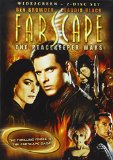
In the meantime, I wanted to say that I heartily approve of all the Farscape love in the comments to my last post. I realize that there is this problem with reviewing Farscape: The Peacekeeper Wars as it hasn't aired everywhere and some people prefer not to partake of spoiler goodness. I personally am a lover of spoilers. So here's my compromise: I will review the miniseries below. You can click on the 'continue reading' button, and follow me, or you can remain unspoiled, and wait until you see it. It's up to you.

Farscape: The Peacekeeper Wars (four stars)

First the good things: It was a miracle that this got made, and I am careful about using that word. A real miracle, thanks to the hard work of the viewers and the Henson people and all the others who just wouldn't give up. At the Farscape convention, Wayne Pygram (who played Scorpius) came on stage and said: you are the most goddamn stubborn people in the universe, and he got a standing ovation.

The actors were in high form, all of them. Not one off-performance, and I think it must have been a very arduous shoot. Ben and Claudia had that magic connection immediately, and that was what it took to make the whole thing a success for me. That alone was enough. The dialogue (first d word!) was top notch. That has always been a strength of Farscape, and the miniseries was no exception. The strategic use of comic dialogue is an art, and they have that perfected.

CGI and action sequences: jaw dropping
Visuals, sets, music: excellent
The big resolution of the wormhole problem: perfect

Now, for the things that could have been better.

What they set out to accomplish was to fit a whole year of episodes (22, to be exact) into four hours. I think this was a strategic error, because they committed themselves to resolving every major plot line. Which meant that a lot of things were hinted at but not explored. I think it would have been better to focus more closely on fewer story arcs. For example: Chiana comes flying off a ship and shouts: I've got new eyes! The drunken diagnostician gave me new eyes! Resolves the problem of her being blind, but raises a lot of questions, too. At least one episode, probably two, would have been spent on this in a full season, is my guess.

So they had four hours to get John and Aeryn back together (literally), save the universe, punish the bad guys, resolve the war, clear up the mysterious connections between earth and Sebaceans, figure out what was going to happen to Chiana and D'Argo, and bring Aeryn's baby into the world. You'd think this would be enough on any screenwriter's plate, but they went ahead and complicated matters. The baby gets lost for a while, and turns out to be ... well, I said there were spoilers, and this is my only real unhappiness with the miniseries, so I'm going to say it... as a result of his part in putting John and Aeryn back together, Rygel ends up carrying the baby, so they have to find a diagnostician to transfer it from Rygel to Aeryn before it gets big enough to hurt Rygel.

In my opinion, they could have done without this whole storyline. I'm just not big on male pregnancy stories; maybe it's me. They wanted a way to give Rygel more of a role to play, is what I'm guessing, but I wish they hadn't gone there. Aeryn's reaction to pregnancy and birth was far more interesting to me and I would have liked to have had more of that. Although I think they needed to make it a little clearer that Sebaceans had been genetically modified to recover quickly from childbirth. I don't think any human being could have pulled off what she did minutes after delivery.

And the worst, saddest, most awful bit? It's going to be really hard to get more Farscape. I fear this might be the end.

March 9, 2005

nu?

I sense I've gone quite far enough with the subject of cover art. Either that, or you're all over at getupgrrl's place talking about monkey porn and Dr. Love.

Today I wrote 2,000 words, and I'm feeling hopeful that I can do the same tomorrow. And I'm reading about ten books simultaneously, half of them non-fiction (Mammon and Manon in Early New Orleans by Ingersoll, just as disturbing as I feared it would be; three different books on Andrew Jackson, who I never much liked and like even less, the more I read about him.); and half fiction (I've just discovered Laura Lippman and am happily plowing my way through her books; also, Francine Prose, whose work I really like, has a new novel out, waiting for me even as I type).

PS Let me say: if somebody has questions they'd like answered (beyond the usual 'when it Queen of Swords coming out?') speak up, and I'll see what I can do. Otherwise it'll be potluck tomorrow.

March 8, 2005

covers, alas

So a lot of you have pointed out the importance of the book cover. I think any given author would like to believe that the cover doesn't matter, that people know to look inside before they make decisions -- but of course that is wishful thinking of the most useless sort. The cover does matter; the cover is the first thing, and even if beauty is only skin-deep, it's enough to get a stunning cover where it wants to go. The author says: run away with me, but it's the cover the reader is evaluating. One night stand? Life long love?

I was very lucky with Homestead, which first was published by a very small press. In that case (and it will probably be a singular experience) I got real input on the cover. I even supplied the photograph, which I adore, still. Did it help sell books? Who knows.

Bantam has been very good to the Wilderness series, but their ideas about marketing and advertising don't coincide very well with my own. However, that it something I must, contractually, leave to them. They send me rough first versions of the covers with little notes that say "Isn't this gorgeous!" which does not mean: do you approve? Publishers are very wary about authors getting involved in developing cover art. I guess they are afraid I'll insist that this painting my daughter did when she was four is the perfect cover, or that I'll want something expensive, a detail from a painting they'd have to pay royalties on. They don't care, really, about my taste: they know their readers.

Or they think they do. I have no idea how much real market research goes into covers. I'd love to read some of that work, if it exists. I haven't been able to find it. My suspicion is that it's all done with Magic-8 balls.

Q: Will the public like this cover and therefore buy the book?

Magic-8: It is decidedly so.

Each publishing house has a history or an approach to the cover art issue. It's not something that can be negotiated along with the percentage you get of mass market sales; it is what it is. Like, you're dating somebody who is seriously addicted to coffee and you detest the smell and taste of the stuff. Either you (1) decide it's not going to work (2) decide to learn to put up with coffee or (3) fool yourself into thinking you can change the person in question.

I knew I couldn't change Bantam, which has a cover approach that is fairly traditional and (this was somebody else's word, but it fits) staid, but was I going to turn down my first big contract because of that? Not likely.

If, as discussed some time ago, there are as many of 20,000 new novels published every year, that means 20,000 original book covers have to be designed (and I'm completely ignoring non-fiction, so this number is way low). Most are nothing much to talk about, and just adhere to a pattern established for the genre. But there are some gorgeous covers out there and some beautifully designed books. I have been known to buy a book I have no interest in simply because of its cover and design.

And finally this admission: what makes me happy, the covers that really click for me, will not work for everybody. Would a cover of my choice work for more people than the cover that the publisher designs? A question that will most probably never be answered.

March 5, 2005

contractual relationships

When you pick up a novel in a bookstore and read the first paragraph, you are being wooed by the author. The author has a story to tell and very little time to convince you that it's worth reading -- and more important, worth buying.

But this pressure on the first paragraphs of the novel starts long before that casual meeting in the bookstore -- it starts when the person you hope will be your agent picks up the manuscript and gives the story its first professional audition. Some agents will give any manuscript only the most cursory of looks; others are more willing to spend a little time figuring out if there's a story s/he can sell.

But jumping forward, for the moment, to the potential reader standing there in the bookstore with your novel in her hands. She might have picked it up because she liked the cover, or the title, or just because she's browsing and she's picking up on book after another. She picks it up though she doesn't recognize your name. Maybe she picks it up because you've got a good blurb from a big name or a good review, but those are all just come-ons. The real test is the first paragraph, or, if she's the patient, thoughtful type, the first page or two. She's reading the start of a story, but she's also looking at a contract.

As the author, you set up a whole slew of expectations/obligations in the first pages. You've got just those few minutes. You're saying: take a chance. See, I can write a good sentence, I've got characters you'll like or love to hate. Take a chance. Run away with me.

If the match is good, she may buy the book and take it home and find a good chair and read. The love affair that started in the bookstore may blossom; she may stay in that chair reading until her eyes refuse to go along with her self destructive behavior and insist she go to bed. Or the relationship may start to pale quite quickly. Maybe she'll put the book down after the first chapter wondering if she finished the last of yesterday's soup and never come back to it. Maybe she'll pick it up tomorrow, or next week, and work her way through it out of a sense of obligation (she spent money, after all). Maybe the book will get lost in the cushions and a year from now she'll find it and think, huh? I have no memory of buying this. Wonder what it's about. Or: that was a waste of money. Or: I should give this another try, I wasn't in the right place back then for another story about a teenager acting out because of a hostile father.

This whole dynamic has changed, a little, with on-line bookstores. Often you can't read the first pages, or if you can, it's hard to manage technically and so you depend on reviews from newspapers and other readers. But in a bookstore, this old contract-dance still happens. I've watched it happen, with my own books. I've watched people pick up Homestead or Lake in the Clouds or one of the other books, look at the cover, read the blurbs, turn to the first page. Put it down and walk away, or get distracted because a child is asking for Curious George. I haven't seen this many times. Maybe five or six total. I do know that only twice I saw the person take the book to the counter and pay for it. I think 6:2 is actually pretty good, but I don't know, for sure. What I would like to be able to do is stop the person who put the book back down and ask, politely, so, what is it that made you decide against that novel? Just out of curiosity? But I can't do that, because almost certainly it will come out that I'm the author, and that would be really embarrassing. Nerdy to the nth degree embarrassing.

I could tell Author X why I read the first paragraph of his or her novel and then put it down, if s/he really wanted to know. Usually what I would say would be something like: at this moment, the voice didn't strike me as what I'm looking for.

Because authors have voices that speak from the page, and that's a topic for another post.

March 4, 2005

the un-said

Cynthia wrote:
What makes an interesting book are not always the things that are included but the spaces, hesitations and things left out. I have been reading a lot of Hemingway lately [.....] where he is talking about his writing craft, he says he wants not to explain the story to the reader but to have the readed experience the emotion for him/herself as the story is unfolding....the story moves forward with our (the readers) emotional involvement moving with it....
This is a topic which always makes me slightly uneasy. I'm not sure why, except that back in the days when I was workshopping stories and chapters, the constructive comment I heard most was that I am too subtle.

Now that you've stopped laughing. What my readers meant, I think I can say this with some certainty, is not that I am particularly subtle in my social interactions. They meant that as a writer, in trying to establish balance between what is told and what is left for the reader to figure out, I err on the side of the un-said. I have had people tell me this repeatedly about various plot points in Homestead, about specific themes and backstories in the Wilderness books, and just about everywhere else. The thing is, I couldn't tell you how to do this. I couldn't teach a class on the writing of the un-said. Un-writing. I know I do it; I can even admit that, in retrospect, I have over-done it on occasion, but it's a very subtle thing.

I had one professor (a linguistics professor) who told us that the key idea, when writing a lecture or paper for presentation is: never underestimate the ignorance of your audience. I liked this professor a lot, as a person and as a teacher, but this particular bon mot of his drove me nuts. My approach has always been: assume the best of your audience. They'll get it, or they won't. If I did my job well enough, most of them, the ones who are really reading, will get it. I hope. Clearly, this must mean that some readers won't like my work, because they are in the other camp, the camp that likes to have things spelled out.

So now to the topic of Hemingway. Another touchy topic. When my editor called me, way back when, to say (basically) hang on to your hat, Homestead won the Pen/Hemingway award, one of the very first things that went through my head was: oh no. does this mean I have to stop being snarky about Hemingway? And then the thought: Will they take the award away if they find out that I am snarky about Hemingway on a regular basis?

So I came to a number of resolutions about my relationship with Hemingway.

First, it's okay that I don't like his work; I can still recognize the value in (at least some) of it. For example: the only story of his I ever had my students read was "Hills Like White Elephants" -- precisely because it is a masterpiece of the un-written and un-said.

Second: My dislike of Hemingway is not his fault, it's mine. I'm not the right reader for his work.

Thus, my conclusion: you can be on the same side of the un-said fence, and still not get along. That probably makes no sense to you, but it makes me more comfortable.

So, there you have it. A series of confessions, and material with which to blackmail me, if you like. Although I doubt they'll take the PEN/Hemingway award away at this point. I still wonder what Jack Hemingway would have said to me if I had told him the truth before he handed me the award.

March 2, 2005

my bad. maybe.

I had an email from a reader who is unhappy with me:
I have all your books and just re-read the whole series. I am still not satisfied with the way you left the information regarding the death of Hannah's husband. It left a big gap in the book that seemed like you were just leaving it for the next installment. All your other books had been complete and satisfying into themselves. Will we learn what happened to him and Hawkeye in the next book. Thank you for writing such wonderful stories.
Once in a while a reader gets irritated with me, and to be truthful: I understand. I get irritated with authors sometimes, too. I really hate that Larry McMurtry kills off Gus in Lonesome Dove, for example, and when he killed off Newt in the sequel, well. That struck me as totally wrong. If I ever meet Larry McMurtry-- I won't have the nerve to say so, but I think it was a rotten thing to do. So yes, I understand. But.

Sometimes you do have to wait for a storyline to be resolved. I don't hold back information to tease or to get you to buy the next book -- I do it, usually, because not everything has been revealed to me, either. My subconscious has a role to play in what gets told, and sometimes it holds on tight to bits that aren't quite ready for public consumption.

Some readers were pretty upset that there was a crucial letter in Lake in the Clouds -- one that would have cleared up a lot of questions about what happened to a young slave -- that never gets opened. When the letter was opened, in Fire Along the Sky, the need for the delay became clear (at least I hope it did).

Reading this over, it doesn't seem like much of an explanation -- but I hope it will help, a little at least.