getting back to work
I'm going to push for a lot of words this weekend and into Monday. Wish me luck.
take me to the front page of the tttt weblog | back to the current weblog
« March 2005 | Main | May 2005 » canaafrica.org this resource
So I can boil my concerns and questions down like this: first, what is the purpose of the book club? My understanding is that it is meant to encourage reading, especially for people who aren't in the habit. I believe, though I can't find any documentation on this right now, that another of the originally stated goals was to promote authors and books that might not otherwise have much exposure. If somebody can either confirm or correct this point (and point me to a source one way or the other), I would appreciate it.
If in fact the idea is to call attention to books and authors who need promotion, then I think some of the choices are pretty questionable. Bill Cosby does not need a boost from Oprah Winfrey -- and he's been up there more than once. Toni Morrison has a Nobel Prize for literature, so I think she's pretty much set. There are other authors on the list who are very well established, but there are also some who were relatively unknown when their books were chosen. But maybe that wasn't the idea, and the only real goal is to get people to read more. In which case I have some concerns about the methods used.
I know lots of people who aren't in the habit of reading. Many of them are my relatives, just regular folks with nine to five jobs. Some have high powered jobs or very busy lives who don't find the time to read. It's just not a high enough priority for these individuals. So here's the question I asked myself: if I took on the task of getting one or more of these people to read on a regular basis, what books would I hand over to achieve that end?
Take a look at the list of books Oprah has featured thus far:
Once in a while you hear about a clueless or cruel parent who decides to teach a water phobic kid to swim by throwing him or her into the deep end of the pool. Handing Tolstoy or Morrison or García Márquez or Dandicat to a reluctant reader feels similar to me. These are authors who have produced some great work, but are they best authors to hand to cousin Nancy, who counts herself lucky if she has time to read a magazine in the dentist's waiting room? Nancy needs a story that will really pull her in fast, and hold her attention. Sure, it should be well written, with strong characters. But look at the first two paragraphs of Anna Karenina:
Anna Karenina by Leo Tolstoy
Back Roads by Tawni O'Dell
The Best Way To Play by Bill Cosby
Black and Blue by Anna Quindlen
The Bluest Eye by Toni Morrison
The Book of Ruth by Jane Hamilton
Breath, Eyes, Memory by Edwidge Danticat
Cane River by Lalita Tademy
The Corrections by Jonathan Franzen
Cry, The Beloved Country by Alan Paton
Daughter of Fortune by Isabel Allende
The Deep End of the Ocean by Jacquelyn Mitchard
Drowning Ruth by Christina Schwarz
East of Eden by John Steinbeck
Ellen Foster by Kaye Gibbons
Fall on Your Knees by Ann-Marie MacDonald
A Fine Balance by Rohinton Mistry
Gap Creek by Robert Morgan
The Heart Is a Lonely Hunter by Carson McCullers
The Heart of a Woman by Maya Angelou
Here on Earth by Alice Hoffman
House of Sand and Fog by Andre Dubus III
I Know This Much Is True by Wally Lamb
Icy Sparks by Gwyn Hyman Rubio
Jewel by Bret Lott
A Lesson Before Dying by Ernest J. Gaines
A Map of the World by Jane Hamilton
The Meanest Thing To Say by Bill Cosby
Midwives by Chris Bohjalian
Mother of Pearl by Melinda Haynes
One Hundred Years of Solitude by Gabriel García Márquez
Open House by Elizabeth Berg
Paradise by Toni Morrison
The Pilot's Wife by Anita Shreve
The Poisonwood Bible by Barbara Kingsolver
The Rapture of Canaan by Sheri Reynolds
The Reader by Bernhard Schlink
River, Cross My Heart by Breena Clarke
She's Come Undone by Wally Lamb
Song of Solomon by Toni Morrison
Songs In Ordinary Time by Mary McGarry Morris
Stolen Lives: Twenty Years in a Desert Jail by Malika Oufkir
Stones from the River by Ursula Hegi
Sula by Toni Morrison
Tara Road by Maeve Binchy
The Treasure Hunt by Bill Cosby
Vinegar Hill by A. Manette Ansay
A Virtuous Woman by Kaye Gibbons
We Were The Mulvaneys by Joyce Carol Oates
What Looks Like Crazy on an Ordinary Day by Pearl Cleage
Where the Heart Is by Billie Letts
While I Was Gone by Sue Miller
White Oleander by Janet Fitch
Happy families are all alike; every unhappy family is unhappy in its own way.In all good faith, I just can't see this working. Not as a first try. Maybe in a few months time when Nancy is already on the hook.Everything was in confusion in the Oblonskys' house. The wife had discovered that the husband was carrying on an intrigue with a French girl, who had been a governess in their family, and she had announced to her husband that she could not go on living in the same house with him. This position of affairs had now lasted three days, and not only the husband and wife themselves, but all the members of their family and household, were painfully conscious of it. Every person in the house felt that there was so sense in their living together, and that the stray people brought together by chance in any inn had more in common with one another than they, the members of the family and household of the Oblonskys. The wife did not leave her own room, the husband had not been at home for three days. The children ran wild all over the house; the English governess quarreled with the housekeeper, and wrote to a friend asking her to look out for a new situation for her; the man-cook had walked of the day before just at dinner-time; the kitchen-maid, and the coachman had given warning.
My theory is that Oprah has many dedicated viewers who really want to go along with her book club idea. They buy the books she recommends, a good number of them -- sales do jump when she announces her choice. But I would bet quite a lot that most of the time, the books don't actually get read. They are piled on bedside and coffee tables, where they stay, looking wistful.
My solution? I don't have one. It's Oprah's show, she gets to pick the books. I'll let her get on with that, and watch to see what happens.
 The History of Love has got a good amount of press, and so I stopped by to look at it on Amazon, where I do most of my browsing. I try not to read the customer reviews on Amazon, because I seldom find them useful.
 And still I got sucked into the reader reviews on this novel, and I ran into one that ends like this:
Let's be honest. The Serena and the Venus of the celebrity-literary world have arrived on the court; they're mighty talents. Score. Genuine show stoppers. Score. Genuine show offs. They write with a public in mind. And yes, they write terrifically well. THE HISTORY OF LOVE is really good, literally spell-binding, literally charming, inspiring; it's just not great, morally significant literature. I think maybe you can write better! Try showing off for once! Just imagine what YOU could achieve if you tried to write on the subject of love! Go for it!This is the ending of what must be the nastiest, snidest reader review I have ever run across on Amazon. It is the writer's first Amazon review, which makes me wonder if there's some kind of personal vendetta against this author or novel. It certainly reads that way.
The author is (according to the reviewer) destined to be loved by the literati. The novel doesn't meet the reviewer's standards for morally significant literature. That's good enough for me: I am going out to buy A History of Love, today.
I love the Smart Bitches weblog. I love it as much as I love gettupgrrl and Robyn Bender's fanfic and all things Farscape. Here's what I believe: if anybody can bring the romance genre into the light of day (and by that I mean, get people to admit that (a) there is some great writing in the genre and (b) it's worth reading), it's this group of women. It may take a couple more years, but I think they could pull it off.
So here's the (maybe not absolutely final) word on sex scenes from a post titled Too Much Sex is Bad, MMMKay?
Now sit down and brace yourself, because this may come as a BIG FUCKING SHOCK (whoops, sorry, BIG MMM-KAYING SHOCK), but I generally don’t judge the merits of a book solely on sex scenes or whether naughty language is used. If the characters engage me, if the craft is solid, if the plot is entertaining, I’ll enjoy the book whether it had 20 sex scenes or none at all. What a revolutionary concept!
I have had quite a few people ask me why this weblog isn't available as an RSS feed. If you don't know what that is, and you don't care, please carry on without me.
I have tried, at various times, to make the rss feed work. I just spent another highly frustrating half hour, without success. I have tried just using the built in movable type syndication feature; I have tried Feed Burner. Without success. I have looked at the great tutorials at Learning Movable Type, and I now have the url of an extended entry at Feed Burner explaining (maybe) what has gone wrong and what I need to do. But really what I need to do is write, so I'm going to forget all about rss feeds and syndication and all that other great stuff, and go write. When I have some words down, I may feel strong enough to take another run at this. Or maybe not.
I am pretty good at technology, for the most part, but I declare myself officially cowed in this particular matter.
Do you see a column to the right? It starts with the header "confused?", and continues with a list of my books, statistics for this site, archive links, etc etc.
Just today I heard from somebody who uses IE on a windows machine that she does not see the right hand column at all. I'm curious if this is a more general problem (in which case I wonder why I haven't heard about it before) or specific to her case. So please do let me know what you see, and what you don't, and which browser you use, and whether on a pc/windows or a mac.
This article is about profilic writers, or really more accurately, it's about the fact that there are some people out there who can write a lot, many many pages every day, and get a lot or most of that work into print. This is in comparison to the rest of us, who wobble along, happy for two solid pages a day, or thrilled with five, or despondent when only a few sentences survive the battle.
I find this subject vaguely interesting, the same way I might stop to read an article about people who can twist themselves into odd shapes or wiggle their scalps or who have photographic memories or perfect pitch. These are not things that can be taught. It would be wonderful to have pefect pitch or a photographic memory, and it would be even more wonderful if I could sit down every day and write 3,000 solid words without breaking a sweat.
Okay, the parallel isn't perfect. People who can write 3,000 words a day were not born with that skill. They developed it at some point, a combination of personality traits and early habits. But I still stand by the comparison, because at a certain point in your life, the possibility of becoming one of these profilic/productive writers has passed. I can't decide to be one now, the same way I can't simply decide to have perfect pitch. It doesn't make any sense to be jealous of somebody who does have perfect pitch, and, it seems to me, the same is true of reactions to writers who can turn out one or two books a year. I will confess to the occasional itch of irritation when I see that Joyce Carol Oates has got yet another title on the new arrivals shelf, but mostly I can shrug it off. I have no idea how she does it, and that's okay.
So I think this is an interesting topic, but one with limited usefulness to anybody, even other writers. And the article bothered me for another reason: there's a big discussion of genre authors vs literary authors (the terminology used in the article) and how less tolerant we are generally of profilic literary authors, because:
It hearkens back to this notion we have of how “serious” novels are created — that every sentence is the result of years of contemplation and agonized toil. Anything less is deemed half-assed — or purely for a commercial audience. Atkinson acknowledges the stigma. “If a Jonathan Lethem produced something like The Fortress of Solitude every year and a half, I think he would be lauded a lot less,” she says.There is a bone deep compulsion to divide things up, it seems to me. Us/them, commercial/serious, genre/literary. Why do we do this? Would it have been possible to write this article and consider the issue of prolific writing without bringing in this largely artificial distinction? Because I think it's patently false that so-called literary authors are more disliked for being prolific than other authors are. If you look at the illustration at the beginning of the article, it's not John Updike they've got there, but Stephen King. People who get pissed off at authors who are prolific and successful at getting their stuff into print are just generally pissy, without genre boundries. It's got something to do with the cultural need to both deify and tear down people who are too obviously successful.
Today, let me tell you, I was prolific. I wrote more than 2,000 words. You may put this down to the fact that I don't write what you might consider serious fiction, and thus those 2,000 words must have come easily. Or you can put it down to the fact that my routine is paying off, at this moment. You may fling tomatoes, if you like, but be assured: this is a temporary thing, and will (sadly) pass.
Earlier this month, Mistress Matisse mentioned the sex scenes series on her weblog. Mistress Matisse is a professional dominatrix, and she has a lot of readers. In the comments to her April 12 post (which is where she provides the link leading here), one of her readers raised an interesting point, from which followed a short discussion. Here are some of Lor's thoughts on what struck her/him as missing in my study of how to write a sex scene:
I was just amazed at the omission of what is, for me, an obvious point of writing about sex. I think that just like a good horror scene is good because it scares the reader, a good sex scene is good because it arouses the reader (or shocks, or whatever the character/narrator is feeling). I think the reader's sexual response would be something an aspiring author needs to consider.So I've been thinking about this, because it is an interesting issue. A few distinct questions come to mind. (Please note: I am specifically excluding erotica from this discussion, as that seems to me to require a different approach.)Granted, saying "good sex writing is usually hot" isn't very specific, but could lead to some productive discussion about what makes something hot or not. Perhaps it's not your style to be as forthcoming about the color of your orgasms as Susie Bright, that's fine, but certainly there's some way to throw into the mix that a lot of readers like a sex scene to get them off, or give them ideas, or just to learn more about sex, no?
is a good sex scene (which I have defined, for my purposes, as a scene that furthers characterization and plot) necessarily erotic? Does a sex scene work the same way as other emotion-driven scenes? A parallel: is a good fright scene necessarily frightening?
is it possible or necessary for an author to use his or her own sexual response as one way to judge the effectiveness of a sex scene in progress?
do we need to define 'erotic'?I'm curious what will happen, and if the people who comment regularly and most often will feel comfortable answering one or all of these questions -- or if other people who don't usually speak up might have something to say. This weblog had close to four thousand distinct visits last month (not counting bots and search engines) [correction: to be exact, 3929 unique visitors and 8629 distinct visits and 63249 hits, not counting bots and search engines, for the month of March] so I know you're out there. Anything to contribute before I go ahead and voice my own thoughts on this?
Here's the thing. We live outside of a small city or large town, depending on your perspective. Far enough out that we don't get cable here, and it doesn't look as though we will be getting it anytime soon. I make frequent calls to QWest to ask them about this, and they will never really tell me much beyond the fact that expansion into this area is not on the books. Yet, they always add.
All this means is that we have satellite for television reception, and no access to a fast internet connection. We do have ISDN, which is (as I understand it) simply a bundle of dedicated telephone lines. A lot faster than a dial-up connection, but tons slower than DSL.
I do a lot of research on line, a good deal of which requires looking at graphic images of journal pages. I have an extensive genealogical database on line. I also do quite a lot of website maintenance, both my own and for the Garden Sense Online site, which involves moving a lot of big graphic images around. I download audiobooks. My daughter is addicted to itunes, and spends all her allowance downloading music. My husband, who also works at home, is constantly online and sometimes has to up or download huge data sets. (An aside: just recently I ran into a paragraph written by Bill's co-investigator on some grant, and for the first time in the fifteen years that he has been working on this project, I actually understood what he does. In the technobabble spirit of this post, I include it here:)
W.D.K. Green is the sole designer and programmer of Edgewarp, a 25,000-line sophisticated workstation package for manipulation of 2D and 3D biomedical images and related data structures by a combination of landmark location, thin-plate spline, and image unwarping and averaging. It is built of C and C++ code and makes extensive use of SGI's OpenGL graphics interface. Communication with the user is by textual and graphical interfaces managed using TCL/TK, a general purpose scripting language. Since 1995 a series of steadily more powerful releases of Edgewarp have been released for free downloading from the internet, along with source codes for the versions prior to 1996. Currently the linux versions are by far the most popular. Edgewarp has been exploited in a huge variety of scientific contexts, from systematics and evolutionary biology to radiology, teratology, and kinesiology. It has also stimulated diverse reverse-engineered implementations of its pieces for other computing environments, such as the Rohlf series of thin-plate spline programs for Windows and the Pittsburgh "Visible Browser" for navigation of Eve. A decade after its initial release, Edgewarp remains the sole general purpose image comparison package, commercial or noncommercial, and continues to spin off new visualization tools and analytic strategies.cha cha cha.
So back to the issue at hand: you can see that we suffer under the restrictions of an ISDN line. I have looked into satellite internet, which would be worth the considerable cost (installation alone is five hundred bucks) if the technology were just reliable, and there weren't all kinds of restrictions on how much you can use it. And a delay, I'm told, of up to two seconds. And all other kinds of problems (uploading, apparently, is slower than what we have now; downloading is four times faster -- I asked if we could order ala carte, two times faster up and two times faster down, a side of eggroll, but the person on the phone didn't even crack a smile).
Sometimes I get desperate, and I think about calling up QWest and demanding that they come out here and lay the cable, damn the cost, full speed ahead! But then sanity kicks back in and I remember we have a daughter who will be going off to college in two years and that four years at her college of choice, along with travel, room, board and books, will most certain hit the $150,000 mark.
Thus my tale of woe.
If you happen to be the head of QWest, or you babysit his/her kids, or you play canasta with his/her father, or you were in the armed forces with his/her mother, sister, cousin, best friend, would you put in a good word for us out here in the boondocks? I promise you the moon, or at least something good to eat, pretty to look at, or fun to read.
So a couple things: if you've emailed me and not heard back, that may be the reason. The other reason may just be that I'm overwhelmed and trying to stay focused on writing these days. So please be patient.
When I have time and energy to deal in a more proactive way with the spam issue, I'll do the research and figure out if there's a better way to handle this. Or if anybody has a suggestion (maybe I should just change my email address, and bounce everything that comes to the old one -- would that work?) please do speak up.
Jodi Picoult's My Sister's Keeper is a novel that really worked for me on multiple levels, so much so that I've bought copies for a few friends. Some of her other novels I liked almost as much, and so I was looking forward to this new one, Vanishing Acts. Which fell flat.
This is a novel about a young woman who works in search and rescue from her home in New Hampshire. Delia's the single mother of a four year old girl, engaged to the father of her child, who has been a major force in her life since she was very young. Three of the main characters are Delia, her fiance, Eric, and Fitz. These three grew up as neighbors, and have been best friends forever. When the story opens, Eric is a recovering alcoholic; Fitz has always been in love with Delia, but stands back for fear of losing the two people who mean most to him in the world.
Early in the novel Delia finds out that contrary to what her father has told her for many years, her mother did not die in a car accident. When she was four years old, her father abducted her during a custody visit. For twenty-eight years she has been living under a name which is not really her own. Her father, who she respects and loves and likes a great deal, is arrested and extradited to Phoenix -- where her mother lives -- to stand trial. Delia asks Eric to defend her father; Fitz, who is a newspaper reporter, is assigned to cover the case. Thus the whole crew -- Delia, Eric, Fitz, the four year old Sophie, Delia's blood hound Greta, and Delia's father, Andrew/Charlie, move (along with the plot) to Arizona for the trial.
You can see that there is a huge amount of material to deal with here: the complex of reasons that led Charlie to take his daughter and run, the way his relationship to his daughter must change, the stresses put on Eric, who is expected to handle everything and solve the whole mess (and stay sober, though he has only been on the wagon a relatively short time). Fitz longing for Delia; Sophie coping with a new place. Add to this Delia getting to know her mother and start remembering her past, us getting to know the defense attorney, the judge, and other supplemental characters. It takes a skilled storyteller to pull this off. Picoult is a very skilled storyteller, but she stumbles. The problem, I think, is two fold.
I've talked before about researching a novel. What goes into it, how research can be so interesting and rewarding. How careful you have to be to not overwhelm your reader with the fruits of your labor. My sense of what went wrong with this novel has to do with the fact that Picoult got too wound up in her research about what it would mean for a sixty-ish male with no violent history to go to jail. In the chapters where Andrew/Charlie (new name/old name) narrates, there are two dominant themes: what happened in the past -- his relationship with his exwife, and what made him abduct his daughter; and his experiences in jail. The first theme is what I wanted to know about, but mostly what I got was the second.
There is a lot of detail here about the indignities, small and large, of life in jail. How someone could get caught up in drug trafficking, racial conflicts, how to make meth amphetamine, how to make a zip gun. These details are all well handled, but they don't belong in this novel. The research got the upper hand, and the novel suffers for it.
Even abstracting away from those long passages which slow down the flow, there are problems. There are late revelations which are too big and thorny to be given such short treatment, among them one of the reasons for the abduction that Andrew has held back until he is on the stand, and even worse: what happens when Eric starts drinking. Delia makes decisions and acts out in ways that struck the wrong chord for me, and she makes them in a hurry, so I was left feeling manipulated and dissatisfied. Another aspect of this problem is that unlike Picoult's other novels which are told in the same way -- each chapter by a different character -- in this case, the voices are not distinct enough from one another. All the characters make the same kind of very ethereal comments and observe the world around them in the same way, so that I sometimes forgot who was at bat.
Picoult has shown in other novels that she's not afraid to take on a lot and juggle it all, and beyond that, to confound expectations. Usually she pulls it off. In this case, I'm sorry to say, she didn't.
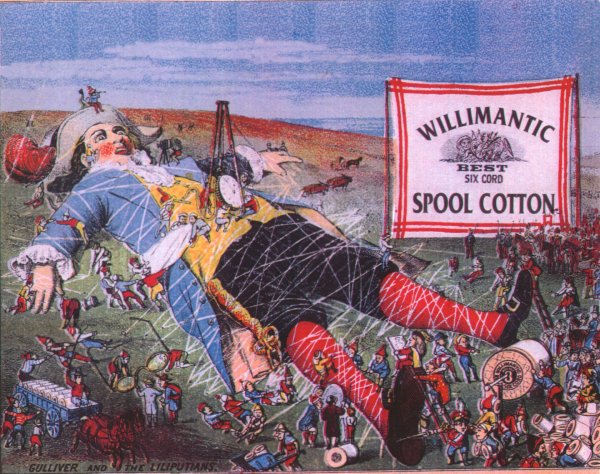 These days I'm trying to get into a particular kind of writing mindset. Which means wearing blinders for a while, which means I can't really scout around for interesting stuff to post about. I can you give you my quick take on matters of public record: The pope? Please, enough already. White smoke, purple smoke, I really do not care. Tom DeLay? Give him the steel-toed boot, pronto. Bush? Ditto.
 So I was all set to try launching an open thread to see what happens, when I ran across the Litblog Co-Op. Which made my working-class hackles (my father was a cook, and my mother a waitress, so I claim this still as my heritage) stand on end, immediately.
The Litblog Co-Op is a group of so called literati weblog writers who have got together with this purpose (from the blog itself):
Uniting the leading literary weblogs for the purpose of drawing attention to the best of contemporary fiction, authors and presses that are struggling to be noticed in a flooded marketplace.My reactions to this are strong and immediate and not at all positive. In fact, some of my reaction is very personal. I find myself channeling Woody Allen: I'm not interested in any club that would have me as a member. But is the corollary to this that I am automatically interested in a club that would NOT have me as a member? Or am I just pissed off at the excusionary nature of such a venture and, in a word, insulted? For myself, or my novels, or both?
I spent a good portion of my adult life in the university system, both Ivy League (my PhD is from Princeton) and Big Ten, in other words: where intellectual snobbery was born and where it flourishes. I didn't like it then. I disliked it so much that when I went into the tenure review process at the University of Michigan in my sixth year, I was ready, even eager, to be rejected. Willing to jump out of the plane before I got pushed, if you can see that. I had a lot of well received publications and two full books, in addition to a published novel (a novel that went on to win the PEN/Hemingway award), I had great teaching credentials, but at that time, the turndown rate in the humanities at the UM was about 80 percent. I just assumed they'd give me my walking papers. I had seen a lot of other good people get them.
But I got tenure, and while I was surprised and gratified, I was never really comfortable about the whole thing. The very exclusive club opened its doors to me against all expectations, but once I was inside it never did feel right. I left four years later, shocking everybody. The dean said to me (I remember this conversation word for word) What are you thinking? You are throwing away a promising career. Because nobody gives up tenure at the University of Michigan, you see. That was the general opinion. This mirrors almost perfectly my experience after Into the Wilderness was published, when certain people asked me when I was going to go back to writing novels like Homestead. The idea being that Homestead was a real, serious novel, and Into the Wilderness was not. I was capable of real stuff, just as i was worthy of tenure at a prestigious university, and yet I had turned my back on both these good things.
But I don't think I did turn my back on anything at all, or at least not on anything worth having at such a high cost. I can tell stories from many different angles and directions, and I'm just happier standing over here on the periphery where I don't have to go along with the party line. At least, I'm usually happier.
So I admit that my feelings about the Litblog Co-Op are complex. I have experience on both sides of that literati divide: as one of the inner circle, and in the last few years, as a persona non-grata. Somebody who gladly walked away, of her own free will, and now must live with the consequences, Which is usually not a trial, at all. I have a great life; I make a very good living from writing fiction; I have a wide and appreciative readership. And still, all this gets under my skin now and then.
The literati talk about the "best in contemporary fiction" but their definitions are usually so narrow and, often, self-serving, that I find them really objectionable. I had a debate with one of that crowd some time ago about his use of the term serious fiction in the comments to this post. That conversation ended with this last comment from me, which was never answered:
My point is, the distinction between "a yarn, a page-turner, a good time" and "serious literature" is an artifical one that has more to do with dogma than a real examination of what makes fiction work. I would call most of Austen and Dickens page-turners, and certainly I have a good time when I'm reading them. They are also thematically rich, highly plotted and full of interesting characters. The no-pain-no-gain approach to reading strikes me as perverse, and truly unnecessary.Shortly after that exchange I gave up reading the self-proclaimed elite literati weblogs. Mostly I found them to be too pretentious to be useful or interesting, with the exception of Ed's Rants, because inspite of myself, I find I'm interested in his tasty brownie escapades. And now that I've vented, I'm hoping I can go back to ignoring the Litblog Co-Op.
After all, I make a pretty mean brownie, myself.
I was at a library paperback sale and I came across this book called "Into the Wilderness" by Rosanne Bittner published in 2002 by Tom Doherty Asso. Books. Is that possible? Same type of story too. I bought it...sorry 20 cents......takes place in 1750s in Allegheny mountains in Pennsylvania and this girl is saved from the indians by a darkly attractive hunter (their words).....weird....do you know about this?You can't copyright a title, and thus they do get recycled. I don't think any publisher would allow a title like Gone with the Wind -- something so clearly and obviously associated with a book that has achieved legendary status (deservedly or not; The DaVinci Code won't be resued for a long time, either). You might remember that Thunder at Twilight was the title I wanted for the fourth book in the Wilderness series, but I was overruled by my publisher, who preferred Fire Along the Sky. You'll note, if you look up Fire Along the Sky, that there's another novel -- out of print -- with that title, by Robert Moss. So it does happen.
And yes, I was aware of Rosanne Bittner's novel in 2002, but again: there's nothing to stop a title being reused. It might not even have been her choice. Publishers have the last say about titles in most cases. Before you ask: I haven't read it.
More soon.
His primary statement about the process of writing:
The Importance of Design: Good fiction doesn't just happen, it is designed. You can do the design work before or after you write your novel. I've done it both ways and I strongly believe that doing it first is quicker and leads to a better result.And when Randy says design, he means design. Have a look at the Snowflake Process and you'll see that he advocates a lot of prep work, such as character sketches. He then proceeds to make lists of scenes and chapters, which are expanded, bit by bit, until there's a whole novel. The tools he uses for this are suited to the nature of the task. For example, by step nine of the process:
Make a spreadsheet detailing the scenes that emerge from your four-page plot outline. Make just one line for each scene. In one column, list the POV character. In another (wide) column, tell what happens. If you want to get fancy, add more columns that tell you how many pages you expect to write for the scene. A spreadsheet is ideal, because you can see the whole storyline at a glance, and it's easy to move scenes around to reorder things.So Randy's approach is very, very structured, and most important: it works for him. It may work for other people, too. The thing about writing fiction is that there are are no universals. What is magic for one writer may paralyze the next one. I've heard many stories over the years of odd things various writers do; some of my own process is idiosyncratic.My spreadsheets usually wind up being over 100 lines long, one line for each scene. As I develop the story, I make new versions of my story spreadsheet. This is incredibly valuable for analyzing a story. It can take a week to make a good spreadsheet. When you are done, you can add a new column for chapter numbers and assign a chapter to each scene.
My first reaction to the Snowflake is that it's way too structured for me personally, but on the other hand, I like structure and so I'm intrigued. I just can't really imagine getting one of the Wilderness books to fit into a spreadsheet, scene by scene (we're talking, what, maybe 500 scenes in a 300,000 word novel). But who knows? At some point in the future it may be exactly the thing I need to get a novel off the ground.
Why every one as they like; as the good woman said when she kissed her cow.--Jonathan Swift
 I just realized I never formally reviewed this novel, and so for the record: A Thread of Grace may well be the best novel I read in a long time. I did talk a little about it in an earlier post, here.
The story is set in northern Italy in WWII. It has to do, overall, with the fate of Italian Jews and the non-Jewish Italians who came to their aid, but really it's about a handful of individuals. Characters you come to understand and truly, deeply, like, in spite of their flaws or sometimes, because of them. This is a beautifully written, skillfully told story, and I could hardly recommend it more highly but I can say this: I have already bought copies for a few friends, and I went out and found a signed first edition, which is the biggest compliment I ever pay a novel.
A Thread of Grace is what good historical fiction can be.
 The Sparrow is Mary Doria Russell's first novel, a story that almost defies categorization. It is, of course, science fiction, because it deals with space travel and first contact with sentient beings on another planet. It's also anthropology, because it approaches that topic -- first contact -- with deep understanding of the complexities in such situations. But mostly this is the story of a man's life, and it's compelling and satisfying on that basis alone. The rest of it is all frosting on a very good, very rich cake.
 The main character here is Emilio Sandoz, a native of Puerto Rico, and a Jesuit priest. So here I have to tip my hat to Russell. She pulled off something I thought impossible in my case, because a childhood of Catholic education vaccinated me against this particular illness: she made me fall in love with a priest. This is such an interesting, complex character, and you go through so much with him -- that's my excuse, and I'm sticking to it.
There are a half dozen other characters I also fell in love with. The kind of characters you want to be real so you could live across the street from them and go over to borrow sugar and shoot the breeze. This group of characters heads off on a mission organized, secretly, by the Jesuits. It's the year 2019 and they are going to the planet that will eventually be known as Rakhat.
You may remember that in various places I've discussed the difference between story and plot. Story is what happened in chronological order; plot is the artful rearrangement of that order to create suspense and interest. Russell chose to start telling this story at the end: in the year 2059, when Emilio returns from Rakhat. Because of the nature of space travel and time and relativity and all those things I don't pretend to understand, he is only a few years older but everyone else is significantly aged. More important: Emilio is the sole survivor, barely clinging to his sanity and his life, and reluctant to tell the story to his superiors in the Society of Jesus. The novel moves back and forth in time, between the near-broken and maimed Emilio, the years before the mission, and the four years of the mission on Rakhat.
If there is any problem with The Sparrow at all, it's a mechanical one: Russell pulls off the high wire act of moving back and forth in time while juggling several dozen characters, and she does so gracefully. And still there are a very few points where she wobbles, ever so slightly. Some of the four years on Rakhat feel a little rushed. We've come a long way with the characters and I was disappointed to have some storylines resolved out of scene. Some -- but not all of that -- is addressed in the sequel, Children of God.
This is not an easy novel. It's demanding in a variety of ways. It will make you laugh out loud and it will break your heart, and most of all, it will make you think.
The comment function should be working now; however, if you run into an error message, please email me, okay? Because that's the only way I know that something's off. In the meantime, this comment from Robyn on my Auden-esque ramble:
I've decided that my qualifiers for a Great Read (one worthy of shelf space and re-reading and pressing on to others) is, it: made me laugh, made me cry, got me sexually or sensually involved, made me think, and had at least one compelling character who CHANGED or LEARNED and whom I still cared about some time after I had closed the book. For bonus points, or if one of these areas was weak or neglected, having been surprised in a satisfied manner (or satisfied in a way I didn't see coming).Now see, this is why I need input. Because Robyn's qualitative questions work in a way that my venn diagram does not. I suppose my approach has some merits, but it doesn't get to the heart of the matter, basically Robyn's two-pronged question:If it made me see something in a new way, or had a few words that stuck in my head that I had to copy down to read again, that's extra points, too.
If I can't muster that much critical energy, then the fast, economy test for me is a two-pronged question -- Did it keep me in a trance? (judged by, lost track of time, lost track of where I was, wasn't bothered by bodily signals) and, When I came out of the trance, was I glad I had read it? (vs. embarassed, ashamed, cheated of the time, made slightly worse as a person, etc.)
So, interesting -- I, the consumer, judge a read by the effects it has on me. You, the pro, (pro-ducer and pro-fessional) describe it in terms of its structure, prose, etc.
I love your illustration, btw. Putting things in their proper spot on a Venn diagram always makes me feel that the world is in a teeny bit better order [g]
Did it keep me in a trance? (judged by, lost track of time, lost track of where I was, wasn't bothered by bodily signals) and, When I came out of the trance, was I glad I had read it? (vs. embarassed, ashamed, cheated of the time, made slightly worse as a person, etc.)I'm not sure where the compulsion comes from to quantify something so objective and personal as a story. Maybe my academic training; maybe the fact that my right and left brains are always in a struggle for the upperhand. Maybe because it's what I do for a living, and as Robyn says, it just gives me a feeling of having some kind of understanding or control over a process that is opaque by its very nature.
Off to write.
With apologies to Auden, this book evaluation scheme works for me better than his more streamlined version.
***** well written, great characters, great plot
**** some flaws, but still all around pretty darn good
*** nothing out of the ordinary
** some redeeming features
* poorly written, cardboard characters, terrible plot
(+) I like it.
(-) I don't like it. (boring, annoying, irritating)
(~)Under other circumstances, I might come to like it.
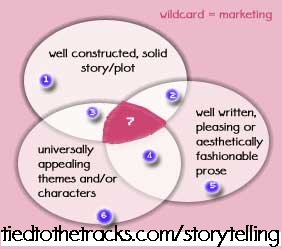 Now, thinking about this further, I would be even more comfortable going the whole way and using the system I set up when I was trying to figure out why some novels become best sellers. You see the diagram here, with seven categories. That would mean, for example, that a given novel might be a 6(~) or a 4(+) or (less likely) a 1(+), in my evalation.
A German idiom comes to mind: warum einfach, wenn es kompliziert auch geht?
This quote is from W.H. Auden, who was one of the principal poets of the last century. It comes from his autobiography (it's not a standard autobiography, but there's not much else to call it), A Certain World:
For an adult reader, the possible verdicts are five: I can see this is good and I like it; I can see this is good but I don't like it; I can see this is good and, though at present I don't like it, I believe that with perseverance I shall come to like it; I can see that this is trash but I like it; I can see that this is trash and I don't like it.
This both interests and disturbs me, because while it looks very even handed and reasonable, there's one flaw I can't get past. Every book must fall into one of two primary categories: this is good or this is trash.
So I tried to figure out how this does or doesn't work for me. I've named novels that fall into each category, for me personally.
1. I can see this is good, and I like it. The Magician's Assistant; Pride & Prejudice; A Thread of Grace
2. I can see this is good, but I don't like it. almost all of James Joyce
3. I can see this is good and, though at present I don't like it, I believe that [with perseverance] I shall come to like it. Atonement
4. I can see that this is trash but I like it. I prefer the wording: guilty pleasures: Princess Daisy
5. I can see that this is trash and I don't like it. DaVinci Code
It's sad when a good story goes bad.
 I've been thinking about writing this review for many months, ever since I saw the Battlestar Galactica miniseries. Now the first season has ended, and I've come to the conclusion that while BSG can't replace Farscape, it's damn good, and deserves a lot of recognition. So just to make myself clear: five stars = Farscape. Battlestar Galactica may end up with a four++, if it continues on its current trajectory.
 You probably know some version of the story, which has been around in one form or another for a long time (starting with the first television series, circa 1980). Humans create sentient machines; machines decide they can do without humans, and start cleaning house. At the beginning of this version or iteration of the story, humans exist on on twelve planets with an aging military fleet in a state of uneasy peace when the bad machines -- called Cylons -- show up again, intent on getting rid of us once and for all. So there we are, fighting a war without enough resources, dying in vast numbers. The storyline revolves around the head of the military (played with subtle, vaguely threatening intensity by Edward James Olmos), the president (Mary McDonnell), a former secretary of education, various pilots and support personnel, and the Cylons. Who can look like metallic robots or, here's the innovation -- like humans. And they've got a great spy system in place. They've infiltrated in the most imaginative ways, compromising a key character. And another nice twist: some human-looking cylons don't know they're cylons, because they haven't been activated.
The things I like best about BSG: it's gritty, and it feels real inspite of the science fiction nature of it and cgi. I love the fact that the human population has a dominant religion that is nothing like what we now cope with. People are raised believing in the gods, and the idea that they are playing out a scenario setup by the gods that repeats itself over and over, forever. Those who don't believe in the gods kind of shrug and make up their own explanations for why things are happening. But the very cool twist is this: the Cylons, the ones who look like humans and act like humans and seem to feel emotions in a human way -- they believe in the one god, the old god, and they preach, where they can, the will of that one god to non-believing humans.
This is a very small part of the overall makeup of BSG, but it's the kind of detail that makes the story interesting to me, aside from the human interactions. There's no great love story here, but that's okay for Galactica. And I'm looking forward to the new season.
As a side note: I have to say that I wish Ben Browder had found a new home on this particular Battlestar rather than with the Stargate crew, but then I'll give that every chance, once he's on board.
Go ahead, hiss. Boo. Throw tomatoes and curses at the computer screen, but then tell me, after you've vented: do you have a small space someplace within reasonable driving distance of my home where I can work with a lot of background noise that's easily ignored? A place where I can get something to drink (mint tea; I don't drink coffee) and a cookie, if I'm feeling like it. A place that's well lit and where they let me plug in the computer. Most of all: a place where people know not to talk to me.
I've tried every cafe in town, and out here on the western coast of Washington, that's saying a lot. This is the land of coffee houses of every stripe. Drive-through coffee shacks (Java the Hut; Espresso a Go-Go; Mocha Madness, etc etc), and ten sit-down places, not counting four different Starbucks. I've tried them all and every one of them had problems that I couldn't overcome. Bad lighting. Too quiet. Too much background music. A no-laptop policy. Wobbly tables. People who don't get the please-don't-talk-to-me vibes I send out so strongly. Tables too close together; no table where I can work with my back to a wall. Because I can't work someplace where somebody might come up behind me and read what I'm writing. That is the stuff of nightmares.
Speaking of which, when things get really bad, sometimes this nightmare comes back that I first had when I was on the faculty at the University of Michigan. I'm walking through campus past the library when I see there's a preacher up on a box with a big crowd around him. Nothing unusual in that, except this particular preacher has my office trash bin in the crook of his arm and he's pulling pages out and reading random sentences to his audience. Sentences from early drafts; awful, horrible sentences that I have already excised from my memory, but now are recorded in the minds of all the people standing there. Who turn and look at me. Like hungry jackals.
So today I went to Starbucks, yes. I went to Starbucks, and I wrote for three hours straight, and I got not a lot down, but enough so that I have the sense that tomorrow I can do the same thing, and maybe even more. I'll go early and get the good corner table and plug in my laptop (because if the battery goes below 80% I start to obsess and get all anxious about that) and descend into the haze where the story bubbles, where I will wallow as long as I can, until I have to come up for air.
Scoff if you must, but desperate times call for desperate measures.
You get the idea. Pardon me while I go clean the gunk out of the seams on the food processor, will you? And maybe after that I can get a few words written. Or at least I could paint the dining room.
 I don't review every novel I read, and I especially don't review novels just to be negative. There's nothing to be gained in setting out to bash somebody else's work, not for me, or you, or them. If I do decide to post about a novel that doesn't work for me, the reason is usually that I see a bigger issue I'd like to address. This time, in talking about Swerling's Shadowbrook, the issue has to do with historical fiction more generally.
The thing about historical fiction that makes it so challening is quite simple. You've got to do a lot of extra work, in terms of research, and then there's the challenge of shifting your mindset. It's not easy to write from the POV of a character whose life and times are so very different from your own. So first, that acknolwedgement. This novel, which encompasses most of the French and Indian War as its backdrop, was an ambitious undertaking.
I went and read other reviews of Shadowbrook after I had finished it, which were all pretty positive and very complimentary about the quality of the research that went into the work. Which brings me to the other, primary challenge that goes along with historical fiction. Here it is: you can't lose track of the fact that this is a story you're telling. First a story, then a history. A novelist who lets him or herself forget this is bound for trouble, and I think Shadowbrook is an example of such a novel.
Swerling tries to cover pretty much all of the French and Indian war, fit in every major character and institution and battle. In order to do that she has to spread her two main characters really thin. She's got them jumping from Louisiana to Manhattan to Quebec to the Adirondacks with little apparent effort.
The two major characters (Quentin Hale and Cormac Shea) are young men connected to white slave holding society (in one direction) and various Indian tribes (in the other), which positions them to cover many aspects of the war, but not all of them. The third main character, the young woman called Nicole, feels as though she was constructed completely to fill a void in this net Swerling casts over the entire continent. Nicole, half French, half English, is on her way to join a convent in Quebec when she finds herself traveling with Quentin and Cormac. Without Nicole Swerling wouldn't have a way to bring in French Catholic sensibilities. At the same time Nicole provides a vague, underdone love interest for Quent. He loves her; she loves him but mon Dieu, she's made a promise to God.
Nicole's role is to bring various priests, mostly Jesuits, into the picture. Which is important if you're determined to tell the whole story of the this particular war, because the Catholic church played a major role.
Once Nicole is in Quebec she ends up playing a role in the communication between Montcalm and other major historical characters -- something that requires some plot finagling, because she's cloistered among the very strict Saint Clares. At any rate, that setup keeps her busy while Quent is running from battle to battle, and trying to save his father's patent, a huge tract of land called Shadowbrook, populated by Quent's evil elder brother and a lot of slaves, all the better to examine that aspect of the war, of course.
And then there's the second-string love story, which also feels manufactured primarily so the author could fit in the story of the Acadians being expelled from Canada by the English. Cormac Shea falls in love with a young woman in that community and then, determined to find her when she's expelled, goes to Louisiana. Let me point out one of the linguistic... infelicities... which bugged me the most: why would Native Americans in Canada be dreaming about alligators? And if they did, how would they know that such creatures were even called alligators? Beyond that observation, I'm not going to address the matter of historical research directly, because some of what I would have to say comes down to a matter of difference in interpretation.
Thus you've got characters who are being moved around like puppets to fulfil the author's need to get the historical facts, as she interprets them, onto the page. The result is a story without a lot of dramatic tension, and certainly without character development. The characters change as historical circumstance dictates. Which is unfortunate, because I think there was a great deal of potential in quite a few of them.
All in all, this novel felt too broad and unfocused to me, diluted to the point where it was hard to maintain interest in the characters at all. And of course, as always: this is my take, alone.
When the emperor sneezes, we must all take to our beds;we are the poet
with passive-aggressive vampires, it works better to tailor your strategy to fit
their particular dynamics.
The various relays are grouped together in several
locations. I watched
from the kitchen, then moved through
to the study as she prowled the grounds.
But you two.
Substituted objects at this stage need to look similar to the desired object.
Prune after flowering and again in late winter, should you wish to control its size.
But the strategy broke down at night.
The first place I saw this book meme was at feministe.us (a weblog I mean to visit more often, because I always find something interesting there). The rules:
1. Grab the nearest book.
2. Open the book to page 123.
3. Find the fifth sentence.
4. Post the text of the sentence in your journal along with these instructions.
5. Don’t search around and look for the coolest book you can find. Do what’s actually next to you.
Here's my sentence from page 123 of Sherwood's The Book of Splendor:
"When the emperor sneezes, we must all take to our beds."If you don't have a weblog, post your 123.5 to the comments, here. Maybe something interesting will happen. A prose poem, full of buttery yellow daffodils and broken wheel axels.
Today is the third day of a workshop I'm enjoying a lot (nothing to do with writing, though) and thus no posts. Except I'm going to jump on this meme-ish bandwagon quickly, before I have to leave.
You're stuck inside Fahrenheit 451, which book do you want to be?
So, I've got to pick a novel that (1) I'd want to memorize and (2) recite outloud constantly and (3) eventually pass on to another book-talker, (4) without losing my mind out of boredom. Oh and, it's got to be something that I feel strongly enough about that I want to save it from extinction. That means it has to be fairly long, episodic, with funny bits as well as good prose and excellent characters. Maybe Mark Helprin's A Soldier of the Great War. Maybe Dorothy Dunnett's Niccolo Rising. Maybe in a couple years, after rereading it a few times, I'll feel the same way about Mary Doria Russell's A Thread of Grace.
Have you ever had a crush on a fictional character?
Crickey. All the time. Isn't that a big part of the reason to read fiction? So you can fall in love again and again without cheating on the person who takes out the trash and leaves marmelade covered knives on the counter and brings you chocolate when you're feeling down? I wouldn't trade him in for anything, but on the other hand, I'd be very sad if I couldn't open a new book ready to fall in love with the next Lucas Davenport or Niccolo van der Poele. Remember this movie quote? I just met a wonderful new man. He's fictional but you can't have everything.
The last book you bought is?
Frances Sherwood, The Book of Splendor
What are you currently reading?
Frances Sherwood, The Book of Splendor; Francine Prose, A Changed Man; Beverly Swerling, Shadowbrook, Robert Remini, The Life of Andrew Jackson; Thomas Ingersoll, Mammon and Manon in Early New Orleans: The First Slave Society in the Deep South, 1718-1819.
Five books you would take to a deserted island:
Does this island have septic and a working well and a shower and kitchen facilities? How about a telephone? You've got to give me some more information before I go picking out books. Really, if there's nothing there, what choice do I have but take the five best books I can find on survival techniques? Okay, the four best and then as the fifth: Dorothy Dunnett's Niccolo series. Yes, I counting it as one book. So sue me.
Three people you're going to pass this meme onto, and why.
I'll leave jumping on the bandwagon to the discretion of the jumper.