" /> storytelling: October 2005 Archives

take me to the front page of the tttt weblog | back to the current weblog

« September 2005 | Main | November 2005 »

October 31, 2005

and now for something completely different

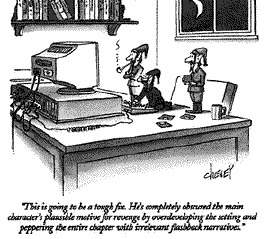
Tom CheneyTime to pull this out again. Because really, don't you need a laugh just about now?

If you want more of the same, try the Philosophy Comix website, or the repository of lost masterpieces, the Cartoonbank.com site. By plugging a few words into the advanced search screen I found my all time favorite cartoon by Tom Cheney. In case you can't read the caption:

This is going to be a tough fix. He's completely obscured the main character's plausible motive for revenge by overdeveloping the setting and peppering the entire chapter with irrelevant flashback narratives.

If you've got to be mad at somebody

Try Brendan I. Koerner for his discussion not just of A Breath of Smoke and Ashes, but also of Diana herself. I would call this an example of a badly done professional piece. It's condescending, offensively personal in tone, snide and predictable.

I am amazed that reviewers and reporters feel it not only necessary but reasonable to use a cliche like bodice ripper. That's far more offensive to me than a good old fashioned Anglo Saxon cuss word. Such as: asshat.

October 30, 2005

once more, with feeling: negative reviews

I have a feeling I'm just going to have to keep answering questions about this post and this one for a good while. Here are two recent comments to these posts (which discuss negative reviews in general and Beth's review of A Breath of Snow and Ashes in particular):

from Jamie: [...] With that said, it upsets me that one person's review would turn you off reading the book. What if your fans (I am a huge one) took the same stance with a negative review of your book? The fact that they didn't *purchase* it aside, wouldn't you feel as though you were somewhat short-changed in that you didn't even get the chance to prove the reviewer wrong? I was just surprised to see your POV on reading the book. To be honest I was quite disappointed.
from Dana: It seems highly innapproriate to me to find an extremely negative review of another authors work on your homepage. Even if everything said by Beth is valid why would you want to post it here? If Diana Gabaldon ever considered you a friend I doubt she does now!
As for the tone, I don't speak to any one, friends, enemies, whatever, using the language Beth used. Fuck is not an adjective! It made it hard to read. It also took away some of her credibility, because it made her sound like she's a foul mouthed 16 old.
I am telling you this, because I have so enjoyed your books and respect you as an author, but I think posting something like this on your homepage can hurt your reputation.

To Jamie, first:

The plain truth of the publishing business is that negative reviews cost sales. It's just part of what goes on. I've had bad reviews from readers (the infamous Amazon anonymous reviews) and from places like Publishers Weekly, and those bad reviews cost me readers, right or wrong, justified or not. Just as the good reviews (and there have been more of those, for which I'm thankful) have brought in readers.

I would hope that any potential reader looking at reviews before making a buying decision would bring critical thinking to the process. I don't automatically decide to read (or not read) a book on the basis of a single negative review.

For example, this review:

"This is the absolute worst book ever, gag me with a spoon, what idiot wrote this shit?"
-- I would ignore completely.
"I didn't like this book as much as x's book."
-- Again, there's no substantive content here, so I'd ignore the review.
"This author knows nothing about her subject and she can't write a sentence to save her life."
-- This review would make me pause. If there were a lot of reviews like this, it might slow me down reading the novel unless there were other considerations.
"Author X has been putting out this crap for years and people keep buying it. A person with a degree from a public university has no right to advertise themselves as an expert in this area."
-- this kind of review -- which attacks the author on personal grounds -- makes me angry, and I would probably read the novel to spite the reviewer.
"I loved the first three books in this series, loved everything about them. Adored the characters. But this new novel was such a huge disappointment, and I'm sad and angry about that, and here, exactly, is what went wrong in my estimation: [...]"
-- In this case, especially if I had admired the early books, and especially if the problems touched on areas that I personally find very difficult, I might well decide not to read the book. As I did in the case of A Breath of Snow and Ashes.

Now to Dana, who is worried about my reputation:

I am trying to imagine some day sitting down at the computer and finding a review of my next book that parallels Beth's review in terms of detail, tone, and conclusions. I can tell you how I would feel: devastated that a reader who had once loved my work (because her love of the stories is very clearly there) was so disillusioned by the new book.

Of course it would be hard. There is no denying that. But after I got done being shocked and hurt, I hope that I would be honest enough with myself to admit that such a review is a labor of love. A reader has to be very invested in the universe I made to go to so much trouble. Because if you read Beth's review, really read it, you'll see how much thought went into it. She didn't just dash off a one-sentence "I hated it" review. She didn't go after Diana personally. She sat down and said, here's where it went wrong, and then she laid it all out point by point. If somewhere down the line I get a review like that, here's what I hope I'd do: (a) scream and cry (b) calm down (c) read the review carefully (d) make notes (e) decide which, if any of the substantive comments had value (f) talk those over with my editor and agent (g) decide how to go forward.

That's what I hope I would do. Conversely, I dearly hope I would NOT do any of the following: (a) go after the person who wrote the review and try to make her life miserable (b) go after people who agreed with the review for the same reason (c) try to rally the troops to go out and slay the negative reviewers in my name.

Please note, I have no idea if Diana has read Beth's review, or the discussion of Beth's review here. If she has and wants to talk to me about it, I know that she will. Diana is a strong woman. She is perfectly capable of defending herself if she feels she has been wronged. If she does contact me, I will be sure to let you know.

Here's my bottom line:

Honest reviews are hard to come by in this particular part of the publishing world. Beth's was an honest review, and that's why I wanted to talk about it. I'm not worried about losing anybody's friendship, and if my reputation suffers, then those are probably people who wouldn't like me or my work anyway. Which is fine. It's a wide world with many choices, and there's room for all of us.

Edited to add: it occurs to me that one valid criticism that might be coming my way is that I rarely include negative reviews here. I haven't been doing much reviewing at all lately, but I have been negative on occasion. Examples: Hunter's Havana and McCullough's The Touch.

October 29, 2005

more on negative reviews

A few days ago I pointed to Beth's review of Diana Gabaldon's A Breath of Snow and Ashes. The response was immediate and strong, and the discussion was interesting. Some commenters objected to Beth's review, and their problems with it fell into two groups: those who didn't like the tone of the review, but didn't object to the substantive content; those who disagreed with content and disliked the tone.

Beth has a thread over at her weblog dedicated to discussion the substantive points she made. It would be great if those who really liked and admired ABSA will go over there to discuss what worked so well for them -- although at this point it looks as if the pro-ABSA folks have been silent. That's too bad, because I'd follow the discussion with great interest.

What concerns me personally is the repeated references to tone. The OED's definition:

tone: A particular style in discourse or writing, which expresses the person's sentiment or reveals his character; also spec. in literary criticism, an author's attitude to his subject matter or audience; the distinctive mood created by this. (Cf. 9.)
Now, reading over Beth's review this is what I see in terms of tone: frustration, disappointment, anger. A review written for a weblog audience with a central message: once I adored these characters and these stories, and now I don't, and here, exactly, is what went wrong for me: [...]

Some people seemed surprised that I liked the review. So I'm going to explain my take on this subject overall:

I don't mind a strong tone.

If there is going to be a long discussion of the merits of a novel, I prefer that the discussion be as explicit and detailed as possible.

Thoughtful content is more important than presentation. I like a good review whether it was written for a weblog (in a more familiar way) or the NYT (in a more detached way).

There's a distinction between a review that criticizes the book, and one that criticizes the author. Beth's was the former. For an example of the latter, see my discussion of a NYT review that went way over the line in taking apart the author's life and background. I'd consider this an example of a professional negative review, well written and a discredit to the reviewer.

Women who write fiction that has anything to do with romance (and you can fill in the dozens of labels here) have to start providing honest, straight forward, thoughtful reviews that go beyond cheerleading. We are strong and smart enough to disagree with each other. There are some people out there who have been working toward this end (the Smart Bitches spring to mind), but it should be the rule rather than the exception.

Reviewer X's dislike of Novel Z should not be taken as an attack on the author. To automatically jump to that conclusion is to cut off discussion before it can start.

There you go. My take on reviews in general, on Beth's review in particular, and life as we know it.

October 28, 2005

Natty, Nate, Nathaniel, Daniel, Hawkeye

Every once in a while I get an email like this one from Larry:

In James F Coopers books, the original Hawkeye was Nathaniel (Natty) Bumpo. Why did you name him Daniel Bonner?

I have a longer answer to this question in the FAQ section for the Wilderness books (here it is, to save you the time):

James Fenimore Cooper wrote a series of books called the Leatherstocking Tales. His main character was Natty [Nathaniel] Bumppo (also called Hawkeye, and several other names), and seemed to be based on the legends that grew up around the real life character Daniel Boone. One of his novels was The Last of the Mohicans; another, set in Hawkeye's later life, was The Pioneers. The Last of the Mohicans has been filmed a number of times, the last and most memorable by the director and producer Michael Mann. That is the movie staring Daniel Day-Lewis and Madeline Stowe. In Mann's version of the story, Hawkeye's real name was Nathaniel Po.

I wasn't so much interested in retelling the story of The Last of the Mohicans -- that has been done often enough -- but I was interested in Hawkeye's later life. So I set out to do a few things: first, write a very loose retelling of The Pioneers (keeping some of the plot, some of the characters, and some of the themes, especially the environmental ones); second, to tell the story from the female perspective (Cooper was a fine storyteller, but he didn't write women very well -- they come across as idealized and two-dimensional); third, to put my own spin on the legend of the frontiersmen who populated the New-York frontier; fourth, to try my best not to contribute to the stereotypes rampant in literature about the Mohawk. I hoped to portray them as a people who survived in spite of great hardship. Because I wanted to put my own version on paper, I changed Hawkeye's name yet again. Not Bumppo or Po or Boone, but Bonner. So I have a Dan'l Bonner and his son, Nathaniel Bonner.

Something else I'd like to say, very clearly: when I wrote Into the Wilderness it was not conceived as any kind of sequel to Last of the Mohicans. I never, ever called it a sequel, and Bantam didn't, either. However, some reviewers did call it a sequel, and that idea stuck in the minds of readers. Criticism of ITW as a sequel to Last of the Mohicans followed -- and still follows.

You see how this would be frustrating.

So ITW is not a sequel. It's my take on an older story, and as such, I changed things to suit my version. Think of West Side Story, where you get Maria and Tony instead of Juliet and Romeo. Think of A Thousand Acres, where you get Larry Cook instead of King Lear and his caughter Ginny instead of Cornelia. There are hundreds of examples of retold stories, and often the author shifts names and places and times, and then lets his or her own imagination go to work.

October 27, 2005

watching the characters

Thomas Harris is best known for his character Hannibal Lecter, who appears in three of his novels: Red Dragon, The Silence of the Lambs, and Hannibal.

This is just a guess, but I'll bet that most of the literati haven't read Harris and would decline any interest in reading his stuff because of the subject matter and the genre taint. Which is actually kind of sad for them, because Harris is one of those writers who transcends boundaries. His stuff is certainly about serial crime, but it's also top notch storytelling, with complex characters and exacting, evocative use of language.

I just re-read the essay he wrote that appears in the front matter for the most recent paper back edition of Red Dragon, and I remember feeling just the same way the first time I read it. It's rare that somebody really captures what it's like to write fiction, the feel of it, but Harris does that. Here, for example:

You must understand that when you are writing a novel you are not making anything up. It's all there and you just have to find it.

He goes on to talk about his partnership with his main character, Will Graham, his empathy for the guy, what it's like to have watched him shift through evidence and come to a reluctant decision about needing help, and who he needed to get that help from. And at that point:

Will Graham and I, approaching Dr. Lecter's cell. Graham was tense and I could smell fear on him. I thought Dr. Lecter was asleep and I jumped when he recognized Will Graham by scent without opening his eyes.

I was enjoying my usual immunity while working, my invisibility to Chilton and Graham and the staff, but I was not comfortable in the presence of Dr. Lecter, not sure at all that the doctor could not see me.

To somebody who doesn't spend their time watching characters and following them around, this probably sounds a little nuts. But to the rest of us there's the feeling of rightness. This is how it works when it works. The characters have the power to surprise you, to frighten you, to make you shift uncomfortably in your seat.

There are new characters in Queen of Swords. One of them is a man who frightens me, and I don't like getting to close to him either. He's no Hannibal Lecter, but he's callously cruel and he likes to inflict pain. I keep trying to get rid of him and he keeps coming back. I have another character I like much more, but don't know well enough yet to really trust. He keeps going away when I want him to stay around.

For the record, I want to state, yet again, my position on all this:

Storytelling is a strange and wonderful business, and I'm fortunate to be able to pursue it. I'm thankful that I have readers who are as interested in my characters as I am.

October 26, 2005

ANNOUNCEMENT: we have a winner.

I pulled Sal's name out of the hat. Her LibraryThing username is Towse, if you'd like to have a look at her library.

Thanks to everyone who signed up.

Next giveaway: a Queen of Swords ARC.

computer shuffle

Every two years or so we undergo a big computer shuffle around here. We've got one going on right now.

new powerbook
My two computers (a desktop G4 iMac and a laptop G4 iBook) are being replaced by my purty new PowerBook G4. My daughter's older model G3 iMac is being replaced by my old G4 laptop. Which means I have to sell the G4 iMac and the older model G3 iMac.

Normally I give older computers away to charities or schools that need them, but in this case, as my husband pointed out, I kinda blew the cover off my budget and it would be a good idea to actually sell the older machines and try to recoup a little. But you know, I just hate the idea. I've written thousands of emails and millions of words on these computers. Even if I completely reformat the hard drive, the ghosts of the characters and the stories are still wafting around them. In an odd way it feels like selling a horse I've been hooking up to a work wagon day in and day out. Disloyal.

Eventually common sense (the husband's, not mine) will probably hold sway and they'll go onto Craig's List to see who might be able to provide a good home. But in the meantime I'm sitting here with this new thoroughbred stallion, admiring his gorgeousness and sleek lines and great resolution and huge screen and I'm feeling a little sad, and a little disloyal, and very, very thrilled.

cursing

There's a very interesting post/discussion over at Smart Bitches on cursing in its greater socio-cultural historical context. But of course there's a ton of cussing going on, so steer clear if you're uncomfortable with that.

October 25, 2005

how not to flinch

It's hard to write a negative review. For me at least, it's very hard because I see the author in front of me with every word I put down. Do I want to slap that person in the face? Rarely do I feel so strongly about a book that I am really angry at the author, but it happens. (You want an example? Bret Easton Ellis. I could gladly beat the guy up, if you'd hold him down for me.)

And then I still would have trouble writing a truly honest, negative review, because if there's one thing that's sure as little green apples, it's Payback in Review Land. So I'm a coward. So sue me.

Beth is not a coward. Beth is so incredibly courageous, I am in awe. She has reviewed the most recent book in Diana Gabaldon's Outlander series, called A Breath of Snow and Ashes. And she hated it.

I haven't read the book. I don't think I ever will, though often I read a book after a scathing review just to see if the reviewer was being fair. But this unflinching review is very detailed and very convincing. It also makes me sad, because like Beth I loved the first three books in this series, and it's hard to see something like this happen.

I'm sad, but mostly right now I'm hoping that somebody will be honest enough to stop me before I ever got to the point of writing a book that could result in a review like this.

Also, I don't think I'll ever have the courage to ask Beth what she thinks of one of my novels. Love the girl for her honesty and courage, but really. I'm shaking in my boots at the very idea.

October 24, 2005

a tag line challenge

So my tag line for Tied to the Tracks stinks. I knew it wasn't very good. I'm terrible at tag lines. As I've said before, my big hope is that the marketing people at Putnam will come up with a humdinger and I won't have to think about it anymore, but in the meantime, I'm going to put out a challenge.

If you come up with a great tag line that I love and Putnam loves too, enough to actually use, I'll put you in the acknowledgements and otherwise shower you with thanks, and a signed first edition, and anything else I can think of.

What you need to know:

The novel is about a woman from New Jersey (Angeline Mangiamele) who goes down to a small private college in rural Georgia to make a documentary about a literary legend, a seventy-plus African American woman called Zula Bragg. The name of Angie's documentary film company is Tied to the Tracks. The chair of the English department at this college (John Grant) happens to be somebody Angie had an intense affair with for a whole summer five years earlier. Neither of them ever really got over the other, and now things are about to get sticky all over again. There's a mystery about a long-ago love affair gone wrong, there are secondary story lines about other couples, and there's a lot of talk about food, religion, race, and lesbians. And there's sex.

Go forth, and tag.

historical fiction, and political simplifications

One New Orleans during the War of 1812 was a really complicated place. More complicated than any other city of an equal size, primarily because the way race and society intersected. There was a huge population of Free People of Color (in official documents, such a person's name was followed by FMC or FWC) who build the beginnings of what we would call a middle or working class. There were slaves from all over the continent of Africa and the islands from Jamaica to Haiti. There were the remnants of various Indian nations, and of course there were large groups of people who intersected all these racial groups, for which there was a whole vocabulary of terms like quadroon and octaroon and redbone.

The white population included poor immigrants from all over Europe, Creoles (middle and upper class people who were the results of the early settlement by French colonists), the backwoods whites, also Francophone, the remnants of the Spanish who ruled for a few years, villages of fishermen and sailors and pirates, and the encroaching Yankee whites, who began to come to New Orleans as soon as the ink was dry on the Louisiana purchase in order to pursue business.

This all sounds complicated enough, but it gets worse. It would be easy and comfortable to assume that internally at least the subgroups got along, but it wasn't like that at all. Within the community of people with origins in Africa (slave or free) there was a very strict social order, with the newest arrived from Africa at the bottom. The black population was in general not enamored of the Indian tribes, because some of the tribes had been enthusiastic blackbirders -- going after runaway slaves and returning them for the reward. The whites did what they could to encourage the animosity, because of course they would have been in trouble if the non-whites had got together with uprising on their minds. Among the Indian tribes there was huge disagreement about how to handle the war, and ongoing white encroachment. Things got to the point where Indians fought Indians and the result? More land for the whites, less for the Indians, and the push westward.

And if you think you know about the way rich white men interacted with Free Women of Color, my guess is that you got that information from novels and movies, most of which simplified or romanticized the situation. The historical work I've read on this social phenomenon is far different from the usual portrayal of Creole Balls. The problem is that if you read something often enough, you begin to believe it. As is the case with what people think they know about voodoo (or voudou, or vodou, as the religion is more usually called as it is practiced in southern Louisiana).

So here I sit trying to tell the story, aware that my readers bring certain preconceptions (many of which are wrong in whole or part) to this novel. And aware that I am going to have to challenge many of those closely held assumptions and that some people won't like it, no matter how carefully I tread.

what's fair

OW posted a comment here about GetupGrrl, who kept a weblog during the years of her infertility treatment and up to the birth of her son, who was brought into the world with the help of a gestational surrogate.

Here's OW's comment:

I just read in a comment on Blogging Baby in a post about copyrights and infertility that GetUpGrrl is writing a book. Don't you think that's deceptive since she always appeared to be writing her blog to help other women. Writing a book for money is helping herself and it's my feeling that she wrote her story and left her readers hanging so that she could sell them a book to get the ending.

I pulled this comment/question up because I think it's important and I'd like to state my position on this very clearly.

Getupgrrl's weblog was a joy to read. Funny, insightful, beautifully written, full of information. My own troubles with secondary infertility are long ago, but the scars run deep and more than that, there wasn't ever anyone to talk to about those scars. People don't know what to do with the kind of pain that comes with the loss of multiple pregnancies, and so you keep it to yourself. Getupgrrl's blog made it possible for some women to come out of hiding and talk about their losses and anger and sorrow.

I don't ever remember her promising that she wouldn't write for broader publication. In fact, I encouraged her to do just that, because even a popular weblog reaches a limited number of people. There are women out there who would be helped by her story. If she makes some money with the book, I don't mind that either. She's not a non profit organization. When her book comes out -- as I hope it does -- I will buy copies to give away, and I'll be glad of the chance to support the work she does for all of us.

And finally -- the readers of the weblog did get the ending. A tremendously happy ending, the story of her son's birth.

October 23, 2005

being mean to the characters

Fiction is about storytelling, and storytelling is mostly about trouble.

I like my characters, even the unlikeable ones. Or let me say: I don't especially like Jemima, but there are things about her that I admire. The same thing was true of Elizabeth's brother Julian, once you got below the surface and saw him as the sum of his experiences. Even Jack Lingo had a backstory, though it didn't show up in the novels.

Right now I'm coping with very bad things happening to the characters I like best, and it's unpleasant for me as well as them. But you know, these characters insist on putting themselves in the most dangerous situations, and sooner or later, the consequences show themselves.

I'm hoping that by the end of this book -- and I should finish it by January 1 -- some good things will happen for Hannah. I almost see the light at the end of that tunnel. The really odd thing is this: I feel the rest of the characters watching me. Waiting to see what will happen, a little worried, a little impatient. Nathaniel is definitely on guard and not exactly enamored of me at the moment.

Back to work.

October 22, 2005

about teaching writing

I figured it might be a good time to repost this bit from the FAQ page for more general consumption:

Q: I have been working on a novel for quite a while now and I would so much appreciate input. Could you possibly find time...?

I get mail now and then from readers who are working very hard on their own stories. These are people who are struggling with the very issues and questions and doubts I faced some years ago, and that I still face, in a different way, today. I understand very well what they are experiencing but the help I can offer is limited.

It is a great responsibility to read the work of aspiring authors, and it is also a delicate, involved, and time consuming one. When I have a piece of work in front of me, I hold a person's hopes and dreams in my hands. The wrong word or approach could crush those aspirations.

This is true no matter what the relationship. I exchange work with my best friend, and we both step carefully even though we give each other honest criticism. Over tea I can say to her "This just doesn't work for me," or "The transition here falls short" and she will not be crushed, because she knows that I respect her and her work. She can say to me "You just can't use that name, it evokes too many associations to X" or "You've used this image before" or "huh?" and I'll just nod, because she's right and I know she is.

But an author who is just starting out may need commentary on many levels. From how to open a story to where to end a paragraph, from word choice to dialogue, from story to character. When I teach introduction to creative writing I don't let my students write a whole story to start with, simply because they will give me ten pages that require so much commentary it would take me longer to comment than it did for them to write it.

I once had a graduate student in creative writing who was very talented. She was writing her master's thesis -- a collection of short stories -- under my direction. She had a whole file of stories she said were "junk", but I asked to see them anyway. She believed that they were junk because a previous teacher had handed them back to her with the words "not worth the effort" written on them. But in that pile of rejected stories (about seven of them) I found four that had wonderful promise. Strong characters in interesting conflicts, but the rest of the story was in poor shape and needed extensive work. Over a summer I worked with her on those four stories. Each went through ten or even fifteen revisions, and she worked them into something wonderful. But it took tremendous effort.

The moral of that story is that the wrong reader can do a great deal of damage; the right reader is just the beginning of a long writing process.

I am sure that some or even many of the people who ask me to read their work are talented. They may need direction and help, and need it very sincerely. If I am not the person to provide it, what other choices do they have?

My strongest suggestion is to make connections to other writers around you. Community colleges often have classes in creative writing. Even if a new writer feels they are beyond the "introduction" stage, this can be a great way to make contact to others with the same interests and concerns. I found my first writing group (an excellent one) through a creative writing class. The other real advantage of taking such a course is this: it teaches you to accept constructive criticism gracefully, something that is often very hard for beginning writers, but absolutely necessary.

If for whatever reason it isn't possible to take a course, then there are very good writing communities on-line. I highly recommend the authors' forum at CompuServe, which includes sections where people submit and critique each other's work, according to genre. CompuServe was very helpful to me when I was in the early stages of writing Into the Wilderness. Finally, I am always happy to suggest two books which were (and still are) helpful to me. The first one because it looks at the nuts-and bolts of putting together fiction with great insight, wonderful examples, and most of all, common sense; the second one because it is hopeful and wise and funny.


Jane Burroway. Writing Fiction: A Guide to Narrative Craft. 5th edition July 1999. Addison-Wesley Pub Co. ISBN: 0321026896

Anne Lamott. Bird by Bird. October 1995. Anchor Books/Doubleday. ISBN: 0385480016


Writing is a demanding business, but a rewarding one. It's hard for everybody; take comfort in that. And then get down to work.

not playing nice

I thought the rating system for individual posts was worth a try, but I was wrong. Within five minutes of putting up a new post, somebody (and it's one person, given the IP address) voted three times, each time with a one (=worst). Whether that's out of general dislike of me, the weblog, the rating system, or just plain bad manners, I have no idea. In any case, it makes it clear that I have to bag the whole experiment.

hide the crayons


I make no secret of the fact that I like to work with graphics. So I was trying to come up with a small advertisement for Tied to the Tracks, and this is the result. I'm planning on putting it (or something like it) in the right hand column, but first, can I ask:

What do you think?

What associations come to mind?

How does the tag line strike you? (And I hasten to add: this is my invention. Probably not the one Putnam will go with.)

Would this ad make you look more closely at a novel?

fair enough

There's a comment to yesterday's post that I wanted to pull up into the light of day:

Erm, I'm pretty sure that most of the novels that I consider great, from Jane Eyre on down to White Noise, break some or most of these rules. If this is intended to be advice for beginners, then I'm sure it's all sensible enough, but something about how you're stating them chafes.

My response: yes. absolutely. I should have begun this whole venture with the usual disclaimer, so here it is:

Rules of thumb are not graven in stone. They are guidelines. Every one of them has been broken, and broken successfully. I am just one more writer who was a teacher, with one approach. I have had some success with these rules as my point of departure.

So why provide these guidelines, I'm asking myself. I came up with some reasons:

1. to air out my thoughts and regain perspective (on this count I can say, the weblog has been useful for me)
2. to share what experience I have that might be useful to writers at an earlier stage in their careers (see disclaimer above)
3. to start conversations

Point three is where things haven't really gone the way I thought they might. I rarely get a substantive comment that might be the beginning of a conversation, although the same Guest Commenter did provide one in response to this entry (Rule 5):

This seems to depend on the prose form. Short stories don't require that the characters change; in fact, I find many shorts in which the character does experience some kind of epiphany or transformation to be rather artificial. Often the thing that changes in a short story is not the change in the main characters, but the reader's understanding of them. Consider, e.g., George Saunders's "The End of FIRPO in the World", which is a terrific story but I have a hard time isolating any change in the main character. (The main character does die, but I submit that this isn't an "interesting" kind of change.)

So why don't I get these kinds of comments and following from them, conversations? A few different possible reasons come to mind.

1. my usual readers just aren't that interested;
2. my approach does grate, as Guest Commenter suggests;
3. this isn't a good venue for such discussions.

I put up the new feature that allows readers to rate the posts for just this reason, to see what's interesting and useful and what isn't. If a clear pattern emerges, I'll just stop doing whatever it is that isn't working.

One thing I can't do, though, is change my voice. Because there is the possibility -- even the probability -- that what grates on Guest Commenter's ear is just me. My personality, the way I present myself to the world. In which case, I suspect we'll just have to do without each other's company.

Back to work.


Rule 7: yakety yak

Rule 7.

Dialogue makes or breaks a novel.

Things to remember about dialogue:

1. Only put the really important stuff in direct dialogue.
2. Avoid long speeches. Try indirect speech or internal monologue instead.
3. A character can say a lot without saying anything directly.
4. Avoid drawing attention to the mechanics with elaborate tag lines, she exclaimed.
5. At all costs, avoid trying to get across dialect (social or geographic variation) by means of spelling. Not only is it terrifically hard to do, there's a real danger it will look as though you are condescending to some of your characters.
6. There are better ways to handle this. Word choice and syntax if you need to establish character through dialogue.
7. If you're writing historical fiction, for dog's sake, do your homework.

October 21, 2005

why blog

Miss Snark is a literary agent who keeps a weblog. It's an interesting read, with many insights into the business end of publishing. She also answers questions from her readers, as in this case about weblogs: Should a novelist start a blog?

Her opinion: no. Novelists should be revising and not blogging.

So I was thinking about this and trying to come up with a list of reasons why authors (or aspiring authors) might benefit from keeping a weblog. It's a bit of a spin on the old question why do you write? -- which has a million answers, many of them the height of snark, such as: Because I can.

This is my (partial) list of reasons a published author might want to keep a weblog. Which (if any) of them is valid, that's something I can't answer, but it is an interesting question.

Marketing/exposure. Given the saturated marketplace and the lack of money/ideas in how to promote new novels, a weblog seems like a fairly cheap and painless way to find potential readers.

Communication. Many readers like to know about the person behind the books they're reading. Reaching out to them through a weblog is like holding an open house. You invite them in for a while, have a short discussion, learn something about each other. And hopefully the weblog keeps them interested in the pause between novels.

Brainstorming. Some people explore ideas best in writing, and profit from feedback.

Politics. Writers are just as political as anyother group of humans. The drive to divide into groups and set up fences and gates is really strong. Once a kingdom is established, it must be defended. Literary rivalries used to take place in letters to the editor or in salons. Now they blossom on the internet.

Solitary Madness. Those who write full time from home have two choices: write, or let yourself get caught up in the household. And as any writer knows, when things are not going well the idea of cleaning the bathroom becomes oddly appealing. The internet -- weblogs, chatrooms, discussion boards -- provide a watercooler-like escape for writers that has nothing to do with cleaning solvents. I try to imagine writing from home twenty years ago when it was just the typewriter, the telephone, and the blank page. How terrifying.

Exhibitionism. Writers have egos, of course. Sometimes big ones.

Dropping Knowledge.* Some writers like to share what they know, or feel obliged to do so in the spirit of wider communication.

Procrastination. Of course. But here's a newsflash: a writer who needs to procrastinate (and I use this word on purpose) will procrastinate, with or without a weblog or the internet.

I probably could come up with more -- if you have others, please speak up, because I think this is an interesting topic. Or maybe it's only interesting to me. Or maybe it's no more interesting than contemplating your own navel, but at any rate, I've opened up this discussion, I dare you to join in.

Before stopping I want to say that in my own case, I don't have big expectations as far as this weblog's ability to boost sales or widen exposure. I think the internet is still too small a universe for that. In my case, it's primarily solitary madness, procrastination, and the compulsion to share. Of course, if somebody could prove to me that this weblog is repsonsible for selling a million copies of my next novel, I'd gladly add marketing to that list. Either way, I'll stick around doing this as long as it seems useful.

*Dropping Knowledge (the website) has a stated goal:

Dropping knowledge means dropping the assumption that we know all the answers. It means questioning the conventional wisdom. It means figuring out which questions are the most important to ask, sharing answers and then challenging those answers. We call the practice of asking questions and sharing wisdom, dropping knowledge.

Final note: I would have posted a comment on Miss Snark's weblog directly, but you have to have a blogger identity to do that, and I don't.

October 20, 2005

Rule 6: get the details right

Rule 6.

Fiction writers have a license to lie. Even an obligation to lie, and to lie convincingly. A good liar is somebody with an excellent memory for details, and a good writer is a good liar.


professional liar
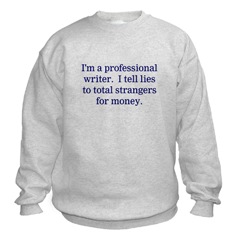
The folks at Viable Paradise (an annual writing workshop for the sci fi crowd) have some great sweatshirts to sell. This one (you can get it through their Cafe Press shop) is my favorite.

If you remembering being a teenager or if you have a kid who is a teenager, you'll be able to come up with examples how how details are crucial to making a fiction work.

Father: And why are you two hours over your curfew?

Son: Um, the dog ate my homework.

This kid may grow up to be a surgeon or a musician, but he's probably not going to write novels for a living.

Father: What's this note from the school that you were an hour late?

Son: Well, cripes, dad, if you had to drive through the city when half the traffic lights were out, you'd be more than an hour late getting where you need to be. Talk about crazy, old ladies driving their El Dorados down the sidewalk and cops screaming at cab drivers. The only people moving were the guys on motorcycles, which reminds me you said we could talk about that--

Father: never mind.

The real trick is learning to hit just the right details, the ones that give you crucial information about the character or the setting. And finally, a good detail does not necessarily entail adjectives or adverbs.

play nice

In addition to leaving a comment, you can now rate selected posts anonymously. If you see a Whaddaya Think box at the bottom of an entry you can use it to indicate how useful (or awful) you found a particular post to be. As the system is new, it will take a while for patterns to emerge. In the right hand column just below the "recent comments" section is a list of rated comments with more than three votes.

Now, I really do want to know which kinds of posts are of most interest, but if people start play the Amazon Reviewer Game with the ratings, then I'll just have to give up on the whole idea.

Amazon Reviewer Game: In theory, the reviews are meant to be there so potential readers can decide if the book is something they might like. Person A reads the book and posts a review. Five stars, high praise. Person B comes along. She's read the book too and hated it, but she's too lazy to write her own review. Instead, she decides to review the other reviews. She disagrees with the reader who liked the book, so in response to the question "was this review helpful?" she clicks NO. Comes back twenty times to do it again, just to make her point.

Really, Amazon should just give up and either take away the "Was this review helpful?" bit or add another one: "Did you agree with this review?"

Gosh, I had no idea I was so irritated by that flaw in the Amazon system, but there you see it: ire. I'm going to leave it to make the point that you should only vote once on a given post, okay? Unless you like the idea of me being cranky, which you might.

Rule 5: the Constancy of Change

Rule 5.

Somehow your characters must change.

There's a lovely quote in the OED: A ship is the crucible in which morals are put to the test (St.-Pierre's Stud. Nat. 1799), which I found when I was trying to solidify a thought I had about the relationship between the character and the story. So I'll twist this a little: The story is the crucible your character has to survive.


Melodramatic, eh? I'm trying to make a point, and so I hope you'll forgive me. The idea is this: the story you construct with and for the character is something that the character must endure and (usually) survive. The character on page one is not the same person on the last page -- or if she is, if she hasn't changed at all, your story is lacking something very basic.


Change can be small and subtle or very grand. Maybe after the battle with his daughter about the color of her hair Mr. Malone now understands that he's never really been happy as a sign painter; maybe George loses faith not only in the Mariners, but himself; maybe Rose goes on to make a life for herself without connections or money, because she knows now that this is possible; maybe a little girl has a sudden and unhappy understanding of what it means to be betrayed, and is shut off from ever trusting men; maybe Juanita decides to marry Ralph, full knowing that this is the wrong thing to do. Maybe John figures out that of all the things to strive for in life, perfection is the most overrated and least rewarding.

Change can be good or ambiguous or tragic, but change always is.

October 19, 2005

Rule 4: Power to the People

Rule 4.

A conflict only works if the two parties are truly equal in some way, have some kind of power over each other. It might not look on the surface to be the case, but they do. The power passes back and forth, and this is how tension is created and the reader's interest is kept.

One of the funniest and most instructive class discussions I remember from teaching had to do with the movie Notting Hill. Plot: A beautiful actress at the top of her game, an American, falls in and out of lust/love with a poor London bookseller.

One group of students thought the movie failed because there was no tension, and there was no tension because the bookseller was not as powerful as the actress. He had no way to hold her or influence her; what she wanted was what was going to happen. The other group disagreed, of course.

My take on this (not very good) movie is that there was a basic problem with the characterization and conflict, one that could have been remedied. In a well done story, a poor bookseller can be as powerful as an A list actress or the president of the United States. Just in the same way that a disabled elderly woman in a wheelchair can be as powerful as a thirty year old, healthy, strong, successful son. She may poke and prod and manipulate to get her way, or she may encourage and cheerlead and manipulate, or she may be in a coma and all her power is derived from the power of memory.

Emotional weapons provide more bang for the buck than any kind of wealth or power, at least when it comes to characterization.

October 18, 2005

how... sad. or funny.

I'm not sure why this makes me giggle.

Thomson-Gale publishes a reference work called Contemporary Authors. You'd find it in any university library and some public libraries, and you might use it if you were writing a term paper about, say, Hemingway. You'd also find it online, but it costs money.

I knew I had an entry in there because they asked me for basic information. I've never gone to look it up, but now it's been brought to my attention and as I said to start with, I'm finding it hard not to laugh.

Amazon is offering for your reading pleasure an html download of the Thomson-Gale biography on me. Three pages, 747 words (the arithmetic doesn't seem right, but you know me and numbers) for $2.30. For this you get:

Place and date of birth and death (if deceased)
here's a hint: I'm not.
Family members
you know about the husband, the daughter, and the puppy boys
Education
again: you know more about that than you probably want to
Professional associations and honors
who cares, really
Employment
I guess I have failed to disclose that my first job was selling clothes in the teen section at Goldblatt's on Lincoln Avenue, and that I worked as a nursing assistant while I was an undergrad.
Writings, including books and periodicals
painfully obvious
A description of the author's work
ha!
References to further readings about the author
like, this no-cost website?

For no cost at all there's a lot more information on this weblog and my various websites (if you go digging around) than this uninspired list of factoids would give you for your twobucksthirtycents. What does Thomson-Gale know about my love of KitKats? How about the story of how the husband got bit on the head by a bat or my contemplation on why nobody wonders why the three brothers in the Godfather look nothing alike, and why Mama Corleone is always smiling? And of course they have no access to the annual this-is-my-daughter's-birthday post, and I know how you all wait for that one. And I'll guarantee you this: they make no mention of the long series of posts on how to write sex scenes.

What I haven't given you in any explicit way is my birthdate. So I'll fix that. On January 14 I turn fifty.

Funny how writing that sentence gives me goose flesh. And not the good kind.

Tomorrow I'll post Rule 4, but in the meantime a question: are these things useful to you at all, or just boring? I'm thinking of adding a "rate this post" feature (which would be anonymous). As I can't hear you nodding off to sleep, this might give me a sense of when I've lost you.

October 17, 2005

Cheryll's second penny

Just below I've posted an example of how an editor might communicate with an author. Actually, this is drawn from a recent letter transmitting a first-round edit for author review. (Details have been changed to protect confidentiality.) This particular assignment was unusual because this author prefers red-pencil edits on actual paper. Most editing today is done electronically until the galley-proof stage. No matter the medium or how the comments are exchanged, however--or how the manuscript itself is eventually transmitted--it is true that the more "clean" the manuscript, the happier everyone will be. Including the author. And now to the excerpt:

"It is important to be mindful of consistency. In nonfiction, it is also important to stick to standard, accepted editorial conventions. A writer of fiction has considerably more leeway where, for example, spelling, grammar, and punctuation are concerned. In these cases, however, the author's choice must be applied consistently. This comforts the reader, for lack of a better term. It brings readers on board rather than throwing them over, and it enhances their ability to stay involved in the story as the author intends. Here are a few things you might want to consider:

· Spelling consistency: You'll see many notes from me about this. You might want to designate one dictionary (it can be an older one, used during the years when your story takes place) to establish your rules for terms and for spelling throughout the manuscript. This must be carefully handled, and the style sheet we've developed together will keep us on track. Its use will ensure that Superfortress, for example, always appears just so, and never as superfortress or Super fortress or super fortress.

· Compound adjectives: you will find several comments from me about these. In contemporary writing, the tendency is to 'close' compounds: 'moon-lit' has become 'moonlit,' for example. You tend to use the hyphenated form most frequently, and I think this is a good thing. It contributes to the old-time and slightly more formal tone that is perfectly aligned with the setting and your characters. But again, you should be consistent. This is where your own style guide for this novel will be helpful. If you use moon-lit once in a book or a story, you should always use moon-lit rather than moonlit in that same book or story. Where an adverb is involved, however--such as with 'wickedly pointed'--you might want to consider not using hyphens at all. But again, if you do--and you can; after all, you're the author--you should do so consistently.

· Commas: in the beginning of the manuscript, you use commas a little more liberally than you do later on. Again, modern usage calls for fewer commas, rather than more. However, you are the author and can do as you wish. It's my feeling that by using more, you retain the old-fashioned rhythm that serves your setting and characters well. But you must be consistent within the rules you decide on. One guideline? Read the sentence or paragraph or section aloud and see if it 'sounds like' something your characters would be comfortable with. Beware of mixing contemporary language with that from the 1940s--and for this book, you might want to choose the forms that are just slightly stilted. Your characters are from another culture--and one that is considerably more formal than ours, then or today.

· Novel-specific conventions: you will find notes regarding the Ph versus the F form of Raphael/Rafael; and other, more subtle conventions: Her Imperial Highness The Empress, for example (all words are capped, including The). Again, once you decide which form best suits your intent, you should always be consistent within the same novel or story.

Only a few times do you step out of your narrative stance as a neutral observer. I've marked those. I've also made a good many other marks, all intended to serve the integrity of your story and characters. I hope you find these useful and do not take offense."

So there you have it: the last of my two cents on this topic. My thanks for the opportunity to speak up about what it is that manuscript editors and copyeditors do.

Rule 3: Conflicts and the Happy Ending

The other things first: note that Cheryll dropped by yesterday and has some interesting things to say. My personal favorite:

the style and preference of the author must be respected. It is the editor's job to make the author's life easier. It is most definitely not the author's responsibility to make the editor's life easier.

This reminds me of something else. Once you get to the stage of pre-publication -- which means that you've bested the odds by finding an agent and selling your novel -- you have a distinct but seldom mentioned advantage. The publishing house is a business, looking to make a profit. If they could do that without authors -- without you -- they would. It would certainly increase their profit margins. But they can't do without good authors who have stories to tell. That's you. Everybody at that publishing house has a job that depends on you and people like you. So it's in their best interest to support you, and it's in your best interest to let them do their jobs.

end of homily

So the next of the seven rules:

Rule 3

Resolving Conflict does not (necessarily) mean a Happy Ending

A satisfying story will set up various conflicts, some large, some small, and then step by step it will move toward resolution, but resolution doesn't necessarily mean making every character happy and fixing everything that's wrong. Resolution can mean disaster, disappointment, resignation. It can mean that the bad guy gets what he wants and the good guy gets killed, though to pull that off successfully you have to have other things going on as well.

Not every question raised has to be answered. In fact, I personally prefer stories that leave me to figure some things out for myself. Joyce Carol Oates' short story "Where are you going, where have you been?" is a classic specifically because it doesn't answer questions, and leaves the reader in a state of uncertainty. It would have been a far less powerful story if it had ended with a one paragraph police report that tells us exactly what happened to Connie.

Finally, let's say this straight out: there is nothing wrong with a happy resolution. I am a huge fan of Jane Austen, and Jane Austen wrote happily ever after stories. In this day and age the literati tend to sneer at anything that doesn't fall within the culture of ugly, but that's a fad like any other, and it will, eventually, pass (and then, eventually, come back again). One of my favorite all time novels, A.S. Byatt's Possession, plays it both ways, and beautifully. There are two sets of major characters -- one in the Victorian era, one in the present day. For one of these sets of characters the endings are melancholy, even tragic; for the other, the resolutions are decidedly optimistic, even happy.

The story is done when you've resolved major conflicts while (1) staying true to the characters; and (2) leaving something for the reader to do.

I'll end this rule with a widely-told writer's joke.

Aspiring author comes into a publisher's office. He's carrying a huge manuscript wrapped in brown paper and tied with string. He staggers up the stairs and into the publisher's office and drops it to the floor with a thud.

The guy says, "Mr. Publisher, how long is your average novel?"

The publisher considers. "I'd say around 100,000 words."

"Oh good," says the guy. "I'm finished."


a penny from Cheryll: authors, editors, commas & such

I know authors and assigned editors sometimes have sniffy relationships; but when it works the way it's supposed to, the editing process serves authors and their works (and publishers) very well.

There is a huge difference among various editorial functions. These range from acquisitions editor (or executive editor or managing editor or senior editor) to developmental editor, manuscript editor, and copyeditor. There is an equally huge difference between categories--fiction or nonfiction--plus the many subgroups of these: novel form, short story, poetry; creative, academic, technical, to name but a few.

I speak here of manuscript editing, which is sometimes called copyediting--although many of us make a distinction between the two.

In all cases, manuscript editors (and/or copyeditors) should serve as helpmates to authors. An experienced editor does a great deal of hand-holding and is always deferential to the author. He or she takes on the responsibility for grappling with the hobgoblins that drive authors to distraction and put their muses to sleep or into a snit: everything from trade names (marking jello as Jell-O) and spelling (the tractor is a John Deere [not a John Deer]; "I believe you mean this to be the word discreet rather than the word discrete") to pointing out repetitive words and disjointed rhythm, to safeguarding consistency--characters' names, locations, time, season, and so on. The manuscript editor must protect the author's intent and the integrity of research--and make sure the manuscript complies in all ways with the house guidelines. Much of this has to do with the mechanics of language and veers off into format.

It is easy to see that there are different rules and approaches between, say, a historical novel and an academic text. But even within these subgroups, no single approach ever fits all.

Many authors resist being edited because they think--and sometimes this is based on unfortunate experience--that the editor will try to push them into places they don't want to go. Force them at pencil-point to use serial commas. Make them change the names of their characters. Revise their plot, misconstrue their findings, mess up the pace of their story. As a result, they submit manuscripts with snow falling in July, the maid Edna becoming the maid Emily in the tenth chapter, and the hero picking up a flashlight at noon. Perhaps the setting is the southern hemisphere, the maid has multiple personalities, and the hero must take action during a solar eclipse. If so, of course they should stand. If not, the editor must bring them to the author's attention. These sorts of errors (plus typos and unintentional grammar garbles) disconcert publishers; cause eruptions (and cost overruns) during the production phase; and, if allowed to slip through, annoy readers no end. Gadflies among them write letters posthaste.

You can glean from this how I react when I read of an editor waggling a finger in an author's face while insisting the author follow at all times in all respects The Chicago Manual of Style. If that editor will inspect her Chicago, she will find explicitly stated in section 2.56 (15th ed.) and implicitly stated throughout that the style and preference of the author must be respected. It is the editor's job to make the author's life easier. It is most definitely not the author's responsibility to make the editor's life easier. That would be like cleaning your house before the housekeeper arrives. If you have a housekeeper who comes in and shrieks, "Look at that dining room. What a mess you've made of it! And look how you've dirtied your bathtub!" then you have the wrong housekeeper.

This is one of my two cents on this topic. The second I'll post tomorrow.

October 16, 2005

Rule 2: Conflict Rules

Rule 2

At the heart of any satisfying story there is at least one conflict

Good, balanced, healthy people in happy situations are sweet, but boring. You want to be related to them, but you do not want them populating the only novel you've got to keep you busy on an eight hour flight. They do not make interesting fiction.

In a good story there are usually multiple conflicts on multiple levels, some small and some larger. Conflicts are most usually between people but sometimes the primary conflict is within the main character. A person can be in conflict with an addiction, with a horse, a town, a mountain, a river. A town can be in confict with a governor; a child with a teacher; a mailman with a cat. In any of these conflicts, one character (say, the cat) can be symbolic of an internal conflict (Jeremy hates being a mailman and wants to quit, but his wife would leave him if he loses another job; and there's the fucking cat who terrorizes him every morning of his life).

A complex story will have major characters with internal conflicts that harmonize with the conflicts that arise between them. I'm writing a novel about a woman who is agoraphobic who is attracted to a man who is a recovered claustrophobic. It's like two stormfronts running into each other.

Often writers or film makers will take something out of the news that has caught the attention and interest of the nation and build a story around it. The Titanic is the obvious example here. You've got a big ship, it goes down. If you want to tell that story yet again, you've got to find a new focal point, new characters with a new conflict that you can use to prop up the framework of the ship going down.
Even the blandest of storytelling depends on conflict. Think of Ozzie and Harriet or any of the television shows from the 50s and 60s that are based on the mythology of the perfect middle American family. Nice people with jobs and houses and cars and well adjusted kids. On the surface, no story at all, so the writers had to come up, week by week, with a conflict that would allow them to move the characters around the set. Andy lies to Aunt Bee and tells her how much he loves her awful home made pickles, so she enters them in the State Fair, sure she's going to bring home the blue ribbon. There's a big formal dinner party to go to and Laura gets her toe stuck in the bathtub faucet. These are small conflicts that can be used to explore (in a superficial way) the relationship between the characters, and make the viewers laugh, all in a half hour.

But you could, if you felt like it, twist one of these well known settings into something new, darker, more complex. Ozzie's granddaughter is playing in the attic one day and discovers and old trunk, and inside the trunk, wrapped in quilts, is the mummified body of a six month old child. Suddenly the perfect American family is interesting in a new way. Or, Harriet decides she likes her neighbor Milly more than she likes Ozzie. Or she doesn't want to be married anymore and instead would like to run a tavern.

If you study a particular piece of fiction or film and want to find the bones, look for the conflicts and the way they work together to provide structure.

October 15, 2005

Rule 1: Function before Form

I have these basic seven rules that I use as a departure point when I'm teaching creative writing. I thought I had posted them here, but nope. So I'm going to give you one at a time. None of these are reality-altering statements, and all of them have been well established elsewhere, many times. This is just my take on the basics of solid storytelling, riffs on things you have heard before, if you've made any attempt to study the theory behind the art.

Rule 1.

Any satisfying story has three basic elements: conflict, crisis and resolution. This is true of stories on a screen or stage or on a page.

Notes:

I use the word satisfying in this particular sense: a satisfying story is one the reader finishes. Whether or not she likes it in the end, the reader was curious enough to stick with it until it was done. If she put it down after two chapters because she was bored, didn't like the characters, was irritated by the voice -- then that story was not satisfactory in the most basic way. So this is my lowest passing grade for any piece of storytelling.


And of course, satisfying is -- like everything else in art -- subjective.


Experimental fiction may play with voice and structure and do without conflict or crisis or resolution, and it may do those things successfully. But think of this: Picasso mastered the principals of perspective and drawing before he went on to abstraction.

October 14, 2005

introducing Cheryll

I have a close friend here in town who is a professional editor and writer, and was one of my beta readers for Tied to the Tracks, which means I trust her instincts and value her opinion. Beyond the scribbling connection, Cheryll and I have other interests in common, from dogs, kids, cooking and gardening (she keeps a weblog called dig it) to reading. Cheryll is one of the women I ambushed into reading the entire Niccolo Rising series with me, and now she's busily spreading the Dunnett word.

Cheryll and I have had many discussions about the relationship between writers and editors of various kinds, sometimes as a result of something I've posted here about my own experiences. I thought it would be interesting if she came by to present her thoughts on the issues I've raised. I would guess we'll get into some debate, because that's what Cheryll and I do, and at least part of the reason we get along so well. I expect also that you might have questions for her, which you'll be able to post and she'll answer as time permits. So look for her post sometime this weekend or early next week.

I still love Steve Almond

Way back in November of 2003 I made a public declaration of love for Steve Almond. Okay, so he has a girlfriend and I'm happily married and if he's thirty or younger, he could be my kid, but I still like the guy, a lot.

Then I read Candy Freak, and my affection for the guy doubled. Because like is drawn to like, and Steve has a case of the special edition dark chocolate Kit Kats hidden away in a secret location. I will admit that I went to every gas station in a five mile radius trying to find the even more elusive mint Kit Kat, so I could buy out the entire stock -- but without success. And in case you're think we are just sugar addicts, there's a lot more going on here. Read the book, you'll start to understand.

Then something odd happened. You know how you may have a cousin or good friend from growing up that you somehow lose track of? I lost track of Steve's website for a while, but I don't think that will happen again. Not after The blogger who loathed me, an essay he wrote for Salon. I tried to make some of the same points when I decided it wasn't worth my time to read The Elegant Variation, but he does a much better job.

October 13, 2005

more confusion, but this time I fear...

it has to do with socialization particular to gender.

There are things that don't stick in my head. I can look them up a hundred times (I have looked them up a hundred times) and I still don't remember a day later if a corporal is higher or lower than a sergeant, or what a philips screwdriver looks like. These are things completely within my sphere of intelligence, of course. I could, if I really wanted to, remember this kind of thing. Just as my husband could remember, if he really wanted to, how to make a roux or sew on a button. But we are the products of our upbringing, and in some areas at least, we don't fight against those divisions of labor.

However. Given the kind of stories I write, I have to concern myself with these kinds of details. The same way Preston and Childs should have done the basic legwork to figure out that lace isn't embroidered, I have to be careful that I don't mix up the fact that a company is led by a captain (in the U.S. army) and a brigade by a colonel. Facts like that are easy enough to figure out. I have a book I use a lot called The Order of Things, by Barbara Ann Kipfer.

Except. There's always an except, I know, but bear with me: Except for the fact that reference works like The Order of Things seldom take a historical perspective. I need to know about how ranks were ordered for the militia in 1814. Can I use the current day army system? Probably it's not going to be right in the details. Can I overlook that probability? I have to make myself, sometimes. It's easy to get so lost in the research that a day is spent on a really insignificant detail. Such as this:

War of 1812, Battle of New Orleans (or really, battles, from December 1814 through January 1815): approximately 350 men in the prestigious uniformed militia (company?) under Major Plauche, divided into four distinct (units? platoons?) under Captains. Each with its own very fancy uniform. These were the sons of the first families, dressing up to go to war. One of my characters is in the Hulans, as one of those four (units? platoons?) was called. And what exactly does THAT word mean? What's a Hulan? Pardon me while I go query the OED and a couple other research sites... okay.

Hulan is a variant of Uhlan, "A special type of cavalryman or lancer in various European armies (originally in Slavonic countries, esp. Poland; subsequently spec. in the German Empire)". (OED)

So, I'm wondering, why would a Francophone militia (unit? company?) headed by a native Frenchman in a fancy uniform call themselves after an originally Polish type of (unit? company?). They had another name too, Dragons a Pied, or Dragoons on Foot, which makes me laugh. I keep misreading it as Dragons on Foot, and I see a line of big ole dragons drudging down the road in army boots. Also from the OED, on the term dragoon:

A species of cavalry soldier. The name was originally applied to mounted infantry armed with the firearm (sense 1). These gradually developed into horse soldiers, and the term is now merely a name for certain regiments of cavalry which historically represent the ancient dragoons, and retain some distinctive features of dress, etc.


 In France, the edict of Louis XIV, 25 July 1665, ranked dragoons among infantry, and this was their status until 1784. In Montecuculi's time, a1688, they still ordinarily fought on foot, though sometimes firing from horseback; when Simes wrote, 1768, they mostly fought on horseback, though still occasionally on foot. The French règlement of 1 Jan. 1791, confirmed by the décret of 21 Feb. 1793, classed them among horse soldiers, after the cavalry proper. In the British Army, the Cavalry are now (1896) divided into Life Guards, Horse Guards, Dragoon Guards, Dragoons, Hussars, and Lancers. Earlier classifications made the Hussars and Lancers subdivisions of the Dragoons. (See quot. 1836.) In the U.S. army the term is not used.

Clearly the New Orleans uniformed militia companies didn't consult the OED, because they did call themselves Dragoons.

I think you've got an idea how this all snowballs. I hope you're suitably appalled. I'm going to go try to do some more writing, and not worry about Hulans and Dragoons for the moment.

October 12, 2005

I'm so confused

I'm not good with numbers, let's start with that basic fact. Call it a mental block or a black hole or whatever you like: I'm easily confused by anything numerical. Ask my accountant, he has some hilarious stories, I'm sure. And yes, my husband is a mathematician. Math isn't about numbers, you know. It's about ... other things. That I also don't get.

So having established that, let's look at Paperback Writer's post on writing speeds and how to break the 10k barrier. There's a lot to comment on here, but I'll try to stick to a few major points.

1. 10K

Is this a measurement that other people are comfortable with? Because, let me admit it: it means nothing to me. Nothing.

Edited to add: I see I must clarify. I know that K=three zeros, so 10K = 10,000 but what I don't know is, 10,000 what? Characters, sentences, paragraphs, or is this the size of the computer file? Erin sez (in the comments) that Paperback Writer means 10,000 words. Which is a huge number. Huge. Is that really what PW means? Let's assume Erin is right, and PW is talking about finding ways to write more than 10,000 words a day . To which I say this: if I could write 10,000 words a day, I could write 100,000 words in ten days, which would be a whole novel, and then I'd have 355 days a year to play. That would be nice. Impossible, but nice.

I judge my progress by word count, because that seems to me the basic building block, more reliable than sentences or pages (which all depend on font and size and other things that can be fiddled). So I know, for example, that when I started working this morning I had 133,000 words in the file I'm working on, and when I finished, there were 137,716 words. Which means (my calculator tells me) that I wrote 4,716 words today. Which for me is a GREAT day. Fantastic. Is this anywhere near 10K? I have no idea. Is that important? This leads me to the next point.


2. Paperback Writer is an established novelist with a large following and lots of good advice. Here's some of what she says about this topic of speed:


Everyone has a speed at which they feel they can write comfortably. It may be writing a page in a week, a day, an hour, or ten minutes -- we'll call it your personal speed zone. Your zone probably fluctuates according to your mood, your work environment, your energy level and your current health situation. If any of these are in flux, so is your zone, but if you've established a set time and place to write, and you're in good physical and emotional shape, then you've already got a fairly stable zone.

If you're writing steadily while you're in the zone, and doing nothing else but writing, then you're probably at a good speed for you. The more books you write, the more confident you'll become, and that confidence will help you build your pace a bit more. On the other hand, if you're not writing steadily, then you haven't found your zone yet. There are other things getting between you and the page, and you need to get rid of them.

[...] Focus is everything. The more I wrote, the faster I became.

To establish my departure point: I do not equate speed (fast or slow) with quality of writing, genre, or anything else. Clear on that? Also, I agree that everybody has their own rhythm and speed at which they write comfortably. I also acknowledge that especially for people who write full time and have to produce in order to eat, discussions of how to increase your speed may be necessary. I'm having to face this issue myself, as I'm shifting from big fat historicals (250,000 - 300,000 words) to contemporaries (100,000 words). It took me two years to write one of the former, and if I want to stay in the business, I'm going to have to start writing one of the latter every year.

So sure, if you've got ideas to share on how to write in a more concentrated, faster, more efficient way, I'm willing to listen. But I also know that there's a huge difference between theory and practice, and no matter how sensible your advice, it's probably not going to work for me. Because, I'm not you. My writing metabolism is different from yours.

Is this an excuse? I really don't think so. Some artists can produce masterful work in days, others need years for the same size canvas. If you're standing in front of a painting in the museum, you have no idea which category it belongs in, fast or slow. For writing the same applies. Sometimes a chapter comes fast, sometimes it comes slow. And here's something else I know for sure: in my case, at least, it does not get easier as I go along. I've got five novels in print, two forthcoming, and every time, each and every time is harder than the last. It never gets easier. That's me, and I know other authors who would say the same.

That's just my two cents, of course. I hope for your sake things do start to get easier as you go along, but then I'd also give you my standard line: hope for the best, prepare for the worst.

It occurs to me, reading this over, that I don't know what Paperback Writer considers an average length for a novel. 70,000 words? 100,000 words? If I add up all my novels in print I've got more than a million words out there. If a novel is on average 100,000 words, that's the equivalent of ten novels, written over a ten year period. So I have been writing a book a year, looking at it this way. More than that, I've been writing historicals that require a huge amount of research and background work. So I'm going to give myself an extra two books: twelve novels over the past ten years. Then there's the fact that for five of those years I was also publishing in academia, books and articles both. And teaching. So that's another three books credit. Fifteen books in ten years. Arithmetic, according to me.

There. I'm feeling better now.
October 11, 2005

!?@?!poor@!#$ English

oh, no. When I posted about the construction probably may not be (which I ran into in The Wall Street Journal) I somehow misrepresented my concerns.

Let me clarify.

I didn't call this construction bad or poor English. I would never, ever do that. I am by training a linguist, and linguists take language as it exists. Spoken language (specifically excluding written language here) is a living, growing, mutating thing that can't be nailed down. It will change, no matter how many grammar books may be written or laws passed. You can codify written language, but spoken language? Nope. Cannot be done.

So I ran into a construction which surprised me, because I had never seen it before. That doesn't make the construction bad English.

There are hundreds and hundreds of varieties of English over space, and each of them is distinct from the next in a lot of different ways. To priviledge one variant above another is a social call, and has nothing to do with the viability of the language construction itself. Let me point out, if you're really interested in this topic, that the standard college text on issues of language standards, ideology and discrimination was written -- well, by me, back in the days when I was still a full time academic. You can probably find a library copy, if you're really keen to know more.

English with an Accent: Language, Ideology, and Discrimination in the United States

Routledge
ISBN: 0415114772

In summary: If it turns out that probably may not be is a new spoken language construction that's popping up (which seems to be the case), then so be it. My first reaction was surprise, not disapproval. Now I'm just curious about its genesis and the way it functions.

October 10, 2005

writing clubs

HelenKay has been talking about writing clubs, which makes me want to jump up and move to Manhattan or someplace where such things exist.

I have a great big house. I have a study in my house, and a studio. The desk in the study is piled high with stuff I'm supposed to file but probably never will; the studio is worse. Far worse. Fabric and paint and every conceivable bit of stuff you need to do textile art (basically, everything). But even if they were absolutely neat, these rooms, I couldn't write in them.

Very rarely, when my muse is feeling generous, she allows some writing here. Mostly she shuts me down with a snap of her fingers. Mostly I find everything in the world to do but work when I'm at home. So I go to Starbucks, where the internet connection is expensive but ten times faster than my home internet connection. (We live in the boonies. Satellite instead of cable, no DSL, and thus an anciently slow ISDN connection). In Starbucks I have a corner table that I claim with a plug so I don't have to think about my laptop battery. At Starbucks I can usually write with great concentration for long periods of time.

But Starbucks isn't perfect for one big reason: the puppy boys have to stay at home. I hate leaving them for more than three hours, so that puts a crimp in my work rhythms. They spend a day every week running like crazy with their friend Sherri, and I spend the whole time at Starbucks.

So you see my problem. I need a Writing Club. Someplace where I could have a corner to setup my laptop, an internet connection, and my dogs could sleep on the floor near my feet while I work.

I can hear you saying that I should just go out and rent an office and you know what? I would love to. An office downtown, I'd go to work there everyday and write pages and pages. But offices cost a considerable amount of money --$350 a month is the very least I'd end up spending -- and it's just not in the budget for the foreseeable future. So a Writing Club sounds great, but the problem is, there isn't one where I live and the idea of getting one organized and running -- that gets filed under Procrastination Projects.

I love the idea, I just can't see how to make it happen with a reasonable amount of time and energy.

More on research/internet stuff after I've fed my people. And the puppy boys.

PS. I admit without hesitation that my good friend Suzanne is absolutely right when she calls me a spoiled space glutton. Actually she calls me a spoiled space whore, but lovingly. You shouldn't get the wrong idea.

October 9, 2005

cool library link & off topic stuff

thanks to the ever vigilant and radiant Robyn Bender for a link to the British Library, where they are always thinking up interesting ways to use the internet to bring their incredible holdings right to your computer screen. You'll do better with it if you have a fairly fast internet connection.

Also from Robyn, somebody who really knows how to top a wedding cake. When we got married, lo those many years ago, I was so anxious about the terrible cake toppers available to us that I finally decided not to have one at all. Instead I scandalized both cake decorator and florist in that small English town by providing drawings of the floral arrangements I wanted to put on the cake. That kind of thing hadn't made it to England in 1988, and they resisted. But I did get my way, in the end.

Still, I would have preferred something like this couple, courtesy of the guy who does the amazing pumpkins.

three in the morning, and other odds and ends

Generally my take on writer's block is simple. If you're stuck, you're trying to force the story in the wrong direction. This time it took me three days to figure that out, three days of inching forward against huge resistance from the characters and the story itself. Trying to figure out what was wrong, how I could fix it, how such a great scene could fall so flat.

Three in the morning, I woke up and realized that I was committing the great sin, the pushing-the-story-where-it-doesn't-want-to-go sin. Just as soon as that thought came to me, the floodgates opened and now I know what to do. Starting with deleting the scene which I like, but doesn't work right here, right now. Sometimes you have to do that, and it's hard. Generally I take such bits and pieces and stick them in a file called bitsnpieces, which I check once in a while to see if there's anything I can use.

In this particular case I'm going to have to do some drastic POV finagling, but I think it will work.

On a different matter entirely, this sentence from The Wall Street Journal:

And the perpetrator probably may not be a stranger.

Does this strike you as odd? probably may not strikes me as so odd that it took me a moment to parse it. I would expect to read probably is not OR may be, but not this unholy union of modal verb with adverb, that doesn't work for me -- and by that I mean, it doesn't strike me as something a native speaker of English would say or use. Is this a new construction that's making the rounds? If you've seen it in other places, please provide examples.

more soon.

October 6, 2005

resolved

Paperback Writer's cats have a list of new year's resolutions. My dogs, Tuck and Bunny, also have an ongoing list which they regularly revise and present to me. Here is the current version.

1. We will stop raiding the laundry for dirty underwear and then galloping through the house dragging it behind us, no matter how deliciously peoplish it might smell.

2. If unwashed human underwear should appear by magic on one of our beds, we will not tear it apart while we are luxuriating in its scenty goodness. Nor will we play tug of war with it.

3. Should underwear somehow get torn apart in spite of our best intentions, we will not hide it under the couch and then retrieve it when the house is full of guests.

4. We acknowledge that it is rude of us to sit and stare when the people are eating Meat. If the people will likewise acknowledge that it's rude of them to eat Meat without sharing it with us, we will try to stop.

5. No matter how intriguing the smells from the neighbor's stable or how tempting the bits and pieces we find there, we will bring no souvenirs home to share. This includes hoof pairings and dried horse pats, although we want to state for the record that we believe these delicacies to be an acquired taste, if only our people would make an effort.

6. As it is so distressing to the mom, we will stop absconding with the tissue box and systematically distributing shredded tissues over the entire house.

7. We will not monopolize the couch or the good pillows on the bed. If we forget about this resolution, we will not slink away looking abused and unloved when our people remind us.

8. When out walking and competing with each other to be the first to mark every bush, rock and tree, we will not get carried away and pee on each other as well.

9. When the nice people in local shops offer us nasty old dried out bargain basement dog treats, we will not pee on those, either.


10. We resolve not to fornicate
with the George W. Bush voodoo doll
unless our people are present
to enjoy the performance.

October 5, 2005

completely off topic

My agent had a baby, a little girl. Mom and daughter and dad, too: all doing very well.

I generally don't have the patience for traditional quilting, but I made an effort in this case. You can see the completed quilt; a detail (before actual quilting) and/or a close up (also before the quilting) here.

Or not.

this awkward construction

That construction I mentioned in yesterday's post: pink-tinted nails? In half hour I found five examples in six novels, and they all have to do with color. I'm sure I've seen this construction about things other than color, but this is what I've got right now:

pink-tinted nails
wine-tinted fingertips
scarlet-painted mouth

This construction strikes me as terribly awkward and self conscious, even coy. You want to tell the reader what color something is? You've got two (reasonable) choices: straightforward

one pink nail tapped impatiently on the table top
his mouth was shockingly scarlet

metaphor

a nail as pink and sharp as a claw
a mouth like a slashed heart

If you run into examples of this construction, please do post them in the comments. If you write such constructions, I'd like to respectfully suggest that you rethink your approach.

Heads Up

Things aren't looking so great for the audiobook drawing. Here's an idea, see what you think:

If there aren't enough entries by mid November, I'll go ahead and draw a name. That person will get a box from me with various signed books, at least one unabridged audiobook, and other bits and pieces.

How does this sound? Email me with your thoughts: [email protected]

October 4, 2005

more of same

What I forgot:

7. I've thought of an alternate to the current sign-up scheme for the drawing that doesn't involve postcards, stamps and snail mail. I'll post about that tomorrow.

8. Over the last few weeks I've pinpointed a syntactical construction which bugs the hell out of me, and that I find mostly in romance novels. I love good romance, you realize, so this is in no way a condemnation of the genre as a whole, but it is a matter of some concern. To be brief (I'll go into more length tomorrow), there's a tendency toward this type of description:

her pink-tinted nails

Note the formula:

ARTICLE (possessive, definite or indefinite) +
ADJECTIVAL CONSTRUCTION (adjective + past participle) +
NOUN

There are some variations on this pattern. I'll look at them in greater detail, with examples, and maybe we can found some kind of support group for authors who have been seduced into this addictive habit.

catching up

I'm here, things have just been nuts over the last few days. Stuff, in no particular order:

1. the daughter is still okay as far as the car accident is concerned. Still haven't heard from the estimator about the car. We are braced for bad news on that front, as we are for a big jump in our insurance premiums.

2. the daughter is still okay, but: I may have to throttle her because, (1) she's sixteen and she sometimes seems to be actually hoping to be throttled (for example: less than twelve hours after she drove her car into a guardrail, she asked with all seriousness to borrow my car), and (2) why disappoint her?

3. don't worry, I'm still in possession of my basic good instincts. just barely.

4. to all those kind people who have been encouraging me to watch Firefly: I would. I really want to, but our DVD rental place doesn't carry Firefly. The clerks don't seem to know why, and they also seem to be sincerely sorry. They are all Firefly fans themselves. So I have to figure out where I can rent Firefly, and then I will watch it. I promise.

5. In the meantime, I'm watching Lost on dvd. We are all watching Lost because close friends finally browbeat us into it, and now we can't stop. Because as much as I hate to admit it, it's good. Although I wish the writers hadn't gone in the ooooh-what's-that-big-scary-monster-in-the-forest direction. And, polar bears? There's enough good material without polar bears.

6. To Beth, who wants to hear details about the huge number of novels I'm reading lately due to insomnia: sorry. I don't feel easy giving a list of titles under the heading: Didn't Work. Because, you know, that doesn't do you or the author or me any good. I may review one or two of the stinky ones at length if I see any greater good possibilities. I can mention the novels that worked for me: I've just read all but the most recent of Preston and Childs' Inspector Pendergast series, which I like a lot. That's actually very surprising, because this is the first time I've liked any Sherlock-Holmes-esque type story. Pendergast has got my attention. I liked Cabinet of Curiosities best so far and Still Life with Crows least (in fact, I didn't like Still Life with Crows at all; more on that another time. And yes, I realize I just did what I said I wasn't going to do. It has been a rough few days; cut me a break).

Also, read two books by Susan Donovan, one I liked (Public Displays of Affection) and one I did not. Same goes for David Morrell. In his case, I really liked Creepers, and really did not like another one of his titles that was so very different in tone and approach I had trouble believing it was by the same guy.

What else? I should be out getting the garden cleaned up for the winter, but of course: I'm not. There's tons of business type stuff to take care of, but ditto: not. Sleeping through the night: not. What I am doing: writing pretty well. Making good progress on Queen of Swords and feeling the first pangs of guilt about not making quicker progress on Pajama Jones.

So that's me at the moment. More writerly stuff soon.