
« personality tests | Main | Category Seven »
storyworkings
Thus far, I'm not spending any money, but I am reviewing questions that haunt me on a regular basis. canaafrica.org this resource
If you read a lot, you'll know that there are a million novels out there. The publishing business may be in trouble, but that doesn't stop them from putting hundreds and hundreds of new novels out every year. More than anybody could possibly read. I read across genres because I'm always interested in a good story, and because it's of professional interest to me, seeing what's out there, what publishers take a chance on and how the public responds.
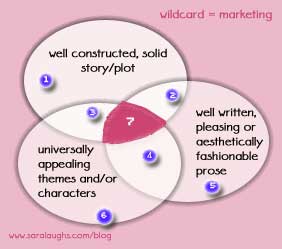 So of these four books I've read in a few days, I would have to say that three were very disappointing, in spite of a variety of reviews from critical venues and individuals who gave them high praise. This led me to try, yet again, to work out the very subjective issue of what makes a novel work (critically and commercially) and what factors contribute to a novel's success. I came up with this chart, which may not survive a lot of close observation and thought, but it is a start.
I've said before, I'll say again: a book can be a huge commercial success even if it is (a) poorly written (in terms of prose) and (b) the plot is fraught with difficulties -- category (6) on the chart -- if the topic and themes somehow resonate with the book buying public. The DaVinci Code is the obvious example here, in my opinion (and of course, this is a subjective process). Other candidates for (6) might include The Bridges of Madison County and ... I'm sure you can come up with some. Novels that tickle the zeitgeist and then, through word of mouth and/or marketing, really take off.
More commonly, a big seller will fall into category (3), I think. A good storyteller with a good theme is the darling of the masses even if his or her prose is ham handed. Many people don't care about a well turned sentence or a strong visual image or poetic language. The story is the thing. The story is the first, and for some, the only thing, which means that books that fall into category (1) -- great story, blah theme, blah writing -- still have a good chance of doing well.
My sense is that for the general public, the importance of the three critical areas: story, theme, writing, is ranked pretty much in that exact order. They want a great story; they'd prefer it to be about something that interests them to start with (a good love story, a good spy story, a controversial story about famous characters). Well written prose is frosting on the cake, and not much missed. Which means that novels that fall into categories (1) and (6) have a good chance of succeeding commercially (given the right marketing); but a novel that falls into category (5) -- one that has beautiful writing going for it, but little else -- is rarely going anywhere in terms of sales. The critics may love it (character is all; plot is a four letter word -- that crowd) but the critics have never been very good at predicting what the readers really want.
Of course, a well written novel that has a great plot is in good shape, as is a well written novel with a theme that interests the public. The ultimate, of course, is category (7): a beautifully written novel with a solid, engaging story that is thematically interesting. That's the holy grail of novel writing. That's the novel that will make the critics sing hosanas, and even Bob will go out and buy the darn thing in hard cover.
There are not many books that fall into category (7). I can name a few that might qualify, but certainly there would be a debate about any title I propose. Person X might not think much of the prose; Person Y might find the plot flawed. But anybody who reads widely will have a list of such books according to their own tastes and evaluations. Here's one possiblity: To Kill a Mockingbird. This is a story that is still popular, because, I believe, it's a solid, three legged stool, almost impossible to upset.
What's disturbing and mystifying is how many hundreds of novels out there stand not on two legs, but on one. Novels that make it into print with half a hackneyed plot, two dimensional characters and awful prose because they are well timed in terms of theme, and play into publisher x's burning urge to get on a particular bandwagon.
Of course, I have no solutions to offer. The publishing business is in deep trouble, we're told, and who knows what's down the road? Editors clinging to books that fall into categories (1) (3) and (6), almost certainly. Which is depressing, and sad, and sobering for anybody who makes a living writing stories. Like me.
January 26, 2005 04:46 PM
Trackback Pings
TrackBack URL for this entry:
http://www.tiedtothetracks.com/cgi-bin/mt/mt-t.cgi/317
Comments
OK Sara,
Which 4 books? I'll get back to later about this subject and my method of searching for the good novel. Very interesting.
Cynthia in Florida
Posted by: Cynthia at January 27, 2005 08:00 AM