
« voila | Main | the mistress of procrastination »
Shadowbrook -- Beverly Swerling**
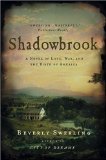 I don't review every novel I read, and I especially don't review novels just to be negative. There's nothing to be gained in setting out to bash somebody else's work, not for me, or you, or them. If I do decide to post about a novel that doesn't work for me, the reason is usually that I see a bigger issue I'd like to address. This time, in talking about Swerling's Shadowbrook, the issue has to do with historical fiction more generally.
The thing about historical fiction that makes it so challening is quite simple. You've got to do a lot of extra work, in terms of research, and then there's the challenge of shifting your mindset. It's not easy to write from the POV of a character whose life and times are so very different from your own. So first, that acknolwedgement. This novel, which encompasses most of the French and Indian War as its backdrop, was an ambitious undertaking.
I went and read other reviews of Shadowbrook after I had finished it, which were all pretty positive and very complimentary about the quality of the research that went into the work. Which brings me to the other, primary challenge that goes along with historical fiction. Here it is: you can't lose track of the fact that this is a story you're telling. First a story, then a history. A novelist who lets him or herself forget this is bound for trouble, and I think Shadowbrook is an example of such a novel.
Swerling tries to cover pretty much all of the French and Indian war, fit in every major character and institution and battle. In order to do that she has to spread her two main characters really thin. She's got them jumping from Louisiana to Manhattan to Quebec to the Adirondacks with little apparent effort.
The two major characters (Quentin Hale and Cormac Shea) are young men connected to white slave holding society (in one direction) and various Indian tribes (in the other), which positions them to cover many aspects of the war, but not all of them. The third main character, the young woman called Nicole, feels as though she was constructed completely to fill a void in this net Swerling casts over the entire continent. Nicole, half French, half English, is on her way to join a convent in Quebec when she finds herself traveling with Quentin and Cormac. Without Nicole Swerling wouldn't have a way to bring in French Catholic sensibilities. At the same time Nicole provides a vague, underdone love interest for Quent. He loves her; she loves him but mon Dieu, she's made a promise to God.
Nicole's role is to bring various priests, mostly Jesuits, into the picture. Which is important if you're determined to tell the whole story of the this particular war, because the Catholic church played a major role.
Once Nicole is in Quebec she ends up playing a role in the communication between Montcalm and other major historical characters -- something that requires some plot finagling, because she's cloistered among the very strict Saint Clares. At any rate, that setup keeps her busy while Quent is running from battle to battle, and trying to save his father's patent, a huge tract of land called Shadowbrook, populated by Quent's evil elder brother and a lot of slaves, all the better to examine that aspect of the war, of course.
And then there's the second-string love story, which also feels manufactured primarily so the author could fit in the story of the Acadians being expelled from Canada by the English. Cormac Shea falls in love with a young woman in that community and then, determined to find her when she's expelled, goes to Louisiana. Let me point out one of the linguistic... infelicities... which bugged me the most: why would Native Americans in Canada be dreaming about alligators? And if they did, how would they know that such creatures were even called alligators? Beyond that observation, I'm not going to address the matter of historical research directly, because some of what I would have to say comes down to a matter of difference in interpretation.
Thus you've got characters who are being moved around like puppets to fulfil the author's need to get the historical facts, as she interprets them, onto the page. The result is a story without a lot of dramatic tension, and certainly without character development. The characters change as historical circumstance dictates. Which is unfortunate, because I think there was a great deal of potential in quite a few of them.
All in all, this novel felt too broad and unfocused to me, diluted to the point where it was hard to maintain interest in the characters at all. And of course, as always: this is my take, alone.
April 5, 2005 01:24 PM
Trackback Pings
TrackBack URL for this entry:
http://www.tiedtothetracks.com/cgi-bin/mt/mt-t.cgi/398
Comments
Interesting review. It reminds me that I found a book you reviewed on your previous webpage. My interest was piqued but I've now forgotten the title and author. It was historical fiction, set in London, Ontario, I think? The review was very positive. You wouldn't happen to know what book this was, would you? (This is probably not enough information.)
Posted by: Jorie at April 5, 2005 04:26 PM
AHA!
Just this very weekend I picked up this book at our local bookstore. It was only after I'd picked up the book that I noticed the store card review which said something to the effect that if you had enjoyed "Into the Wilderness" by Sara Donati, you would enjoy this too. So I read the blurb on the back cover and then thought to myself "Did this person actually read either book?" From the back cover I just got the sense that it would be extremely difficult to get a satisfying read from everything that was supposed to be fitted into the novel. There just seemed to be so many facts and characters spread over such a time and area.
It basically felt like I had just read a list of historical events and fictional characters and the writer had set herself the challenge of working them all into one story. (No offence to the writer - maybe she should have had less detail on the back cover and I would at least have opened the book).
Even a few days later, I was still asking myself what really made me put the book down and move on to something else. And I still don't know.
The other thing that came to mind about historical fiction is it's nice to have that trust/reassurance that what you are reading is researched and factually/historically correct, but on the other hand, that doesn't need to be bigger than the story. I hope you understand what I mean - it's always nicer when the story comes first and the facts are factual (!) rather than having lots of facts which someone has tried to fit a story around.
Posted by: Alison at April 5, 2005 06:11 PM
Jorie -- that might be Bride of the Wilderness by McCarry. You can get a list of all the novels reviewed on this blog and the old one by clicking on reviews: fiction in the archives list to the right.
Posted by: sara at April 5, 2005 07:16 PM
Yes, that's it! Thanks!
(Went through list. Race of Scorpions may be my favorite Niccolo so far, though I still have to read Gemini. Everyone seems to discuss Lymond and no one discusses Niccolo. Although I won't do a serious search until I finish the last book.)
Posted by: Jorie at April 5, 2005 07:45 PM
I found that an author putting in too much history is like the author who is too attached to a character's backstory. He/she might be thinking that it ( the info) is soooo interesting he just has to put it in without realizing that it slows down the story in more ways than one (lack off focus, too much detail, etc...)
I, too, put down Shadowbrook without reading it for that very reason. It seemed to be all over the place. Sara's books use the history as a backdrop for the stories she is telling, as opposed to letting the history "be" the stories. Thus, in my opinion, they offer more compelling and interesting reading adventures.
Posted by: Catherine at April 6, 2005 12:34 PM
Another similar trap into which historical fiction writers can fall is the desire to fit in anything they found interesting in their research, SOMEWHERE. Especially on re-reads, this sort of thing, when badly done, can become glaringly obvious. A certain author whom I enjoy to a degree, and to whom Sara is *ahem* frequently compared, started to employ this tactic in her second or third novel and it's only gotten worse, IMO. Whereas, if Sara plugs stuff in just because she finds it interesting and thought we would too, I haven't noticed any episodes of it yet. ;)
Posted by: Rachel at April 8, 2005 12:35 PM
I loved City of Dreams. Therefore I was eexcited when Shadowbrook came out. I did have to put the book down and then come back to it. I had to think too much in the beginning. But, once the characters' relationships to the events became clear, I thought the novel moved right along. I was satisfied at the end of the book.
Posted by: Diane at August 17, 2005 06:46 AM