" /> storytelling: July 2006 Archives

take me to the front page of the tttt weblog | back to the current weblog

« June 2006 | Main | August 2006 »

July 31, 2006

PJ experiment

You know I'm trying to keep my nose to the proverbial grindstone so I haven't been as consistent as usual in posting to the weblog. But here's something small that might be of interest: another Pajama Jones excerpt, which you'll find below the jump. This time I've also provided a PDF document. Seems to me pretty much everybody has to be able to read PDFs these days. Anytime you have to download a form to fill out, for example.

It's a very small document; you can download it to read and then delete it, if you like. Otherwise you can just read it here. And if you have an opinion on what's more convenient when it comes to excerpts, please let me know. I have been thinking of making PDFs of a few of my published short stories available here, if anybody's interested.

And I hope you like Trixie and Big Dove, they are two of my favorite characters.

download the pdf

Excerpt from Pajama Jones
forthcoming 2007, Putnam Books
copyright Rosina Lippi
All Rights Reserved
Do not duplicate in whole or part without express written permission from the author.

[In this scene, John Dodge has just recently relocated to Greenbriar, South Carolina. He is taking some new acquaintances to lunch: two elderly women (Trixie and Big Dove) and Bean, a ten year old girl. Greenbriar is the new North American headquarters of Kallsjö, a Swedish car manufacturer.]


The four of them piled into Dodge's car and drove across town to Moe's.
"Look there," Bean said. "A help wanted sign in the bank window."
"In't that pretty? Thank you Jesus." Big Dove ran it all together into two words: intthatpretty (breath) thankyajesus.
"Things really are picking up," said Trixie. And: "What are all those folks doing passing out fliers? Is the circus coming to town?"
"The circus ain't been to Greenbriar since Hector was a pup," said Big Dove.
"Hector?" said Bean.
"It's the Swedes, I'll bet," Big Dove said. "Look there, they got a sign up already on the old Larrabee building. There's no moss growing on those Callie-Joe folks, that is for sure."
"Ma'am?" said Bean. "It's not Callie-Joe, it's caaals-yeeeew." She leaned forward to touch Big Dove's shoulder. "Those two little dots? You say that eeeew."
"In't that what I said, sugar?"
"No ma'am. You said Callie-Joe. Sounds like some old country woman setting on a porch husking corn."
Dodge laughed at the image, but Big Dove just sniffed.
"Well this mouth of mine is too old to be wrapping itself around Swedish, and that's the truth."
"Now what are all those cars?" Trixie said. She craned her head to look as Dodge eased into a parking spot.
"They look brand new," Bean said. "Pretty colors."
"No moss on those Swedes, no sirreee," Big Dove said. "They're moving right on in, dragging better times along behind them."
Once on the sidewalk outside the diner a kid came up and handed them fliers, bright yellow and green.
"Josie's youngest, ain't you?" Trixie said as she took hers. And: "Give your mama and daddy my love, don't forget now."
Big Dove was holding out her flier at arm's length and squinting. "I forgot my specs. What's it say?"
Dodge scanned the flier. "Monday morning nine o'clock they're going to start to take applications for the first round of hiring. Office workers and housekeeping but mostly construction. Unionized."
"Now that is exciting," Trixie said. "They'll be lining up come sunrise, you wait and see."
It took them ten minutes to get settled in a booth, mostly because Big Dove and Trixie had to exchange a few words with everybody from Moe himself to the old men who sat over coffee at the counter. Bean dove right into the menu, her face alight with pleasure.
Dodge said, "I am hungry enough to order one of everything. How about you?"
"This child could out-eat a football team all by her lonesome," Dove said, sliding into the booth next to Bean.
"Our Bean has got a hollow leg," agreed Trixie. Dodge got up to let her in next to him.
"Mama says I'm growin," Bean said, looking a little uncertain.
"You'll need a big lunch then," Dodge said, and Trixie winked at him.
The waitress was Big Dove's second cousin once removed, a quick, lean middle aged woman with a poof of bright red hair over coal black eyebrows. She managed to take their orders while answering questions about her daddy's kidney stones and whether or not he was going to come down and fill out an application on Monday morning along with the rest of Greenbriar.
"Billie, you tell your daddy to stop by and see me when he comes into town."
"He'll be there," Billie said. "You'd think it was Christmas, as excited as he is about going back to work." She looked across the street at the row of new cars. "Those Swedish cars look like toys, don't they? Something the kiddies would drive around in a circle at the fair."
Then she was gone and Trixie leaned across the table and grasped Dodge by the wrist.
She said, "I'm just an old confused lady who only got through the tenth grade, so I'll ask you straight out to explain something to me. Why have they got all those cars lined up like that?"
Dodge caught Bean's expression, which was slightly panicked. She said, "I think they're cute."
"A car in't supposed to be cute," Big Dove said. "My daddy, he drove a Ford. Wouldn't even look at no other kind of truck." She cast an easy glance out the window. "Them little cars won't be much use out in the county. Those clay roads turn to muck and misery in the rainy season, you need something with some muscle."
"What I was wondering," Trixie went on, "is why bother hauling those little foreign cars all the way down here to Greenbriar? It don't make sense."
Big Dove said, "Maybe they're just for show."
"That must be it," Trixie said. "A curiosity to look at, like a calf born with two heads. They couldn't mean to build those foreign cars here." She huffed an uneasy laugh and looked directly at Dodge.
They were all looking at him, the two old ladies with a certain hope, and Bean with some degree of sympathy. He cleared his throat, and managed a smile. "That model is called the Freya. From what I understand they do plan to build that very car here at the Greenbriar plant."
Trixie's mouth fell open and then shut with a snap. She looked out the window and back at Dodge. "Son," she said. "You must be confused. Those cars are foreign. Last I looked, Greenbriar South Carolina was American."
Big Dove reached over the table and poked Dodge with a forefinger. "You're joshing us."
"No ma'am," Dodge said. "I'm serious."
Trixie and Big Dove looked at each other. Bean looked at her lap. Dodge looked around for help, but there was none to be found.
"I thought they were going to build Fords or maybe Chryslers," Big Dove said. "Olds-mobiles, even. You've must have got it wrong."
They were looking at him sternly, waiting for him to justify his absurd contention that the Kallsjö company would dare to build an assembly plant in which to manufacturer Kallsjö cars. Laughter, Dodge told himself, would be a mistake.
He said, "Things are pretty complicated these days when it comes to cars. If you went out and bought a Buick—"
"That's a fine American car," said Trixie. "My Uncle Henry had a Buick."
"Most Buicks are made in Canada these days."
Trixie reared back. "No."
"Yes ma'am, it's true. My sister drives a Mazda. You know where that was built?"
"What is Italy!" Dove hollered, and slapped the table with the palm of her hand.
"Shush," said Trixie. "This ain't Jeopardy we're playing at, Dove. Dodge, those Mazda automobiles are made in Italy, en't that so?"
"Well no," Dodge said. "Mazda is Japanese."
Big Dove's whole forehead creased itself in half. "Doesn't sound Japanese to me. Sounds Eyetalian."
Trixie said, "Like mazda ball soup."
"Matzo ball soup," Dodge said, trying very hard to keep his voice even, "is Jewish."
The two old ladies exchanged solemn looks that seemed to say they would graciously overlook such an absurd statement, just as they would pretend not to hear him if he passed gas. Trixie cleared her throat. "I never heard of a Jewish car," she said. "Is there such a thing?"
Dodge said, "I truly don't know."
"Well and why should you?" Big Dove said. "Now, Eyetalian cars. Those little convertibles, those really are cute."
"Alfa Romeos," said Trixie.
"Like Romeo and Juliet?" Bean asked.
"Not like Romeo and Juliet," said Dodge. He was starting to enjoy himself. "It's RoMAYo, not ROMeo."
"Either way, it's Eyetalian," said Big Dove.
"Yes," Dodge said. "The Alfa Romeo is an Italian car. But if I can get back to my original point, Mazda manufactures their cars in Japan."
"So they are Japanese," Big Dove said. "Doesn't anybody remember Pearl Harbor anymore?"
"Wait," Dodge said. "It's complicated. Mazda is an American owned company that makes its cars in Japan. So is my sister's car American or Japanese?"
Trixie smiled nervously. "Dodge, sugar, you're not making any sense. Are you claiming that Americans go to Japan to build cars, and Swedes come here to do the same thing?"
"Yes ma'am," Dodge said.
Trixie's small mouth pursed. "That's just foolish. Musical chairs for grownups. Why would they bother?"
"That's a question I can't answer," Dodge said.
Bean caught sight of something across the street and sat up straight. "Miss Trixie, here come a whole crowd of the Kallsjö people. Why don't we ask them?"
Dodge had never been so glad to see Swedes in his life.

July 28, 2006

free stuff

Just a reminder. If you'd like an autographed page from the second pass Queen of Swords proof, it's not too hard to request one. Details are here.

I have one more Queen of Swords ARC to give away, which I will do by drawing a name from the people who have signed up and participate on the forum. That drawing will take place late in August. More details on the process here. I will send the ARC anywhere in the world, so don't hesitate to jump in if you are interested.

In late September I expect I'll get the first copies of the actual novel, and then I'll give away a couple of those, signed first editions. Those drawings will also have to do with the forum, but I'll vary the rules to give more people a chance.

And sooner or later there will be another Box o' Books giveaway.

So you're probably wondering why I'm giving all this stuff away. The catholic school girl in me feels it's important to point out that this is not some selfless altruistic gesture on my part. It's got something to do with making readers happy, sure. If you're happy more books will sell, and then I can write more books, and thus it goes. With any luck.

July 27, 2006

world building, inventing language, setting the scene. cha cha cha

Sci-Fi authors talk a lot about world building. You can take workshops in how to everything together, including such complex things as topography and climate and creating a language. This idea always makes me smile. I'm sure the people who take creating a language seriously have put a lot of time and effort into setting up a way to do this, but crickey. What a task.

How far can the native English speaker get from the structure of English? (or Turkish from Turkish, or Japanese from Japanese?) Without extensive study of languages with very different phonologies and syntax, most of these invented languages have to be very English (or whatever language the author speaks) like. Even with my training, I don't think I could easily create a fictional language that uses tone (for example) as a primary phonological feature. Or infixes in the morphology (you know how we stick things on the front and back of words? Some languages stick things in the middle. Lots of complex little morphemes tucked in there, little things with big important meanings that you can't do without). Or has a complex honorific system, such as Thai. An adolescent girl in Thailand ends every sentence with an honorific that means (very loosely) me-little-rat. Adults end sentences with honorifics that shift with the setting, the relationship between the people in the conversation, the topic, the mood, and gender (and in Thai there are more than two genders to worry about). If you're setting up a language for a world in another galaxy, do you try to work some of these kinds of features in, or do you stick with English sentence structure and just change the vocabulary? One seems too hard, the other too lazy. Do these creatures see color? Do they have fewer or more senses than we do? How do you create a vocabulary for a sense that is next to impossible to even imagine?

Where was I? I didn't mean to run off on the topic of language invention, really. I wanted to say something about world building.

It seems to me that world building is one of the more engaging and fun things for a sci-fi author to do. Figure out basic biology (three sexes? four? none? mutable? reproduction is handled how? love, yes or no? birth how? death when?) and social structures, economies, all that stuff. It sounds like so much fun I wonder how they get anything written.

Here's the thing, though. Every author has a world to build, on one level or another. Even an author who sets all her novels in the same city -- the place where she was born and still lives -- has some inventing to do. A community of fictional people, where they live and work, how they relate to each other. The places they hang out may be real or made up. It all has to work together, the fictional with the factual.

I love this part of writing. It's like a complicated puzzle, setting up a fictional town, not just its geography and infrastructure, but its history, social and economic and everything else. The names of the streets, the number of schools, the business district. Most of this stuff won't make it into the novel, but these are the details that go through my head while I'm driving or in the garden or sewing.

Pajama Jones is set in a fictional town in South Carolina. A fictional town on a fictional river, plunked down exactly where I want them for reasons of plotting. I haven't changed the topography of that part of the state or the climate patterns, but everything else is mine. Last night I found myself wondering where the power plant and water treatment facility were. Is there a water tower? Almost certainly. On the web I found a water tower in a town in South Carolina constructed to look like a giant peach, with a single green leaf. From some angles it looks like a big rosy colored posterior, which apparently is still a contentious topic at town meetings, the big pink butt in everybody's line of sight. This is a wonderful detail but not one I could use, as Jenny Crusie did something similar with a water tower in Welcome to Temptation, except it was an accident that its paint job made it look like a giant ... lipstick. Can't play with the water tower, but I still want to know where it is. So I dragged out my maps (I draw lots of maps of my fictional places. Sometimes I draw individual buildings and floorplans. So I'm obsessive. This is a surprise?)

One of the basic plot points in this novel is that this small town has been economically depressed ever since the two largest businesses went bust, but is now on the upswing because of good urban renewal policies and the fact that a large Swedish car manufacturer has chosen it as the site for its North American headquarters and a state of the art assembly plant. Swedes in the deep south, that idea just appealed to me. Now, I can't use a real auto manufacturer (I doubt Volvo would appreciate it) but I can make up a fictional one, which is another kind of world building. When was this company founded? By whom? What are they best known for? Which models? What are they called? Who is the president of North American operations, and how important is s/he to the story? Is the invasion of the Swedes backstory/background or should it be up front and center? (the answer: not upfront, not center; just a n opportunity for some kinds of conflict and comparison).

At some time when I was first researching this book I did a search to see if Volvo had a North American plant and where it was. And it turned out that they thought about building one some years ago, and had even settled on a site, in Virginia. In a town called Greenbriar. But the whole thing fell apart when the economy went south and has never been revisited. I liked the name Greenbriar and so I started using it for my fictional town in South Carolina. I may still have to change it, as South Carolina is more a palmetto kind of place that a greenbriar kind of place, but I could spend days trying to settle on a name and I need to focus on moving the story along.

The real world building in this novel has to do with Lambert Square, which was once the site of the Lambert Printing Company, and which has been renovated into a complex of shops, community space and city offices. I spend a lot of time thinking about Lambert Square, what the shops are, who owns them, how those business people are related to each other (or not). How my main characters, both of whom own a shop there and are the only non-natives, fit in. Or don't.

So world building is a big part of writing, and for me one of the most interesting and challenging parts. Some authors do it all automatically and give it little thought; they probably write faster than I do. It's a risk, but I couldn't write without taking it.

Back to Greenbriar. Or whatever I end up calling it.

July 26, 2006

the (sad) skinny from bookseller chick

Bookseller Chick is somebody who really knows the bookstore biz, and here's what she has to say about the fate of many of good book:

You could have written an amazing (fill in the blank sub-genre) novel, but if the critics are just tired of reading them, if the public is just tired of the same derivative covers, if the marketing department just wasn’t on the ball, and if a bookseller didn’t read it on their off time and realize that this is obviously the hand-sell of the century, then your book could still sink away into oblivion. These days books have about six weeks to prove their worth before they’re yanked off the shelves, factor in some delayed reviews (or a lay-down date that got moved up), a slow to start word of mouth chain, and lack of up-front store time and your book could be off the shelves before anyone has realized it was there.

My heart sinks and my stomach cramps when I read this, because I know she's right. And I have a new book out there, and most likely this will be its fate. If I'm lucky it will resurrect with the publication of the mass market edition, but I would have to be very lucky.

This scenario is entirely what I expected to happen when Homestead was published, but in that case the booksellers jumped in and hand-sold, and then the PEN/Hemingway people called, and things took off. Totally unexpected, utterly wonderful and gratifying. But luck played a big part in that. The same scenario for the new book? Ultra unlikely.

So all of you who are writing novels, please be aware that luck and fate and all those unquantifiable market forces out there will have their way with your book. Which of course can also work in the other direction. Look at The DaVinci Code as the ultimate example.

July 25, 2006

A new Diana Norman novel

Not yet released, but it looks very promising. The Sparks Fly Upward is a kind of sequel to the Makepeace Burke novels, about her daughter Philippa. The cover blurb:

A new novel of love and courage in a time of war, from the author of A Catch of Consequence and Taking Liberties.

Few of those Philippa loves in London return her affection. Not the love of her life, who has a new bride. Not even her widowed mother, Makepeace Burke. So Philippa decides on a marriage of convenience to a prudish, if kind, man.

Across the Channel in France, the Reign of Terror is causing the beheading of thousands from the French nobility. Among those in danger is Philippa's friend, the Marquis de Condorcet. Not only has Philippa the means of rescuing him from the guillotine, she's got the courage. And as fate would have it, Philippa will find love where she least expects it-while staring death in the face.

Scheduled for release on September 5.

revision to the Queen of Swords cover


You know those mustard colored banners at the top and bottom of the QoS cover? They were meant to stand in for what would be gold foil, but in the meantime -- fuuugly.

Today my editor wrote to say that they were worried about the timing on the production of the cover, which is tight. If the gold foil turned out badly, there would be no time to fix it. So they changed the banners to a deep scarlet.

And I'm pleased. I like this. What do you think?

be still my heart

Over at LibraryThing they've launched the new groups feature. Anybody can set up a group for people with a common bookish interest, and anybody can join. There's a group discussion board, and group statistics, and all kinds of lovely geeky things to make my heart beat faster.

I just set up a new group called Romance, from Austen to Byatt to Crusie. All you need is a free LibraryThing account and you can hop on over there and join.

Can you see this as a challenge? As people are scrambling to set up groups and get members to join, the romance community could kick some butt. Some thriller-butt, some baseball-butt, some aviation-butt, even poetry and theology and numismatic butt.

the Mathematician cheers up

Last week the Mathematician's symptoms suddenly improved to a surprising degree. Almost pain free, and able to take reasonable short hikes. So yesterday the neurosurgeon postponed the surgery for two months.

Because he's getting better, and because he's almost certain to relapse. Eventually he'll need the surgery, but not just now.

So, good. For the moment.

July 23, 2006

we get off easy

The weather is almost always very moderate where we live. In the summer the hottest stretch is July-August (and it's also very dry, no rain at all, usually), but we're talking ninety degrees tops in the town. Out here in the county we're always five to ten degrees cooler. The winter is very mild, too. We had less than an inch of snow fall this past year. I was out in shirtsleeves in November and then in January without discomfort, for a short while at least. And again, for us it's usually five to ten degrees warmer in the winter than it is in town.

And I grew up in Chicago, where a hot and humid summer is a given. And I mean, humid. Ninety percent humidity wasn't all that unusual. When I was a kid, the only places that were airconditioned were taverns and the movie theater. Most of the time we made do with fans. I remember that once in a while, the heat made it hard to sleep. But mostly we coped just fine.

As I get older (and rounder) I'm less able to deal with the heat. It puts me to sleep. Sitting in the front room just now on the shady side of the house, the doors to the deck are open and there's a cool breeze and birdsong. No noise at all, beyond the birds. No road noise, no neighbor noise. Nothing. Oh wait, a small plane just flew over head. That shut up the birds for about five seconds.

/aside/ someday I have to find a bird watcher who is willing to come sit on my deck and tell me what I'm hearing. At least twenty different kinds of birds, including eagles -- we have a lot of eagles, so I do recognize that call /aside/.

I've been writing, but mostly I've been struggling not to fall asleep. It's hypnotic under any conditions, but the additional warmth is like an airborne narcotic, and I know that if I let myself I could drift off to sleep right here and doze away most of the day.

But I have to go back to South Carolina, where it's early October and my character is about to spill the beans.

July 21, 2006

Judy Judy Judy

...won the Queen of Swords ARC ARC ARC. Two more to give away, all you have to do is go sign up on the forum and leave at least one post.

Judy, please email with your mailing address.

Did you want to be in the drawing for the Queen of Swords ARC?

I'll be drawing a name tomorrow evening from the forum membership roster. It's not too late to throw your name in that hat. All you have to do is sign up and post at least one message.

The August ARC drawing will also be done through the forum.

Finally, there are a handful of people who have signed up for the forum but who haven't posted at all. If you're one of them, please be sure to get over there and speak up so you're in the drawing.

July 18, 2006

excerpt: Pajama Jones

I haven't posted anything from this novel in progress yet, and so now maybe it's time.

This is from the second chapter. John Dodge has come to Greenbriar, South Carolina, to overhaul a failing business he bought from the owner, who was retiring. He is in regular phone contact with his younger sister, who lives in Brooklyn.

Copyright me and only me; no duplication of any kind without express written permission.


At eleven Dodge took a chance and called his sister, and got his brother-in-law to start with.

"How're things down there in the Land of Dixie?"

"Interesting," Dodge said.

"Interesting good or interesting bad?"

"A little of both," Dodge said. "Why don't you come down here, bring the kids, have a look around. See what you think."

Tom was still laughing when Nora got on the line.

She said, "I don't see what's so funny, it's not like every vacation goes wrong." And: "So tell me."

"It's a wild place," he said. "Maybe I bit off more than I can chew this time."

"Hard to imagine," said Nora. "Give me the big picture."

Dodge thought for a minute. "Today I had something like ten unannounced visitors who just walked into the apartment. Most of them female."

"And what did all these people want from you?"

"Let's see," Dodge said. "Mrs. Tindell brought me supper, Big Dove Porter and Trixie Jameson made my bed and gave me decorating advice, Lyda Rose Guzman sent her husband over here to measure my windows to see if the curtains she has put away might fit, Marnie Lambert brought me a spider plant, I think she called it, and Hobart and Mae Oglesby from the Artists' Cooperative brought me a little hand woven Cherokee rug."

"As a gift?"

"As a gift. Hobart's mama wove it. Apparently his great grandma is clan mother, she lives up in Columbia. And of course everybody has advice, on everything from where to buy underwear to how to clean the bathtub. I lost track of the invitations after the first dozen or so, and I don't remember which ones I accepted. I'm pretty sure I turned down the personalized tour of the Greenbriar Money Museum."

Nora was giggling by the time he finished. She said, "You're making that up."

"You know Lambert Square used to be a printing plant, a family operation. Apparently the Lambert ancestor who built the place took up counterfitting as a hobby. Money from all over the world, circa 1830 They've got a little museum in the community hall. Right outside the room any local group can reserve for meetings. There's a list posted so you can take your choice. AA, the Pray for Peace Fellowship, a salsa dancing class and a meeting of the Elks.

"You did say you missed the south."

"Hey," Dodge said. "I do like the south. I like Greenbriar."

"Hmmmm," Nora said. Her therapist hum, Dodge called it.

"The one thing that's got me curious," he went on, "is the way everybody kept warning me away from one particular woman."

"Cocoon Widow?"

That gave Dodge a jolt, but then Nora had always picked up on things that he believed well and truly tucked away. The only defense was hide his surprise, though he would wonder for days what he had said to give her a heads up.

"Her name is Julia."

"Go on."

"Everybody goes out of their way to tell me that she doesn't need any more heartache and I should stay clear of her."

"And so you asked her out. Never one to back down from a challenge."

"--and she turned me down. So I took Link -- one of the employees I inherited from Cowper -- to dinner, and he tells me that Julia killed her husband. A mercy killing, according to him."

"Did she?"

"I have no idea," Dodge said. "And I don't think it would be a good idea to get wound up in this particular drama."

"But you're interested anyway."

Dodge thought of Julia sitting in that deep chair in her pink pajamas, the turn of her head, the tentative quality of her smile, and shook his head to dislodge the image before his sister could pluck it out of his head.

"I don't have to act on every urge."

"Dodge," said Nora, her tone both more serious and softer. "I'm going to repeat that back to you the next time you announce you're ready to move along."

There was a pause, and she said, "Tell me about the apartment."

"Big windows, high ceilings, a good view out over the town in two directions. I don't anticipate any problems."

"Hmmmmm," said Nora.

July 17, 2006

news-like items

Things are unsettled here still, and I'm often disoriented and distracted. But I wanted to get a few things down before I forgot.

1. Lots of people signed up on the forum, posting away madly in the hope of winning the Queen of Swords ARC. I'll be drawing the name on Friday, so get over there and say something if you're interested. Even if you don't care about the ARC, you might find something to interest you on the forum. There are lots of interesting conversations going on. I'm also thinking of posting the original, longer first chapter of Fire Along the Sky over there.

2. So far I've had about twenty-five letters (or postcards) from people who would like a page from the Queen of Swords galley proofs. I sent out a pile on Saturday and I'll send out another pile tomorrow. I'll open a thread on the forum where you can, if you like, indicate if you've received one of the pages and which page it is. It would be fun to see how much of the galley proof we can reconstruct. In a quirky, I'm the only one laughing way. If there's interest, I'll open another spoilerish thread for people to talk about the pages they've got and what they think is going on.

3. Still time to send me a SASE or postcard (I got a Farscape postcard today, now there's somebody who knows what makes me happy), and I'll send you a signed, dated page in return.

July 16, 2006

quote of the moment

The life that produces writing can't be written about. It is a life carried on without the knowledge even of the writer, below the mind's business and noise, in deep unlit shafts where phantom messengers struggle toward us, killing one another along the way; and when a few survivors break through to our attention they are received as blandly as waiters bringing more coffee.

from Old School, Tobias Wolff

July 15, 2006

nostalgia, via pop culture

Over at Strip Mining for Whimsy, Joshua just posted about Hill Street Blues, which you can now download from iTunes.

This ties into something that has been on my mind lately, and that is how one pop culture reference can trigger a whole avalanche of memories and associations. Hill Street Blues premiered on January 15, 1981 -- the day after my twenty-fifth birthday. I was three years into a very turbulent relationship with Not-the-Mathematician, an East Coast Italian (ECI), a charming, very tall (taller than Joshua, even), good looking guy with a terminal case of the runarounds. I had just moved back to Chicago from Boston. Urban Cowboy was playing in the theater down the street from my apartment. Reagan was president elect. John Lennon had been dead exactly one month. My associations around Hill Street Blues are not upbeat.

There are movies that have this same effect on me. Annie Hall is the ultimate example. It opened in April of 1977; I was twenty-one. I went to see Annie Hall with the ECI. I also saw Star Wars, Animal House, Saturday Night Fever, and a dozen other iconic movies with him within a few days of release. That list includes (cue the irony) Looking for Mr. Goodbar. I met the ECI in a disco on Rush Street. Not that the ECI was ever physically violent, please don't jump to that conclusion.

But of all those movies, Annie Hall is the one that resonants most clearly. Watching Annie Hall is like getting into a time machine. I remember Manhattan exactly as it was then, pretty true to the movie. I remember everything about that spring. The Ramones and Rod Stewart and Stevie Wonder on the radio. Some really cheesy music, even then it was clear it was cheesy. Torn Between Two Lovers, Feeling Like a Fool (kill me now); Don't Give up on Us Baby (make it quick); Barry Manilow was at the top of his form. So to speak.

What I didn't have: money. An answering machine (few people did). Any kind of computer (even fewer people), or the hope of ever having something like a computer. No VCRs, much less iTunes and downloads.

All this makes me feel not so much old as full. Chock full of memories. No more room, and I've got, what, thirty more years. Amazing, the elasticity of the human mind.

July 14, 2006

the reading, and the unsaid.

It all went well, lots of people who were kind enough to laugh at the right parts. I'm told that I pulled off the Georgia accent, though the one native Georgian who could have confirmed that couldn't make it.

Someone asked a question that I thought I should repeat here. She wanted to know why I hadn't been more explicit about a crucial event in the backstory. The two main characters had a very intense relationship five years earlier, over the course of a summer, and then broke up. But the reason for the breakup is never spelled out clearly. You get some of his thoughts on it, you get some of hers, and also her mother's take on the whole thing. There are also a lot of hints sprinkled here and there. But I never tied it all together, and why not?

This is a good question, one I get a lot and not just about this book. I like a novel in which some things are left for me to figure out on my own. I appreciate it when an author doesn't bam me over the head with answers to everything. This is something I strive for in my own work, and sometimes, I am very willing to acknowledge, with too much success. Not every reader is ready to invest that much energy in a story. They come away irritated rather than intrigued, the same way that my tendency toward a lot of characters is off putting to some readers.

So here's my take on this situation: my style is my own, and it won't work for every reader out there. There are authors I don't read because of specific stylistic or mechanical idiosycracies that rub me the wrong way. There are authors I adore for the same reasons.

Really what I wanted to say is, I step back from revealing too much in order to give the reader the chance to draw some conclusions on his or her own. Sometimes a reader will draw a conclusion that is -- not to put too fine a point on it -- not at all what I had in mind. Either because they read something into the hints that I hadn't intended (which is just fine, by the way), or for some other reason. But this is not me trying to fool or confuse or tease the reader. There's no sense of being sly or mysterious. I just like leaving some things unsaid.

I haven't been posting a lot because well, the Mathematician is still in spinal limbo, and I'm trying to write. However. If you have something specific you'd like to ask, or some topic you'd like me to address, please speak up in the comments. That kind of nudge will remind me to take some time to post here.

July 13, 2006

I really should have paid more attention

I did an email interview with a reporter from our local paper, which ran today as I am reading/signing at Village Books tonight.

The tone is a little more candid than I would have hoped for, because I answered the email questions in a hurry, as I remember now, sitting in the doctor's waiting room with the mathematician. It didn't occur to me (and it should have) that my answers might show up word for word.

Here's the link, if you care to have a look. As is always the case with newspaper links, it is free now but won't be in a week or so.

July 12, 2006

99 and counting

The forum went live on the last day of June, so it's been up almost two weeks. Today there are 99 registered users. That's including me, so we've got 98 people in the July drawing for the Queen of Swords ARC (assuming all 98 have posted at least once). Those same people will be in the August drawing and most probably future give-aways will be handled in the same way.

There are some good discussions going on, so please have a look if you're at all interested. Link above on the navigation bar, or to the right.

Also, I've got this other (admittedly a little odd) giveaway going on. You send me a SASE (or an interesting postcard, if for some reason a SASE is difficult), and I'll send you a page from the final galley proofs of Queen of Swords, signed and dated.

Rosina Lippi/Sara Donati
Post Office Box 4114
Bellingham WA 98227

I'll be doing this for about two weeks. And if you send a postcard, don't forget to include your mailing address.

Back to that sticky wicket of a scene.

July 11, 2006

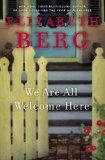
We are All Welcome Here - Elizabeth Berg

The author recorded the audio version of We are All Welcome Here herself, which is always a gamble. It mostly paid off. The only voice which didn't seem right to me was the first person narrator. She did a much better job with the secondary characters.

I've been thinking about this novel a lot. Domestic drama like this can easily sink into the melodramatic abyss. You've got a quadraplegic woman struggling to keep afloat financially; her husband left her when she came down with polio -- at nine months pregnant -- and the only help he offered was to get the baby adopted. A real peach of a guy.

The daughter (Diana) narrates. She's thirteen when the novel begins. Much of the story is about her relationship with her mother, with Peacie, the black woman who has cared for them both since Diana's birth, and Peacie's husband; with her best friend. It's about poverty and how weary it makes people. It's about the sixties, segregation, voting rights, racism. It's about Elvis Presley.

Berg is juggling a great deal, but mostly she pulls it off. I see two real flaws in this novel. The characterization of Diana's mother, who is a stereotypical wise and quietly suffering disabled person; she stays upbeat and positive in the worst of situations, never speaks out of anger or irritation, is constantly reading and ambitious for herself and her daughter's education.

She really is too good to be true. I kept waiting for her to scream at somebody. Just once. To say something small or thoughtless. There is one very small moment when she finally speaks her mind to a lazy and dishonest caregiver, but it's really not enough to rescue her from stereotype.

The other problem is the last chapter which wobbles precariously. My sense is that Berg wants to leave these characters in a good place, but a lot of very bad things have happened. So there's a bit of magic there, of the authorial kind. I can't say more without giving too much away, but I can say this: I was very moved by the last few scenes, though the whole time I was also aware of the heavy handed nature of the resolution. It still worked for me on some (sentimental) level.

There's nothing wrong with sentiment, with emotion, with happy endings. I'm just not sure about the way Berg produced them, in this instance.

July 10, 2006

the thing about mistakes

My observation is that people tend to repeat mistakes. Even recognizing the nature of the error and how it came to be, we jump right back into the same hole, at least some of the time.

Writer's block is usually about trying to force the story in the wrong direction. I have said this countless times in classrooms, and I have said it here. And still I realized today that I have been running in a circle for two weeks with a very difficult scene ... because I'm forcing something. Or trying to.

This scene is about character A getting some key information. I thought this would happen in a scene with character C, and in fact I have been rewriting that scene a dozen different ways. Every time I think, okay, good. That's it. And then the next day I read it and I groan.

And this is a crucial plot point, let me say that.

So today I realized that it wasn't working because character B is not part of this scene, and she's unhappy about that. Unhappy to the point of shutting things down. The question is, why I was trying to keep her out of the scene in the first place. What was going on in my head? It will be a challenge to get A and B through this scene, sure. But how ever difficult it is, it will be easier than the two weeks I just spent trying to make it work with the wrong characters.

If you've ever read Stephen King's The Stand (which is, I've heard somewhere, his most loved and widely read novel), you will remember an early scene where two survivors of a superflu epidemic have to walk out of Manhattan. There is no transportation and so they decide to try the Lincoln Tunnel rather than walking all the way up the island to one of the bridges.

The Lincoln Tunnel isn't much different than any other long bridge that goes under a river. It's fairly narrow, two lanes in each direction. At one point in my life I drove through it every day, twice. I often thought about the fact that the Hudson River was flowing over my head, but not with any kind of panic. My phobias are very different in nature.

But King's characters have to go through a very different version of the Lincoln Tunnel. There's no electricity, so it's dark once you get ten feet in. And it's full of cars, people trying to flee during the epidemic. And the cars are full of dead people. Mostly dead of the flu, but there were accidents and mayhem and basically what you've got is a mile of dark tunnel crammed with cars and corpses, and you've got to climb and crawl your way through it to the other side.

Now, if I had to do this with the Mathematician, I'd be fairly calm. He's been competing in orienteering events for years, he can fix nearly anything, and reason his way out of pretty much every puzzle or problem. I'd follow him into a cars-and-corpses tunnel, no problem. But King's characters aren't so prepared, and the trip through the tunnel is traumatic. To the extreme.

Sometimes when I approach a scene that is potentially difficult, i feel like I'm standing at the mouth of that cars-and-corpses tunnel, and there's no Mathematician -- nobody at all -- for company or companionship. I've got to get through it alone. Dog knows what hazards are waiting for me in there, but I can't just sit here, can I? So I forge ahead. And sometimes I hit a snag. A wreck I can't figure out how to climb over, a pile of bodies I just don't want to deal with. Sometimes i have to take a few steps back in order to find my way forward. And that's what I'm doing now.

How's that for a long, drawn out, and melodramatic take on writer's block?

I'll let you know how it goes.

July 9, 2006

GirlChild report

She arrived safely, was gathered up by cousin Tom without incident, and spent yesterday at a AAA baseball game out at the far end of Coney Island with various cousins. She likes everything about everything.

Oh and: she saw Elijah Wood on the subway. She wouldn't answer my question about the size of his feet.

July 8, 2006

any interest?

This odd idea came to me, I thought I'd run it by everybody and see what y'all think.

But first, ARC news:

You know that next Friday or so I'm going to draw a name from the roster of people who've signed up over at the forum (and who have posted, at least once). That person will get the Queen of Swords ARC. Toward the end of August I'll give away one more -- same deal, drawing a name from the roster of people who have registered on the forum. Except for the August drawing, you'll have one entry for every time you've posted. And by posted, I mean more than one word or a smiley. Some kind of substantive response, more than great forum! thanks! or I love these books or Go away or I shall taunt you again.

So by the end of the summer, I'll have given away two Queen of Swords ARCs.

But wait! There's more! If you act now... okay. Not right now. I'll be doing a signing/reading from Tied to the Tracks at Village Books on Thursday (July 13), 7:30 pm -- so if you're in striking distance of Bellingham, Washington, you might want to stop by. The first person to come up to me and say: I'm registered on your forum, and please could I have that Queen of Swords ARC? -- that person (if such a person comes forward) will get it.

So that's it, three copies and then no more ARCs to give away.

However (and here comes the odd idea): anybody like a page from the second pass proofs? Just one page per person, and I'll pull them at random. You may get an exciting page that gives a lot of the plot away, or a confusing page because it comes in the middle of a complicated twist, or a page from a sex scene. I'll sign and date it, too. Would y'all be interested in something like this? the idea came to me because I hate having to disappoint so many hopeful people over on the forum who won't get the ARC -- a little bit of a consolation prize. If enough people seem interested, this is what you'd have to do:

1. Send me a stamped, self-addressed envelope.

Rosina Lippi/Sara Donati
PO Box 4114
Bellingham WA 98227

EDITED TO ADD: Jacqui raised the question of people outside the US who can't send a SASE. So a change:

If you are out of the country, instead of an SASE you can send me an interesting postcard with your return address on it. In fact, I'll extend that to everybody inside or outside the US: either an SASE, or an interesting postcard with your return address.

I'm hoping I don't get 500 requests from down under, but I'll take the chance.

2. Agree not to post or otherwise make public the content of the page you get. The exception: I could set up a spoiler discussion on the forum.

3. Agree not to send a second SASE; one per reader.

I'll pull a page from the typeset manuscript, sign it, and send it back to you. I can't imagine I'd get more requests than I have pages, but if so, I'll post here to say the well has run dry.

So lemme know what you think. If it's too lame, speak up, please, so I can duck my head in embarrassment.

July 6, 2006

and she's off

Tomorrow the Girlchild is off to Manhattan for her month as an intern. It is past eleven at night, and she has yet to put one thing in her suitcase.

I refuse to panic. I refuse to get drawn into a discussion, much less an argument.

I am going to bed. When I get up at seven, I will reassess my position on panic, and arguments. Then we will get in the car and drive two hours to the Seattle airport.

I hope to post something about writing as soon as I've regained my normal calm and serene nature.

cough.

July 4, 2006

writing about matters medical

A post in the forum made me realize that I've never talked about this subject in any depth. And it's a big subject. Unless you happen to be a medical professional who also writes fiction, writing a storyline that involves injury or illness requires research and a delicate hand.

This is especially true when it comes to historical fiction.

In the Wilderness books, I've dealt with fatal and not so serious gunshot wounds, internal injuries, cancers, tuberculosis, surgical methods, early laboratory science, psychosis, smallpox, thyphoid, Addison's disease, rabies, nerve damage, liver failure, syphilis, and a streptococcus epidemic that swept through a village in the form of scarlet fever, strep throat, childbed fever and necrotizing fascitis.

I think everybody will be healthy in the next book.

If you want to write about these things as they were understood and treated two hundred years ago, there's really no shortcut and few easy sources of information. It took me a long time to track down an affordable copy of The seats and causes of diseases investigated by anatomy; in five books, containing a great variety of dissections, with remarks by Giovanni Battista Morgagni -- written in the mid 1700s, translated from Latin into English, and full of the most intriguing case studies. Then there's Thacher's The American new dispensatory With an appendix, containing an account of mineral waters. Medical prescriptions. The nature and medical uses of the gases. Medical electricity. Galvanism. An abridgment of Dr. Currie's Reports on the use of water. The cultivation of the poppy plant, and the method of preparing opium. And several useful tables. The whole compiled from the most approved authors, both European and American (1813). My copy looks as though it was submerged and then trampled by horses, but then it is legible and I paid $75 for a book that usually costs in excess of a thousand. Thacher and I have spent a lot of time together. He taught me about experimental methods for treating tuberculosis, and I passed them along to Richard Todd.

One of the primary storylines in Lake in the Clouds has to do with smallpox vaccination, and the whole idea for that came from a single line in a Manhattan newspaper in 1802, about the opening of a smallpox vaccination clinic based on Jenner's research and methods, and dedicated to administering to the poor. Wow, I thought. Perfect. Hannah's going to spend some time in Manhattan, learning how to vaccinate ... except I couldn't find details anywhere on the mechanics. I consulted doctors and librarians and multiple books on the history of medicine and smallpox, I read Jenner's original monograph, no luck with the details I needed. I finally had to hire a graduate student in American History, from NYU. I paid him to go into the city archives and dig up the original notes from the kine-pox clinic, the details of how the vaccinations were carried out.

And even then, there were some details that I had to extrapolate.

You can see that after so much work, the urge to use all the information would be pretty strong. But that's just the problem. You can't dump all that on the reader when you're writing a novel. It just won't fly. You have to tuck things in here and there, carefully. Which is why medical detail is often badly handled in historical novels. Either there's too little or inaccurate detail (not everybody is as obsessed as I am about research), which detracts from the story's ability to convince the reader, or there's too much. I have read historical novels which were (supposedly) about epidemics in certain times and places, in which the author completely glosses over anything specific about the disease in question beyond the more lurid details of that particular death. Doesn't work for me, not if the idea is to get me to the point where I feel as if I'm standing on a Paris street in 1760, or New Orleans in 1840.

In contemporary novels medical matters are both much easier and much more touchy. You can get the information you need about cancer treatments, orthopedic surgery, the Ebola virus, strokes and aphasia, sure. I have found that physicians are usually happy to help you maim or kill off a character, and they'll even tell you what goes into healing them, though with less enthusiasm. And of course, the more information you have, the more interesting you find the topic, the harder it is to achieve the necessary balance between detail and story.

I'll try to come up with a list of novels that handle medical matters well, see if I can provide some examples.

July 3, 2006

cover copy

Imagine you picked up a novel in the bookstore, and this was the cover copy:

Miss Zula Bragg, a literary legend and the most famous citizen of Ogilvie, Georgia, has finally said yes to a documentary about her rich, fascinating, and until now, intensely private life. The problem? The film company Miss Zula has chosen to come to traditional, deep-south, conservative Ogilivie is an unconventional operation ("with an edge") out of Hoboken, New Jersey.

Rivera Rosenblum, Tony Russo and Angie Mangiamele arrive ready to get to work, but soon find that it's not only Miss Zula's secrets that need to be brought into the light of day. Everybody in Ogilvie has a story to tell -- or hide -- including Angie. Who now finds herself against all expectations in daily contact with John Grant, chair of the English Department where Miss Zula still teaches.

Their summer romance was a long time ago, they are both reasonable adults, and John is about to marry the daughter of a prominent local family in what promises to be the wedding of the century.

What could possibly go right?

Intrigued? Repulsed? What parts work or don't work?

the forum is off to a great start


Forumbutton
Edited to add:
look for
/---this link
in the right hand column.

It may all go away once I draw the name of the person who gets the Queen of Swords ARC, or maybe things will take off. At this moment there are some interesting questions and discussions, so head over there and check it out if you have a moment.

July 2, 2006

back away from the metaphor

There are many words which are notoriously hard to define. Pornography is the obvious example, a word that stumped even a Supreme Court justice ("I know it when I see it").

Here's a word that I have trouble defining: corny. An online dictionary defines it:

dull and tiresome but with pretensions of significance or originality

I have been thinking about this because I recently finished a very disappointing novel by an author I usually like. I'm not going to name the book or the author, because that would get in the way of the point I want to make.

This author never met a metaphor or similie s/he didn't fall deeply in love with. His/her imagery is always packed full of comparisons. In this novel, I counted six in one short paragraph. Now, imagery is an important tool for any writer. There is great power in drawing an apt but unexpected comparison. The problem is that this author has lost perspective, and s/he's fallen head first into a big old vat of Corny.

Here's a paraphrase of the sentence that made me put down the book: "Heat rose off Max's skin in the shape of his soul."

Corny is the word that comes to mind, but when I look at this in relation to the definition quoted above, I see a logical gap. Because this isn't dull or tiresome. Worse. It's meant to be observant and profound, but it's just silly. Self-conscious and awkward are two other words that come to mind.

Everybody has a bad sentence now and then. I've got more than a few of my own, scattered through my books. My leaning is to be generous and overlook this kind of misstep, which I would have done here, if this sentence hadn't come near the end of a book riddled with an excess of images and metaphors. By the time I got to this one, my patience was at the breaking point.

So here's the bottom line. If you're writing about serious things and it's important to get the reader to empathize and identify with the emotions your characters are feeling, step back. Don't force images in delicate situations. Don't make the reader stop in mid sentence to contemplate, as in this case. What went through my mind:

What shape is a soul, anyway? And what shape is heat? Are they really similar in shape, given the fact that one is an abstract concept and the other a fact of physics? Is this character sweating his soul out, and if so, what does that say about him? Or maybe she doesn't mean soul. Maybe there's some other meaning of the word I'm unfamiliar with. Because I just can't see this soul-shaped heat thing he's got going on, unless maybe it's something like body odor. When you've been camping for a week, no showers, and the stink feels like an overcoat, that I understand. But this soul business.... where was I in this story, anyhow?

My advice: back away from the extraneous metaphor. The story you save may be your own.

Queen of Swords ARC

There's a new discussion forum, which may or may not take off. You know how that sort of thing is supposed to go: I ask you questions, you ask me and each other questions, a discussion gets started, maybe, in which Much is Revealed and Evidence is Brought Forth and Closets are Cleaned. Of course the forum may not thrive in the long run, but right now I'm using it to give away a QoS ARC.

You want to be included in the draw all you have to do is

1. Register on the forum (no personal information will ever go anywhere, for any reason).

2. Wait for the verification email that will come to the email address you provided, and click on the link in that email to complete your registration.

3. Pick a topic, any topic, and submit a short (or long, it's up to you) post.

After that you're can (1) bid the forum adios forever; (2) stick around and ask/answer questions; (3) lurk. In any case, you will be in the drawing.

July 1, 2006

putter, putter, sputter

I am finding it hard, this last week, to concentrate. Things I like to do, things I hate doing, and everything in between: I have a very short attention span.

Example: yesterday Thor and Penny called up and invited me to see The Devil Wears Prada. This was a lovely thing for them to do, as they know how hard things have been these last couple weeks and wanted to offer me some time off. The Mathematician was doing fine and wanted me to go, so I did.

And I hardly remember anything about the movie, except the bits where Meryl Streep teaches us all what it means to be an incredibly sharp tongued, quick thinking, abusive, self aggrandizing bitch with excellent fashion sense. Somewhere recently I read the sentence: it is harder to be kind than to be cruel. In which case, Meryl Streep's character doesn't like a challenge. I don't think these impressions are what the film maker was hoping for, but that's what I came away with.

At home I check email and various websites and weblogs and open Pajama Jones and read a bit and make a few changes and talk to myself about the scene I should get done today, and then in a bit I wander off to check something on the internet and I end up at eBay looking at vintage aprons, china saucers without cups, signed editions of books I wouldn't want under any circumstances, lawn furniture (we have no lawn), and contemplating the great variety of stuff available to American consumers.

Last night I made the mistake of going to look at the reader reviews of my books on Amazon. Of which there are many positive, even generous and expansive ones. But there are also negative reviews, mostly of two types: the straight forward not-for-me reviews, with or without argument; and the people who post reviews to get even with some real or imagined slight. Most often this second kind of reviewer is from the brigade of people whose responsibility it is to ride out and defend Diana Gabaldon from all usurpers to her throne. For example, a Ms. Piper who gave Fire Along the Sky one star and a review with the title: "This author's work is basically a rip off of another much better writer." Here's the whole thing for you to ponder along with me:

I have read her first three books and they were pretty good but very familiar. I think she tends to copy her style from another well known series writer. Her work has gotten progressively worse from book to book. Basically read Into the Wilderness and possibly Dawn on a Distant Shore but stop there. If you want a great series you can sink your teeth into, read Diana Gabaldon's Outlander series and Dorothy Dunnetts Lymond Chronicles, they are vastly superior.

You know, this might make me mad or depress me if I weren't so tired of the whole you're-not-Diana-so-die song and dance. I am very aware I'm not Diana, and I'm also not Dorothy Dunnett. I have no wish to be either of these women. Especially not Dorothy, as she died a few years ago and I'm hoping for another thirty or forty years.

It takes me about a minute to work through the claims this reviewer makes. Are my novels getting worse from book to book? Obviously that's a matter of opinion, and AmyLou believes they are. I don't. So we'll call that one a draw. Have I been copying my style from Diana and/or Dorothy Dunnett? Here I can say more definitely, no. The differences are so large and broad that anybody who has read the work of all three of us would not mistake one for the other. This is a claim I've heard before, though, so it's clearly something being bandied about and picked up. Anything I can do about it? Nope. Any use in challenging Ms. Piper to back up her claims? Absolutely not.

Then there is Kristin, a self proclaimed historical fiction junkie, who gives Fire Along the Sky five stars but gets in her licks anyway: "While lean on historical accuracies, this book delivers if you are looking for an entertaining story with some sexual tension and interesting characters. It is simply a very enjoyable read - nothing more. Just fun!"

First, I find this a little confusing. Did she skip the part where children died, where a whole village was laid waste? Where hearts were broken and families torn apart? Maybe her definition of fun is just different from mine. But oh, the rest of her slings and arrows really do have the potential to injure, as I pride myself on my research... but then pride cometh before the prat fall. Fortunately my tender sensibilities are soothed by the fact that Audiofile's review is also on the same page, and their take is very different: "Her lively, intelligent reading gives Donati's well-researched historical fiction the power it deserves."

Now you know what authors do when they are feeling vulnerable, out of sorts, and out of touch. We look for validation, and sometimes we are punished for our neediness by the casual (or not so casual) snarkiness of strangers.

The lessons to be taken from all this:

1. I know my own strengths and weaknesses. I can tell a story, I can write a sentence. I'm comfortable disregarding and disagreeing with Ms. Piper's assessment of the quality of my work.

2. Some people like my work, and some never will, and that's the way it goes. AmyLou doesn't like my stuff -- and her reasons, whether they make sense to me or not, whether they are logical or fair or not -- don't matter. She's entitled not to like my work, and she's entitled to tell other people that in her opinion, my work isn't worth reading.

3. The hard core Gabaldon Defense Riders have put me on their permanent search-and-destroy list and there's nothing to be done about it. Or maybe this will work, if I have it printed on the cover of all my books and tattooed on my forehead:

Diana Gabaldon is the premiere writer of her generation. The rest of us cannot hope to compete. If you have not read all her work, put the book I wrote down and go buy the full set of her novels, novellas, short stories, and reader guides. After that, in the unlikely event that you will ever need or want to read another author, you might come back to this lowly and inferior book for purposes of comparison alone. But I doubt it.

4. Finally: I have to find some way to block access to Amazon from my computer.