" /> storytelling: June 2006 Archives

take me to the front page of the tttt weblog | back to the current weblog

« May 2006 | Main | July 2006 »

June 30, 2006

book talk & ARC giveaways

A couple of people have asked me, here and by email, if I'm going to open up a discussion of Tied to the Tracks. That's something I'd love to do. Rachel has a very interesting review of TTTT on her weblog, in which she raises her discomfort with one of the themes of the novel. That would be an interesting conversation to have. So I've been thinking about how to handle this, as it's next to impossible to conduct any kind of real discussion on a weblog.

The problem: I'm not willing to set up a Google Group or a Yahoo Group or anybody else's group, for that matter. The solution: my service provider makes it laughably easy to set up a discussion forum right here. Took me all of fifteen minutes.

I've had mixed luck with discussion forums in the past, but I thought I'd give it one more try. So here's the deal:

You want to be included in the name draw for the Queen of Swords ARC, all you have to do is

1. Register on the forum (no personal information will ever go anywhere, for any reason).

2. Wait for the verification email that will come to the email address you provided, and click on the link in that email to complete your registration.

3. Pick a topic, any topic, and submit a short (or long, it's up to you) post.

After that you're free to shake the dust of the place from your heels forever. Or maybe you'd care to stick around and talk about books. Completely up to you.

I'll give this ten days, and then I'll pull a name.

And in the meantime, maybe we can get a discussion of Tied to the Tracks going.

you can't have everything

Sarandipity's comment to the last post made me thing of this movie quote:

I just met this wonderful new man. He's fictional, but you can't have everything.

big announcement: the sixth (and final) Wilderness novel

Wildernessnovel6Yesterday I signed the contracts for a new Wilderness novel, as yet untitled. Contract went into the mail and now I'm free to make the announcement.

One more novel, which I will start writing as soon as I finish Pajama Jones. The new novel will be set almost entirely in Paradise over the course of a summer, with all the Bonner family in attendance. The story will focus on Daniel and Gabriel in the first line, and Elizabeth and Nathaniel as well.

Good news, eh?

June 29, 2006

Diane's Books

Just ran across a very nice review of Tied to the Tracks at Diane's Books, which is located in Greenwich, Connecticut. TTTT is one of Diane's July picks, and here's what she had to say:

Angie Mangiamele, a documentary filmmaker from Hoboken, N.J., and her film company, Tied To The Tracks, land in small-town Oglivie, Ga., where everyone knows everyone and tradition reigns. Oglivie's own Miss Zula is a national literary icon and as Tied To The Tracks explores her life and is reluctantly allowed into this closed society, our willful Italian Angie stumbles onto an old love and Tied To The Tracks takes on a whole new meaning! Author Rosina Lippi (Homestead), who also writes under the name Sara Donati, winner of the 1999 Pen/Hemingway Award, knows this difficult craft of writing and I loved every moment, every funny, sexy, smart, thoughtful, clever moment. I predict Tied To The Tracks will be a new store favorite!

If you live in the vicinity and ever stop by Diane's, please say hey from me.

June 28, 2006

Librarything = greenery

I changed my username at LibraryThing from saralaughs to greenery. It didn't occur to me at the time I did so that there wouldn't be a way to find me, but apparently you'll get an error message if you go looking for saralaughs. Thanks to Stephanie for the headsup on that one.

Trying to write, sitting here in the family room with the Mathematician on the couch in an opiate haze. He had pretty much weaned himself off the hard core painkillers, but today he couldn't manage on ipuprofen alone. Last night Thor and Penny brought him Indian food, which he loves, and spend a few hours talking, which cheered us all up a lot. Friends. You just can't do without 'em.

Still waiting to hear from the surgeon's office about the surgery date.

On another front, the Girlchild is leaving a week from Friday to spend a month in Manhattan on an internship. She'll be staying with our beloved and infamous cousin Tom Vincent in Hoboken, and she is ecstatic. We are nervous but believe the following:

1. It will be an excellent learning experience for her. By which we mean primarily it will be great for her to have to get up and go to work every morning, stay at work all day, and come home in the evening tired.

2. It will be an excellent thing for us that we're not the ones getting her up every morning.

3. The whole experience will be a positive one for her and she'll come home (we hope) with a new understanding of what it means to work for a living.

4. She'll have a lot of fun hanging out with Tom and Jen when she's not working. Hopefully she'll have little opportunity to worry about the Mathematician and his surgery.

5. Absence makes the heart grow fonder.

Back to work.

PS. The poll is working, as far as I can tell. I'll let it run until the end of the week.

June 27, 2006

ARC giveaway: vote

Time to give away another Queen of Swords ARC. I'm not sure how best to do it, so I'm going to put up a poll, and you can vote on it.

UPDATE:

took the poll down, and will make an announcement re the giveaway tomorrow.

June 26, 2006

dov'e?

I'm here, but things are very... fraught. The Mathematician and the Girlchild are taking up a lot of my energy, and what's left over goes into trying to write.

But maybe tomorrow, something more substantive. I hope. Thanks for your patience.

June 23, 2006

noble savages

What really distinguishes humans from other animals is our fascination with ourselves. It's almost embarrassing to think about, if you look at it hard enough. We sit around thinking about how we think.

Conceptions of human nature and intelligence shift and reform themselves based on new trends in psychology, sociology, medicine, and anthropology. Often these views are encapsulated in the majors religions of a time and place. There have been various Christian sects that believed that an individual's eternal fate was predetermined, and that no amount of good works could offset what the person was born to be. In the mid 20th century there was a lot of debate about the mind as a blank slate, a child born with no innate traits or knowledge and totally molded by his or her environment. In the eighteenth century Rousseau popularized the notion of the noble savage, in which humans are good when they come into the world, and become corrupted by civilization.

The noble savage idea led to all kinds of literary mischief. In this continent we got Fenimore Cooper's idealized and romanticized Indians, while Defoe sat over in England dreaming up Friday, who is probably the best known example of the noble savage in 18th century storytelling.

He is also something of a Magical Negro, put there to provide for Robinson Crusoe.

The wikipedia article on the noble savage includes a list of attributes:


  • Living in harmony with Nature

  • Generosity, fidelity and selflessness

  • Innocence

  • Inability to lie

  • Physical health, disdain of luxury

  • Moral courage

  • "Natural" intelligence or innate, untutored wisdom

Which is reminiscent of the characteristics common to the Magical Negro in modern day storytelling, in print and on screen. So this is a long but positive yes to Lisa's question of a couple day's ago: it does look as if the concept of the noble savage is a precursor to the Magical Negro.
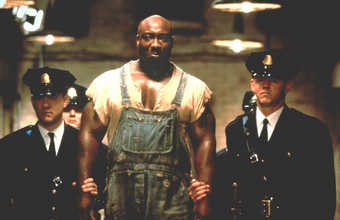
coffey
I wanted to look at two extreme examples of Magical Negros. And by that I mean, the Super Duper Magical Negro (to use Spike Lee's purposefully exaggerated term), and a more nuanced (but maybe just as negative) example, which is where Coffey of The Green Mile comes in.

If you haven't read The Green Mile or seen the movie version, you might be a little lost here. Also, there are spoilers.

The story is set in a prison in the rural South, circa 1935. Coffey is a very tall, very strongly build black man of indeterminate age. He's simple minded to the point that he remembers very little of his own history, he has no relatives and belongs to no community, he's empathetic and kind. He does indeed have a magical power, and that is if he touches someone, he can sense physical illness in them. He sees the illness, as though touch opens up the ability to look through flesh. He also sees something of a person's soul, the basic goodness or lack thereof. And finally, he can cure the illness he senses by drawing it out of the afflicted and into himself. He then expels it by opening his mouth and expelling what looks like a cloud of gnats that fades into nothingness.

Coffey has been convicted of raping and murdering two little girls, and he is brought to The Green Mile to wait for his execution. He seems to not fully understand the charges against himself, but he is docile as a prisoner, quiet and unassuming. He is brought in on a day when the head guard, a man called Paul, is in the grips of excruciating pain from a bladder infection. This is pre-antibiotics, remember, and a bladder infection could easily kill you. In the course of the story, Coffey cures Paul and performs other miracles, small and large. In the end he goes to his execution having taught Paul and the others a great deal about kindness and generosity and the nature of good and evil.

So sure, Magical Negro and/or Noble Savage. All the main markers are there. First question: could this story have worked as well if the main character were not black? Well, no. Because this is the deep south, and the year is 1935, and the blatant everyday fact of racism is crucial to the story. It's senseless to ask if there was any doubt of Coffey's guilt in the murders, because in that place, at that time, nobody would have paused to wonder. The circumstancial evidence (he is found crying over the bodies) is enough to send him to the electric chair; in fact, it's a miracle that he isn't strung up right then and there.

In many (but not all) cases, a Magical Negro character could easily be of another race. Friday could have been a French sailor stranded on the same island for twenty years, and perfectly suited to teaching Robinson Crusoe what he needed to survive. In all the current day movies, the Magical Negro role could easily have been taken by somebody of another race. But in The Green Mile, race is a central theme.

But John Coffey does depart from the stereotypical MN, and in a big way. Magical Negros are supposedly selfless, kind and gentle of spirit. They do not inflict harm; it is their role to teach. Revenge is not on the list of characteristics common to Magical Negros.

In this story, Paul sees Coffey for the gentle soul that he is, and begins to doubt he could be guilty of such heinous crimes. He is so concerned that he goes off to see the lawyer who was assigned to defend Coffey at trial. This is a pivotal scene in the novel -- and also a well done and eerily creepy scene in the movie. Paul sits down with the lawyer on his back porch, and the lawyer tells him he has no doubt that Coffey is indeed guilty. He tells a story about a family dog who had been loyal and protective and playful until the day he turned on the lawyer's eight year old son and bit him in the face. Sooner or later, he tells Paul, the animal will turn on you.

Now, this is disturbing to the extreme for any reasonable reader. The lawyer doesn't hesitate to compare a human being to a dog on the basis of his skin color, and he is as easy about putting the man to death as he was about shooting the dog. Paul's reaction is guarded, but he doesn't challenge the lawyer. He goes back home, unsure of how to proceed.

And here's the twist. Not everybody is kind and reasonable on The Green Mile. There's a sadistic guard with relatives in high places that Paul would like to fire, but can't. And there's a prisoner who is everything evil and disturbing. Each of these men does something incredibly cruel, something almost beyond belief. In the case of the guard, he purposefully mismanages an execution so that the prisoner -- a friend of Coffey's -- dies in the most prolonged, agonizing way possible. And the other prisoner is the man who actually raped and murdered the little girls. Coffey knows this because he has touched the prisoner, and he is filled with revulsion as he takes in his past.

For all his gentleness and his simple mind, Coffey plans and carries out a very elegant plan against both these men. Revenge of the most cunning and effective sort. And then he tells Paul -- who is willing to let him escape and disappear -- that he doesn't want to go on living. That he's tired of the misery in the world, and he wants to go on with the execution. And that happens.

Now, John Coffey certainly fits the description of the Magical Negro, but Stephen King couldn't leave it at that. He had to raise some doubt and some disturbing questions, and he did that by means of the lawyer's story. Paul (and the readers) reject the idea of the black man as an unpredictable animal out of hand, but then Paul never anticipates Coffey's actions against Percy (the sadistic guard) or Billy (the man who committed the crimes against the little girls).

A good story leaves you with something to think about. I doubt that Stephen King anticipated that a middle aged woman on the other side of the country would spend time considering John Coffey and the Magical Negro, but in my case, that's what happened. I don't think his characterization of Coffey was racist, in spite of the many Magical Negro features. I do think he could have done a little more to temper the MN characteristics, but then it was his story, and not mine. And I'm glad he told it.

June 22, 2006

a pause to indulge in snark to the power of three

Smart Bitches Trashy Books is one of the newer weblogs that provides commentary on romance novels and the industry that is refreshingly honest. Apparently the SBTB snark has reached a critical mass, enough to trigger snark about the snarkers.

Enter a new weblog, Snarking the Snarky. The second post has a short riff about Smart Bitches Candy and Sarah, a modest offering with sourbitchytwist aftertaste ala Ted Casablanca's The Awful Truth. The question is whether the StS blogger (anonymous, which doesn't bode well) can deliver the kind of tony, informative snark we've been getting from SMTB. I'm certainly curious.

In the meantime, I'm thinking more about the MN post and your comments, and I'll probably have something in response later today.

stereotypes of the less obvious kind

You don't have to look very far to find thoughtful articles on the subject of the Magical Negro in literature. In addition to the one I first linked to (Stephen King's Super-Duper Magical Negroes by Nnedi Okorafor-Mbachu) here are two others mentioned in an overview at wikipedia:

3 Vectors of The Magical Negro
Movies' 'Magic Negro' Saves the Day - but at the Cost of His Soul

I'm going to summarize, rather ruthlessly, what I see as the main points and arguments:

There is a recurring stereotype in literature and film which has been called the Magical Negro or, as Spike Lee rephrased it, the Super Duper Magical Negro. The MN is more a plot device than a real character. In a storyline where a white person is in desperate need of direction and guidance, the MN is the character who appears, often out of nowhere, to provide what is needed.

The main characteristics of the MN are:

he or she is isolated, with no observable family or community of their own and no backstory or conflicts;

the only purpose of this character is to provide the support the white protagonist needs;

the MN often has supernatural or magical powers;

these characters are benign or supportive, with no personal stake in the outcome of the story;

the MN either slips away quietly once his or her work is done, or is sacrificed so that the protagonist can prevail.

The articles listed above all list books and movies which rely on this stereotype. Some examples:

Noah Cullen (Sidney Poitier) in the film The Defiant Ones (1958)
Dick Hallorann (Scatman Crothers) in The Shining (King, 1977)
John Coffey (Michael Clarke Duncan) in the serialized novel The Green Mile (King, 1996)
Cash (Don Cheadle) in the film The Family Man (2000)
Bagger Vance (Will Smith) in the film The Legend of Bagger Vance (2000)

The problem with this kind of characterization is that it perpetuates a lot of negative stereotypes. The kindly, selfless Negro whose primary purpose is to support the white protagonist and make sure that he or she finds a solution to a tough problem. Or you could see it like this: black characters have a far more limited range of roles to play in our stories, and one of them is the Magical Negro -- which looks, on the surface, like a positive portrayal but which really is nothing more than second ranking to the ever present and pervasive white characters.

Storytellers often reach for plot devices. A stereotype is a plot device, and used to excess, the hallmark of a lazy or unimaginative writer. It's far easier to take a stock character off the shelf and dust it off than to sit down and construct a real personality with real wants and needs and motivations. And of course, to some degree stock characters are a necessity. A writer who takes the time to put together a full backstory for every minor character who flits on and off the page is a writer who will never finish a novel.

Thinking about this, I tried to come up with stereotypes that could be compared to the MN, and it occured to me that the MN is an innovation based on the stock character of the interfering angel which showed up in a lot of movies in the forties and fifties and still shows up now and then. Clarence the Apprentice Angel in It's a Wonderful Life; Dudley the angel (played by Cary Grant) in The Bishop's Wife; Here Comes Mr. Jordan, Heaven Can Wait, Wings of Desire, What Dreams May Come.

So now I'm wondering if there aren't multiple issues here. One has to do with a certain type of story that depends on a stock character, one with the way African Americans are portrayed, and the third with the variety of roles available to African American actors.

Would it be possible to retell any of the stories in the first list above and switch the race roles? Putting aside the issue of historical fiction for the moment, think about this: you're casting for a remake of the movie The Family Man. In this movie Jack Campbell (Nicolas Cage) is the stereotypical Wall Street high powered business executive, the guy who works Christmas because he wants the deal and his love life has mostly to do with paid professionals. On Christmas Eve he goes into a convenience store and finds himself in the middle of an escalating situation involving guns and a very rough, street wise black man (Don Cheadle). Jack Campbell takes a risk and intercedes and the situation is defused. Then he runs into Don Cheadle out on the street, and it turns out he's not what he first appeared to be. He offers Jack a look at what his life would have been like if he had married his college girlfriend and taken a different path -- one that involved kids and a house in the suburbs.

Don Cheadle comes across as a very rough customer in this movie and Nicholas Cage as very composed and sophisticated. Could you switch the roles? I think this could be pulled off, as they are both strong actors. In other stories it gets a little more difficult. In Bruce Almighty, you've got Jim Carrey as the white guy in need of guidance and Morgan Freeman as the God who gives him the powers he thinks he wants.

Could you switch those roles? A white God and a black man in need of guidance? Harder to pull off.

It's easier to rationalize a two dimensional character who is not of this world. What is there to know about an angel's backstory? Is there any doubt about God's motivations? The problem is when the character is grounded in the here and now, but is treated like an abstraction. The Never-Mind-About-Me Negro, the Magical Negro, the Negro without needs or wants of her own.

All this brings me to the topic of John Coffey in The Green Mile. Because while on the surface he would seem to be an example of the Magical Negro, there's more going on about his character. He's certainly part MN, but King seemed to be trying to move beyond the stereotype. And I'll put that down in more specific terms tomorrow, after I've done some work and seen to the Mathematician. Who, by the way, does indeed need surgery.

June 21, 2006

characterization, redoux

I am going to tie in the discussion of the Super Duper Magical Negro to this informal series of posts on characterization. What I would like to do is to consider the character Coffe from King's The Green Mile, and how he fits or doesn't fit into the idea of the SDMN. So first I'll try to put together a SDMN character analysis based on other writings.

You realize I'm just mumbling to myself, here. You're welcome to come along for the ride and I hope you'll have something to say, but if not, I'll carry on.

But first I have to take the Mathematician to see the neurosurgeon (I'm sorry, I can't help thinking about McDreamy), and then I've got to get a lot of writing done.

June 19, 2006

work work work

I am writing today. In various waiting rooms, I will continue to write. My goal is at least a thousand words. This evening I will post to tell you if I have reached that goal.

If you don't see a post update here by eight in the evening, pacific standard time, you should use the comments to remind me about my responsibilities. Okay?

Also: the quote thing in the right hand column isn't working. Because I couldn't sleep last night so I tried to set up a php sideblog... which really, is pushing my technological capabilities to the breaking point to start with ... and it was like, three in the morning.

And now I have to write, and take the Mathematician to the doctor, so I have no time to fuss with php includes. But someday hopefully.

June 18, 2006

well of course

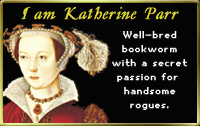
Via Auntie Beff, one of those nutty 'who are you' quizzes. As it is so exactly spot on, I thought I'd better share it.


Which of Henry VIII's wives are you?
this quiz was made by Lori Fury

getting even

You remember when I wrote the other day that I don't base characters on my novels on a specific person in any kind of direct way? In particular I avoid anything of that kind when it comes to unlikeable characters.

Some writers are not so concerned about this. I was just looking through my collection of quotes on writing and storytelling, and two jumped out at me:

The best revenge is to write about it. - Meg Cabot
Getting even is one reason for writing. - William Gass

And of course, it does happen that writers work through painful episodes in their own lives by putting them down on paper. I should have said so more clearly. Note: There's a distinction between putting a character in a story exclusively to get back at somebody you have cause to dislike in an ad-hoc kind of way, and telling a bigger story involving a variety of characters and a series of complications based on personal experiences.

When I taught creative writing at the university level, I found that many students new to fiction had a hard time stepping back from their own experiences. That's perfectly understandable, especially for younger people, but it is something that has to be modified. If you're too close to a story it's less likely you'll tell it well. Especially if a lot of emotion is involved.

A standard suggestion in this situation is this: if you are compelled to write a story based on your own experiences with something big and difficult (divorce, betrayal, loss), one way to get the necessary distance is to switch genders. For example:

You have been wanting to write a novel based on your experiences with a college professor. You are male. The professor was female. You admired the professor and learned a lot from her, but then one day you saw her shoplifting. You became obsessed with this new knowledge, and so you started following her and documenting her life of petty crime. In her theology class (that just came to me) you found yourself getting angry in a discussion about moral relativism, and before you could stop yourself, you made a comment to the professor about her extra curricular activities. You find yourself suddenly in a unique situation: you are being cited for sexual harrassment by your teacher, and she's about to sue you for defamation.

So how do you approach a novel like this? My strong suggestions: 1. do not write it in first person. 2. switch the genders. The professor is now male, and the student who sees him shoplifting, female.

If this were a real scenario -- you lived through this experience ten years ago and find it won't let you go unless you write about it -- you need to skew your approach not only for the sake of the story, but also because in this situation, there are legal considerations. I think that must be obvious. The question is how much you have to change things to avoid a letter from a lawyer. You might have to change the setting. An insurance office instead of a college campus, for example.

You might be thinking that these changes will take away from the 'getting even' experience but consider one thing: if you really want to tell the story for yourself alone, you can write it exactly as it happened with no worries. If you want other people to know exactly what happened and you want them to know the how and where and why, write it as non-fiction, taking care not to slander or defame anybody (note: you can't be sued for stating the truth, no matter how distasteful the truth might be; so, in this scenario you might write that Dr. X was seen shoplifting on a store security camera --if such a thing exists -- without fear of legal action).

If you want to really explore the potential in the story, you'll need some distance, a lot of time, and patience. And possibly the characters will need to be tweaked to give you the perspective you'll need to pull the whole thing off.

June 17, 2006

where characters originate, and the mangled mathematician

Update on the Mathematician: he's got a herniated disc. C4-C5, which is shorthand for the cervical spine.

So my question to women reading this: do you find it a little odd that they refer to the upper part of the spine -- just below the neck -- as cervical? Because my mind goes someplace very different when I hear that word. A place men don't have to worry about when it comes time for an annual exam.

Nomenclature aside, we know what's wrong. Now it's just a matter of getting him in to see the neurosurgeon. Hopefully early in the week, but we have been warned about delays. Not that I'll settle for any such thing, of course. I am quite willing to speak up and advocate for me and mine.

Which brings me to the subject of how real life reflects on the writing process and characterization. It has to be obvious that no character is created in a vacuum. Any character I put on a page can only come from my personal experience, fifty years of interacting with other human beings (both real and fictional) in a variety of settings. Pam's comment on this topic:

It seems so exposed to be a writer. Turning your thoughts inside out for others' pleasure.

How true. You put books out there and people are curious about the characters and the author and the connection between the characters and the author. One of the most irritating questions to come from a reader is this: "Is your character [insert name] based on you?"

So if my characters aren't me, who are they? The only possible answer is that each character is an amalgam of people I have interacted with over the course of my life. Some only in passing, on a bus or at a dry cleaning counter or in a cab. Sometimes five or ten minutes with a person you'll never see again has such an impact that you know, sooner or later, you'll be drawing on that experience in your writing.

An example out of my own life.

About eight years ago I was in Seattle to read and sign books. I was up on Capitol Hill and I had to get downtown. As it happened, I ended up sharing the cab. No problem, I've done that many times without incident, though this was my first such experience in Seattle.

The woman who shared the cab with me was maybe thirty-five, tall and slender and blond. Completely normal looking human being, wearing a business suit, carrying a briefcase and a suitcase. Well groomed. We made small talk as we waited for the cab. The cab pulls up and the driver gets out to put the other woman's suitcase in the trunk.

The cab driver was a woman of about sixty, very lean and athletic looking. Very short hair.

"Oh great," said the blond. "A dyke. I'll hold on to my suitcase."

She said this loud enough for the driver to hear her. I froze in place. I would have cut out, but I was already late for my reading. So I climbed in, and the blond climbs in with her suitcase. And she's chattering away at me, mostly about Seattle, restaurants, shopping. She mentioned a particular restaurant and a street and the cab driver said, very politely: "Actually that restaurant is on X Street."

The blond's face contorts and she snaps her head forward. "Nobody is talking to YOU." Really loud. "Nobody wants YOUR OPINION." Louder. "Mind your own business, you fuckin LESBO."

I was shocked out of my skin, but I managed to stutter hey, that's uncalled for.

The blond didn't even hear me. She kept on berating the driver, for what seemed like forever but must have been about three minutes until she got out. She tossed a five dollar bill into the back seat, dragged out her bags, and stalked off.

There was a moment's silence in the cab and then I leaned forward. I said, as calmly as I could, that I had never seen the blond before in my life, and hoped never to see her again. That I wanted to apologize for her absolutely outrageously unacceptable and rude behavior.

The driver shrugged and gave me a half smile. Takes all kinds, is what she said, and then we had a very civil discussion about bookstores in the city until I got where I was going. I way overtipped, and my hands were shaking.

Ugliness happens every day. It happens to people who are minding their own business, going along living their lifes. Some of them are used to it and handle it with at least outward composure, others have a harder time. This driver struck me as a woman very much comfortable in her skin, and able to weather the storm. So over the years as I've thought about this situation, it's not so much the driver that comes to mind.

It's the blond. I think about her quite often, especially when I'm writing. When I have to deal with a character who is willfully cruel and hurtful. I can still see her face, and I focus on that when I'm trying to get that kind of irrational fear and hate for a character. I have never written a main character that extreme and I don't think I could stand to do it -- why would I want to climb into that person's skin for any amount of time? But neither can I only write about more rational, reasonable people.

The blonde business woman has a story, of course. It's probably an interesting story, if not particularly pleasant. Whatever her story is, there's no excuse for her behavior. But it might be a way to understand that kind of person, how they think.

I also think of this incident when I have to assert myself publically. When it's necessary to speak up, and I'm uncomfortable about that. I think about myself in that cab, how shocked I was, and how incapable of acting in the driver's defense. I have wondered how it might have gone if this had happened in a restaurant with a waitress, if I would have been more able to speak up. I don't know the answer to that question. I do know that I am more able now, at this age, to confront this kind of bad behavior than I was even ten years ago. Maybe I have the blonde to thank for that, at least in part.

So there's no simple answer to the question of where character inspiration comes from. A hundred or a thousand different moments over the course of a lifetime. A long gestation, and then a birth which is sometimes amazingly easy (Curiosity just about sprang onto the page in mid sentence).

The more unlikable the character, the more arduous the process.

June 16, 2006

real people =/ fictional characters

There's a very nice reader review of Tied to the Tracks up at Amazon, and in it is a question:

I don't need to go in to the details of the story since the other reviewers have done such a good job, but I just wanted to say how much I enjoyed the story. As a big fan of Deborah Smith (who wrote A Place To Call Home, and many others) I had high expectations, and Rosina Lippi didn't disappoint. From reading the authors blog I know she had a career in academia so my one burning question is, who was the secretary modeled after?

This question is particularly relevant because the relationship between real people and fictional characters is a strong theme in the novel itself. There's an ongoing discussion of Miss Zula's habit of writing people she knows into her novels. There's even a verb: My daddy was buttoned by Miss Zula. Another character claims that the residents of Ogilvie read her novels primarily to see who gets buttoned.

You'll note, though, that Miss Zula never participates in these debates. Whether or not Button Ogilvie was in fact the basis for a character in one of her novels -- to that she has nothing to say.

There are a couple reasons an author will keep out of such discussions. First, it's just fun to listen to the debate. People with strong opinions about a novel you wrote, who get into arguments about them -- that's a huge payoff. To write a novel that arouses such emotion and interest in readers, that's a sign that you did good.

Another reason not to answer questions about character inspirations: It's one thing to use a novel to get back at somebody (not me, never me, nope, unuh, I don't go there), and it's a whole other other to find yourself on the receiving end of a lawsuit. Or a hysterical accusation thrown across (say) a crowded restaurant.

Finally, sometimes people see a connection where there is none, and they are so committed to their own vision that they won't listen even if you break silence to dissuade them from their erroneous assumptions. So it's better not to get involved in such discussions in the first place.

So for the record, I will repeat: with .75 exceptions (which I will note below), I didn't base any of the TTTT characters on real people. Patty-Cake is a force unto herself, and has nothing, absolutely not one thing to do with any of the fine secretaries and office people I have known in the course of my academic career. Every one of them a diamond, a peach, a selfless, non manipulative, self possessed humanitarian.

We clear on this?

The .10 exception: Miss Zula does have a few small traits in common with various Southern women authors of the last one hundred years, but only very tangentially.

The .65 exception: Tony Russo, on the other hand, is vaguely based on my cousin Tommy V. Not in terms of his job or family, but personality? Yes. Anybody who knows Tom will have no doubt that the wisecracking guy from Hoboken with a flair for the visual arts and a strong interest in the opposite sex is him. Tony is my small tribute to Tom, who always makes me laugh.

The bigger question -- where characters come from -- is something I want to talk about in more detail in the next couple days.

June 15, 2006

more on the mangled mathematician


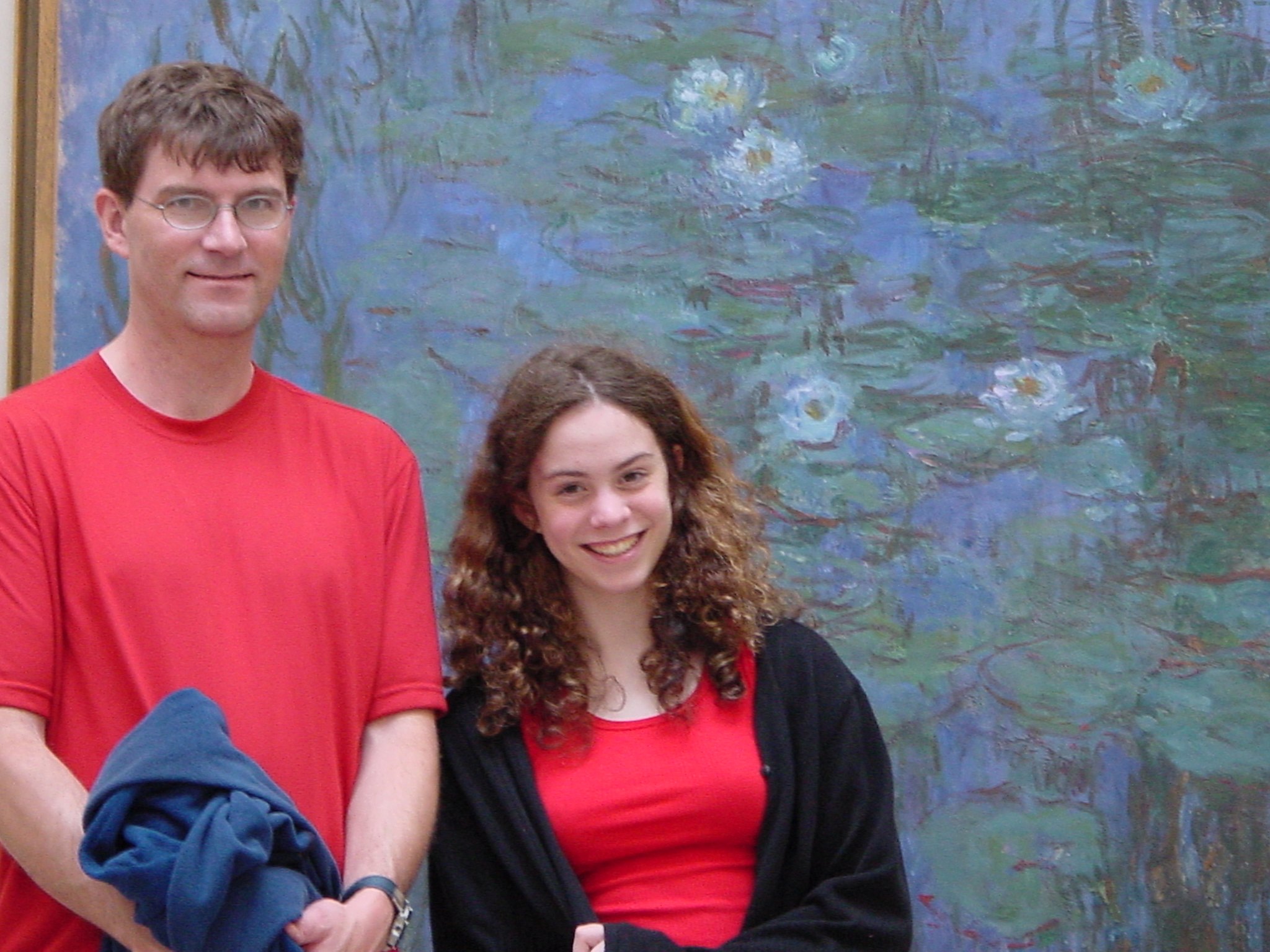
Mmandgirlchild
We are still waiting to hear about the MRI. He's flying high on those Very Good Drugs, except when they wear off, and then he's miserable until they kick in again.

Here's a photo from our short stay in Paris, two summers ago. The Mathematician, the Girlchild and Monet. Click for a bigger version, if you are so inclined.

Thanks for all the good wishes, and I'll post when I have news.

sidebar disaster

it was all going so well, and then half the sidebar disappeared. just gone, poof, missing from the template.

I have no idea how that happened, and no time, just now, to try to fix it. Hopefully soon.

June 14, 2006

jolt! wow! Jolt. wow. + Shakespeare, Hemingway and the Unibomber


It's hard to concentrate on writing while the Mathematician is pacing, so I've tried to fix the formatting problems here. I had to start from scratch with a fluid template (if you don't know what that is, never mind, really, the details are boring). What that means is, everybody should be able to see everything, both columns, and to resize your browser screen without losing anything. The screen cap to the left is what you should be seeing.

There is a style contest going on over at Movable Type, and the base template I am using was an entry there called Fleur.

Sorry to ask again for help, but could you let me know how this is showing up for you, and what browser you're using?

And as a small offering, as I have nothing of real interest to share today beyond more mangled mathematician stories, here:

Jim Trelease is a reading education specialist and a very smart guy. The quote in the upper right hand column is from him, with a link to his website. On his website there is also an interesting article which considers a great question: how would Shakespeare, Hemingway, and others well established in the literary canon be graded on the new SAT essays?

Not that the answer is a surprise. But it's still very sobering, the mess we've got when it comes to evaluating how ready kids are for college.

mangled mathematician

Mangle is maybe too strong a word, but I wanted alliteration and it's been a rough couple days.

After five days of steadily increasing pain in his shoulder, the Mathematician finally agreed to see the doctor today, so off we went. About half my day was spent in the waiting room, and the rest was divided up between waiting in line at the pharmacy, and transporting the Girlchild to appointments she couldn't handle on her own.

Tomorrow I expect we'll be spending a good part of the day at the hospital because the Mangled Mathematician needs an MRI. They did an EKG in the doctor's office and it's not his heart (high on my list of worst case scenarios). It may be a slipped disc. Which would probably mean surgery. Good news: they gave him Real Drugs to help with the pain. As he hasn't slept in three days, the minute the pain went away he conked out.


How did he slip a disk, you're wondering. I truly don't know. But I can tell you that he's been spending a lot of time sailing and trying to repair the Etchell he co-owns with a friend. This here is an Etchell, a small racing boat. Also, there have been some hikes. And trail clearing. And I believe he played tennis just recently.

The lesson I take from all this: a sedentary life style has a lot to recommend it.

So now I'm going to try to write, but I fear that I may fall asleep fairly soon. Also, I'm feeling disoriented because the puppy boys aren't here. I sent them off to have an overnight at Sherri's, so I don't have to worry about them on top of everything else. But I miss 'em. The little monsters.

Wish us luck.

PS There is a very loud silence out there about Tied to the Tracks. One review on Amazon, and y'all are keeping mostly mum. Right now I'm a little too worn out to obsess about it, but I'll pick up where I left off once we know what's going on with the MM.

June 13, 2006

IE users

Any better? If the page is showing up as it should (see image in yesterday's post) please let me know, and also let me know if it isn't. I won't try to fix other infelicities until the sidebar/banner issue is fixed.

June 12, 2006

browser problems?

Pam writes to say that when she looks at this weblog, there's some wackiness going on. The sidebar shows up below the main body.

Is anyone else having that problem? And if so, could you please leave a comment telling me what browser/operating system you're using?

thanks.
UPDATE: why didn't any of you mopes mention this to me before? Sheesh. I bet you let men walk around with their zippers down, too, and then giggle about not telling them.

If you click on this thumbnail you'll see what the page is supposed to look like. I've got no idea what's up with IE (you know, Firefox really is a great browser, you'd be so much better off...) but I put in a help ticket. Stayed tuned.

June 11, 2006

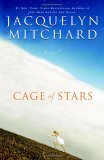
Cage of Stars- Jacquelyn Mitchard

There's a fiction subgenre that doesn't really have a name. The kind of novel I'm talking about isn't about romance or romantic love in the first line, though that may be one of the subplots. These are novels that examine the way families work, or fail to work, in the face of crisis. And I mean crisis in the bigger sense of the word. Divorce would be the least of the problems in this kind of book. We're talking accidental deaths, fatal illness, rape, murder, permanent disability, kidnapping, felony arrests. You get the picture.

Some of the authors who are active in this genre (which is sometimes called domestic drama, a term I dislike because it feels dismissive) are Jacquelyn Mitchard (The Deep End of the Ocean, A Theory of Relativity), Jodi Picoult (My Sister's Keeper, Vanishing Acts), Judith Guest (Ordinary People), Elizabeth Berg (Range of Motion,We Are All Welcome Here), and Elizabeth Strout (Abide with Me).

Somehow this subgenre -- though it is written primarily (or maybe even exclusively) by women -- has mostly been spared trivialization or undue snark from the litcriterati. A few of these novels have received both high critical praise and popular success.Ordinary People is the best example of that, and it is also the novel that sets the standard for this genre. And of course, not all attempts at this kind of family in crisis novel are equally successful or well written.

Before I talk about Cage of Stars, I wanted to ask you what other novelists or novels you think might fit into this category.

So now, Mitchard. She's best known forThe Deep End of the Ocean, which was an early Oprah pick. It was her first novel, and it catapulted her into the best seller list. Publisher's Weekly said: "One of the most remarkable things about this rich, moving and altogether stunning first novel is Mitchard's assured command of narrative structure and stylistic resources. Her story about a child's kidnapping and its enduring effects upon his parents, siblings and extended family is a blockbuster read."

I've read most but not all of Mitchard's novels since her first. The second one,The Most Wanted, probably made the biggest impression on me. Publisher's Weekly wasn't so happy with it: "Despite portentous foreshadowing, Mitchard second novel never achieves the dramatic momentum and the emotional immediacy of her acclaimed fiction debut,The Deep End of the Ocean. But her depiction of two female protagonists is so large-hearted and wise that readers undoubtedly will be engrossed in their story."

Side note: Beware the review -- especially the PW review-- that starts with the worddespite. I speak from personal experience here.

I read Mitchard's newest about two weeks ago, and I've been thinking about it ever since. Of course that's a good thing, a story that stays with you. But in this case there was something off, and I couldn't put my finger on it. One thing that jumped out at me was how much her style has changed, or maybe just her approach to this story is a departure. Not necessarily a bad departure, but I was strongly reminded of Jodi Picoult in a way that Mitchard probably wasn't aiming for.

Cage of Stars is about a small, healthy, close knit Mormon family that lives in a tiny rural community where people generally get along and take care of each other. In the course of the novel you learn a good amount about the LDSaints, all provided in a matter of fact way. You get this information through the main character, Veronica Swan (Ronnie to family and friends), who is twelve years old when the novel opens with a very powerful image: "At the moment when Scott Early killed Becky and Ruthie, I was hiding in the shed."

This is a story not so much about the murder of two little girls as it is about the way violence is embedded into the heart of their twelve year old sister. Scott Early, who commits this crime, does so in the grip of a psychotic break. It's his first, and with it, his history as a good guy, a man loyal to family and scrupulously honest, is null and void. He is not convicted of the double murder of the Swan girls, but is sent off to a hospital for the criminally insane for treatment.

Ronnie spends the rest of her adolescence nurturing her anger, while her parents work to overcome their despondency and sorrow after the little sisters are buried. Eventually they meet with Scott Early in the hospital and they forgive him. Which only makes Ronnie more determined to extract justice.

Most of the novel deals with how she does that. Her plan, which is elaborate and well thought out, eventually takes her to California where she inserts herself into the lives of the now released, medicated and stable Scott Early and his wife and infant daughter. This sounds like a retelling of The Babysitter, no? But it's more complex than that, and we're in Ronnie's head for the whole time, watching her thoughts as they evolve.

And here's the cause of my discomfort: This is another case where I'm unhappy about a first person teenage narrator. And I freely admit that this is a matter of my own quirk, my need for a broader narrative scope and a dislike of the restrictions Mitchard puts on her readers by keeping them in Ronnie's head.

So is this a good story? Yes. Is it worth reading? You may like it, if you aren't as sensitive to the narrative voice issues as I am. If you are getting started with fiction writing yourself, this is a novel that might be instructive in terms of approach and structure. It's one of the few cases where a prologue felt off to me (I generally like prologues; which you probably knew if you've ready any of my novels).

At any rate, I continue to be interested in Mitchard's work and look forward to the next novel.

My latest Grievance - Elinor Lipman

The narrator of this first person novel is Frederica Hatch, a teenager and the only child of two ultra liberal professors whose primary purpose in life is bringing her up to be a strong, well adjusted, analytical and happy person. Frederica makes fun of her parents but it's clear at all times how much she loves and admires them.

The setting for this novel is a small fictional all women college outside Boston, one with no pretensions to academic excellence -- not so long ago it was two-year college dedicated to producing secretaries who 'married up'. Things have changed, and Fredericka's parents are a big part of that.

The launch of the real story is Fredericka's discovery that her father had a first wife. Her curiosity gets the upper hand and she sets a series of events in motion that bring the dramatic and narcissistic Laura Lee French to campus as a dorm housemother.

Aside from matters of personal history and potential embarrassment, it could have all worked out well except Fredericka never reckoned with Laura Lee's need to put herself in the middle of high stakes drama, and her willingness to create those dramas in the most destructive ways possible. Laura Lee immediately launches herself into a very obvious affair with the married president of the university, with results that are only partially predictable. The Hatches get mired in the middle of all that, and their family ties and child rearing philosophies are put to the test.

This novel is in some ways very typical of Lipman's other work. Laura Lee is a lot like the birth mother in 'And then She Found Me' -- flamboyant, self centered, disdainful of laws and rules when they get in her way. On the other hand, while many of Lipman's novels end just when the going gets interesting ('The Pursuit of Alice Thrift'), this one carries through, so that we find out what happens to everybody for years down the line.

I like that kind of thing, so that made me happy. What I'm still not sure about is the first person narrator. I liked Fredericka, but it's hard to tell a story like this from a teenager's limited perspective. I would guess that Lipman liked the challenge of that, and for the most part she pulled it off. And it is interesting to see the union-oriented, this-family-is-a-democracy Hatches deal with a precocious teenager.

I liked this novel a great deal more than some of her work, but not as much as The Inn at Lake Devine.

June 9, 2006

Scanners

If memory serves, that was the title of a movie about people whose heads exploded.... yes indeed, according to google. Exploding heads. Maybe that's why the name BookScan makes me laugh.

Pam sent me this link to "Book Clubbed" an article by Daniel Gross on a company which keeps track of book sales. And so what, you ask. We are nation of people who love statistics. We invented baseball, after all. What's the big deal about sales figures for books?

It's simple: there aren't any. It's almost impossible to get reliable sales figures on books because the industry is very secretive about that end of things. The article explores this topic in some depth, by means of BookScan:

BookScan, a Nielsen service started in January 2001, tallies retail sales from chains like Barnes & Noble and Borders, from Amazon.com, and from stores like Costco (but not Wal-Mart). James King, vice president for sales and service at BookScan, suggests that the database captures about 70 percent of sales for a typical hardcover book. As such, BookScan has emerged as a powerful tool for the editors and agents whose employers pay several thousand dollars a year to subscribe.

And before you ask: I don't have access to BookScan. Which is good, because I can think of no better way to feed the howling dogs of anxiety. You think I'm overstating, but Gross agrees:

... in the hands of journalists and polemicists, BookScan data has becomes a blunt instrument to humiliate, minimize accomplishments, and express joy at the misfortune of other writers.[...] Edward Wyatt of the New York Times has been a connoisseur of disappointing BookScan figures. Last December, he gleefully noted that Martha Stewart's The Martha Rules, which had garnered a $2 million advance, sold a not-very-good 37,000 copies, and he cited even smaller figures for Salman Rushdie's Shalimar the Clown ("just 26,000 copies") and Myla Goldberg's Wickett's Remedy ("only 9,000"). In November 2004, he cited BookScan figures to show that the finalists for the fiction category of the National Book Award were a bunch of poorly selling obscurities.

Here's my dilemma. I have to admit that if I did have access to BookScan, I would find it next to impossible to resist looking for other people's bad news. Oh, I am awful. But I am not alone. From one of my favorite poems "The book of my enemy has been remaindered" by Clive James:

The book of my enemy has been remaindered
And I rejoice.
It has gone with bowed head like a defeated legion
Beneath the yoke.
What avail him now his awards and prizes,
The praise expended upon his meticulous technique,
His individual new voice?
Knocked into the middle of next week
His brainchild now consorts with the bad buys
The sinker, clinkers, dogs and dregs,
The Edsels of the world of moveable type,
The bummers that no amount of hype could shift,
The unbudgeable turkeys.

You can read the whole poem here. Have mercy on us writerly types, for we are deeply flawed, but we tell a good story.

June 8, 2006

Fiona, down undah

Fiona is my Australian editor for the Wilderness books and also for Tied to the Tracks.

Some time ago somebody asked (and I don't think I ever answered) why TTTT is coming out under the Sara Donati in Aus/NZ, and Rosina Lippi on the flip side. It's simple. Sara Donati is a best selling author in that market. I'm not sure why, but the Kiwis and Aussies really, really love the Wilderness series. Of course Australia is also the place that nurtured and housed Farscape, so I'm not surprised at their communal good taste (she said modestly), but I've never been quite clear on it, either.

Rosina Lippi -- that name isn't familiar to the Sara Donati readers down undah, thus the name switch.

And now back to Fiona, the fabulous. An email from her today:

(we need to to make doubly sure our author knows the book will now be released here in August, not July(as a result of us rethinking the cover, but was obviously worth it) so she can holler about that on her website as we're doing the same.

This is me hollering: Did y'all get that? TTTT in August for you. Fiona also tells me that their marketing people do not like the US cover for Queen of Swords and she has to come up with something else. She didn't know what they don't like about it, but they were adamant. Which makes me sad. Finally a cover I really love and it's being rejected. Now I have to think up some alternate ideas to suggest. And you know what? I don't have any idea.

release date confusion

Andrea writes that she checked Amazon.com and Barnes and Noble, the release date on Tied to the Tracks now reads Tuesday, June 13.

Which is odd, because when I just checked Amazon, it still said June 8. So, confusion reigns, as usual. Just be aware: it is coming out. I promise. And if your local bookstore tells you no, it's not: you have my permission to smite that person about the head with a wet noodle. Or you could just correct them. Choose one of the following:

A) Pardon me, but you are very much mistaken. This novel was indeed published by Putnum Penguin, and if you cannot be bothered to look into your computer machine with the proper degree of attention to detail, I shall take my trade elsewhere. Good day.

B) I don't want to talk to you no more, you empty headed animal food trough wiper. I fart in your general direction. Your mother was a hamster and your father smelt of elderberries. I shall go away before I taunt you again.

C) Most likely you aren't paid very well and you work long hours and people pick on you. I expect life hasn't been pleasant since the newest Coulter came out, what's it called? Heartless? Oh yeah, Godless. So I understand, things slip by you. But this book does exist, and in fact, it might be just the thing for you to read too. Cheer you up a little. Go ahead, indulge.

Andrea also mentions that her book group is going to read Into the Wilderness which of course is lovely, and many thanks. Books groups are wondrous things. People talking about books. What could be better?


June 7, 2006

waiting room jitters

You know those old movies where the father is smoking one cigarette after another while he paces the waiting room? Sterile white hospital, a couple other tired looked men who need shaves.

Then the nurse comes out and announces whatever it is, and his face lights up. Gee, he sez he. That's swell. He's happy; no reviewers around the corner waiting to spring details of the delivery or newborn on him with pithy commentary. Now they just have to go home and raise the kid.

For some reason I'm feeling very anxious Tied to the Tracks. I am more nervous about this book than I can remember ever being about any other book. There are some obvious reasons for that, but they are really too easy to be the whole story.

Now see, I'm not asking for sympathy. I have nothing to complain about; in fact, career wise, I'm pretty well off. It's hard to get review space these days, so when I tell you there was a two line blurb in the Washington Post, you should remember that sometimes there really is no such thing as bad publicity. Because those two lines? Not nice. My agent called to paraphrase and it went something like this: run of the mill chiclitromance; completely predictable.

I don't suppose you're surprised to find out that the Washington Post is disdainful about anything that smacks, no matter how faintly of (whisper it) romance. Now, I don't think the ending is completely predictable (there are a number of endings, and some of them go interesting places), but that's beside the point. And what was the point again?

Oh yeah. To the WP, being able to predict the ending of a novel is a mortal sin, and thus am I cast into the fires of wapostian hell.

But Booklist loves Tied to the Tracks, and Booklist is all about librarians, and I hold librarians and libraries in much higher regard than WaPo, so I'm fine. Really. No need to worry about me, nosirreee.

Oh, and the person who went to Barnes and Noble and was told they didn't have it? They do have it, or will. but I'm glad you're calling Village Books. They are nice people, and deserve support. However, if you do try to buy it someplace and they don't have it, would you send me an email and let me know? My editor needs to be kept in the loop on that kind of thing.

Finally: in a month or so I want to post about the theory of the Super Duper Magical Negroes (those litcriterati, such wags. such players with language). Because I have been thinking about this, and I have come to the conclusion that Curiosity is not a SDMN. Nor is Miss Zula Bragg. But I'd like to hear your thoughts on that.

Link via RydraWong via the Radiant Robyn Bender.

Blogger behaving badly

So I tried to post an answer to Fuse #8's question regarding the top kids' books of the last twenty years, but Blogger won't cooperate. It was only by some strategic backpedling I managed to save my post at all. Thus, I am putting it here. No interest in children's books, please, just pretend this isn't here.

My answer to this post:

Coupla questions:

Maybe you should separate out picture books? Because really, can you compare Rainbabies to Fly by Night? Babushka's Doll to Skellig (if you hadn't tossed them, that is).

Me, I'm all about picture books, especially for younger kids. Go ahead, make mock if you will, but here are the books I really admire. Note the lack of LLFE. Paperbag Princess would be on this list but it's slightly too old.

Rainbabies (Melmed)
Sheep in a Jeep (Shaw)
Babushka's Doll (Polacco)
The Jolly Postman (Ahlberg)
The Owl and the Pussycat (Lear/Brett)
Brundibar (Sendak/Kuschner)
Voyage to the Bunny Planet (Wells)

June 5, 2006

and while we're on the subject of books

You realize that Tied to the Tracks is about to come out, right? You might not realize -- because I just found out myself -- that the publication date has been moved up to June 8. Three days from now.

Now, of course I hope you go out and get a copy but what I was brought up to say is something like this:

Of course it may not be your kind of book, and please don't worry about it if you don't have time/energy/interest/money/inclination or you're too busy/too depressed/not interested/caught under a large piece of furniture without hope of escape. Because of course books are expensive and you probably have more important/interesting/rewarding things to do with your money. So really, I insist that you don't bother. Send your money to the charity of your choice, I'll feel so much better about that.

That's what I should say, according to the good sisters of St. Francis who were my teachers at St. Benedict. Self promotion was as horrifying as self abuse in that setting. Modesty and humility, those were the things that mattered.

Case in point. I am sitting, right now, at Starbucks getting up the energy to open the PJ manuscript. I sit at a corner table so nobody can come up behind me and read what I'm writing. It's right next to the pickup spot on the counter. Two women just came over to ask me about my computer. This happens once in a while; mac people are drawn together by a mysterious magnetic-y force. So they come over, admire the computer, remark on the new intel based macs, and then they ask me what I do.

Here's my standard answer, which I gave them: "I'm a writer."

Sometimes people ask what I write. I prefer that they don't, but I answer if they do ask. This time they didn't ask, but because I'm sitting here writing about the challenges of a new book coming out, I was infected -- infected, I use the word purposefully -- with the need to be proactive. So I said: As a matter of fact, I have a new novel coming out this week. On Thursday.

Oh? came the answer. With a slightly glazed look. The oh no look. The more information than I wanted look. The how quickly can I walk away look. But having jumped in, I wasn't going to drown. I said: A novel. called Tied to the Tracks. On Thursday!

Then they went away, leaving me here to feel embarrassed, but also with the odd and almost irresistable urge to stand up and talk to the whole room. In my old teacher voice.

Hey! If you come in here regularly and often see me sitting right here typing, you might be interested to know -- well okay, you might not but I'm telling you anyway. What I was writing was this novel (holding up example I don't have with me) about half of which I wrote write here. It's a darn good novel. BookList says so. So on Thursday, why not wander by the bookstore and have a look? Why not INVEST in my writing career? You'll get a good story and my thanks.

You know what? I bet that would cost me sales. I bet people who might otherwise have picked up Tied to the Tracks will decide, when they do happen to see it in a store, not to. Because of the weird, self promoting, loud mouthed author.

You see my dilemma. The damnedifIdodamnedifIdon't nature of the beast.

However. If you are reading these words you came on your own power, and so to YOU I can say: (repeat refrain).

Village Books
If you have time, of course. And interest. You would find it -- if you're so inclined, really, no obligation, at Amazon, at Barnes and Noble, at your local independent bookseller by means of Booksense, or you could order a copy from Village Books, my local independent. You can even request first edition signed and/or inscribed copy -- I stop by there to take care of such things -- and then they ship it off to you. Give 'em a call (360 671-2626). If you are so inclined.

read read read

M.J. Rose may well be the most connected writerly person ever. Or at least just now, in cyberspace. She's an author but she also writes about publishing and the challenges facing authors.

She's got a post up that serves as a call to arms. The message: the publishing business will continue to decline unless people start not just to read more, but also to invest in buying books.

Using stats published by R.R. Bowker. Lulu.com worked out that if we keep publishing at the rate we are publishing now, in 2052 148.4 million books will be published -- but only 129.4 million Americans will actually read a book.

Do the math. This means 19 million new books will not find a reader.

Even if this is an exaggeration, those of us in the industry know that the challenge we all face is how to keep people reading and how to get more people reading. With the internet, cell phones, iPods and other listening devices, laptops, cable television, netflix etc there is no lack of competition for the book.

She's got some suggestions for ways to encourage reading. For example, if you're off to dinner at a friend's house, bring a book instead of a bottle of wine. I'm thinking there are lots of occasions where books could be substituted for traditional gifts, but not everybody may appreciate the gesture. A book for mother's day would suit me fine, but many might not feel that way.

So the problem is more than just getting books into people's hands. It's getting people interested in reading the books once they've got them. Getting them into the reading habit. And that's harder to do.

M.J. is launching a recurring feature. She's asked popular authors for a list of books to read this summer. The first one up is Lee Child (whose books I often write about here). I'm curious to see who else she's got lined up.

June 4, 2006

favorite posts?

If you have a favorite post or posts, could you comment and say which one(s)? I could make a list based on hits, but that doesn't feel quite right.

It has been a hectic weekend, but I hope to have more to post about tomorrow.

Oh and: a few people have posted general comments about the Wilderness books in the comments recently. Which is fine; I like to hear from readers, in whatever format. Bruce (or maybe his wife; it was unclear) just posted that s/he was disconcerted by the lack of a clear antagonist in Fire Along the Sky. It's an interesting observation, and makes me wonder if other people had this same feeling.

June 3, 2006

you learn something new every day

What I learned from this trivia contest:

1. You are an eager bunch.

2. In your excitement, detailed instructions got lost. I should have kept comments turned off for the first two hours or so to make you slow down.

3. It might be better, next time, to pick a name out of a hat.

4. The next time I'll do this on the weekend so people can participate without getting in trouble at work.

5. It's likely that everybody except the winner is going to be unhappy about the way this went.

Remember the part about this being subjective, and me being the final judge? The winner is Andee.

The next ARC giveaway will be in the last week of June. Stay tuned.

PS: Andee, email me with your mailing address, please.

June 2, 2006

ARC giveaway trivia question. ANSWERS SHOULD BE POSTED HERE

UPDATE: As there seems to be some confusion, let me clarify. Some people have posted answers to the question. Of the answers I've got so far, one comes very close to hitting all the points and hitting them accurately. Which means there is still room for somebody to post a more complete and accurate answer. So: I'm going to extend this until tomorrow morning. The first entry that is (a) thorough in providing the details (b) accurate will be the winner. It may be that the winning post is already up, but then again somebody may surprise me. The bottom line: between now and tomorrow morhing, somebody could post an answer that is more complete and/or more accurate than the answers already there. I'll check about ten, and see how things are going. I hope that's clear.

Here's the trivia question. You post the answer here by clicking on "your 2 cents" at the bottom of this post and filling in the comment box.

By what other name was the girl called Connie known, and what was her fate? Details should include (at a minimum) facts of her parentage and her manner and place of death.

The Queen of Swords ARC will go to the first person to post a comment which includes

--a valid email address
--name (first name alone will suffice)
--the correct and full answer(s) to this question
--title of novel in which you found this information.

You may enter only once. Multiple entries will be summarily tossed, so don't post in a hurry. Take your time and get it right.

By entering a comment, you are agreeing to the following:


  • You won't sell the ARC before its publication date;
  • You won't make copies of it in any way, for any reason;
  • You won't make excerpts available, or give away plot points. In short, you are sworn to secrecy. You can email me if you really need to say something about what happens (or doesn't). You may post a review on the internet IF you can do it without spoilers. Unless you hate it, and then maybe you could wait until after the pub date to say so. Or not. That's up to you.
  • You won't contact me to say you found (a) a typo (b) a logical error (c) a confusing passage. This is an uncorrected proof, and that means errors. Of all kinds. You can be sure that between the editors, copyeditors, and me, we will catch 99.9 percent of them before the final version goes to the printer.
  • All decisions of the judges (me, me, and me) are final. Please note that this is a qualitative quizzy type thing, which involves some interpretation on my part.
  • I can't be held responsible for technical problems that might interfere with your answer being posted. If that happens to you, just remember that I'll be giving away three more copies in the next two months.
  • You will email to let me know that you've received the darn thing.

At around eight this evening I will go through the answers and pick the first most complete one.

Finally, I will put the ARC to the winner in Monday's mail, at the same time I mail ARCs to my beta readers, etc. So beta readers who are expecting one and asking (repeatedly) when it would go into the mail (and you know who you are): the answer is Monday.

IF YOU HAVE QUESTIONS do not post them here.

Questions re ARC trivia quiz should be posted ***HERE***.

Confusion about how to post an answer, requests for clarification of the rules, or anything else related to actually entering the contest: click on "your 2 cents" below this post and fill out the comment box.

DO NOT ANSWER THE TRIVIA QUESTION HERE.

June 1, 2006

Queen of Swords ARC giveaway: sorry, I forgot

I'll get it organized and up by tomorrow, I promise.

EDITED TO ADD:

Listen, people. I am very touched by all the fervor around this new book. It means a great deal to me. But I have a total of ten ARCs. Ten. One I keep. Four are promised to people who were readers or otherwise involved with research. My parents-in-law want one. That leaves four copies to give away. Four.

I want everybody who really wants one to have a fair shot at a copy. The only way I can think to do that is (1) to restrict the competition to those who haven't yet won something here; and (2) to come up with some moderately easy trivia question and then to send the copy to the first person to post the correct answer.

Any questions?

I will post the trivia question tomorrow at about noon, Pacific Standard Time.