here comes the sun
take me to the front page of the tttt weblog | back to the current weblog
« November 2005 | Main | January 2006 » canaafrica.org this resource
scribbling like mad, trying to stay on track to finish Queen of Swords by Sunday evening. Carry on without me, if you're so inclined.
So I'm writing pretty well.
interrupted to say: imagine me knocking on wood madly, okay? and find some wood and knock on it a few times yourself. just humor my superstitious Italian self.
And I can feel Queen of Swords becoming, solidifying into a whole. If all goes well I should be finished by the end of the year. In spite of the fact that today I have to spend a half day in the kitchen with the promised cookies, and the tree has to be decorated, and presents wrapped, I am not panicky. Which you know: a good sign.
Here's one of the weird things that happen to me as a writer, the way my mind works. I have a character, a minor character who plays a pivotal role fairly early in the book. I thought, well, enough of you (because I don't like her much), but then she popped in again a few chapters back. Okay, I said to her, I can see the need. Now, be gone.
Then an other character, this one major, said: I'm going to see the woman, and I shrugged and followed him, and okay, he was right. That's what he needed to do.
Where is this story going, you're wondering. Here's the aha moment.
Yesterday I was thinking about this woman, how she keeps insinuating herself back into the story, and the first time she showed up. We meet her when another minor female character, this one really a good and likeable person, goes to the Woman I Don't Like for help.
At the time I didn't think much about it, but then yesterday: aha. The Woman I Don't Like is linked to the Woman I Do Like in a crucial way that is instrumental to the story. It's been there all along, but my subconscious hadn't bothered to inform me until this point. Yesterday, though, the door between my conscious and subconscious mind flew open with a bang, and out came this whole revelation in a flash. I tried to peek in and see what else might be waiting in there, but no luck. The gatekeeper is wily.
I freely admit it: the whole process behind writing this big, complex story is as odd and mysterious as the quantum physics.
from Cary Tennis at Salon. If I had any ambivalent feelings about the guy's approach to giving advice, they would be gone now, because this is a wonderful letter. Here is part of his response to a woman who is mightily unhappy about her husband's aging dog.
[...] Age in our loved ones often takes us by surprise. Someone can no longer see very well, can't hear what we're saying, can't walk so well, can't remember anything. At first we don't get what it means. It's just an annoyance. Then slowly it comes to us: She's going away. This is the sound of her departure.
The dog is losing control, one of the signs of impending death, one of the messy, stinky, unpleasant things that happen as life nears its end.
Let's tell the story again from the dog's point of view -- a little doggy flashback told with a handheld camera. Before you came along, she had her master -- your husband -- all to herself. He took her on long walks. They had many fine times together, just the two of them. Then you came along. But though you were a rival and superseded her in the pack, she welcomed your arrival, because she is such a social animal.
Then you became pregnant. You became the center. You acquired a heightened sense of smell. Your concern with cleanliness increased. You battled doggy odors. You erased the olfactory narratives that the dog was used to reading. She began to feel physically lost in the house. She needed, more than ever, a room of her own. She needed a purpose. She tried to claim one, but was punished and shunned. When the first child was born, the dog sensed her rightful role would be to protect and nurture the infant. But she was shunned.[....]
Is euthanasia right? Ask yourself: Is it for you, or for the dog? While it might not be ethical to put the dog to sleep merely for your own convenience, it might be ethical to release the dog from an increasingly difficult and painful life.
If you choose euthanasia, you might want to first try to bring some happiness to the dog's life. Maybe she could have a week or two where nobody scolds her for things she can't control. That would make a nice ending to the story. At the end, you could say, she was happy.
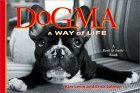
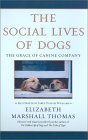
If you're considering a dog, you might want to think about adopting an older one. Here are the people who will tell you all about the benefits.
I love my dogs for their personalities and for the role they play in our family. I love the way they greet me when I come home, and the joy they take in everything. One day they will be old. I dread that day, but I hope to meet their needs with all the warmth and caring that they bring to me now, day by day.
Beth got tagged for the Seven Meme (the one I started, she said grumpily, and never got credit for), and then instead of tagging other people to do it, she exempted them. Including me. Which is kind of weird, as I've never actually been tagged, and now find myself untagged.
Memes are a great way to procrastinate, hence I am fond of them. However, Hannah is in the middle of something big and I have to get back to her.
seven things I'm good at
storytelling. writing. research. textile art. languages. linguistics. mothering.
seven things I'm terrible at
cleaning. laundry. math. music theory. puzzles. word games.
seven things I'd like to be very good at
Italian. American Sign Language. textile art. drawing. photography. singing harmony.
seven favorite modern novels
The Magician's Assistant. Welcome to Temptation. Possession. Niccolo Rising. The Time-Traveler's Wife. Gone Baby Gone.
seven favorite movies
When Harry Met Sally. Reds. Bull Durham. Groundhog Day. Last of the Mohicans (Daniel Day-Lewis version). Mansfield Park. Sense & Sensibility (1996)
seven favorite television shows
Farscape. ER. HomeFront. My So-Called Life. Deadwood. Battlestar Galactica. NewsRadio.
seven role models
Eleanor Roosevelt. Margaret Sanger. Noam Chomsky. Jean-Hervé Bradol. Francois Marie Arouet (Voltaire). Barbara Jordan. Galileo (Eppure, si muove).
I've been thinking about how to go about this, and it occurs to me that I might try to do it the same way I analyzed sex scenes. So I'm going to compile a list of scenes from novels that made me laugh, or that were supposed to make me laugh and didn't. Then I'll try to see what elements they have in common -- drawing in part on the model set up by Scott Adams for cartoons.
My purpose here is not to look at novels that are primarily comedic in approach, but at comedy used in small ways to achieve a certain effect. The first scene that comes to mind is from Russo's Straight Man, so I'll put that on the list. If you would like to suggest a short(ish) scene from a novel for its comedic effect (or lack of effect) please put that in the comments.
I expect it will take some time to put this all together. Probably in January I'll start posting on the subject.
On another topic entirely: there's a great post over at Booksquare about publishers who don't realize the importance of readers.
Friday night I took a car load of girls over the border to Vancouver, and we saw Brokeback Mountain at The Park theater.
It's hard to know what to say about a movie like this. The photography was stunning, which is something that always mezmerizes me to the point that I forget to pay attention to the story. I remember feeling the same way when I saw Days of Heaven on its first day of release in 1978.
But okay. The thing that stays with me most is a strong sense of sadness. The story is tragic in the sense that pretty much everybody's life is ruined by the main character's flaw. Heath Ledger portrays Ennis as a man so frightened of his own needs that he sacrifices everything in the name of responsibility -- including the happiness of the people he's responsible for, and himself.
I haven't seen Heath Ledger in much else, and what I have seen didn't much impress me, but this performance was letter perfect. He gives you an Ennis who lives buried within himself, unable to reach out and take what he wants. Unable to break out of the path that's been laid out for him. We see that he is capable of openness and emotional connection only in two situations: with Jack Twist, and with his daughters, who he loves simply and absolutely. Heath Ledger captured the man with such clarity that I doubt I'll ever be able to look at him again without thinking of Ennis.
Or maybe not. Because I did see a brief interview with him last week, in black leather, slouched in a chair, hiding behind sunglasses, mumbling. A stoner, as my daughter would call him. But inside the stoner, an actor.
The other performances were excellent across the board. Jake Gyllenhall as the man more self aware, more open about his emotions and needs, less able to sublimate into work. The joyous one, who draws Ennis out of his huddle, and grows more desperate every year when they part after their few days together. The women, whose lives are stunted for reasons they don't realize or fully understand, who funnel their anger into the few channels available to them.
This is not a movie to see if you're feeling low. The final scenes are so poignant that it felt almost wrong to watch them. Ennis hears of Jack's death after the fact, and goes to visit his parents, desperate for some kind of connection. In Jack's old room he finds two shirts hanging on the same hanger -- one his, one Jack's, from the first summer they spent together. Everything about that moment, from Ennis's posture to the way his hands hold the shirt, speaks of unbearable loss.
So yes, this is a movie that is beautifully made, the story told with precision and insight and gentleness. Movie making at its best.
My daughter loves Christmas, though she is a professed atheist. She likes the glitter and the smells and the cookies most of all. She likes the tree (which is decorated exclusively with secular type ornaments, including a rather raunchy santa for the top, with a sheep in his lap), and of course, presents.
Years ago I made dozens and dozens of different kinds of cookies for Christmas and gave them away to neighbors, but that is a social convention that doesn't seem to fly out here on Puget Sound. I tried it the first year and got that odd look, you know the one: wow, how nice but now I'm obliged and I'm not sure what to do about it.
Thus I cut way back on the cookie thing. To my daughter's distress. She wants three dozen kinds of cookies and homemade truffles and caramels and cakes. This is the daughter who is very tall and wears a size three, remember. She can get away with eating this stuff, and she has no pity on her matronly, rounded mother.
And of course I'm trying to finish this novel, too. If I had three dozen cookies sitting here, I'd eat them all in my push-to-finish-the-novel anxiety.
But tomorrow I will bake some cookies. After much negotiation and debate (the United Nations has nothing on this family when it comes to baked goods) we have settled on a compromise. The girl child picked two kinds of cookies (chocolate mint fingers and meringues), the mathematician husband picked two (hazelnut shortbread and browned butter shortbread), and I stuck with my favorite recipe, for this cookie, called Neopolitans.
I have made these cookies every Christmas since 1977, and I am fond of them. They are a Maida Heatter recipe from this out of print cookbook which is, believe me, much the worse for wear.
The cookies require two separate doughs, but it's well worth the effort. The yield is very large -- 70 cookies -- I usually bake half and leave the other half in the freezer until Christmas Eve. They also taste best if they've been left to age a day or two. This recipe requires one large loaf pan, two small loaf pans, or a square (8x8) cake pan with straight sides. I prefer the square pan. Whatever you use, you need to line the pans with aluminum foil or waxpaper so that you can lift the dough out after it freezes.
70 cookies
3 cups all-purpose flour
1/4 teaspoon salt
1 teaspoon baking soda
1/2 teaspoon powdered cloves
1/2 teaspoon cinnamon
1 cup chocolate chips
1/2 lb unsalted butter
2 teaspoons instant coffee
1 1/2 cups brown sugar, firmly packed (dark or light)
2 eggs
1 cup pignoli nuts
2 cups all-purpose flour
1/4 teaspoon salt
1/4 lb butter
1-2 teaspoon vanilla
3/4 cup granulated sugar
2 tablespoons water
1 egg
3/4 cup golden raisins
1 lemon (the rind only, finely grated)
24 candied red cherries, cut into quarters
1/2 cup green pistachios (shelled, of course)
This dough chills overnight. On the day you're ready to bake, preheat oven to 400.
For the dark dough: sift together flour, salt, baking soda, cloves, and cinnamon and set aside.
Grind or cut chocolate until it is fine (otherwise it will be hard to slice the dough). Set aside.
In the large bowl of an electric mixer, cream the butter, add the coffee and brown sugar and beat well.
Add the eggs and beat to mix. Beat in the ground chocolate.
On low speed gradually add the sifted dry ingredients, scraping the bowl regularly. Don't overblend! Then stir in the nuts. Set the dough aside (not in the fridge) and make the light dough.
Light dough: Sift together flour, salt, baking soda. Set aside.
In a large clean bowl of the electric mixer with clean beaters, cream the butter. Add the vanilla, the sugar, water and beat well. Add the egg, beat to mix. On low speed gradually add the shifted dry ingredients. Don't overmix.
Mix in the currents, lemon rind and cherries.
Layer dough in the pans: one half the dark dough (carefully pack down and smooth), all the light dough (do the same), then the rest of the dark dough. Press down to make a compact loaf.
Chill overnight (or for about twelve hours) in the freezer.
To bake: preheat to 400. You'll need unbuttered cookie sheets, lined with foil if possible.
Turn the pan over so that the cake of dough slides out, and peel off the foil or waxpaper.
With a long and heavy knife, cut the cake in half the long way (if you used loaf pans); if you used a square 8x8 pan, cut it in three equal strips. Work with one piece at a time (wrap and freeze the others).
Now slice the long piece you've got into individual cookies, about 1/3 of an inch thick. Place them 1 1/2 inches apart on the cookie sheets -- they will spread.
Bake 10 minutes, watching carefully. The white dough should be lightly browned, but the dark dough will burn if you're not careful.
My tip for these cookies:
Get a male into the kitchen and set him to prepping all the things that need to be chopped. Because that's the most time consuming part of these cookies and you know, men like to be useful. Really. Promise him anything, but give him a knife.These cookies taste better after they've aged a couple days in a air tight container. They are chewy, buttery, full of flavor.
Now I'm going to back writing.
Scott Adams, the creator of Dilbert, has a weblog that is really interesting, particularly because he talks a lot about the process that goes into putting together one of his cartoon strips. For example, a post about how to evaluate the success of a particular cartoon on the basis of six basic criteria.
If you read the post and look at the examples you'll see how he came up with this formula. I read it yesterday and I'm still thinking about it because I'm trying to figure out how it overlaps with writing a funny dialogue scene in a novel. How does the visual nature of the comic impact on the six different criteria? Or maybe no comparison can be drawn... but I think there is some kind of connection. Maybe a vague connection, but this could be a way to start analyzing humor in novels, how it works (or doesn't work).
I have to go write now and the I'm off to Canada with teenaged girls to see Brokeback Mountain. But I'm going to think about this humor thing in fiction, and how to take it apart.
I'm trying to stay focused, so if you don't see me much, you'll understand why. I've got maybe four more chapters to write and then Queen of Swords is finished.
Of course between now and then is the Holiday (I do like to thumb my nose at Bill O'Reilly) which adds a dozen or so items to my already neglected to-do list. But I am determined to finish, and to that end I'm going to go into exile in the week after Christmas to a cabin about two hours away. Me and the dogs and the computer.
Back to work.
From PW:
After more than 50 years in the publishing industry, Leona Nevler passed away suddenly Dec. 10. She was 79. Nevler, who was a senior editor at Penguin Group, held posts at Little, Brown and Lippincott before landing at Fawcett Books where she would go on to publish a book that would inspire a cultural phenomonen, Grace Metalious's Peyton Place. On the heels of the success of Metalious's book, Nevler was named publisher of Fawcett World Library in 1974, becoming one of the first women to head up a major house.After her tenure at Fawcett, Nevler moved to Ballantine and then Berkley Books before landing at Penguin. Having worked with both literary luminaries and major bestsellers alike—the lengthy list includes John Updike, Faye Kellerman, Amy Tan, Charles M. Schultz and James A. Michener—Nevler was known for her ability to discover new talent and to work with established authors. As Penguin Group president Susan Petersen Kennedy said of the late editor: "She had great taste. She had great persistence. She had great honor and she published a list of great writers."
A memorial service for Nevler is schedule for Tuesday, December 13 at 1:30 p.m. at Frank E. Campbell, Madison Ave. at 81st in New York City.
The New York Times:
NEVLER-Leona. On December 10, 2005. Suddenly, she left a love that was spread through a family and beyond. She was the dear mother of Ellen and Michael Silberman and their spouses Brian Baron and Emily Eldridge, and devoted grandmother of Sophie, Eli, Ethan and Jacob. With the same gentleness and understanding with which she guided the young of her family, she helped writers become authors over her 50 years as one of the first women in publishing. Smart and elegant, she loved good food, stylish clothes and a good turn of phrase. Generous (to a fault) to her family, she is deeply missed by her sister Alberta N. Grossman, brother-in-law Lawrence K. Grossman, nieces Susan Grossman, Jenny Peltz and Caroline Grossman, and their husbands, Sanford Cohen, Andrew Peltz and Andrew Greene, and her six grandnieces and nephews: Rebecca, Ben, Hilary, Allyson, Sarah and Jeremy. Service Tuesday, December 13, 1:30 pm, at Frank E. Campbell, Madison Ave at 81st St.
Published in the New York Times on 12/12/2005.
Also, GalleyCat has a piece about Leona.
You know that old saying, less is more? Well I think that sometimes, more is more. So I've got Bookpedia going, and now I'm adding Library Thing, which is an on-line way to catalog books and share your lists.
Library Thing is very easy to use, but not nearly as flexible as Bookpedia. With Bookpedia I can add tons of additional information per book; LT is a little more basic. So I'm keeping Bookpedia and I'll use LT as a way to publish lists of books people might be interested in.
To start with I've got forty books in my LT catalog, all of them reference works I'm using for Queen of Swords -- and I've tagged them that way. You can see the whole list here, or see a random selection in the right hand column. Which hasn't been formatted yet but I'll figure that out eventually. Edit: list thing not working. No time to figure it out.
In case you're wondering, this is one of three data screens for each book in Bookpedia:
.
.
.
.
.
.
.
.
You can catalog up to 200 books for free at LT, which works cross platforms and looks to be a great community of readers. Give it a try. What could it hurt?
Leona Nevler died this weekend, quite suddenly. She was my editor at Putnam, the person who acquired Tied to the Tracks.
In spite of many long phone conversations, the only time I actually spent with Leona was this past summer when I was in Manhattan, when she took me to lunch. Leona reminded me of a particular type of grand older woman of my mother's generation, very elegant, very polite, with a million stories to tell. She made me comfortable, she made me laugh, and she made me envy her kids, who she talked about with obvious love and affection.
She was eighty, and still working pretty much full time. When I met her I had to ask about the one thing I knew about her work history -- that she had acquired Peyton Place for Julian Messner in 1956, a process that involved not only taking Grace Metalious out to lunch numerous times but also having her over for a whole day to listen to her problems and, where she could, sneak in some talk about the book. Leona didn't actually edit Peyton Place, but she was instrumental in its acquisition.
While she was telling this story I was thinking about the life she had led. Imagine her as a young woman pursuing a career in Manhattan of the mid fifties, through the sixties and seventies and eighties and nineties right up to last week, in December of 2005. Women like Leona really did pave the path for the rest of us.
The publisher called my agent today to give her this news, and she called me. I suppose it wasn't exactly a huge surprise, given Leona's age, but I am very sad. Because I liked her tremendously, and because she loved Tied to the Tracks. It was the last book she acquired, and I'm honored.
I'll be talking to my new editor this week. I have every faith that things will work out well, but I will miss Leona.
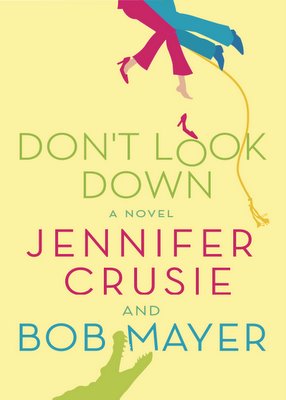
There are some gorgeous covers out there in novel land. Look at the one for Jenny Crusie's forthcoming novel, Don't Look Down, coauthored with Bob Mayer. Gorgeous. Colors, composition, it tells you something about the story... except it may give you the idea that Bob gets et by a gator. Which apparently is not true.
 .
.
.
.
.
.
.
.
.
.
.
.
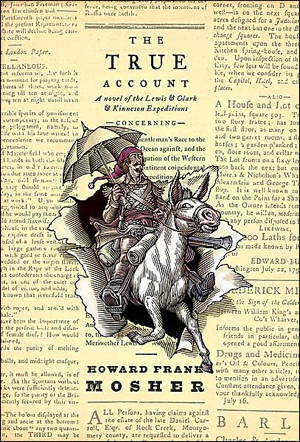
Now look at this novel from a couple years ago. I bought it for the cover. Haven't read it yet, but I will eventually, after I'm done contemplating the artwork. I love the use of the old newspaper style, the illustration bursting through the two-dimensional to give you a sense of a fully three dimensional story.
I have to go take some graphic arts classes. I really do. In my spare time.
I could not begin to count the ways. But I can give you a list of the things that I adore the most. Not the workhorse applications, you understand. The flash and sizzle. These are not in order of how much I love them, because that would depend on the day and project at hand.
1. Ecto, a desktop blogging client that renders everything Movable Type easy.
2. iTunes, because within this small computer on my lap I have organized 2,000+ songs (by title, artist, band, album, genre, etc etc), thirty plus full length unabridged novels, and various episodes of Lost which I have downloaded just so I can watch it whenever I please.
3. Tinderbox, which is first of all, very expensive but it's the only graphical note taking tool that has ever worked for me. Also, the icon is fuuugly but the innards of the thing do what I need, so really, I have to just get over the icon thing.
4. Bookpedia, my newest obsession. It has an interface like iTunes, I can scan in books in a second using a ten dollar CueCat, and by dog I swear all my books will be catalogued and organized by the new year. (Note: I only allow myself to open Bookpedia if I have written a certain amount of pages in a day. In case you were worried.)
5. StickyBrain grabs whatever I need it to grab and holds onto it. My brain isn't sticky enough. No age comments, please.
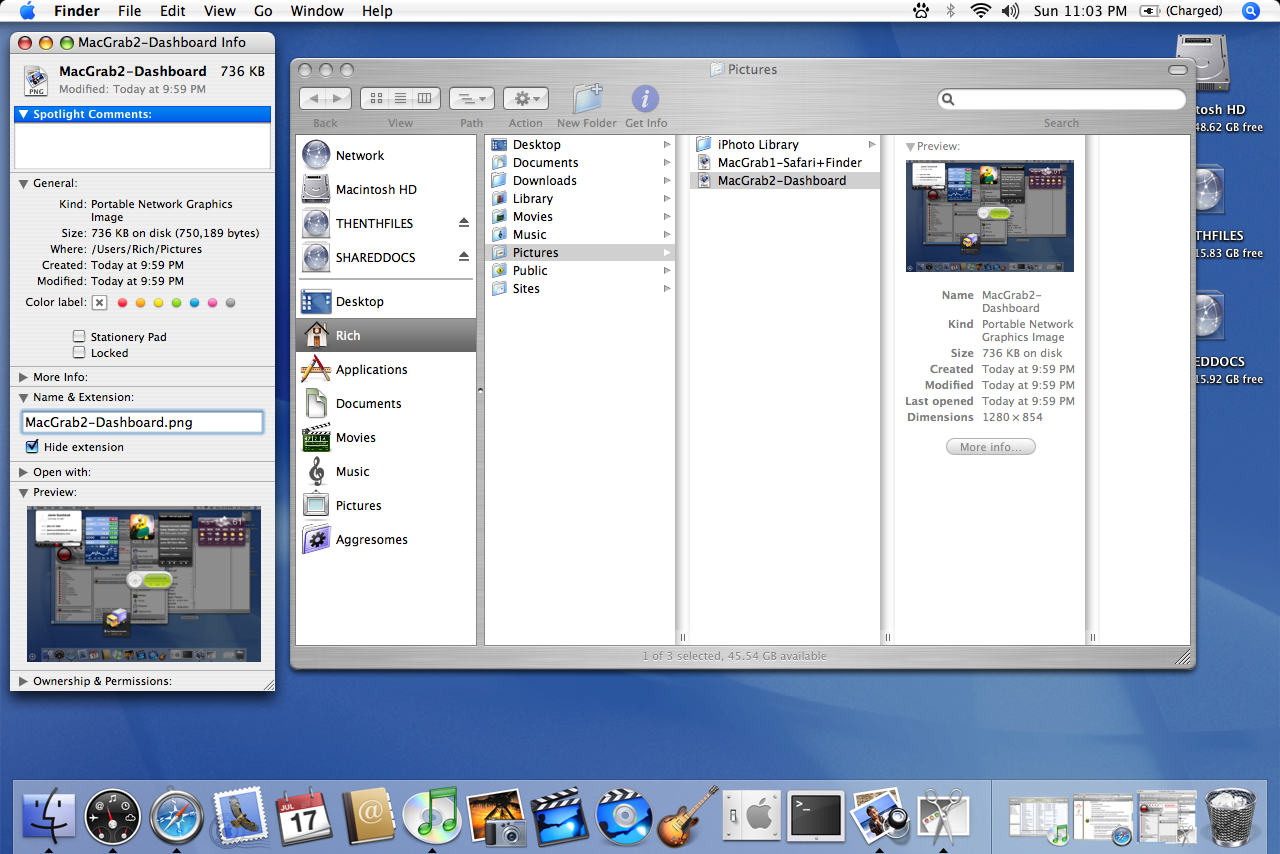
6. Widgets. There are hundreds of them. Some are useful, others are fun. Together they make up the Dashboard. You've got to see it to appreciate it. Like having a secretary right there.
7. I have a bit of a love/hate thing going on with Project Timer. It works like a charm. Which means I have to, as well.
8. Airport, which lives someplace inside this machine and makes it possible for me to check email, look things up on the web, and generally go round the world anywhere in the house without physically plugging into the ether. I am Wireless.
9. the desktop, which is easy to keep empty -- not a single icon. a clean slate. Made possible by the incredibly efficient Finder window.
10. Exposé and the splendid F11 key. In the middle of a project with a dozen windows on the desktop, sorting through them all is a pain. Never fear, F11 minimizes them all to the point where they are still legible, and then spreads them out on the desktop. Click what you want, and it comes up on top. I adore this feature.
You know I don't ask much. I've got a handful of shows I watch (via Tivo) regularly, and they satisfy my need for a certain kind of storytelling. Right now on the list: E.R. (shut up. I like it.), Battlestar Galactica (SciFi), Lost (ABC), Huff (Showtime), Rome, (HB0), the Sopranos (HBO), Deadwood (HBO). Jon Stewart (Comedy).
If you look at this list, what comes to mind? Nothing? Exactly.
With two exceptions, all of these shows are currently on sabbatical. Just, gone. Until January (to the people who schedule Lost: you have a mean streak a mile wide); or in some cases, March (damn you HBO) or even longer. Huff may not be coming back at all, which means I'll unsubscribe from Showtime.
Jon Stewart is still on, but he takes three day weekends and frequent breaks. E.R. is on once a week. Usually.
I am put out. I am mightily, sorely unhappy. Sunday night, and nothing worth watching on what, 300 channels? A travesty, I tell you. Shameful.
The reasons are many and complex.
(1) Rydra Wong does her usually coherant job of articulating her difficulties with the books, which pretty much echo my own.
(2) My daughter, who loved the books when she was little, went to see it full of excitement, and came home, crestfallen. She found the whole undertaking, in a word, cheesy, and worse still: now she can't overlook the blatant sermonizing, and so the books are ruined for her. She also pointed out that she appreciated the Harry Potter books specifically for their lack of a not-so-hidden moral/religious agenda.
Most people are aware of the fact that the majority of Asian language depend on tone as a crucial feature. Falling or rising tone within a single word is as distinctive as changing a vowel... so for example, the English words bit boat bat bait are all distinguished from each other exclusively by the vowel between the consonants. In different varieties of Chinese and Korean and other Asian languages, a word can have exactly the same sounds in a row and still mean different thing, depending on tone, or inflection. The classic example is ma in certain varieties of Chinese, which can mean horse or mother or a couple other things depending on how it's said.
Most people don't kinow about vowel harmony, which is a quirky thing that happens in a handful of languages, including Turkish. In the simplest terms, this means that if there's a certain kind of vowel in the first syllable of a word, it might have to change (or assimilate) to match the characteristics in a later syllable or even later in the sentence. If we did this in English it would work something like this: Round Midnight might become Rind Midnight -- so that the vowels harmonize.
If that makes any sense at all, I'll be surprised, but really I didn't mean to go into so much detail anyway. This was really just an intro to the odd fact that a writer in Turkey, a young man with the musical name Ömer Bahri Gördebak has a blog, on on his blog is a page about me. And on that page is an awful photo, in which I look like Jimmy Durante in the nose department. Now, I'm not vain about my looks because truthfully, there's not a lot to be vain about, but for some reason this bothers me. I know what my faults and strengths are. My nose is on neither list. My nose is on the could-be-better-not-too-awful list. I have never seen another photograph of me that made my nose look like this, so I assume it is some kind of fluke. Or a joke. At any rate, this public announcement: my nose was hijacked some time during the taking and development of this photo, and I disclaim any ownership of the one you see there.
Beyond this, I am consumed with curiosity because I don't have even a smattering of Turkish. I know about vowel harmony, sure, but otherwise, nada. I can usually puzzle out basics of things written in a European language I don't speak by some mysterious process that has to do with multiple historical and social varieties of English, German, Swiss German and Italian that I can shake up and pour out to use as a magic potion on, say, a French text or a Swedish one. What emerges is a basic picture of the content. But I have no idea about Ömer Bahri Gördebak, whether he is admonishing me for my frequently self-absorbed posts or what he considers bad advice on writing, or if he is claiming me as a long lost cousin, or if he is just posting photos of American women with big (or apparently big) noses.
Now that I've confessed my curiosity and straightened you out about my nose I'm going to go write some more.
ften historical novelists chose to work with an historical event that serves as a metaplot. By that I mean that if you want to tell a story about people who survived (or didn't survive) Hiroshima, or the Titanic, or Gettysburg, or in this case, the eruption of Vesuvius and the subsequent destruction of Pompeii in 79 AD, you have a certain set of facts and figures to deal with.
Unless you're writing alternative history, which I'm not going to address just now.
Robert Harris decided to write a novel about the fate of Pompeii when Vesuvius erupted, and to do that he had to (1) learn about the eruption itself, what actually happened in geoglogical terms; (2) create a set of characters; (3) decide which historical characters he wanted to use (the primary one being Pliny the Elder, who actually wrote a description of the eruption and then died in its aftermath); (4) construct a set of conflicts that would fit neatly into the structure provided by the eruption.
This novel is an excellent example of how to write this kind of story, I think mostly because Harris began with a major character who was believable and likeable. He gives us Marcus Attilius Primus, who at a young age becomes the aquarius of the great Aqua Augusta, one of the aqueducts that brought water from inland to the communities along Italy's coast. A water engineer would be one of the first people to take note of the signs of the coming eruption, even if he didn't know what to make of them, and in fact it's easy to imagine that there was a real person whose experiences paralleled those Attilius had to deal with. The drinking water brought to the coastal communities of Italy by the aqueducts -- engineering marvels that they were -- is corrupted by sulphur in some places, and goes dry in others. Imagine if southern California had one day's worth of water and you were the person in charge of the whole system. See? High drama.
The novel works on multiple levels. Historically, it provides wonderful detail and images and background; quotes from geological texts begin every chapter and bring the reader up to date on what is happening below the surface -- the information that the characters don't have; the main characters are interesting and engaging, and the conflicts intruiging. You don't know when you start who will survive, and who won't.
This is an action novel. It moves fast, it's exciting, and it's concerned primarily with the bigger picture rather than close characterization. But it does what it set out to do, and does it very well.

rokeback Mountain, if you're not aware, was originally a short story by Annie Proulx in her collection Close Range: Wyoming Stories. Now it's a movie, directed by Ang Lee, screenplay by Proulx and Larry McMurtry. And (according to my daughter and her friends, who cannot wait for this movie) a stellar cast.
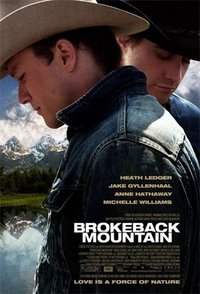
I listened to the story in audio format when I was driving through Wyoming, and so for me the two will always be linked. The natural architecture of Wyoming, the high plains and mountains, lends itself to storytelling of a particular type. It was almost hypnotic, the combination of words and scenery, and a story that is, in a word, tragic.
My daughter loved the story, is determined to love the movie. Her biggest concern is that people won't give it fair consideration because of the subject matter, which has to do with two cowboys who fall in love in a time and place when it was next to impossible for them to share any kind of life together.
But there are some indications that people are going to be more open minded than she expects them to be. I heard an interview with Willy Nelson, the original cowboy of all cowboys. Of course the interviewer asked him about his thoughts on a gay cowboy movie, and he smiled -- kindly -- and said: "I've been working on a new song. It's called Cowboys are Frequently Secretly Fond of Each Other. "
Whether you go to see the movie or not (I will be going with my daughter and -- at last count -- 19 of her friends), I recommend the short story. Annie Proulx is one of the few truly distinctive stylists writing today, and this is one of her strongest works.
 This novel, first published in the sixties, is Catherine Marshall's attempt to capture her mother's experiences teaching school in rural Appalachia almost a hundred years ago. It's told in first person, which was a brave thing to do for any daughter, trying to see through her mother's eyes.
I first read Christy when I was a teenager, and it made a great impression on me, and before you ask: I didn't realize that there was a television program based on the novel, and I have never seen it.
If you go searching for information about Marshall and this work of hers, you'll find that she was a devoted Christian, the daughter and wife of ministers. As I remember this novel, it wasn't primarily about religion or faith, although there is a major character who is Quaker. That character (Alice Henderson) was so finely drawn that I went and looked up more about Quakers as after finishing the novel.
Mostly this novel is about the community of people in the most remote part of Appalachia, and it was that part of the story that really struck me. Now I have to say that it is many years since I read this novel and my memory may not serve, but it seemed to me that Marshall avoided stereotype and cliche. I'm going to reread Christy -- it's still in print -- and see how I feel about it now. I'll let you know.
I've mentioned Cary Tennis before. He's a psychiatrist (or maybe a clinical therapist, I can't remember at the moment) who has a column at Salon.com. He answers letters, and I've got more than one story idea from his column. [Edit: Joy has pointed out that Cary is neither a therapist nor a psychiatrist. He's a writer. More about him here.]
If you don't subscribe to Salon it may be hard to get to this particular letter , so the short version: A woman writes to ask about her need for solitude, and the fact that while she loves her husband and wants to be married, she feels a strong need to have her own, separate household.
This is part of Tennis's reply to her:
My job is to cultivate thoughts, to grow them from little niblets into fully developed structures. The thoughts take time to develop. They need to develop uninterrupted. They're delicate crystals built in the air, each part suspended by an act of consciousness; they're precarious, like data in RAM, if you will: A crash, or a power outage, or any interruption of the system that holds them in crystalline suspension, and the whole thing falls down and you have to start over.
So if there are people around it can be hard to do the job.
Not everyone is a writer by trade. But many people have the same problem: Identity, or consciousness, or well-being, can be a delicate crystalline structure as well; any interruption and the identity crashes. Consciousness becomes muddled. There are people who are not writers who nonetheless live in the imagination, whose identities and sense of the world are precarious structures. They read books and think about the ideas in the books. Or they wake up from a dream-filled sleep and want to think about the dreams, which hover on the edge of consciousness. So even having to say hello to another person in the morning can make the whole thing collapse.
This really is what it's like to write, for me. I live inside my head mostly, and have to force myself to go outside and interact with the real world. Intrusions are destructive. I can't have music on at home while I'm writing because it invades and distracts. Though for some reason I can go to Starbucks, where there is music and talk and noise, and completely retreat inside my head and stay there with no consciousness of what's going on around me.
Then again this may be nothing more than ego and self-aggrandising twaddle.
I rarely look at Amazon reviews. I try not to, because it's frustrating, and there's nothing I can do about it.
Today, however, I had to go over there to check an ISBN and I looked at the first comment (most recent), to find this, from KT of New York:
The one big thing that threw me off was that this 'sequel' to 'The Last of the Mohicans' is actually for the movie version not the classic by James Fenimore Cooper. For one thing, Cora Munro dies in the original story with Uncas, and there is no mention of Hawkeye marrying anyone.So now I'm going to say this once and for all. I'm going to say it loud and clear: I never, ever said that Into the Wilderness was supposed to be a sequel to Last of the Mohicans. A reviewer called it a sequel to Last of the Mohicans and people assumed that the reviewer had his or her facts straight. This was the same reviewer who said my penname is Rosina Lippi and my real name Sara Donati. So, not a reliable source of information, okay?
Thus: Into the Wilderness is not, was never meant to be, a sequel to any version of Last of the Mohicans, movie, book, whatever. It was meant to be a retelling of The Pioneers.
Finally, let me point out that a retelling is just that: the story reimagined. I gave Hawkeye a wife, a son, a home. Because I wanted to. My retelling.
And now, less cranky:
Good progress today, fifteen pages, give or take. Jennet insisted on writing a letter, among other things.
Does anybody know of a website that will provide a list of ISBNs for a single title or author? For example, if Author X has four books out, and I put in Author X's name, I'd get a list of all editions of all books with ISBNs.
Or if I put in one title, I'd get all the editions, each with its ISBN.
Because you know, this would be great. Really great. If it doesn't exist, some clever person should put it together, she said hopefully.
Stephanie asks:
In my Amazon.com "Recommended for you" section today, they recommended a book also titled "Queen of Swords" by Judith Tarr. The subject is very, very different from yours, but I was just wondering about the duplication of title - can you do so, and if not, who gets to decide the new title? You, the publisher, name out of a hat?
By law, you can't copyright a title. They get reused all the time, as a matter of fact. A year after Into the Wilderness came out, there was another novel with that title. Fire Along the Sky was used as a title about fifteen years ago.
The only time the publisher hesitates about this is if they have another book with the same title on their own list. I wanted The Farthest Shore as the title for Dawn on a Distant Shore, but I couldn't have it, because Ursula LeGuin, who is also published by Bantam, had a book by that title. If she had a different publisher, I could have had it.
I wasn't aware of the Queen of Swords title, though. Thanks for pointing it out.
This was one of my father's favorite sayings, and he employed it in a variety of ways. For example, if he thought I was talking back: too big for your britches!; if he thought I was assuming too much: too big for your britches!; if he thought I was hinting for something out of our budget, especially. Then i was way too big for my britches.
Which is one of the reasons I never keep wish lists, because I'm sure my phone would ring and my father would be on the other end, telling me, in case I forgot, just how big my britches really are. He does call from the after life on occasion, usually in my dreams. We have funny conversations.
When we got married and had to do a registry, I was only really half hearted about it. You've got to be reasonable and put down a range of things to suit the people you love who aren't made of gold, and that is: all of them. So stainless steel bowls and salad servers go on the list. Boring, eh? But one person at least who came to the wedding and brought a gift really knew me. The mathematician's godfather. The gift they brought was a big box of perfectly laundred and ironed antique table linens, with lace and embroidery. Really first quality stuff. I was absolutely floored, just speechless. Of course I was glad to get the salad servers too. She said earnestly.
I learned something important from that experience: it's a good thing to go outside the wish list. I have never consulted one when buying a wedding or baby gift for a friend, and I think that usually I'm able to come up with something unusual but on target.
To be perfectly honest, We did get other unusual stuff as wedding gifts, too, but not necessary on target. Not on target: the second cousin who brought us a signed copy of her non-fiction book on Pope Pius, self published. On target: another cousin brought a small carved wooden spoon, really beautiful, with a piece of antique lace tied around it, and a note attached: my mother bought this lace from a peddler who came to our door in 1932. The spoon hangs on the wall, with lace and note still attached. I have no idea where Pope Pius has got to.
So small, thoughtful gifts are wonderful things, but I'm here to confess that on my not for public consumption wish list I've got a lot of really expensive rare books.
For example, I lust after Wondrous Strange: the Wyeth Tradition, which is a hard cover edition of the museum exhibition catalog featuring the illustration work of the Wyeths, who I adore. But really what I want is the limited edition that the museum put together, in a slip case. That costs just about two thousand dollars more than the standard edition.
This is what I'm wondering about, this yearning I have for books that are not so much books as monuments to a book. A three dimensional artwork created out of a book. If I owned the slip case version of Wondrous Strange, I'd never open it. I'd be sure to have the cheap version too as a reading copy. I've got maybe fifty books in my collection that are collectible -- a lot of them first editions/first printings signed by the author. I've never handled those books more than I needed to to make sure I was getting what I paid for. In each case I have a crappy paperback copy too, for reading.
I'm not sure why I am so moony on this topic. I've never been able to figure it out, and I know how weird it is. If I said to the mathematician husband, sweetie, I want this $500 edition of [insert title] for my present, yes, I do have three other copies of it... yes, okay, I would just leave it on the shelf and look at it...
I would talk myself out of asking for it. In fact, by posting this I am sort of innoculating myself against spending money on rare first editions, signed or unsigned, slipcovers or not. Really. No urge at all to go looking, not even a twinge. I know exactly how big my britches are.
My editor just sent me the cover for TTTT. Gold foil where you see gold color, and the resolution isn't excellent on this scan, but this is basically it.
Certainly anybody who sees it will know it's set in the south, no?
A confession: I wish I had published Homestead (and TTTT) under a penname. It just shocks me to see my name on the cover like that, and not in a good way. I could have had such fun renaming myself (or, re-renamiing myself). Evangeline Grant. Graciela Luna. Mimi Occhiogrosso.
Too late now.
Finally, a good way to catalog and keep track of my thousands of books. Bookpedia. And now that we have high speed WIRELESS DSL in the house, I can work (or not work) anywhere.
In case you were wondering: good progress today, about ten pages.
The BBC has an incredible set of photos from the recent historical reenactment of the Battle of Austerlitz, which was fought in 1805. More details from Praha:
The battle of Austerlitz is also known as the Battle of Three Emperors, because the rulers of France, Russia and Austria: Napoleon Bonaparte, Czar Alexandr, and Francis I, took part in the battle themselves.
I love the people who do historical reenactments. Nobody knows the details better. This time 4,000 of them (yes, 4,000) went all the way to the Czech Republic for the reenactment. And there was snow, even. A well organized reenactment is better than the most meticulously done movie, because all senses are brought into play. Until you've heard artillery up close, you have no idea how loud a battle is.
And besides: there are some really, really nice looking uniforms. And men inside them.
I read this line someplace, and I can't remember where. But you know what? I do have a recurring dream about flying. In it I realize that I've always been able to levitate and move around the room in an upright position, two feet off the ground. All I have to do it breathe deep and flap my hands very fast. In the dream I remember I can do this and then experiment with it, flying farther with each try. Always inside, just moving around the house.
And I'm so pleased to be able to do this, as if I am discovering a talent I didn't know I had. I have perfect pitch!?! Wow. I can fly! Who knew?
I'm sure a therapist would have a grand time with this. It's pretty transparent to me but I'm sure I'm missing something obvious anyway.
when it didn't come yesterday, I thought maybe I had ducked the bullet. But here is it:
Hi, keep checking your site to see if there's an update of queen of swords. now that it's december, just wondering if you have delivered it to bantam, and when expected release date will be, and when it will be available in australia.I'm working hard here. Really, I am. I plan to have the darn ms. to Bantam by the 31st of the month. After that, it's up to them and I don't have any more idea than you do of dates. Really. When I know, you'll know.
It's great that people are so looking forward to this book, really. I'm pleased. But believe me, I know what day it is.
It's blog against racism day. Big topic, eh? I fear I can't do it justice, so first I'm going to point you to two other posts: the ever articulate Monica Jackson, and BumblebeeSweetPotato.
So two works (one film, one a short story) that have influenced the way I think about racism:
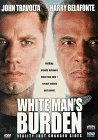 BBSP's post reminded me of the 1995 movie White Man's Burden. The script is weak, and there are multiple problems with the way the movie is put together, but you know what? It does what it set out to do. I showed it twice when I was on the faculty at University of Michigan, both times in what was then my signature course: Language and Discrimination. And both times I showed it, chaos ensued. Because white kids were shocked out of their heads by it. It really upset them, and in a good way.
White Man's Burden is on the surface a pretty simplistic idea. Just swap colors, so that white America now has the history and social standing of black America. Now tell a story about racism and discrimination. The movie fails on some levels because of the way it approaches this task, but what matters is that white kids came up to me afterwards and said, oh. I get it now.
Did they really get it? Maybe. Did they keep it? Maybe. But at any rate, it was a step in the right direction. Because those white kids in my class had never personally experienced any kind of racism, but through the movie they got the slightest taste of what it would be like. And they didn't like it. This was a 'click' moment (as described by BumblebeeSweetPotato), which are hard to come by when the subject is racism.
A short story that I often re-read because I simply love it (for its language and characters and imagery) is Toni Cade Bambara's "My Man Bovanne". It's about mothers and adult children, about getting older, about racism. It's about the importance of oral tradition (now, there's something we need to talk about -- another big topic, one nobody takes on). It's far more subtle and interesting than White Man's Burden...
Cause you gots to take care of the older folks. And let them know they still needed to run the mimeo machine and keep the spark plugs clean and fix the mailboxes for folks who might help us get the breakfast program goin, and the school for the little kids and the campaign and all. Cause old folks is the nation.A true masterpiece of storytelling. And this brings me to my final point.
In my last post I was very critical of Letters from an Age of Reason specifically because the author, who is white, attempted to portray the character of a young black slavewoman by means of manipulating the spelling of her dialogue, as though this could tell us something about her command of language, and in turn, her intelligence, her view of the world, her potential.
So here's my request: unless you grew up speaking the language of the black community, don't try to wing writing it down, okay? Because disaster will ensue. If you need to represent dialectal differences, which sometimes really is a necessary element in telling the story, then do your homework. And do more homework. Read Toni Cade Bambara, and Alice Walker, and the other writers who grew up speaking the language you are trying to emulate. To do anything else is a disservice to the community of people who speak the language. It is, in a word, disrespectful, and another word: lazy.
I was looking forward to this novel. I'm sorry I can't recommend it. I'm going to make a short list of things I think are important for historical novelists to contemplate, points where this novel went wrong.
1. If you want to tell your story in epistolary fashion, stay true to the form.
Rarely do people recount whole conversations in letters using quotation marks and the conventions of fiction.
2. Letters are interesting because they provide a way to bring out the writer's personality in a way that limited third person POV narrative can't. If letters or journal entries are being juxtaposed, it's crucial that the two are strongly distinct from one another.
3. Pay attention to the details that make the character realistic within the setting. For example, in 1860, a person who has little money could hardly afford to send a thirty or forty page letter from New York to New Orleans.
4. If you find it absolutely necessary to write one character's dialogue in an approximation of the dialect they speak, be careful that the character doesn't come across as stupid or caricatured -- which demeans the author as well as the character. Letters from an Age of Reason provides an example of exactly how not to handle dialect in dialogue; I kept thinking of Prissy in Gone with the Wind, a high screeching: don know nuthin bout birthin no babies Miss Scarlet, dat's da trut!
5. A big, complex plot can be a great thing, or it can trip you up. Sometimes, less is more.
I didn't like this novel, in fact, I found a lot to dislike -- intensely dislike -- about it. If anyone would like to argue for its merits, please. I'd be interested.
A good while ago I put the 7x7 feature in the right hand column. Because I was thinking about my birthday next month, and trying to think what I'd miss about being 49: and thus was 7x7 born. Now I find that bloggers hither and yon are 7x7ing. Is this coincidence? I couldn't find the origin of the meme, but I'm wondering.
Have I been robbed? And if so, do I care?
...Nah.