" /> storytelling: August 2005 Archives

take me to the front page of the tttt weblog | back to the current weblog

« July 2005 | Main | September 2005 »

August 31, 2005

old photo


Watching television coverage of what's going on in New Orleans certainly brings things into perspective. And then today I ran across this old photo, which also makes me stop and think and be thankful.

This is my daughter, age one, reading to me. We are very fortunate people, and we are aware of that.

tough old lady in a hard place

I'm following the situation in New Orleans like everybody else, shocked and distraught and wondering what the hell the disaster preparedness office was doing for the last fifty years. Edited to add: see this five part report from the New Orleans Times-Picayune called "Washing Away." None of what's happening comes as a surprise.

I have spent a good amount of time in New Orleans, because I like the place and I'm writing about its history in this new novel. I like all of it, the gritty parts and the tacky parts and the pretty ones. I've spent a lot of time in archives and libraries. Given the damage and destruction to the lives of thousands of people I am a little embarrassed to be worried about books, but I can't help thinking about the Historic New Orleans collection, about Pitot House (see below), and about a hundred other artifacts that probably won't survive this disaster.

Robyn sent me links to the Wikipedia news articles, which I find a lot more useful than network news, so if you're interested, here they are: general information, and a really frightening bit about the toxic overflow. I'm also scouting around for the best way to send money for the relief effort. At this point some people are estimating that it will be four months before the city is habitable again. There are a lot of low income people in New Orleans and the greater effected area, and they are going to need on-going help. If you have any suggestions, please speak up.

Finally, a repost of part of what I wrote about my New Orleans research trip in Janury of 2004:

I did a lot of research for the trip and made plans, and got pretty much everything in that I needed to do. The re-enactment of the Battle of New Orleans at Chalmette was high on the list, and that was indeed a good thing to see. People who spend so much time and energy doing reenactments are a wonderful resource. Who else knows what it's like to wear woolen underwear all day long? And it's one thing to see a uniform in a color plate, and another to see it on a man walking along the levee. Also, I always forget how loud the artillery fire is. I'm surprised anybody who fought in those battles had any hearing left.

The most instructive and interesting place was the Pitot House, (French Colonial/West Indies in style) built in 1799 on Bayou St. John. It's been carefully restored and is maintained by the Louisiana Historical Society. We were fortunate to be the only people touring that morning, which meant I could ask all the questions I usually hold back for fear of slowing things down too much or boring less inquisitive types. Kathy Collins (our guide) was one of the best informed and most helpful people I have ever run across at a historic house. We got into such an interesting conversation that I took up a good hunk of her morning.

The house itself is the kind of place historical novelists are always looking for, with an atmosphere that is so strong that you can -- for a few moments -- get the sense that you are no longer in your own time. The furnishings, the way the light falls, the air itself -- everything comes together in a very powerful way that allows the imagination to take over. I'm going to use the Pitot House as one of my settings in this novel. I will make some changes, of course, but then I will set my characters loose in its rooms. Kathy was kind enough to share the names of some of her ancestors with me, and I may well end up using them, as well: Jean Baptiste Baudreau dit Graveline is especially nice, but from Kathy I also found out more about the Pelican Girls (also called Cassette Girls).

In the early 1700s, the first families and young women came from France to the new French colony at what is now Mobile, Alabama. Many of the girls came from Parisian religious communities, and they were all approved first by the bishop (who made sure they were virtuous, but also hard workers). These young women -- some no more than fifteen-- married the French Marines who were already stationed at the colony. Prime material for a historical novel, if anybody's looking.

August 29, 2005

two more questions from Karen

Will the fifth book mention a little of what happens to Hawkeye out west? I know that in THE LEATHERSTOCKING TALES, Hawkeye did go west but I missed him greatly in FIRE ALONG THE SKY, just like I am going to miss Curiosity when her time comes. She is a great character and you have used her to great advantage in the telling of this saga.

I like Curiosity a lot, too, and it's a matter of great satisifaction to me that my readers are so devoted to her.

As far as Hawkeye in the west, I can't give you any promises. In fact, it's unlikely. He doesn't want to communicate with me, and unless that changes, we'll have to all imagine him hunting in the Great Tetons. And even if he did ... see the answer to the next question.

Have you ever thought of writing a prequel with the story of Hawkeye and Cora? Since you gave some of the movie's dialogue between them to Nathaniel and Elizabeth you may not wish to do that.

I get asked about a prequel quite a lot. The short answer: probably not, given the current state of the business.

At this point in time, historical fiction is considered out of vogue. The publishers are convinced that readers don't want historicals, they want contemporaries. Which is a good part of the reason that the Wilderness series is up in the air after Queen of Swords.

Sorry that I don't have more upbeat news for you, but that's the nature of the business.

August 28, 2005

When insomnia strikes, this is what happens

I've upgraded the Movable Type software that runs this weblog (or rather, the good people at Living Dot did the updating), and now there are all kinds of new toys productivity tools. For example, with this very post I am testing the new notification setup. Supposedly you can choose to subscribe to a particular post if you want to follow the conversation.

Which would require that you converse, of course. But first things first. Let's see how this works.

Edited to add: it doesn't work. Carry on without me while I see if I can hammer out a solution.

It's all Robyn's fault


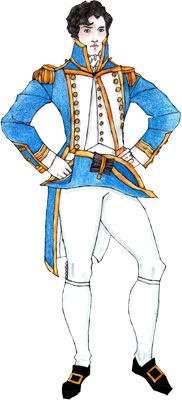
Capt. Wentworth
I've admitted here that I have a terrible weakness for illustrations and illustrators, and now this: Robyn the Enabler sent me the link to The Gallery of Paper Dolls.

These are not playthings, please understand. The dolls are the work of the artist Donald Henricks, someone with a very long and impressive list of fashion credits to his name. Just look at his rendition of Captain Wentworth from Persuasion, and note the attention to detail. And the really tight breeches.

You know that I write historical fiction, and I put a lot of energy and effort into getting the details right. That includes clothing. Which means that I have an obligation to study some of Mr. Hendricks' designs, especially the ones of Austen's characters in stories set in the time period I'm writing about.

That's my story, and I'm sticking to it.

While you're over there, be sure to look at Nijinsky and at Alice and Wonderland and -- well, hell. Look at all of them.

August 27, 2005

reviews, redux

I am a regular visitor over at Smart Bitches. Sarah and Candy have got a good thing going, one that was long overdue: place where people talk about the romance genre with serious intent, thoughtfully, and without apology. Strong voices, strong opinions, without lots of exclamation points, laughing out loud, or cutsey icons.

It's not that I'm always in agreement, but I do find it all interesting. Take this post (Why Evil Reviews Are So Much More Fun Than Nice Reviews) -- which I just read today. There are already fifty comments, so I'm going to write something here rather than pile on the heap over there.

Two things to start with: I haven't read all fifty of the comments, and, Candy makes it clear that she's talking about a certain kind of review:

Assume, for this article, that I’m talking in particular about well-written, entertaining reviews by people with a better-than-tenuous grasp on English and logic, and not poorly-written hack reviews, either positive or negative.

Candy likes evil reviews because she finds them funny. Here's the thing. No matter how you define 'fun' or 'funny' (and she goes to some trouble to do that before she gets going), a really evil review just doesn't make that cut for me. I might draw in a sharp breath at the clever tone or because of a particularly snide turn of phrase, but I don't get any enjoyment out of a review like that. Even if I hated the book, and even if I dislike the author. I will admit that I'm absolutely capable of schadenfreude (see the post a few days ago about envy) -- but if the reviewer goes overboard into the realm of the evil, I lose that tingle that goes along with the affirmation of my righteous indignation.

Also, I admit this: I write novels for a living, and by necessity, authors have a different relationship to reviews and reviewers than readers do.

I have been thinking about reviews a lot lately, which is partially why I picked up on this post of Candy's. Over at the RBA website I recently made an argument againt including ratings in reviews. No stars, no pluses or minuses or letter grades. Just the reviewer's take on the damn book. Why it worked, why it didn't work. Because really, what are reviews for?

That's the question I'm struggling with. Are reviews a way to pick books to read? To advance the discussion of narrative and characterization? To talk about the state of the world today? To show off the reviewer's education and clever mind? To stroke the author's ego?

I know what I want from a review. I want a clear idea of (1) what the story is about (without giving a lot away); (2) the reviewer's take on the strengths and weaknesses of the story. I don't want a diatribe on the author's background or political views. I don't want an essay on the inherent lack of value in genre X, or the sublime nature of first person narration. I want focused, straight forward information and opinions. I don't want funny, but I'll take it if doesn't get in the way.

So now I'm wondering if I'm alone in this boat. What do y'all want from a review?

August 25, 2005

Tied to the Tracks - Australia

We've had a very nice offer for Tied to the Tracks from my Australian editor, and it looks like readers down under will be seeing it in their bookstores within thirty days of the U.S. pub date (July 2006).

In other news, I have been writing really well the last week. Superstitious woman that I am, it was hard to type those words, so please think good thoughts, and if you are so inclined, join me in the sacrifice of copious amounts of chocolate to the muse. That way we'll all be happy.

August 24, 2005

Jenny Rising

Jenny Crusie has been really kind to me at various points in my career when I needed encouragement and advice. There have been some phone calls which were memorable for me because I got off the phone feeling better and with an idea of How to Proceed. On the few occasions I've spent any time with her, she has made me laugh. It was Jenny who encouraged me to smuggle my dog Tuck into a restaurant on Whidby Island, so he could sleep on my lap while a whole table of authors drank too much and told stories out of school.

And I love her stories. I truly admire the knack she has for building female characters of a certain kind, and her flare for dialogue. And all the rest of it. She and I are nothing alike in the way we approach storytelling; I couldn't be her, and don't try.

So Jenny's had a roughish time the last year or so. She tells the story of Hitting the Wall and then finding a German Shepherd to help her get over it on her blog, here. Jenny is collaborating with another writer -- an ex Green Beret (Bob Mayer) who loves violence as much as she loves shoes -- and I can't wait to read the result. It's coming out next May, and it's called Don't Look Down. If you go over to her blog you'll find links to more information about the book, and also an inspiring story for those of us who are coping with the inevitable trials of women in their fifties.

There is also a huge and chatty Yahoo group to discuss Jenny's books and everything else under the sun, here. I don't belong to this group so what goes on is a matter of curiosity for me, but on the other hand, it would feel like intruding, so I don't knock on the door. But you could.

another Karen-esque question

She asks:

This is my most burning question. When I wrote of your series to my book group, I used as a subject line "A book that takes liberties with a movie that took liberties with a book". That you did not adhere to strictly to the tale did not bother me. The stories you wrote are of Hawkeye's later life. However, I do have one gripe--the name changes. It didn't bother me that you stuck with the movie's switching from Cooper's plot and having Uncas'passion for Cora transfered to Hawkeye. I also understood completely that Bumpo was replaced by Bonner (even Michael Mann did not use Bumpo). Furthermore, Nathaniel is much to be prefered over Natty. But why didn't you let Hawkeye keep the name Nathaniel instead of giving it to his and Cora's son? I found it very confusing that Hawkeye is no longer Nathaniel but Daniel. Daniel is a good name choice because of the relationship of Daniel Boone and Kentucky but wouldn't it have worked better to let Hawkeye keep the name that Cooper and the movie gave him, and call his son Daniel instead? It took me the longest time to sort that out-- especially since some of the dialogue that takes place between Nathaniel and his "Boots" (love that appellation) in INTO THE WILDERNESS was dialogue that occurred in the movie between Hawkeye and Cora ("I'm looking at you, Ma'am"). As a result, it is hard to sort out the personality distinctions between Hawkeye and Nathaniel in your books. These characters blur in my mind so that sometimes when Nathaniel is speaking I see Daniel Day Lewis' face when that is the face I should be giving to his father Daniel.

I am sorry to have confused Karen (and anybody else whose trying to sort through the various fictional lives of these long-lived characters).

However. When I sat down to tell the story, I had to make it my story. Not Cooper's, not Michael Mann's (who directed the lovely movie version with DDL). Which meant rethinking things, and for me, that started with the names. So I talked to the characters and thought about it a lot. Thus my Nathaniel and Elizabeth, and Nathaniel's father Daniel, and all the other characters.

Here's a bit of trivia you might find interesting. When I am working with a less ... admirable character, one who I don't like and think my readers probably won't like for whatever reason, I usually find a name for that person in my own family's genealogy files. I named the Widow Quick after a great (9) grandmother of mine. I suppose that sounds mean, but it's better than foisting her off on somebody else, no?

Also, people have asked me if I named Elizabeth after my daughter, or my daughter after Elizabeth, to which the answer is a resounding NO. My daughter's name is not Elizabeth. My daughter's name is Elisabeth. This may seem like an overly fine distinction to you, but to me they are completely different. In the same way, somebody pointed out that I named Will Spencer after my husband. Which really threw me for a loop, until I remembered that Will and Bill are both short for William. But my Bill is not a Will, and could never be. So no, one was not named for the other.

And that's all I have to say about my character's names, except that the whole process of naming them is draining to the extreme, because they are usually more obstructive than helpful.

August 23, 2005

empty your cache

and behold, the new header. As so many of you didn't like the simpler version, I have gone in the other direction.

So I'm a 49 year old woman who likes to color and play with crayons. So sue me.

August 22, 2005

Six Feet Under

If you don't get HBO and don't care about what's on HBO, you probably won't be interested in this post.

Last night Six Feet Under came to an end. A series finale, they called it. I had given up on SFU two seasons ago because I didn't like the direction it was taking, and then came back again this year and stuck with it. The writing was edgier this last season, and I was curious to see how they would bring it all to a close.

It's hard to end a series, of course. Friends, for example, ended on a weak episode. So did Seinfeld. M*A*S*H* ended well, as I remember it.

Six Feet Under's finale was surprising, emotionally fulfilling, funny, touching, glorious.

The majority of the episode followed the major characters as they came to grips (or failed to come to grips) with personal demons following from the sudden death of Nate Fischer, the oldest of the three Fischer adult children. Some of these plot lines were handled better than others. Rachel's acrimonious arguments with Nate's ghost were disturbing and completely believable to anybody who has a new baby and a boatload of self doubt.

They all end up around the dining room table telling stories about Nate, the kind of spontaneous wake that I hope they'll have for me some day. I thought, well, that's a solid, sweet, unsurprising ending -- but it wasn't the end at all. First we get Nate in a white tux singing "I Just Want to Celebrate another Day of Living" and then things really get rolling, this time to "Breathe Me" by Sia.

The last ten minutes or so were comprised of watching Claire driving across country, intercut with flash forwards as each of the main characters reaches milestones: weddings, births, but most of all, deaths. We see each of them come to the end of his or her life, followed by the gravestone with dates of birth and death which has been the symbol of the show all along.

It was really masterfully done. The characters get older, we see them at picnics and around hospital beds and getting married and on cruise ship decks and at work. They die quietly or violently, peacefully or in pain. Sometimes in their last moments they see the people they have loved, waiting for them. Sometimes they don't. Some of the deaths are expected, some a surprise. Some are funny. A very old Brenda is listening, still, to her brother Billy's self involved ramblings about people who won't love him back. You know that this is a scene that has been repeating itself for seventy years. Brenda's eyes roll -- at first it seems she is having trouble hiding her impatience and boredom -- and then you realize she has just died. It made me laugh out loud. Perfect.

On the HBO website they've included the obituaries for all the main characters, here.

Ending a television series is in many ways like ending a series of novels. I hope when I get to that point, I will do it with half as much grace and style.

August 21, 2005

no comment?

I've been married for a good long while, and marriage is one of those partnerships that needs lots of attention or it starts to slide into the mudge. You take each other for granted. You don't notice the little things, or even the big ones. For example:

You get your hair dyed and cut and nobody notices, or nobody says anything. A hundred fifty bucks paid for the priviledge of having a woman who wears a size four stand next to you in a mirror for an hour while you are looking your absolute worst swaddled in towels with your head in a plastic bag, and the response at home?

Nada. Zilch.

Hey! Wake up, buddy. Look at my expensively coiffed head.

Oh. Yes, it looks good. Is that a new color?

I do it too, of course. He comes in and stands next to my chair for ten minutes, we talk back and forth while I keep my eyes on a fiddly bit of fabric. When I do look up, there it is: a pants leg bloody from the knee down. Would he have ever mentioned it, if I had never looked? There is that two inch scar on his arm that I swear wasn't there a year ago that I'm almost afraid to ask about. So, maybe not.

All this leading to the acknowledgement that you and I are no longer in the honeymoon stage. You flit in, see if I've got anything to say that might amuse you, and off you go again. No comment on the new, simpler, cleaner header on this page. You hate it, you like it, you want the old one back -- you really hadn't noticed.

See? Mudge.

August 20, 2005

readers who write

I've had quite a lot of letters and emails lately with many, many questions about things that happened (or didn't happen) in Fire Along the Sky and what's coming next.

It's clear to me what's going on here. I get impatient the same way when I have to wait for the next book in a series I like. So I'll do what I can to help, by answering some questions from Karen (though not all at once). To start with:

1) What was Dolly Wilde's ailment? My own thinking was that it was Alzheimer's Disease which can strike people as young as in their 30s and 40s.

That's actually an interesting idea, but no. Rachel diagnosed Dolly quite well (post partum devolving into schizophrenia), but she actually died from rabies and exposure.

2) In the same vein, was young Robbie Bonner a victim of diptheria?

Yes. Diptheria was a common cause of death in children in this time period.

3) Will Nicholas Wilde's daughter, Callie's story be told in the fifth book? I thought what happened to Nicholas to be one of the most moving parts of FIRE ALONG THE SKY. He was a good, if flawed, man and he lost so much that it is no wonder he took that suicidal journey. When he took up his prize apple tree I thought perhaps he meant to start over. Later when Nathaniel, in telling of his death, made no mention of the tree, I exclaimed "What about his tree?". I was so glad he left it for Callie and my hope is that his legacy will live on in her hands.

Callie's story is quite complex, as it currently stands in my conception of the long-term story. It may be a long time before that part of it gets told, so I'll have to hope you can be satisfied to know that Callie does pick up where her father left off with the apple orchard.

4) The points of view of the children of Elizabeth and Nathaniel have been represented in their female children Hannah and Lily. Will we get more of Daniel's point of view in the fifth book? If we are lucky you will have to give us Gabriel's story too.

You will see almost nothing of Daniel in the fifth book, because things are focused almost exclusively on Jennet, Luke and Hannah and they are far away from Paradise. Daniel is having a hard time of it, I can tell you that. I can also tell you that he does come to grips with his situation, and that the next book in the series (which may be a very long time in coming, be forewarned) will deal with him as a focal character.

I'll pick up here tomorrow.

August 19, 2005

email woes

If you sent me email after July 11, it has dissappeared into the ether. Entirely my fault.

This action cannot be undone.

Please resend any email you might have sent, if you were still waiting for a reply.

what matters

Every once in a while I mention Getupgrrl, who has been keeping a weblog ever since she first started infertility treatment a long time ago. I'm only one one hundreds and hundred of people who have followed her story, which has been consistently thought provoking and funny, but otherwise spanned the emotional gamit from frightening and tragic to this newest chapter, in which a healthy child is born. He was brought into the world by a good woman who agreed to be his gestational surrogate. She will forever be his birth mother, though the egg and sperm that created him came from Getupgrrl and her husband.

Getupgrrl's story isn't there for you to read in its entirely. She's had trouble with people filching her stuff without permission, and so she only leaves one or two posts up at a time. I'm hoping she'll turn the whole thing into a book at some point, because it's a story that deserves to be heard by a wider audience.

In the meantime, you can read her post about the day her son was born.

What a lucky boy he is.

August 16, 2005

another public service announcement

Today I received an email from Mary Doria Russell (author of the fantastic A Thread of Grace, which I reviewed here some months ago, as well as The Sparrow and Children of God). She sent this message to a whole squadron of people she knew would be disturbed by the role Barnes & Noble played in the story she had to tell.

Mary gave me permission to post the entire message below, in the hope that some of you might take the time to write to B&N; and protest.

Fellow fans of the U.S. Constitution:

When I began a 21-city book tour to support A Thread of Grace, I was prepared to deal with Holocaust deniers and anti-Semitic skinhead nutjobs who might show up at bookstores to harass me. I figured I could do that without an armed guard, but evidently Senator Rick Santorum isn't as confident that he can handle folks exercising their constitutional rights to free speech and freedom of assembly.

The Republican from Pennsylvania has written a book called It Takes a Family, which outlines his beliefs that women shouldn't work outside the home, that the government should discourage birth control, and that gay marriage will inevitably lead to the legalization of polygamy and bestiality. Evidently Senator Santorum anticipated that his ideas would spark controversy.

For his August 10, 2005 visit to the Barnes and Noble Bookstore in Concord Mall (4801 Concord Pike, Wilmingtom DE 19808), Santorum had Delaware State Police Sgt. Michael DiJiacomo to protect him -- not from skinheads, anti-Semites, and Holocaust deniers -- but from two teenage girls. Although he was off-duty and privately employed by Senator Santorum, Sgt. DiJiacomo was in his state trooper's uniform.

I know one of the girls personally. Miriam Rocek is the daughter of old friends of mine, Dr. Tom Rocek and Dr. Karen Rosenberg -- married, by the way, to each other for 30 heterosexual years without benefit of a constitutional amendment forbidding gay marriage.

The Barnes and Noble event was billed as a book signing and discussion, but the girls were told to leave by "Santorum's private security detail." When they said they hadn't done anything wrong, Sgt. DiJiacomo told them they were under arrest, and took them outside. There, he made them stand for frisking, and while he didn't actually arrest them, he told them they were "banned" from the Barnes and Noble and from Concord mall.

Barnes and Noble's Amanda Winnington, the community relations manager for the store, confirmed that the girls were asked to leave because "Rick Santorum's security team felt they were going to be a security threat." She also confirmed that only customers who had a receipt for Santorum's book were allowed to come near him.

After 5 book tours, I can tell you that nobody is required to buy my books before they dare to approach me. I talk to anyone who cares to listen, and I hope that my presentation persuades them that reading my books will be worth their money and their time.

I am not terribly surprised that Senator Santorum feels his ideas are so indefensible, he needs armed guards to protect him from those whose opinions differ from his own. Bullies always seem to need a group of enforcers to back them up. However, I was amazed that the staff of Barnes and Noble failed to stand up for the rights of their customers, and ALL United States citizens, to assemble at a public event in a public place and ask questions of a public servant who was there to hawk his book like any other author.

This morning, I spoke to the manager of the Delaware store, and she says that the store staff was taken by surprise and deferred to the senator's security team. I pointed out that if Senator Santorum did not wish to be in a public place with other U.S. citizens exercising their constitutional rights, the senator should have been told he could leave. According to the manager, the incident has been discussed within the store, and their district manager has now given instructions that the store staff is never to cede its authority to conduct business in a perfectly legal manner to anyone -- not even pushy off-duty cops in the employ of an author, regardless of that author's day job.

You've got lots of choices for where to buy your books, and I hope you'll take this into account when you decide which bookstore to patronize. I believe B&N; owes Miriam Rocek and the other girls an apology, and should formally bring its policies regarding signings into compliance with the U.S. Constitution.

Mary Doria Russell

P.S. If you would like to express your opinions about this incident, feel free to contact:

Barnes and Noble Corporate Headquarters
122 Fifth Avenue
New York, NY 10011

They don't have an email address, probably to cut down on mail like I hope you'll send.
To read the news article about the Santorum event, click here.

lend a hand, get a hand

I don't know Marianne Mancusi, haven't even read any of her novels. But the woman is in a bind -- she lost everything in a fire while she was away.

The woman does have a lot of great friends, many of them also authors, who have put together an ebay auction with all the proceeds to help Marianne out of her tight spot. You can bid on a manuscript critique by Jennifer Crusie, Suzanne Brockman, Steven Axelrod or a dozen others. Also lots of signed books and other good things. Have a look, here.

August 15, 2005

the new RBA website

Sayimabitch

The Romantic Bitches Association

a nonprofit organization dedicated to readers, aspiring writers, writers, and publishers of romance fiction
website is up and running, though there are still lots of little things to sort out.

Click on Pollyanna here to be magically transported to the main page. So you know what you're getting into, this bit from the FAQ page:

But the word bitch is so... combative. Aren't you afraid of being seen as... well, bitches?

Let's face it, there is a double standard. If a woman is complaint, seeking to please, and nonconfrontational, she's a doormat or an easy slut. If she's noncompliant, independent, or just plain inconvenient, she's a ballbreaker or a bitch. (And there are plenty of other derogative terms o­n both sides of the spectrum.)


We refuse to feel bad about standing up for ourselves and being independent. We refuse to feel bad about reading romance novels and discussing them; we refuse to feel bad for having been born women. Hell, most of us like being female. (It's better than the alternative sometimes.) We are, in some small part, reclaiming the word "bitch" and turning it into a term of endearment.

August 14, 2005

observations

1. Characters are bossy sumbitches, and also, they withhold vital information. Sometimes even getting a character to own up to a full name is hard work.

2. If I believed in past lives, I would have to conclude that I once died of a blow to the head with a blunt instrument. Mostly because I dream about such a blow on a fairly regular basis; sometimes I am on the receiving end, and sometimes I have got the blunt instrument in my own sweaty hand.

3. Things I would like to believe in, but can't: reincarnation. little people who live in the walls, aka the borrowers. the soul. infinity (my husband, the mathematician says that this inability of mine to believe in infinity stems from my fundamental misunderstanding of the time/space continuum). that I will ever finish the book I'm writing. that I will ever finish the next one. that laser eye surgery really is safe, and that it would be possible for me to see without glasses. that glasses make a person look thoughtful and intelligent.

4. Why is it that when you think of going to the movies, the one movie you might want to see always started ten minutes ago?

5. There is something inherently agitating about warm Sunday afternoons.

August 13, 2005

intrigues literary and criminal

Various writers out there in the blogosphere have been posting about writerly envy, and so now I'm going to jump on the bandwagon. But first I want to get some clarity on what these words mean. Because for me, there's a difference between envy and jealousy:

envy: you've got something I would like to have for myself.
jealousy: I've got something I don't want you to have.

Now, the semantic fields for envy and jealousy are starting to merge, so some people will use jealousy and envy interchangeably. But here, at least, I'm trying to keep them distinct.

There's also a big difference between 'to envy' and 'to covet'. I might envy Rapunzel her beautiful long hair (I'd like to have hair like that) but to say that I covet Rapunzel's hair would mean that I plan to snatch her baldheaded and run off to make a wig for myself out of her hair.

So this extended example:

I love your house, someday I'd like to build one just like it. (I envy you your house.)

I love my house so much, I'm going to copyright the plans and make sure nobody ever builds one like it. It's all mine and nobody else's (I'm jealous of my beautiful house.)

Honey? You know the neighbor's house I love so much, the one they don't really deserve? Well I've taken care of it. Just don't go digging around in the vegetable garden, okay?

All clear?

So now the question: who to envy.

There are many, many writers whose talents I admire so much that I'd have to admit to envy. Of course. Wouldn't it be lovely to write as quickly as Joyce Carol Oates? Imagine having Dorothy Dunnett's ability to weave complex story lines together, and her talent for historical setting. And while we're at it, why not admit that I'm envious of dozens of poets? If I could go out and imbibe a quart of Emily Dickenson and have her inhabit my mind so I could write poetry for the ages, I surely would do that.

One definition of envy: the ability to observe, analyze, admire and set goals for yourself. I aspire to be as good at blank as writer x is.

Envy gets really complicated when money enters the equation. Am I envious of the success of other authors? Let's put this another way: when Stephen King's next book comes out and debuts at the number one spot, and then sticks there for weeks and weeks, do I envy him that success?

Yes, and no. Sure, it would be great, but the feeling I get is fleeting and almost without emotion. No unhappiness or regret or anger. I'm fairly easy with this kind of thing. I think that as a kid, any uge to compete was systematically drummed out of me, and now I just automatically avoid any competitive situations. Really, what sense would there be in coveting King's success? That's not a realistic goal to set for myself. What I can do is to carry on as I have until now, trying to write good stories that people will want to read.

Where I have really been envious, it has almost always had to do with being excluded from some group activity that appeals to me. The only example I can come up with here is a workshop being taught in a really, really nice place. Another writer, who teaches at this workshop regularly, introduced me to the organizers (without prompting -- how's that for a good, kind friend?) but no invitation ever resulted. So am I envious of her? Yes, I envy the opportunity, but have no wish to take it away from her. I don't covet it.

As far as jealousy is concerned, is there anything I already have that I don't want other people to have? I'm talking about myself as an author. Do I feel threatened in my own (moderate) success if you are also successful as a writer? If you come up from behind and make a tremendous success of yourself while I continue to plod along? Do I wish you ill, so I can feel better about myself?

I think not. I've been digging around in my memories for any sins that fit into this rubric, I can honestly say I can't think of any. There are books out there that are successful for reasons I don't understand, but that's not the author's fault; it's my problem. On the other hand, if another writer who has irritated me one way or another falls flat, am I above schadenfreude? Of course not. I'm human, after all, and though I might feel guilty about such a lack of generosity, I would definitely get a thrill if tomorrow everybody woke up and said, wait a minute. The DaVinci Code really wasn't very well written and the story was full of holes, so you know, I think I'll just get Dan Brown's next book out of the library.

I'll admit: that would make me smile, and that smile would be mean of me.
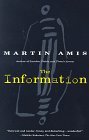
Before I forget, the best fictional treatment of this question that I have ever come across is The Information by Martin Amis. From the inside flap:

Fame, envy, lust, violence, intrigues literary and criminal--they're all here in The Information. How does one writer hurt another writer? This is the question novelist Richard Tull mills over, for his friend Gwyn Barry has become a darling of book buyers, award committees, and TV interviewers, even as Tull himself sinks deeper into the sub-basement of literary failure. The only way out of this predicament, Tull believes, is the plot the demise of Barry.
This novel is guaranteed to make any writer squirm, because Amis peels the writerly ego like a banana, and it's quite a painful process. It's also black humor of the first rank. For example, Richard Tull, enraged and completely powerless in the face of his friend's (he believes, undeserved) success, comes up various ways to make him pay. For example, he searches all over London and comes up with the full Sunday edition of the Los Angeles Times, which weighs what, about five pounds. On top of this huge pile of a newspaper he puts a note that says something like 'thought you'd be interested to see the reference to your work' and then it leaves it on the other guy's doorstep. He then has a gleeful week, imagining Gwyn going through the whole Sunday LA Times, page by page, only to discover that there's no mention of his novel in it anywhere.

Who but a writer would think up something like that? It has the absolute ring of truth. And of course the newspaper caper doesn't work out for Barry as he hoped it would.

So yes, writers are capable of envy and of coveting a friend's success. Authors are artists, and egos get wrapped up in the work. You invest a year or two years or more of your life in a story, and it's hard, sometimes, to remain objective when things don't go as you'd hoped. But there are ways to handle it that don't involve digging holes in the vegetable garden or lugging around piles of newspaper. Like, you could write a novel.
August 12, 2005

dialogue | Deadwood | Sci Fi

I have been watching the first season of Deadwood on DVD, and finding all kinds of interesting bits to admire. This line of dialogue jumped out at me, as it did the first time I heard it:

I begrudge that pervert his capacity for happiness.

Ebfarnum This from the hotelier E.B. Farnum (played by William Sanderson), who provides a really excellent example of complex characterization. On the surface E.B. seems like nothing more than a weasel without any scruples, but there's a lot more to him. He's completely self aware and unapologetic, but more interesting: he's articulate in a stilted, sometimes funny but often strikingly on-target way, so that I find myself wondering what kind of family he came from. He must have had some education, and yet here he is in an outlaw town, nickel and diming himself to wealth, sleezy as Eddy Haskel, and twice as scruffy. In fact, I just realized: he reminds me of a less-than-successful Iago. Just as manipulative and scheming, but without the personal charm to really pull off a coup.


If I think about a secondary character this much, it means (to me) that the writers and actors have done an excellent job.

In case you're wondering, the man whose happiness he's begruding is a regular visitor to The Gem Saloon, a man with a fetish that has earned him the nickname the titlicker.

It's Friday evening, which means I put everything down except whatever bit of sewing I'm working on to sit in front of the television with my husband so we can watch the Sci-Fi channel. The three shows, in order: Battlestar Galactica, Stargate Atlantis, and Stargate SG1. Of these three, I'd have to say that Battlestar Galactica is the one that I like best for its storytelling and writing, although there isn't a single character that stands out for me above the others. I wish I could say that I liked Stargate SG1 as much, especially as Ben Browder of Farscape has joined the cast (permanently) and Claudia Black is there for the first five episodes or so... but. It's an established show with an established writing staff, and I'm just not a huge fan of the style or the premise, which often strikes me as having run its course. I love seeing Ben Browder in a new role, and I think he's doing a fantastic job with the material he's got -- but the material itself is lacking. On the other hand, early Farscape had some eps that didn't work, and that came around beautifully. So I'm giving SG1 every chance. And as others have pointed out to me so cleverly, it is actually good to see the actors whose work I followed so closely for four years in new roles that allow them to stretch in different directions. Although it does take some getting used to to have Claudia Browder as the flirty bad girl with an exhibitionist streak.

August 11, 2005

Fire Along the Sky, and other things

Tomorrow morning I have to email my editor at Bantam the changes/corrections to Fire Along the Sky. Which means I have some work to do this evening, to finish up. I'm having a hard time concentrating on anything much at all because I've got four different books I'm reading at once and they've all caught my interest to a greater or lesser degree.

This all reminds me of when I was in grade school and my father would tell me to put the book down and go out to play. Except now I have to put the book down to write.

The books I'm reading are: Kostova's The Historian (thus far, I am not very impressed); Mitchard's Theory of Relativity (I like her novels in general, but this one took a while to grab my attention); Eisler's Rain Fall (the first in a series of crime/hard boiled-type novels); and Lippman's The Power of Three (almost finished, and thus far, the best of this bunch).

But back to the page proofs.

August 8, 2005

jump right in

Emmanuelle, who is French, but who is married to someone from Martinique (and speaks the French Creole of that Island) very kindly supplied some sentences I may well be able to use in Queen of Swords.

So now my question is: what other languages (or varieties of languages) do y'all speak fluently? And, can I ask you questions about those languages?

To get this off to an entertaining start (and to see if it would work) a few sentences that probably require an idiomatic translation. By idiomatic I mean: you can change the word order or use an expression that gets across the idea. So go on, show me what you've got. Please.

1. Don't look at me, I had nothing to do with it.

In northern Vorarlberg Alemannic (a variety of Swiss German) this would be something like: was luagascht? I hae mit deam doch nuentz z'tuond.

2. That boy is dumb as a post.

August 7, 2005

more language issues

I'm trying to stay focused on Queen of Swords as things are at a critical moment and I don't want to lose momentum ... but I will be back to talk about the dialect in dialogue issues some more.

In a related matter, I'm still feeling my way in the current language situation. In 1814 in New Orleans the dominant languages were French and French Creole, Spanish, English, and Mobilian Pidgin (a trade language of various Native American languages with a French base). It's a delicate business, providing a sense of the linguistic time and place without overwhelming the reader, and also I have to be realistic about how much energy I can invest in the research. It would take a long time to get a real sense of early 19th century French and French Creole. The Native American languages would take years.

I do have a Dictionary of French Creole which is big and heavy and has lots of example sentences, as well as a French-Creole and English-Creole section, but the danger is that I fall into it and can't get out again. For example:

Ki lemiro soulye to met mo ti zanfan? What size shoe are you putting on my children?

Piti a piti zozo fe so ni. Little by little the bird makes its nest.

I tell you, it's hypnotic.

August 1, 2005

why proofreading (yet again) is necessary

WhyOhWhy is any of this necessary? If it's all stored on a computer disc somewhere already proofread and then printed, bound and sold, why is there any reproofreading needed for another printing? Enlighten us non-writers.

Posted by: asdfg at August 1, 2005 04:54 PM

It's necessary because the manuscript was typeset for one configuration (hardcover) and had to be revised for another (mass market paperback). Errors can sneak in during this process. Lines or paragraphs go missing, stray letters creep in and make nests for themselves. Participles fall and dangle. All manner of chaos is possible.

This is also an opportunity to correct any factual or continuity errors. For example, some time ago there was a discussion of my lack of attention to Charlie LeBlanc's reproductive habits. I gave him a lot of children and then forgot that he had them. But at this moment I can't find that discussion, and so it's going to be hard for me to fix Charlie's predicament. Another example: a carefully written letter from a reader who informed me that I know diddly squat about eagles, had their nesting material all wrong, and should desist from writing about them until I mended my sloppy ways (and in fact, I did get the nesting materials wrong -- mea culpa).

And of course, this is the time for me to deal with anachronisms. If I knew where they are hiding, I would do that. However, if history repeats itself as it usually does, I will get six emails each outlining a different anachronism in great detail -- right after the paperback edition comes out, when it's too late to do anything about it. Which happened with Lake in the Clouds.

So, if anybody wants to say something about Fire Along the Sky, NOW would be the time.

modeling

One technique I have used with some success in advance writing classes is called, simply enough, modeling.

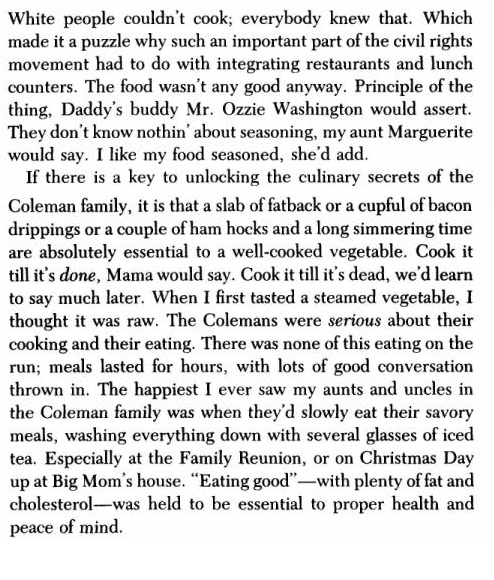
You take a strongly written, very short piece -- no more than two pages of a short story or chapter or non-fiction essay -- and you change the premise and the characters, but you keep the sentence structure and paragraphs and try to maintain the message. I had a lot of luck with an excerpt from Henry Louis Gates Jr.'s Colored People, a collection of essays. The part I used had to do with his recollections of family meals and cooking. (You can click on the thumbnail here to read the first paragraphs.)

Students were asked to shift the identity of the narrator to a fictional character and also to shift the ethnicity of the family and its location. I had students write about Polish families, Irish families, WASP-like families, often with great success.

When first confronted with a modeling exercise, students sometimes balk. It feels like cheating, they tell me. It feels like stealing. But in fact it's just an exercise, like playing Bach and Mozart to get yourself in a certain mindset if you compose music. By forcing yourself to use the form at hand, you are also liberating yourself to think in depth about the target issues: family conflicts, ethnic identities, public personas.

So I'm thinking now it might be useful to do some modeling on the basis of Peter's small speech. I'm wondering if I can recast that paragraph and have Peter become an elderly Italian woman insulted by her son's mother-in-law, or a young Korean immigrant who takes offense at a teacher's condescension. What will have to happen is, each line of the dialogue has to be examined for those markers that make Peter who he is, and transformed.

Stay tuned.