" /> storytelling: July 2005 Archives

take me to the front page of the tttt weblog | back to the current weblog

« June 2005 | Main | August 2005 »

July 31, 2005

typos

I just got the page proofs for the paperback edition of Fire Along the Sky. Let me tell you, it's hard to read these proofs yet again with the degree of attentiveness called for. Bantam also has a professional copy editor reading it, but it's my sworn duty to do the same.

Now, if you happen to remember seeing a typo or some other kind of infelicity in Fire Along the Sky, do speak up. (Rachel, I'm looking at you.)

No doubt Sister Joan, who was my eighth grade homeroom teacher, would consider this cheating. I prefer to think of it as a cooperative effort.

July 29, 2005

the secret to syntax

It's really simple, actually: listen.

If you pay attention to the way people talk, you'll realize that in common interaction, spoken language is nothing like written language. Try taking down sentences you hear word for word, without adding anything. You'll see that lots of stuff is simply left out, without any problems.

What the hell do you want? will often show up as Hell you want? or The hell?

Did you eat yet? as You eat yet?

Your grade school English teachers might object, but the sentence I did not feel like it sounds stilted and forced (which of course may be what your character is feeling, and then it's okay); more likely somebody will say Didn't feel like it.

These are all obvious points of syntax that you can observe, most probably, in your own spoken language. In order to write realistic dialogue of somebody who speaks a variety of English other than your own -- or English as a second language -- you need to watch for patterns of difference. So Candy's example from her comment was interesting:

here are a couple of grammar/syntactical quirks about Chinese (specifically, Hokkien):

- We don't conjugate verbs.


- We don't use "to be" before adjectives. Instead of "she's short" or "he's stupid," literal translations of Chinese sentences would read as "she short" or "he stupid." Or, even more literally, "it short" or "it stupid," since our pronouns are not gender-specific.

The dropping of the verb "to be" is a grammatical feature found in a lot of languages. The copula (look at the root of that word, and see if you can figure out the connection) is used where subject and object of the verb are semantically the same, or linked. Susan is a doctor (Susan=doctor) shows up as Susan doctor in a whole variety of languages, and in some varieties of English as well. So if you're writing a character who speaks Hokkien as a native language and learned English later in life, you need to actually listen to such a person to find out what syntactic patterns from the mother tongue have been transferred into their English.

If you look at Peter's short speech again, you'll see lots of syntactic strategies found in a number of varieties of English, including AAVE (African American Vernacular English), for example: I ain't never been call a nigger by no white folks. Multiple negation is the rule rather than the exception in the languages of the world. The more negatives in the sentence, the more forceful the negation (forget the two negatives make a positive thing, which was thought up by some anal retentive schoolteacher in the 1800s; that's not the way language works).

What you can do, if you have a character who is a native speaker of a Hokkien or Norwegian or Swahili (or a variety of English other than your own, such as Innisfree or Capetown or Mobile) is find somebody to listen to, and make notes of what strikes you as distinctive.

My husband is a Brit, and I have long lists of things from him. Examples: Are you going to stop at the store? I might do. Do you think I should call them? I should, if I were you. What took so long? We were trying to catch Thor up. How is Jeffrey? He's still in hospital.

Before I go on with this tomorrow, I wanted to point out a few things. First, the most distinctive thing about language is often its rhythm, but prosodic notation just isn't possible in a novel, beyond the occasional use of italics. And second, all of these notes have to do with writing dialogue, and thus with the representation of spoken language. The application of these methods to narrative is a different matter entirely, and I'm not going to go into that here.

Now I have to go write my 5,000 words for the day.

July 28, 2005

dialogue with a twist (part the first)

I have to admit, first off, that the part of me that is a linguist cringes a little at the shortcuts I'm going to take here. By rights I should start with a discussion of what accent is (everybody has some kind of accent, okay? You do, too.) and the differences between social evaluations of speech and the idea of grammaticality. But that would mean a whole course on introductory linguistics, and you're not interested, and I don't have time.

So this shortcut: linguists don't judge language as it is used, they observe, record, analyze. Steven Pinker's quick explanation:

A taxicab can flout the laws of the state of (insert where you live here) but it can't flout the laws of physics.

The same is true of language. There are grammatical laws which nobody violates because in the process of acquiring your native language, they became embedded in the way language works in your mind. If you are a native speaker of English, so you'd never have to correct your child in this way:

Lucy! Stop putting your articles after your nouns!

But you might say:

Lucy! Don't say ain't!

The first case is parallel to the laws of physics; the second case to man-made laws. People have opinions about language, which they work hard to enforce. What I'm going to be talking about here has nothing to do with that. I'm going to try to make clear what goes into capturing the natural variation in language that signals a person's social and geographic allegiances.

Ok. Now I feel better.

If, as I've suggested before, it's best to avoid playing with spelling to get across language variation, what's left? There are three primary kinds of variation that are helpful in representing dialect in dialogue.

The first is syntax, or the order in which words are strung together. Every language as physics-type rules about this, things you don't think about because they are so deeply engrained. In English, for example, how do you build a question? You need some kind of helping verb (as my fifth grade teacher called it) or a modal verb. Do you want something to eat? This strategy is particular to English syntax. Most other languages don't take this approach. In German: willst du was essen? would be translated word for word as want you something to eat? If you've got a waitress in your scene and she asks a woman at the counter want you to order something? You know this is not a native speaker of English.

The second area is lexical choice. You remember that Peter, as an African-American slave in Georgia circa 1862, used the word hoppergrass for what most people call a grasshopper. That kind of regionalism is very useful, and there are tons of them. At the grocery store I ask for my stuff to be put in a paper bag, but there are regional alternates. The same is true of pancake and gymshoes and dozens of other words.

The third area, the last one I'm going to talk about, is idiom, or turns of phrase. This is something that is often overused by writers of fiction, but if you do your research it is possible to come up with really useful idioms that move beyond faith and begora for a stereotypical Irishman.

So I'll start to look at syntax tomorrow. If you speak a language other than English, you should think about how that language is different in the way it strings together sentences. The same is true for regional varieties of American or British English.

July 27, 2005

censorship of a specific kind

Over at Smart Bitches Candy has a longer post on the appropriation (or, hijacking, as she puts it) and manipulation of the term politically correct.

She's right about this, of course. Linguists have been watching the evolution of the term and writing about its semantic shift for a good while. Deborah Cameron provides a great deal of information on this in her book Verbal Hygiene: The Politics of Language. She's got some great examples of how the term has been overextended in the oddest ways. One I remember, from a woman calling into a talk show on dieting: "I know that salt is not politically correct, but..."

And of course there's Bill Maher, who gleefully proclaimed himself politically incorrect, and made a successful television talk show out of that. Really, what he was saying was rather simplistic, and it went like this:

I'm going to say what I think, and I don't care who it offends. I won't be censored.

But even so, there were restrictions on what he could -- and did -- say. He couldn't slander or harrass (because the law would stop him), and he chose not to use racial epithets (I would guess because he had no wish to use them, but also because the television station would have stopped him). He could say things like: I think all this stuff about racial profiling is hogwash -- which he did, in a limited way. That caused a lot of discussion, which wasn't necessarily a bad thing. He could have said (but didn't, to the best of my knowledge): Minorities have it too easy in this country. That would have offended and enraged a lot of people, but he would have been within his rights.

Maher seemed (and still seems, on his HBO show) to be focused primarily on political issues, and taking unpopular positions in a devil's advocate kind of way. This went well for him until he said, post 9/11, that it was wrong to call the hijackers cowards. Whatever else they might be, he said, it took some courage to fly a plane into a big building for your convictions.

He lost his show over that statement, which underscores nicely what I set out to say here: political correctness is an overly simplistic term for a very complex set of rules set up to regulate the way we conduct ourselves in public. If somebody breaks the rules (in this case, the rule Maher broke was something like: never show understanding of, or interest in, the underlying factors that motivate people who attack the US).

Another thing to consider about what we call political correctness is simple courtesy. People have a right to name themselves, and to have those names acknowledged. My father took offense at being called a Guinea (unless another Italian was using the term). I've heard someone say she wants to be called a Lakota Sioux rather than an Indian or a Native American. Where I'm aware of what people want to be called, I will certainly do my best to honor those wishes.

Except. When I was teaching at Princeton I had a student who took great joy in reinventing himself. Every few days he'd stand up in class and declare himself newly minted. Today he wanted to be called James Elroy, tomorrow Mombera Ato something or the other. If I forgot and called him Steven, he'd correct me. Finally I had to take him aside and ask him to settle on one name a week, as it was becoming disruptive. He was not pleased, but then this had more to do with exhibitionism than some deep need to claim an identity.

Finally, I want to say something about the discussion of political correctness and historical fiction which is going great guns in response to Candy's post. As somebody who writes historical fiction I'd like to point out something: it's impossible to be completely accurate and true to the historical record sometimes. The best way I have to demonstrate this is with a really disagreeable, horrid word: nigger. This is not a word I use in conversation. It is so fraught with historical baggage and pain that it is best simply avoided. And yet, there was a time when the term was in common usage and wasn't so weighed down with terrible associations. To try to understand this, think of the word Oriental, which was once common usage but which is now slightly out of tune. These days Asian is the preferred term. Oriental makes some people wince. Now, imagine two hundred years from now the word Oriental getting the name reaction in conversation that nigger gets today. If you were projected forward in time and used the word Oriental in conversation, you'd be mystified at the reaction you got.

So torn between the demands of historical accuracy and simple good manners and courtesy, what can an author do?

You know the answer. You simply can't use the word nigger, or have a character who is supposed to be even vaguely sympathetic use it. There are other questionable things you can get away with by appealing to historical accuracy -- a widely loved character can give his wife a light beating to make a point in th 18th century (if you handle it just so) -- but that same character could not talk casually about a man he ran into on the street and call him a nigger.

So my take on all this is that these discussions tend to skirt the underlying, more complex issues. They are certainly important and need to be discussed, but I don't think it's possible to resolve them in any functional way.

a closer look at dialect in dialogue

I'm thinking that I might take the time to be more specific about this topic. I've had a lot of email over time concerning the Peter Post, which leads me to believe people -- especially aspiring writers -- would like more detail.

So I'm going to look for a few passages to work with, long pieces of dialogue which would lend themselves to being tweaked. Maybe I'll just stick with the example from Peter. We can look at lexical choice, syntax and idiom and try to turn Peter into a Scot, a native speaker of German, a native speaker of Russian or Korean, and whatever else comes up.

July 26, 2005

on hiding things

Dianna asked:

I was just wondering if you ever hide historical information in your stories.

For example, I just learned about how green-papered rooms killed many in the 18th century via arsenic fumes. Of course, people didn't figure this out for a long time.

And I got to wondering if authors, such as yourself, hide this kind of historical information in the plot without making it explicit. For example, having a character die an unexplained death in a bedroom with green wall paper.

Do you write in layers - the explicit layer and the secret layer?

Just wondering - it's a lark of a question by a non-professional.

This kind of thing has come up a number of times when I'm writing about illness. I know what is wrong with character X because I've researched it, but medical knowledge of the time wasn't so far along. For example, I'm guessing nobody picked up on what killed Dolly Wilde -- beyond the fact that she was suffering from exposure during a winter storm. There are a lot of hints, but unless you were really paying attention and were able to sort out one set of symptoms from another, you probably wouldn't pick up on it. Any quesses?

The other more obvious case was the epidemic in Paradise when so many people died of what seemed like very different causes -- sepsis, childbed fever, putrid sore throat. The same agent (strep) was at work in all these cases but in 1802 that hadn't yet been determined.

There are a few other such cases, but I'm not going to point them out, specifically.

July 24, 2005

oooh, shiny

Remember I said that once in a while I'd post novel covers that I like? I'm paying more attention now because soon I'll be asked about my thoughts on the TTTT cover. Here's one I like a lot for its simplicity and elegant lines. Wouldn't be right for TTTT, but it caught my eye and my imagination.

I also like this cover, which is nothing like the first one. It's complex and intriguing and the colors work for me. I love the use of text to the top of the image, but I wish they had skipped the stark white blurb at the bottom, which distracts and unbalances the whole.

Finally, they've re-released Marilynne Robinson's Housekeeping: A Novel, which I greatly admired the first time around. And now look at this fantastic cover. A little too sober for the rather sharp TTTT, but I'd be thrilled anyway if I got something like this.

a book worth looking at

I saw The Seven Basic Plots: Why We Tell Stories in a book store in Boston (and to the person who posted in the comments on this topic: yes, great bookstores in Cambridge, no question). As it's a big fat book in hardcover, I didn't buy it until I got home.

I love the title of this book already, and the bits I read in the bookstore made me want to read the rest of it. You'll note, if you go to Amazon or look at reviews such as this one by Denis Dutton at the Washington Post, that the critics aren't much pleased with this book, though Dutton gives Christopher Booker credit for his style:
Booker, a British columnist who was founding editor of Private Eye, possesses a remarkable ability to retell stories. His prose is a model of clarity, and his lively enthusiasm for fictions of every description is infectious. He covers Greek and Roman literature, fairy tales, European novels and plays, familiar Arabic and Japanese tales, Native American folk tales, and movies from the silent era on. He is an especially adept guide through the twists and characters of Wagner’s operas. His artfully entertaining summaries jogged many warm memories of half-forgotten novels and films.

I wish as much pleasure could be derived from the psychology on which he bases his hypothesis. Booker has been working on this project for 34 years, and his quaint psychological starting point sadly shows its age. He believes Carl Jung’s theory of archetypes and self-realization can explain story patterns. Alas, Jung serves him very poorly.

I have yet to sit down with this book, but I'm keeping an open mind. I'm not so interested in the psychological underpinnings of a grand theory, as I am in the fact that Booker looks at storytelling of all kinds and doesn't priviledge one over another. I wonder what he thinks of fan fiction.

I'll review this when I've worked my way through, which may take a while.

Fire Along the Sky, and other bits of news

The paperback edition of Fire Along the Sky is due out in November, and here's the cover. The ever watchful Rachel must have seen that it was up on Amazon, because she asked if I liked it.

I like it better than some of my covers, but I'm not sure that it gives a sense of what the novel is about. This cover makes me think of the wild west and vultures and mesas and deserts.

So now I have good news and less good news. Not bad news, really. Good news or not-so-bad news first? Good, I think.

While I was in Manhattan this last week I signed the contracts for Tied to the Tracks, which will now be coming out with Putnam. That wasn't the original plan, you may remember. Bantam has published all the Wilderness novels and indicated great interest in Tied to the Tracks, but after lots of talk and back and forth, there was a major Change of Plans.

Leona Nevler is my new editor at Putnam, which means she's the person who acquired Tied to the Tracks (and also Pajama Jones). Leona has been in the business a long time, she's insightful and sharp and funny and elegant in a Jackie Kennedy kind of way. Of course, that meant I was doomed to spill something -- not once, but twice -- on my white blouse during lunch. But she made light of it, which was very kind.

So the bottom line is that Queen of Swords may well be my last novel for Bantam, but I have a new nest at Putnam/Berkeley, and I feel comfortable there already. Which brings me to the other news.

I think I have to face the fact that I'm not going to get Queen of Swords to Bantam by October. I hope to get it done by January, though. This means that QS won't be out until (at the eariest) the fall of 2006. I get a dozen emails every day assuring me that y'all are eager eager eager to read QS, but you can be sure of two things: I'm just as eager to finish it as you are to read it, and I'll do everything in my power to make sure it's worth the wait.

What I'm hoping is that you'll find Tied to the Tracks (which should be out in the spring or summer) a suitable stopgap.

July 23, 2005

catching up

After a long day on the road we're back home in the land of cool afternoons. It's very good to be home.

There are quite a few questions that have piled up in the last ten days, which I will post about as time permits. There was a question about writing dialect, a couple about novels that incorporate letters in various formats, and just after I left on this trip, a question on how to get published.

Also, I have some fairly big publishing-type news to share, which I will do in short order.

Finally, though I haven't mentioned her in a while, I do check in with gettupgrrl regularly. After so many years of heartbreaking infertility treatment it seems as though her baby boy has arrived. At least she posted (somewhat cryptically) to that effect two days ago:

Ladies and handful of male readers, we are beginning our final descent into something completely different. The captain has now turned on the "Fasten Seat Belts" sign. At this time, we ask that you discontinue use of all electronic devices, stow any carry-on items, and bring your seat backs and tray tables into their full and upright positions. Please remain in your seats until the plane has come to a complete stop.

Remain calm, do not panic, and practice the zombie survival skills that we discussed earlier.

Thank you. We hope that you have enjoyed your flight.

I'm starting to worry, a little.

July 21, 2005

gremlins

just trying to sort things out; please stand by.

July 20, 2005

Manhattan

I grew up in Chicago, which is not a temperate place. When I was a kid the television weather report was pretty much predictable in the months of July and August. I do remember word for word one report: Humidity 96%, temperature 97 degrees: RUN FOR THE HILLS. The weather guy said that, and now I remember why.

Somewhere along the way, living in places like Austria and the Pacific Northwest, I've lost my ability to cope with the heat. I've been in Manhattan for three days and I feel like a wrung out dishcloth -- and things aren't all that bad. Temperature 91, humidity 56. And yet, when I went outside it felt as though I was being enveloped in one of those hot moist towels they used to give you on overnight flights to wash your face. And before you remind me, I know that there are people in much worse conditions. Hurricane Emily is out there stomping around, causing trouble.

What this does remind me of is writing the part of Lake in the Clouds that is set in Manhattan in the summer of 1802. I remember thinking that Hannah wasn't taking enough note of the heat. When I raised this topic, she scoffed. The heat didn't concern her. But still, I asked her, isn't it hard for you to be wearing O'seronni clothes in this weather? O'seronni clothes were always uncomfortable, she reminded me. So I concluded she had no real observations or comments to make about the weather, and she did not.

We have looked at many colleges and run around the city and I hereby declare today a Personal Break Day, in which I am not obliged to go study anything. I worked in Manhattan for two summers and came here at least once a month while I was in grad school, so if I don't get to see the Empire State Building yet again, I am not so concerned. Instead I'm going to write, and I'm going to luxuriate in the air conditioning, and when the mood takes me, maybe I'll go out -- but not too far -- and find some food.

Back to Hannah, twelve years older -- and still pretty much impervious to the weather, although right now she's in New Orleans, December 1814, and it's cold and wet and pretty nasty in its own way. Though I have to say, that sounds pretty appealing to me at this moment in time.

July 16, 2005

Curiosity's hand

Curiosityhand
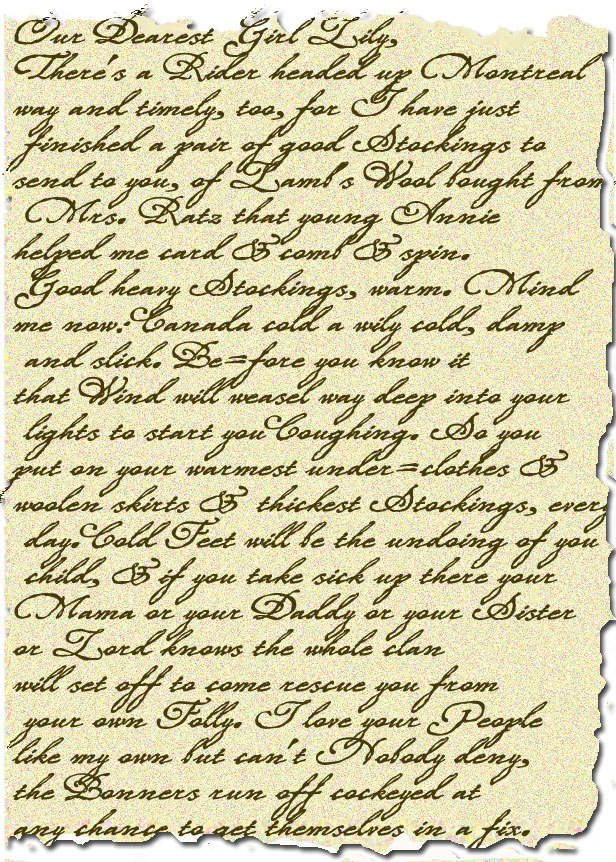
Rachel indicated some interest in Curiosity's handwriting. Here's a fragment from a letter she wrote to Lily when she was away in Montreal. Click on the image to get a full sized version.

You'll see that Curiosity's handwriting has grown a little unsteady with age.

July 15, 2005

pen and ink

Today I sat under a tree on the campus of Boston College with a yellow lined pad and a really cheap pen. This, because I left my computer back at the place we're staying and I had an hour to kill. I had no real thought of writing a scene or anything of that order, and found, as I sometimes do, that pen and ink are a good way to break through problems.

Hannah is in a situation just now and I have been unsure of her actions and reactions, but after writing just a few sentences -- or really, questions to her directly -- it suddenly sorted itself out in my head and I found the whole scene ready to be birthed. Right there on that rather uncomfortable bench on a hot summer day.

I don't really understand why this works sometimes (and other times, does not work) but it's a nice surprise when it does.

Tomorrow the others are going to run around Boston, and I'm going to sit down and write. I lived in Boston for a year and I know it pretty well and really, I'm not so interested in seeing the tourists stuff themselves into Faneuil Hall. So I'll ice my very sore knees and write and hopefully get all this stuff in my head down in a form that works.

And then we're off to Manhattan.

one more thing

I have this idea about the manuscript for Queen of Swords, which I will share though you may think I'm nuts.

If you know the earlier novels in the series (and even if you've just read Homestead) you'll know that I use a lot of letters and other kinds of documents as part of the storytelling process. I like to do this. In fact, I need to do this to make the story work for me. Sometimes it's the best way I have to get in touch with the characters. Elizabeth writes a letter to Jennet or Lily, Curiosity writes to Daniel, Nathaniel to Hannah, Gabriel to Luke, and their voices come to me very clearly as I take dictation.

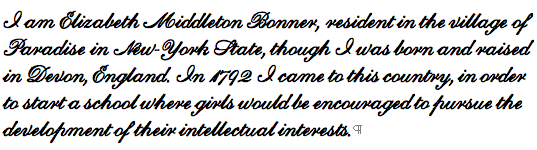
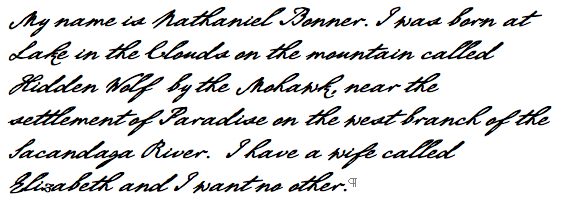
Now, you may also remember that I have a fondness for fonts. What you don't know is that I have a specific handwriting font for each character, and when Elizabeth writes a letter (for example) it shows up on my computer screen in her handwriting.

So I'm thinking that when I turn this manuscript in to my editor, she will find each of the letters not as part of the whole (Courier New 12 point) but instead she'll find the letters themselves. Folded into envelope shape and addressed, as they must be.

I know that the chances of Bantam actually printing the novel this way are next to non-existant, but at least the editor will experience it. I like that idea. So here, for your information, are a few examples.

Elizabeth
Nathaniel-2
Hannah

July 14, 2005

I'm still here

Or better said, I'm on the east coast. Things are busy, and thus not much word here for the last few days and probably even less over the next few.

We are looking at colleges and visiting friends and generally enjoying New England. I am always so amazed to be here, in places that are very familiar to me and still strange because I don't get back very often. And my characters are here, too. I see them now and then. They do glare.

More soon.

July 10, 2005

why I write what I write

This email came today.

Hello,

This is going to sound probably weird to you because I haven't yet read a single one of your books, and yet you have impressed me with them.

I have just started working (home care) with a 92 year old LADY, who went blind two years ago. She's very musical (used to give piano lessons), had her own business back when it wasn't a common thing to do, and crocheted, read and painted. She also made all her own clothes, and by what I can see, she did beautiful work. (That was also part of the business she was in, importing fabrics and so forth)

Anyway, now that she's blind, she can no longer play the piano, drive ..or any of the above things. Although she misses doing it all, the part that impresses me..she read your book 'Into The Wilderness' just before she went blind, and is adamant about me reading the next book in the series aloud to her. She owns the book already, this is not a request or anything like that..lol. Now tomorrow is my second day with her..and I've looked up your bio and printed it out, so after reading that, we'll begin. She has told me she adored the first one she read, and has been anxiously awaiting a 'reader' to finish the story for her. (And now I have to tell her there's more than the two books, she'll be excited!!)

I guess the point I'm trying to make, sheesh! Of all the things a 92 year old blind lady would want to do... or have done for her... (I just hope I'm up to the task!) Sincerely, D.M.

July 9, 2005

the usual chaos

So I intended to go write today, but of course I failed to consider the complications of getting home and unpacking and mail to be answered and bills to be paid.

And then, we're leaving very early Tuesday morning for the east coast. The list of things to get done before that trip just got longer because our beloved Sherri, who takes such wonderful care of the puppy boys when I'm away, seems to have gone out of town, and, according to her message, won't be back until Saturday. The boys love Sherri to distraction, because she cooks for them and takes them on six mile walks twice a day (really). We did book this period of time with her, so I'm thinking there was some kind of family emergency and I'm hoping all is well...

and I've got to figure out what to do about the puppy boys before real anxiety kicks and turns me into a blubbering mass of worry.

It occurs to me that this might be a good start to a comic novel. Woman with obsessive love of her dogs (see? I know my faults) makes meticulous plans for their comfort while she's gone and finds out a few days before she goes that all was for naught. What to do?

Me: Hi, I'm calling about your dog sitting service. Can I ask, do you ever sit dogs for extended periods? Say, five days? And oh, these are small dogs that have never been in a kennel and they would die of heartbreak if you put them in a crate. Also, Tuck has never spent a night where he wasn't sleeping right next to a warm loving person who assures him what a beautiful smart clever wonderful dog he is. Yes, right in the bed. Bunny is happy with the foot of the bed, though, as long as he has his special blankie... hello?

Me: Hi [friend]. Remember when you said you owed me a really big favor? That you'd love me forever? That you couldn't think how to repay me? Well I have an idea.... hello?

Me: Hi [other friend]. Gosh, it's been a long time, hasn't it? I remember how the last time you were here you said you wanted me to put you in my will, that you'd get Tuck if something happened to me. Here's the deal... No, you couldn't keep him. And yes, you'd have to take Bunny, too, because they are very close and they are going to be distraught about me being gone anyway... Well sure, I'll bring them to you, what's a ten hour drive when the puppy boys need something? Um yes, I was serious about the sleeping arrangements. No, a blanket on the floor wouldn't do. Unless you were willing to sleep down there with them? Hello?

Me: So, how much would it cost for us to cancel this trip? That much. Hmmmm.

Keep tuned. Watch the writer lady grow ever more frantic until this is resolved.

quote of the day

But...the litblog co-op doesn't state its purpose as being for "literary" fiction, simply contemporary. To me, contemporary literary fiction is as much a niche market as something like Fantasy or Western. It seems to be written for English students (undergrad and grad), English professors, former English majors who are somehow still involved in the literary world, and writers. Because of its audience, "literary" fiction gets published, gets blogged and reviewed and gets read by its "intended" readers.
Sabra Wineteer in an ongoing discussion of the LitBlog Coop's goals.

home again

a particularly awful trip home, stop and go traffic for a hundred miles in pouring rain, and I'm beat. but we're here, and now I'm going to bed. everybody in England is okay, by the way. Thanks for the good thoughts.

July 7, 2005

name calling

Sheena asked in a comment below about what to call me. There are many options, some of which are less polite than others. So here's the deal: I'm Rosina or I'm Sara, I answer to both. I've never made a secret of the fact that I publish under two names. Rosina is me; Sara is the secondary me.

Please do not call me Dr. Lippi (which was on Sheena's list). I do have a PhD but I don't use doctor as a title because, well, it seems pretentious to me. Also, I worry that if I did call myself doctor, sometime somebody will slap a scalpel in my hand and ask me to do an emergency procedure. Really, that wouldn't be a good idea. You could ask me to do an emergency etymology or call on me when you're in dire need of an analysis of a confusing sentence, but that's about it.

Okay, in the spirit of complete disclosure, I do sometimes call myself doctor, but only when I'm dealing with difficult hospital personnel who treat everybody like a dolt. Many hospital personnel, in my experience, have their dials turned permanently to the lowest common denominator, and it takes a big jolt to get them to actually look at you and see that you might bring more to the table than that. Amazing what a title will do in that situation.

Still waiting to hear from London; am a little tense.

London

You may or may not remember my saying at various points that my husband is a Brit. He grew up just north of London, though his parents moved to Norfolk when they retired ten years ago.

We don't have any immediate family in London but we do have friends, and we're still trying to get in touch with them.

A situation like this isn't the time for politics, and so I'll just say that we are thinking good thoughts for everyone involved.

still away

I have no idea why the posted excerpt starting showing up suddenly, but there you are. Feedback very welcome.

Tomorrow we're headed home, and I'll be posting more over the weekend.

July 3, 2005

Queen of Swords excerpt

I posted this excerpt (or thought I did) right before we set off for the beach. Just today I had the first internet access and I see something went wrong. Sorry for the confusion, and also sorry to say it will have to wait til I get home (to my other computer) before I can see what went wrong and fix it.

At that point, you'll be able to click on the "continue reading" link for the prologue and part of Chapter 1.

Queen of Swords

Sara Donati

forthcoming Bantam Books

All Rights Reserved

do not copy or distribute in any way without express written permission of the author


1814

In the mornings while the men slept, she went walking. First away from the settlement and along the cliffs that looked over the cove, then down the rough stairs carved into limestone. She moved slowly, one hand spread on the rock face like a starfish while the other held her skirts.

For a while she studied the world: turtles sunning themselves on the rocks, restless seabirds, fish dull and sun-bright, quick and darting, languid, sinuous. The constant of the sea, and the horizon. When she could look no more, she turned and began the climb, lizards skittering at the sweep of her skirt. She felt lazy eyes on her back.

The guards had been lulled by the regularity of her habits into complacence. And why not? She could have been no more tied down had they used ropes and chains.

The path she walked ran along the forest that made up the heart of the island. Shadowy cool in the heat, buzzing with insects. Mastic trees so big that it took four men to circle the trunk, arms outstretched; fragrant cedar; stands of mahogany so dense that walking among them was to twist constantly one way and then another. Tamarinds, wild mangoes, other things she could not name.

How her father would have loved this place. Orchids like birds in flight hanging over the frayed stump of a palm tree. Parrots everywhere, flickerings of scarlet and emerald and cobalt blue overhead. She thought of her father often, spoke to him in her thoughts as she made her plans. Imagined his reactions, and made changes accordingly.

The forest gave way to the wet side of the island, mangroves on stilt roots in swamps alive with crickets, flies, great armies of ants and termites. The stink of green things rotting, thick on the tongue. She picked her way carefully, skirts tied into a knot, back straight.

No one was following her now. She was never sure why, if it was simple laziness, or fear of where she was going, or the certainty that she would be back. The lagoons went on for miles, and then more swamps, and finally there would be the sea.

She had loved the sea, once, and dreamed of living on a ship. Now she spent as much time as she could in this particular place, where she could be free of the sound of waves breaking on the cliffs and the scream of gulls.

The lagoon spread out before her in the dim light. She held her breath and waited. A ripple, another. The surface of the water moved and broke.

. She whispered the word while the bulbous body in the water rolled and rolled. Then another appeared beside it, smaller: her child. Water sliding off gray-green skin, a rounded hip, the long curved line of back.

She stepped out of her shoes and into the cool grasp of the water, thought of swimming out to them. To play among the selkies, and learn their language so that she might ask them for shelter and sanctuary. For herself and her child.

Her hands rested on the great curve of her own belly. The life inside it flexed and turned, another swimmer in a silent sea.


Chapter One

L'île de Lamantins

French Antilles

mid August 1814

The island, beautiful and treacherous, drew in the love struck and rewarded them with razor sharp coral reefs, murderous breakwaters, and cliffs that no man sane man would attempt.

But Kit Wyndham was sane. Out of his depths, perhaps, but Major Christian Pelham Wyndham of the King's Rangers was in command of all his senses, while Luke Scott was not.

"Major?"

The lieutenant hovered like a maiden aunt, stopping just short of wringing his hands. If given permission to speak, Hodges would say out loud he had said too many times already: that they had no business here; that what Scott intended was madness.

Hodges was wrong about one thing: they did have business here, and crucial business at that. The only kind of business that could have forged this strange alliance between himself and the Scotts: they were after the same prey.

A fat moon hung in a clear night sky, sending the shadows of masts and rigging out to dance on the water. On the rail his own hands were drained of color, corpse gray.

He turned to assure his lieutenant that he would have no part in this night's insanity. Let Scott take his band of mercenaries and storm Priest's Town, and good luck to them one and all. Kit Wyndham had made a promise, and he would keep it: now that their quarry was in sight, he would step back and let Scott lead.

Just behind Lieutenant Hodges stood Hannah Scott, dressed in men's breeches and a leather jerkin over a rough shirt, her person hung about with weapons: a rifle on her back, pistols, a knife in a beaded sheath on a broad belt. She could heal or kill; he had seen her conjure miracles and blasphemies with equal ease. No mortal woman, he had called her to her face and she had not corrected him with words.

The moonlight was kind to her, as the sun was kind. In the year since they had made their uneasy alliance he had seen her every day, and still the sight of her was startling. By the standards of Wyndham's own kind, Luke Scott's Mohawk half-sister could not be called beautiful. Her skin was too dark, her hair too black, her mouth too generous for pale English blood. Below heavy-lidded eyes the bosses of her cheeks cast shadows. Most damning of all, the expression in those eyes was far and away too intelligent. If her skin were as pale as cream, her mind would have isolated her; Englishmen did not know what to do with a woman like her.

Even at this moment she knew exactly what he was thinking, the excuses he had been ready to offer, the rationalizations. If he voiced them she would simply tilt her head and look at him.

"Major?" Lieutenant Hodge's voice rose and wavered.

He said, "Fetch my weapons." And: "Miss Scott, please tell your brother I will be joining the rescue party."


All this, for a woman.

The men liked to speculate, when the Scotts were out of their hearing, how much money had been spent on this year-long crusade of theirs. They must find the woman, but they wanted the man, too, for different reasons. The obvious reason had to do with the abduction of their kinswoman, but there were other things at stake, things they never spoke about. No doubt Dégre was blackmailing them, as he was attempting to blackmail powerful men in Quebec. That was the real reason his superior officers had sent Wyndham on this strange quest that had begun the day he joined forces with the Scotts.

No expense had been spared. First there was the Isis, the great merchantman sitting idle in the waters off Kingston. She was too clumsy a ship for the kind of work they had to do in the islands, and so Scott had purchased the schooner as thoughtlessly as another man might put down coin for bread and ale. The crew was well paid and the stores of meat and biscuit and ale were abundant. Beyond the material things, there was no calculating the fortune that the Earl of Carryck and the Scotts had spent in pursuit of information.

Kit Wyndham, born to wealth, was not so much impressed with the spending of money. His family had been cultivating those skills for generations; his mother and sisters were experts. Scott spent money too, but with it he bought results. Fast ships, good men, names whispered in dark corners, maps drawn with charcoal on a table top.

Scott's men were expert soldiers, utterly silent, ruthless to a fault, loyal unto death. Part of that was money, but not the biggest part. Kit had had some men like these under his command when he was fighting the French in Spain, and he knew their value and their cost.

Now was not the time to think of Spain. He put those images out of his head and concentrated on the back of the man in front of him, called Dieppe. Scott's most important find: a small, quick, wiry man, his skin the deep true black of the enslaved African.

Just last month Scott had found Dieppe in St. Croix and bought him for more than he was worth. Then he offered the African his freedom in return for one night's work. It was Dieppe who knew the reefs that built a fortress around this island. Without him they would need an army to take it, and no doubt the woman would die before they could get to her.

The longboat wound its way through a swamp crowded by an army of mangrove trees. A sinuous tail as broad around as a man's waist flicked in the moonlight, and Wyndham touched the long knife at his side. He had seen an alligator twenty feet long rip the leg off a man with a jerk of his head. Night birds called and their voices echoed off the water.

Dieppe led them onto land so saturated with water that to stand still was to invite disaster. They followed one by one: Scott, his sister, then the others made a long coiling snake with Dieppe as the head. Dieppe and Scott and some of the other men carried machetes; Wyndham wished he had one of his own.

For two hours they walked through the damp heat of the swamp in the wake of the swinging blades. Tiny flies gathered at nostrils and the corners of lips and eyes, and Wyndham wiped them away with the back of his hand, thinking of the ointment he had been offered and turned down.

The lagoons, then, as they had been told: long commas of water silvered by the moonlight. The men broke into a trot until they came to the edge of the forest, where they stopped for five minutes while Dieppe and Scott spoke, heads bent together.

The swamps were bad, but these forests were worse. Wyndham concentrated on putting one foot in front of the other and not losing sight of the man in front of him. Something screamed in the dark, and the hairs on the back of his neck rose. This dark and fragrant place could hardly be more different than Spain's hot exposed plains and rocky hills, but his blood pounded here as it had there, and would spill the same bright color.

The moon had set when they came out of the trees. Wyndham touched his pistols and his sword lightly, and looking up, caught Hannah Scott's gaze on him. He had seen her kill, but she knew nothing of him in the field, except the stories told behind his back. Of which most were perfectly true.

***

The cove was small, well protected from the winds, and unguarded. Looking down on it they saw two ships – Dégre's Grasshopper, and another unknown to them. If Scott had sailed the Patience into the cove and tried to walk up the path that had been cut into the cliff face, then perhaps one of the men sleeping with an empty bottle cradled between his legs might have woke to sound the alarm. As it was, they died quietly.

Scott sent half the men to deal with the ships, and the rest of them went into the settlement called Priest's Town. It turned out to be nothing more than a half dozen shacks, most of them empty. Two old mulatto women lived in the smallest of them with their goats and swine. They seemed neither surprised to be roused by strange soldiers in the middle of the night, nor worried about their lives. That was another talent of Scott's: he could dispense calm as easily as coin. People trusted him, even when should not. He could be kind, if it furthered his cause; but ruthlessness came to him just as easily. He would have gone far in the army.

The raiders turned their attention to the largest of the buildings, a warren of strung together shacks set up off the ground. Directly in the middle, the largest room's outer wall was made of a series of doors, all open to the weather. A rail hung from the sagging porch like a broken arm. Lanterns swayed from blackened posts, some of them dead, others guttering and spewing black smoke. The inside of the house was crowded.

Scott's men moved like a company who had fought together in a dozen campaigns, silently, easily, joined by invisible threads just tense enough to keep them aware of each other. Kit tested the weight of his rifle, as familiar to him as any part of his body. The bayonet clicked into place. It caught what light there was and winked at him.

They waited for the guide, ten minutes, twenty, and then Dieppe came back, sweat covered, trembling. Scott asked him a question in rapid French, and got a nod in answer.

"Is there a child? Did you see a child?"

"Non." Sure of himself, of what he hadn't seen.

For the first time tonight, Wyndham saw Scott hesitate. No doubt he had been hoping to find the woman and her child together. If there was a child.

Again he felt Hannah Scott's gaze on him, as if she were reading his thoughts. He could read her mind too: not now.
It was an argument they had had too many times: whether or not the information they had about the woman's condition was to be trusted. Scott believed it was true; Wyndham was doubtful. The old woman who had told them that the woman they were after was heavy with child might simply have been looking for more coins.

In a few minutes they would know. Scott sent some of the men around to the back, and gave them orders to wait for his signal.

***

Wyndham saw the room for a split second before the battle started. Tables cluttered with dice and cards and cups, a long bar on the far wall, and men who had been enjoying themselves. A dozen of them, dirtier and rougher than many, but still just men burned by sun and wind and erratic fortune.

The one man who concerned them most sat at a large table in the corner, his dark head thrown back in laughter. It had been more than a year since Wyndham had last seen the false priest, but he recognized Dégre. And on the other side of the room, sitting behind a small table with cards laid out before her, the woman. She was much changed, thinner and drawn and her eyes shadowed, burning with fever, or anger long held in check. Her belly was flat. If she had been with child, she was no longer.

It took less than a second to see all that, and then his rifle found its target and things happened very fast, and all at once.

***

There were very few things the Jennet Huntar could be sure of, but one of them was this: for as long as she lived, she would dream of palm trees. Spindle fingered against topaz skies or storm clouds, dancing against bloody sunsets and bloodier sunrises, always beckoning: they would be with her forever. Right now she could look up and see them against the sky as the night leached away, if she just lifted her head.

But she was at work, and it was the work that kept her wits intact. She had a little table of her own, and two stools. On the table she dealt out her cards for anyone who could pay the price.

When there were few men interested in the cards she laid them out for herself.

The Hangman. The Tower. The Knave of Swords.

Tonight her steadiest, most devoted customer was drinking at the bar. He was called Moore, one of Thibodoux's men off the Badger. When the old Irishman was here, he spent half his coin on drink and the other half he gave to hear her read him the cards. The other men spent money on the women in the back rooms, but Moore was content to sit and look at what he could not have.

Tonight he waited until the moon had set and he was so full of liquor that he would fall off his chair if Jennet leaned forward to prod him with one finger. And yet he was not so drunk that he forgot what he wanted from her.

He sat with filthy fingers laced into his long, tobacco stained beard. The low forehead was remarkable for its deep reddish color, set off by thick twisting white scar in the shape of a cross. His mouth made a perfectly round circle in the middle of it, and his tongue flickered when he talked, snake-like.

"Tell me, Lady Jennet, when will I get me a good wife?"

It was the question he always asked.

Moore was no better and no worse than the other men who drifted through this place. Always hungry: for drink and release and excitement, for sleep, and beyond all those things, for advantage. Hungry and not particularly worried about how he came by what he needed.

"Not tonight, Mr. Moore. But perhaps sometime soon. Let us look."

She took her time. Moore would not complain. It was mostly what he was paying for, the right to sit close enough to imagine the texture of the skin he could not see, would never see. She was the daughter and sister of an earl; surely her skin must be as soft and white as milk. Many of the men who came here would have delighted to quench their curiosity by taking her apart like a crab, cracking open what she tried to hold back. But she was Dégre's pet creature, and they must keep their distance unless it was to sit across a table and hand over coin.

As long as he came no closer and kept his hands to himself, Jennet was content to take Moore's money, and sometimes, when he had drunk enough, the one thing she really wanted from him.

"It's been a good while since you last came to see us, Mr. Moore," she said as she shuffled the cards, slowly, carefully. "A long voyage, then?"

He looked about himself nervously, one eyelid fluttering. Fear cut through the drunken fog. "Aye. Long enough, Missus. Long enough."

She had misjudged the timing, and put him on his guard.

The Three of Swords. The Six of Cups. The Moon.

His gaze shifted to the table in the far corner, where men sat bent over their game. The one he feared was not looking in this direction, but that meant nothing at all.

He's got eyes in the back of his head, does Dégre.

She had heard men say such things too often to count. The man they called the Priest, or more rarely, Dégre – the man who owned this place and claimed the island itself was a legend, a force as inevitable and ungovernable as the winds. None of the hard men who frequented this place would cross him.

Jennet had crossed him, and she lived still. Because in the year since she had begun traveling with him, she had come to understand the way his mind worked. She had planned very carefully, and moved fast when the time came, and she had succeeded. She was alive not because she had got the best of Dégre, but because he had plans for her that promised more satisfaction than a quick death dealt out in the anger of the moment.

The priest was watching her now, as she turned over cards and talked about them. He might be thinking about nothing more than what he would eat for his supper, or of changing his shirt, or there could be something very different brewing there.

It worried Moore, but Jennet was beyond fear. Dégre had already robbed her of everything of value.


"The Moon," she said to Moore. "It shows itself often when you come to hear your cards read, sir. The moon is a guiding image for you, I think."

"Aye," he agreed, his small features bunched together in an attempt to convey sincerity. "And remind me then, Lady Jennet, what does it mean, the Moon card?"

"Inconstancy. Are you inconstant in your temperament, Mr. Moore?"

It was too much for him in his current state. He blinked at her owlishly, his mouth jerking at one corner as he tried to push himself up from the table, a puppet with tangled strings. Jennet gathered her cards together, waiting patiently for him to find his tongue and make it do his bidding. Later, it would be the expression on Moore's face she recalled first when she thought about this night.

As he opened his mouth the sound of a dozen rifles firing together tore the world in two. Moore fell forward onto the table, blood gushing from his mouth.

Jennet dropped to her knees and then pressed her face to the floor. The room was filled with screams and gun smoke and tumbling bodies, glass shattering and the wind, rising suddenly, she heard it howling and howling as the idea presented itself, very clearly: she was about to die, and she had brought it upon herself. The next volley would find her, and she would die here on this filthy floor in this hell begotten place and she would never see him again, never in this life.

July 1, 2005

One Shot -- Lee Child (****+/*****)

I finished this novel some time ago and I've been thinking about it ever since, which of course is a good thing. If I can't remember much about a novel a week after I've read it, that pretty much says it all.

This is the ninth novel in the Jack Reacher series, which has had its highs and lows for me. My favorite remains Die Trying (though I couldn't tell you why, except it struck a chord). This new one comes pretty close to the top of the Jack Reacher list.

Reacher (not even his mother called him Jack) is an ex Army MP officer, who has been wandering the US ever since his discharge. He's taken flying solo and staying off the grid to an extreme, but he likes his life and he's unapologetic.

So we start here with a sniper who shoots down five people leaving an Indiana office complex at quitting time. The evidence is overwhelming, and it points to an ex-army sniper. In Florida Reacher sees the story on the news and dumps the woman he's been spending the weekend with to set off for Indiana. When he was an MP, he prosecuted the accused for a similar crime. That time the evidence was clear, too, but the shooter got off on a political technicality. So now Reacher is going to make sure justice is done the second time around.

Except the guy claims he is innocent, and he wants Reacher -- the last person he should ask for -- to come look into the case. Reacher has no sympathy for the accused, but of course, things get complicated.

This novel moves fast. There are a lot of unexpected turns, a whole slew of interesting secondary characters, and an unusually terse Jack Reacher. In some of the earlier novels he's much more approachable, but here he really is hard as the proverbial nail, unflinching when it comes to dealing out justice. He enjoys women, but the ones he seeks out are the ones he knows he doesn't have to worry about; they are as tough as he is, and won't be surprised when he leaves. The final sentence of the novel says everything you need to know about Reacher: "...he could buy a pair of shoes and be just about anywhere before the sun went down."

I liked this novel a lot, but mostly I'm looking forward to the next one. My primary curiosity is what Lee Child is going to do with an ever more isolated and distant Jack Reacher. I'm waiting to see if he'll be reeled in, shocked out of his loner status, or if that trend will continue.

what an interesting idea. I think.

Bookstore readings are more often than not disappointing. Few people show up, or a lot of people show up, but nobody actually buys a book. You are left exchanging oh-well type comments with an embarrassed bookseller who wants to be someplace else.

Annie Wilkes
I don't do book tours for this (and other) reasons, but Sarah passes on an idea that has some promise: why read in a bookstore? Why not find a reader of your work who has the space and the interest to host a reading in their home? A cross between a bookclub meeting and a Tupperware party, but without the plastic.

I wonder if this could work. It certainly sounds interesting...

except.

What if the person who volunteers to host the reading in her very, very tidy and secluded home turns out to be Annie Wilkes, your Number One Fan?

You can be sure I'll be paying attention as other authors give it a go.

excerpt: Queen of Swords

I'm going to post an excerpt, but the choice is giving me pause. Should I just start at the beginning? Because giving you something from the middle is bound to upset an apple cart or two. I've already posted the prologue; a chunk of Chapter 1?

Opinions? Thoughts? Suggestions?