" /> storytelling: April 2004 Archives

take me to the front page of the tttt weblog | back to the current weblog

« March 2004 | Main | May 2004 »

April 30, 2004

story vs. plot, once again

So I've been thinking about novels and films that worked for me, personally, and comparing in each case story to plot. If you were hanging around a week ago or so you'll remember that I defined story as what happened, in order and plot as the artful rearrangement of what happened.

Mysteries, by definition, can't just give you the story, but depend on arranging the elements into a particular kind of plot. Most genre fiction depends very much on plot. You may know, in a classic western, that the good guys will somehow or another prevail; what you don't know is, how. The artful revelation of the story is the thing. The same is true of romance. The same is true, on a different scale, for joke telling. People who can tell a joke have a talent for knowing when and how to let the punch line go. Good storytellers are often good at telling jokes.

So now I'm trying to think of a novel that had a flawed story but an excellent plot, or t'other way around.

Let me know if you have any such examples.

Today I'm on my way to Gig Harbor, Washington to teach a creative writing workshop, but I should be back later tomorrow and will certainly post something by the end of the weekend.

April 29, 2004

misbehaving browser

Is anyone having trouble getting this blog to display properly in their browser? Suddenly it doesn't work in Safari for me, but resolves just fine in IE and Netscape. Please let me know via comments if you're having problems.

book lists

This list of one hundred (so-called) best books is everywhere on the web. I don't much like the dopey thing because it's so simple minded. You're supposed to bold face the ones you've read, never mind if you forgot it immediately, or tried to read it but fell asleep, or couldn't read it as a twenty year old but loved it at forty. Lists like this are just ways of broadcasting biases and pretensions -- but they do make for some great arguments, like the one I am having currently with my almost-fifteen year old daughter.

She reads, a lot, widely. Stephen King and James Baldwin, Ann Patchett and Louisa May Alcott. Dante and the unedited Anne Frank. I encourage, always, or I did, until she came home from the library with Ulysses under her arm, announcing that it was the best book of the last century, and she was going to read it.

The first question is, why didn't I just say good on you! let me know what you think! -- inclusive of exclamation marks. Why did I say oh no, not Ulysses.

What a dopey thing to do; she'll be fifteen next week, and she lives to challenge me. She insisted on knowing why I don't like this novel that minds greater than mine have decreed to be a masterpiece. So I told her: I dare you to find ten people who have actually read it, all the way through. You can't, because it's just plain hard to read, and not worth the effort. To which she said: I am going to read it. To which I said (mea culpa): Don't do it just to vex me, you've got better ways to spend your time. Like emptying the dishwasher.

And why did I get all crazy? Because Ulysses is supposed to be one of the great masterpieces of the twentieth century, and that says to me that things were pretty messed up, and still are. To me Ulysses is the ultimate literary sacred cow. With one long egocentric, blathering rant sprinkled with some vivid images, Joyce brought in the era of form-before-story, which the literati still hold dear, and which I will always protest. So I told my daughter this, and she laughed. Of course. Wow mama, said she. Ulysses gets you wound up. To which I said, finally, go ahead and read it, and see if you can figure out whether it really is a masterpiece.

A half hour later she came back and asked me to make up my own list of a hundred best novels (or even just fifteen) that she should read. Which threw me, for a moment, until I thought to ask her to define 'best'. She's off contemplating that now. I hope she gets distracted, but I fear she won't. Then I will present her with this list, and ask her to pick one to start with.

My list of fifteen best books that

  • you'd be glad to have with you on a long plane trip
  • you should know something about if you happen to run into Noam Chomsky when he has an hour to talk
  • are good to read when you need to laugh
  • I personally consider true classics
  • are still read in high school and college courses, but don't deserve to be
  • I read because I had to as a student, but am glad to have read
  • I read because I had to as a student, and have forgotten almost completely, despite the fact that I wrote long papers about them
  • everybody says I should read, but can't make myself pick up
  • I tried to like, but couldn't
  • made me think harder than I wanted to
  • helped me understand the way men think, and are different from women
  • made me see the way monsters live inside all of us
  • I re-read, because they give me hope

April 28, 2004

reading recommendations

Quite a few people have made the long journey over to the new guestbook (link to the right) to say hello. What I notice so far is that people have really liked the book recommendations. Except I haven't done that in a while, and I wanted to say a word about why.

I'm not interested in reviewing books for the sake of reviewing them. If I have something to recommend, or something to say that seems useful, then I write it up. So does this mean I've read nothing in the last couple months? I'm always reading, every day, for long periods, but I'm not always reading novels, or if I am, I go through stages of re-reading. I re-read all of Jane Austen every year, and I've said before that I'm re-reading the Niccolo series for a discussion group. I suppose I could write a short review called 'why you should read Pride & Prejudice if you haven't already' but really, I know I'm not going to talk anybody into it.

I have actually read three or four new novels in the last six weeks, but I didn't like any of them enough to recommend them or dislike them so intensely that I feel the need to vent (as I did, you may recall, about The DaVinci Code). I'm hoping this changes soon.

Lileks

Sillybean showed me the way to Lileks. James Lileks, who writes for the Minneapolis StarTribune, has been working on these pages of his for a while, it seems. I wish I had found them sooner. I look at a lot of websites, admire a few, and go back very rarely. This website really struck me, for a number of reasons.

James Lilek and I are of an age, both born in the midwest, with some similarities in our backgrounds. I haven't read his published work (although I will), but we are both professional writers. The similarities end there, with maybe one exception. He's got a soft spot for graphic ephemera. Postcards of old motels (and I highly recommend having a look; the captions alone are worth some time, and his commentary is priceless), advertisements, a collection of odds and ends that add up to a very effective whole. He also has what I would call a photo essay about some snapshots taken by his grandmother many years ago. These are tucked away in the about section, but for me personally they were the most moving part of the site, because (maybe you saw this coming) of the stories in them.

I love old candid photos. A handful of old photos can occupy me the way a symphony can occupy other people, I am completely drawn in. When I teach creative writing I often have people write paragraphs about photos they've never seen before, construct character sketches, assign motives and conflicts. It's a really good way to get yourself writing. Or at least, it works for me.

I have a lot of old photos of my own family, but I'm always begging for more. I have an uncle in California who is constantly teasing me with promised photos. What! he shouts into the phone. You've never seen a picture of great grandfather Oscar! I'll have to send you a copy! To which I always say (because we've had this conversation many times) yes! yes! please!

The photo you see here is one of my favorites. Circa 1931, my father (who was born in 1911) looking very dapper, with some of his sisters. Fifty years later Aunt Fran would pick up her own photo album and systematically scratch Aunt Dorothy's face out of every picture. When she was done with that, she got out paper and tape, and put tiny tags on everything in her apartment. On tarnished spoons, on flower vases: not Dorothy. It was her own way of writing a will, or a non-will, if you please. And they look so innocent, don't they? Like they're having a good time. The kid and the dog are an especially nice touch, though none of my relatives can figure out who they are.

The moral of this story is: don't overlook boxes of old photos, not if you write, or want to write. Such goodness, waiting to be appreciated. And go visit Lileks, too.

PS I am feeling better, and many thanks for the good wishes.

April 27, 2004

under the weather

...I'll be back soon, I hope.

April 26, 2004

the Wilderness novels, in order

In an email Amanda asked about the order of the novels, so I'll point again to the opening page of this website, here, where you'll find that list.

dead man telling tales

I've mentioned before (some long time ago) that I love Samuel Pepys Diary, which is on-line. Here's today's entry:
Thursday 25 April 1661. All the morning with my workmen with great pleasure to see them near coming to an end. At noon Mr. Moore and I went to an Ordinary at the King’s Head in Towre Street, and there had a dirty dinner. Afterwards home and having done some business with him, in comes Mr. Sheply and Pierce the surgeon, and they and I to the Mitre and there staid a while and drank, and so home and after a little re[a]ding to bed.
Not only is the diary annotated (if you want to know about Mr. Sheply, about the Mitre, about the Ordinary at the King's Head, all that is just a flick of the mouse away), but interested parties contribute to each day's entry, working out the fine points. What exactly is a dirty dinner? What a phrase. I will have to use it somewhere.

At present I don't contribute to the annotations or discussion, because I have this certain knowledge that I would get stuck in that universe and have a hard time extracting myself.

It's really worth a look. Really.

April 25, 2004

irritating women

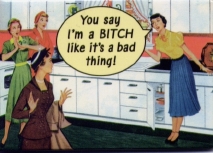
saybitchSo I've been thinking a lot about my list of favorite female protagonists, and then other female protagonists that I don't like as much, and I've come to the unavoidable conclusion that I like difficult women. Because I am one, you'll conclude. Maybe. It's true I have this lovely magnet you see here in a prominent place on the notice board immediately to the left of my desk.

Thinking about this, the hard part is defining the line between good-difficult and too-difficult. I think it has something to do with generosity, for me personally. A female protagonist can be difficult in many ways and still stay on my good side, but she has to have a generosity of mind to really win me over, even though she may not be in a position to show it.

More on this, maybe tomorrow.

April 23, 2004

quotation marks, and their abuse

Why have I raised this subject, when not so long ago I was saying in no uncertain terms that puncutation is boring, and unworthy of discussion? It's my way of preparing you for a short but very intense rant:

There are people who pepper their prose with quotation marks and not as a way to punctuate dialogue. You know what I mean, those "writers" who try to make a point more "clearly" by isolating specific words with quotation marks. As I just did. Forgive me; it was all in the service of making my point.

Using quotation marks in the way says one thing very clearly, and it's most certainly not the thing you mean to say:

This is not exactly the right word; I know it, and so do you.

It's is a lazy and distracting habit, and I suspect that it correlates closely to an excessive fondness of exclamation points.

While I'm on the subject, I'd like to point out that it is possible to do without quotation marks completely, even in punctuating direct dialogue between characters. This is from The Things They Carried, Tim O'Brien's collection of interwoven short stories about his experiences in Vietnam, exactly how it appears on the page:
Henry Dobbins asked what the moral was.

Moral?

You know. Moral.

Sanders wrapped the thumb in toilet paper and handed it across to Norman Bowker. There was no blood. Smiling, he kicked the boy's head, watched the flies scatter, and said, It's like what that old TV show -- Paladin. Have gun, will travel.

Henry Dobbins thought about it.

Yeah, well, he finally said. I don't see no moral.

There it is, man.

Fuck off.

Not that I'm promoting this practice, particularly. Just an observation; and yes, okay, a violent observation, but that is, I assure you, a coincidence. Really, it is.

I'm still thinking about non-negotiables in character development, and will have something about that tomorrow.

April 22, 2004

story is to plot as apple is to

Maybe not quite banana.

There is a simple way to think about the relationship of story to plot. Here it is:

story is what happened; plot is the artful rearrangement of what happened
You can make a chronological list of the things that happened to somebody in the course of a normal life, and make it sound no more interesting than the community events page in the newpaper:

  • Emma Lawrence is born on a cold December morning.
  • When she is three, her younger brother Michael is born.
  • She attends West Side Elementary where she is praised for her meticulous, careful ways.
  • When she is seven, her brother dies of leukemia.
  • She attends West Side High School, and then the state university where she gets a degree in nursing.
  • She goes to work on a pediatric oncology unit, where she is known as a meticulous, careful, thoughtful care provider who is loved by the sick kids, but who never manages to make a connection to the parents.
  • She marries a pediatrician she works with, has two kids of her own.
  • Her infant daughter is diagnosed with leukemia.
  • On a cold December morning, Emma leaves home to take her daughter to the hospital for a chemotherapy treatment.
  • On the way there she makes a sharp turn, sails through the safety rail and over a cliff, and into the ocean.

Okay, so. Not a happy ending, but I'm making a point here.

You can tell this story just like this, moving through Emma's life from day to day, or you can sit down and think about where to start. The possibilities are almost endless. You can start at her funeral, on the morning her second child is born, the day she starts menstruation, with the spelling test she takes the week after her brother's funeral and the fact that she is the only second grader in the school and the city who can spell the word intravenous. From there you can jump anywhere. But why? Why not just tell the story in chronological order?

Sometimes you can do that, but often it doesn't work. Moving back and forth in time, across perspectives and points of view lends a certain kind of dramatic tension that keeps the reader engaged and turning the page. The reader is looking for a reason to keep reading, you know. The reader wants to be swept away, enchanted, engrossed, absolutely mezmerized, but most readers don't have the patience for long build ups. They want some hint, pretty darn quick, about what kind of story this is, what kind of conflicts are going to be moving things along, and what the payoff will be.

Plotting is the arrangement of elements of a story into a dramatically effective whole. This is not the only definition of plot, of course, but it's most generally what people mean when they are talking about the writing process.

April 21, 2004

absolutes

I've had two suggestions about characteristics that are non-negotiable in heroes (of course that term is fraught with difficulties, but for the sake of expediency I'll continue to use it for the moment). From Karen:
How about a rock-solid moral core? The hero can (and probably must) have serious flaws and weaknesses, but some fundamental part of the character, even if deeply buried, needs to recognize right from wrong. But then there's Patricia Highsmith's Ripley -- does he count as a hero?
and from Stephanie:
I think a sense of humor is pretty essential. Not that the protagonist has to be wisecracking through his dialogue, but he should at least recognize things that are absurd.
I think these are good characteristics to start with as basics (again and always, for me personally, when I'm reading or writing).

A character can have a fairly serious demeanor most of the time and still be capable of playfulness (crucial, in my view). Personally I'm also drawn to a dry sense of humor, which probably follows from the fact that my husband is a Brit. When our daughter was about ten, we rented Monty Python's Holy Grail. She asked him if she could watch it, to which he said: "Can you watch it? You must watch it. It's your cultural heritage."

The issue of a moral core is a little more complicated. I think I know what Karen means by "rock-solid moral core" -- I know what it means for me, at least. For other people it may mean (it almost certainly does mean) something else. More important, I think the main point for any writer to remember is this:

the fuel that drives any story is conflict, which has to exist both external to the main characters (to move the plot along), and within them (to move the characterization along).

Let me see if I can say that any more clearly. You can have a main character/protagonist/hero who is rock-solid morally, but you have to poke him a little, or there's no drama. In my own story, Nathaniel has not one set of morals to live by, but two that are very different -- one European in its nature, the other Native American. Elizabeth's strong moral convictions are a source of conflict for her because she is torn between a rational world view and the religious beliefs that permeated every aspect of the culture in which she was raised.

As far as Ripley is concerned, he's an interesting character specifically because he is amoral, but in a thoughtful and quite dramatic way. For me personally he can't be a true hero, but no doubt other people see him as such. Then there's somebody like McMurphy in One Flew Over the Cuckoo's Nest, who is quite scary in a number of ways, whose interpretation of personal property is pretty lax, but who is driven by instincts that are (at least in part) admirable: he likes people, and prefers to see them happy; he dislikes authority, and prefers to challenge it.

I'm still thinking about other characteristics for my list of absolutes. I may take a break to write a little about the difference between story and plot, which somebody asked me about just recently.

April 20, 2004

non-negotiables

Another good question from Chris:
Are there qualites that HAVE to go into the making of an interesting "hero", regardless of sex, and are other qualities only needed/appreciated in either sex? And if so, what are they?
I'm going to have to think about this for a bit. If anybody else has a list of non-negotiable qualities for a protagonist regardless of sex, I'd sure like to hear them.

As far as qualities that I'd reserve for one sex over another, nothing comes to mind immediately except the physical dominance points I raised last week. Which doesn't mean you can't have a physically strong, very fit female protagonist -- that's one of the things I like about Aeryn Sun. It's even okay for her to get the better of John now and then in a wrestling match, at least temporarily. This is, of course, my personal preference as far as fictional characters go.

April 19, 2004

bitches, rebels and other heroines

On my list of female protagonists are more than a few difficult women. If you go looking, you'll find (for example) that readers either love or hate Melanthe of Kinsale's For My Lady's Heart. The comments I have heard is that she is too hard and even abrasive, although I think some of the dislike of Melanthe has to do with the fact that this novel is not an easy read; Kinsale does a good job of approximating Middle English for a modern audience, and it takes a little work to get into it. I loved Melanthe, particularly because she seems -- if you look at the surface only -- to be manipulative and disdainful but is in fact struggling hard to survive in a world inimical to independent women. She has suffered some terrible losses which have made her hard, but the beauty of this novel is in the way she adapts to Ruck, and he to her.

Something that is true of all these women (as it is true of the men) is that they all stand on the social periphery. Christine noted this in a comment to an earlier post about the men:

I think there's always something about those guys that don't quite fit in whatever the 'norm' is. Perhaps that's part of their self-possession, but those characters always seem slightly on the fringe.
For me personally, traditional female characters may be interesting and well done, but they don't make it onto my short list. Which is why I could make a second list of female characters whose stories I liked, but are too traditional for my tastes. This list would include Minerva from Jenny Crusie's Bet Me (an actuary working for her father's company) and Maud Bailey of A.S. Byatt's Possession: A Romance (a fairly run of the mill academic). Christabel LaMotte, also from Possession, is one of the women who probably should be on my list. Please don't misunderstand: I truly love and admire both these novels (for different reasons); I'm distinguishing here between individual characters and the work as a whole.

A look at my list shows all these women to be rebellious in one way or another.

Woman Behaving Badly
Elizabeth Bennett talks back to gentlemen and old ladies, flaunts expectations, refuses marriage proposals
Marie Du Gard In turn of the century France a single woman of good family evades the match her father has made for her, and pursues a career in the new industry of film making
Maddy Timms The most traditional of my seven, Maddy, an observant Quaker, flaunts authority to help a man who is being mistreated by the medical authorities.
Melanthe A rich woman runs away from the men who control her life and does everything in her power to establish a safe haven for herself.
Aeryn Sun Ah, Aeryn. Pulled against her will out of her native environment, it takes a while for her to recognize the rebel in herself and the streak of independence that comes from a mother she never knew.
Hannah Trevor a midwife, Hannah struggles to make a life for herself after she loses her children and a treacherous husband; she gets pregnant because she wants to be a mother again, but rejects the idea of another husband. She is in constant conflict with the men in this late 18th century Maine village, and with her own needs.
Elizabeth Middleton wants an education, the opportunity to learn without restrictions, to teach girls as boys are taught, and to pursue her life without being made to feel aberrant.

April 18, 2004

all (american) girl

Fiona Jeffcoat-Yu left an interesting comment in response to my list of female protagonists, with two recommendations for further reading.

The first is an academic study called All-American Girl: The Ideal of Real Womanhood in Mid-Nineteenth-Century America, by Frances B. Cogan, 1989. This is a University of Georgia Press book and will probably be a bit of a challenge to find in paperback, but I think I'll have to have a look at it if only to give me more to argue with the next time somebody writes to say that Elizabeth Middleton is an anachronism.

(The two extremes of criticism I have got about my Elizabeth are: (1) she's unrealistic for her time; (2) she's June Cleaver. In the first case, I reject the criticism on the basis on historical fact, and in the second, I laugh. I can't see June Cleaver going after Jack Lingo with a rifle butt.)

Fiona's second recommendation was for a novel, Thalassa Ali's A Singular Hostage (Bantam ISBN: 0553381768) which is a historical set in 1836, and looks to be the kind of book I like best, with a heroine in line with My List of Seven. I'm ordering a copy from Village Books today.

April 17, 2004

the other list

Thinking about my list of seven male characters has actually helped me quite a lot in solidifying some things about John Grant, who is the male protagonist in Tied to the Tracks. In the hope that lightning will strike twice, here's a preliminary list of female characters who work especially well for me. Again, this is in no particular order, and I've put my own main character at the bottom for the purposes of comparison.

Three more things I'll be thinking about as I try to deconstruct what makes a female protagonist work for me: (1) unlike my list of male characters, most of these women come out of traditional romance; (2) Each of these women has a male counterpart who I like a great deal, but who didn't make it onto the other list. (3) I can think of another five female characters who probably deserve to be on this list.

Character Novel Author
Elizabeth Bennett Pride and Prejudice Jane Austen
Marie Du Gard Dance Judy Cuevas (Judith Ivory)
Maddy Timms Flowers from the Storm Laura Kinsale
Melanthe For My Lady's Heart Laura Kinsale
Aeryn Sun Farscape of course, of course
Hannah Trevor Hearts and Bones Margaret Lawrence
Elizabeth Middleton Into the Wilderness S.D.

April 16, 2004

another male character to consider

If you've read Stephen King's The Green Mile (or seen the movie) no doubt you were struck by the character of John Cofee, the 6'8", 300 pound gentle soul who had a gift for healing, but was unsuited for life in the South in 1932. I've been listening to this book on tape, having seen it at the library, and while I'm not crazy about the narrator in general, I do like the way he reads John Cofee. This character feels very real to me and very tragic, so much so that all my protective and maternal instincts coming roaring to the forefront.

I've been thinking about this man and what makes him so real for me, and I haven't yet been able to figure it out. He is, clearly, a bit other-worldly. The workings of everyday life are usually beyond him, but he sees very clearly when it comes to the hearts and minds of the people nearby. He seems to have no memory of his own childhood, his family, or his origins, and no way to articulate how he came by the gift that has isolated him from the world.

I think of my own characters, Robbie is a very little like this particular John, in that he has a generous heart and is unable to function very well in the wider world; that's where the similarity ends. But I do write a lot of male characters who are isolated to some degree, by choice or fate. No doubt a Freudian would find something interesting in this, but at the moment the meaning escapes me.

April 15, 2004

really deep water, and pencils

Sometimes a scene is so important that I find myself afraid to jump in. I've been dealing with a scene like that for two days, dipping my toe in the water and drawing back in panic. Just how deep is this water, and what if it's too deep?

<diversion> A short side trip to make clear how serious an analogy this really is.

On a hot Chicago summer day when I was nine years old, and hadn't yet learned to swim, a bully who shall rename nameless (but his initials were Jimmy Malone) pushed me into the deep end of the very crowded public pool at Horner Park at California Avenue and Irving Park Road. I remember trying to reach the side of the pool, and failing. I remember the going down for the third time, and how pretty the sunshine was on the water. Then I remember throwing up on the lifeguard who pulled me out. He was shaking, and he had very bad acne, and that's all I remember about him. So you see, when I talk about jumping into the deep end, I know whereof I speak.
</diversion>

So this morning I did something drastic. I went out to write at Starbucks (please, no commentary on writers at Starbucks) and accidentially on purpose I left my laptop at home. Thus I was left with a notebook and a pencil, and two hours of time. So I wrote long hand. And now the scene is out, and pretty good, I think, after all my agonizing. Once in a while, I can float with the help of a number two pencil.

April 14, 2004

imperfections

I tried to think of what would drive me crazy about each of these men given enough time, and thus this table. None of these negative traits are so prevalent that they override the character's good points, but they do make for some interesting conflicts with strong women.

The trait I found most difficult to articulate was what I've called insensitive/oblivious. What I mean by that is, a male character who retreats so far into himself that he doesn't notice what other characters might be experiencing, or suffering. This might be a self-protective mechanism or simply a lack of empathy, and it's a pretty serious flaw for a main character in a love story of any kind. The prime example here is Darcy's first proposal to Elizabeth Bennet, in which he (as she says) insults her in every possible way, and still thinks he's doing her a great honor. Niccolo van der Poele is, of all these seven, the most astute. His understanding of others is so intuitive and exact that it would be a formidable weapon in an amoral man. While John Crichton is extremely perceptive, there is one incident with Chiana that almost earned him a negative, but not quite. Nathaniel got a negative here, and he deserved it. This is his biggest flaw, the occasional tendency to overlook things he should not ignore in the people closest to him.

FD Fitzwilliam Darcy Pride and Prejudice | PT Phin Tucker Welcome to Temptation | PdSC Philippe de Saint-Christophe The Bride of the Wilderness| NvdP Niccolo van der Poele Niccolo Rising| JC John Crichton Farscape| DJ Daniel Josselyn Hearts and Bones| NB Nathaniel Bonner Into the Wilderness


is, or has a tendency
to be
FD PT PdSC NvdP JC DJ NB
conceited x x - - - - -
condescending xx x - - - - -
evasive
secretive
x - x xx x x x
opinionated x x x x x - x
stubborn
inflexible
x x x x x x x
impatient x x - - - - x
insensitive
oblivious
x x - - - - x
prone to
melancholy
- - x - - x -

April 13, 2004

what a girl wants in a fictional hero

I've come up with a preliminary set of characteristics that my list of seven male characters share, to some degree.

self-possessed These guys are at ease in their skins, confident of their own strengths, and unapologetic about them. The flip side of that is that too much self-possession can sometimes come across as conceit and general bloody-mindedness. Darcy, of course, takes the snobbery prize, but he does better himself by the end of the novel, for love of Elizabeth Bennett. Of the others, Phin Tucker verges on the high handed (Sophie loves movies, which he barely tolerates; he reads). Niccolo is extremely self-possessed and becomes dangerously more so as time goes on, but he manages to hide whatever conceit he has, out of necessity. Very rarely do you get a flash of it. For all these men, a dash of humility is needed to balance out this strength, and that lack is sometimes the character's biggest flaw.

highly intelligent I've got a wide range on this list, from a hunter/trapper to an aerospace scientist, but they are all extremely intelligent men, able to problem solve and to think conceptually.

quiet competence All of My Seven are really good at what they do. Each of them steps in and gets things done, as needed, but all of them are modest or even retiring when it comes to taking credit. All of them rise to a challenge; all of them are natural born leaders, although some of them prefer solitude. This could turn into an inability or unwillingness to ask for help (or directions), and sometimes, impatience.

physically dominant This struck me as interesting: all but two of these men are trained to fight, as soldiers, and do well for themselves on the battlefield. Of the two who are not (Darcy and Phin Tucker), I can easily imagine them in such roles. I suppose the simple answer here is that they are all alpha males, but there's something else going on I haven't figured out yet.

playfulness Playfulness, as has been noted elsewhere in this blog, is what feeds attraction. My Seven can be deadly serious in confrontational situations, but they all know how to be playful, or at least, there's the intimation that they do. We see this least from Darcy, though we get hints, through Bingley, that's he's capable of lightheartedness. The other six have all demonstrated excellence in this particular area. The lack of playfulness is what keeps many hard-boiled detective types off my list. I haven't included (although I did think about) Bob Lee or Earl Swagger (Stephen Hunter's characters); Joe Kurtz (Dan Simmon's character) or Jack Reacher (Lee Child's character).

Finally, they all like dogs. Don't ask me how I know this in some cases, but I do. Every one of them really, really likes dogs, and is kind to old people and understands how to talk to kids.

April 12, 2004

heroes, chickens, eggs

Some interesting questions came up in the comments to yesterday's post, where I made a short list of male characters I love best, as a first step in trying to figure out what goes into a well-written lead male, or hero.

1) Can the appearance of a given character on my list (or anybody's list) be simply a matter of sexual attraction? That is, is sexual attraction the chicken, or the egg?

2) Can a fictional hero be perfect, but not sexually attractive?

3) Can a fictional character be sexually attractive, but not any kind of hero?

Christina's point: "For the record, I don't think a fictional hero can be perfect AND sexually attractive." And she's right, of course; perfect characters, I have said elsewhere, make for lousy fiction. So that was a poor choice of words on my part to start with, unless we're going to get into sticky semantics where perfection brings with it the idea of its own imperfection. With that in mind, the question is now: Assuming that sexual attraction is the result of a number of characteristics that add up to a good match between reader and character, what are those characteristics?

The first issue to get out of the way is the physical. Looking at my own list, these men don't have a lot in common physically except that they are all fairly large in stature and physically strong. We are told so directly about Darcy, Philippe, Niccolo, Nathaniel; it's possible to extract that conclusion in the cases of Phin and Daniel; John Crichton, of course, we can see. Not all of them are handsome in any traditional sense. Niccolo especially we are told is considered plain, if not ugly, by many. Some are handsome, and that's made clear: Darcy, Phin, Nathaniel. Others we are left to draw our own conclusions, and then, of course, there's John Crichton, who (sometimes life is good) we can judge for ourselves.

I've been trying to think of a fictional character who I found physically unattractive but would still put on my short list. So far I haven't come up with one, but I'll keep thinking. I'm also thinking about the rest of the characteristics that go into making these seven characters work for me personally.

April 11, 2004

heroes

At a party a little while ago, somebody came up to me to say how much she and her husband liked the Wilderness novels. Nathaniel, she assured me, was the perfect hero. Which is meant as a great compliment, but actually got me thinking, because I don't think I ever consciously set out to make him a hero, and certainly I don't think of him as perfect. So I started reading in various places, looking for definitions of heroes and essays that addressed the characterization of main characters. This subject is an old one. Aristotle wrote about it and so has just about everybody else.

The first thing I do when I'm trying to take apart a problem like this is look at the data. I came up with a list of fictional male characters I like tremendously, enough to re-read the novels in which they live. This list is not in any particular order, and of course this is my list; no doubt your list will look different. I've put Nathaniel at the end, for comparison.


Character Novel Author
Fitzwilliam Darcy Pride and Prejudice Jane Austen
Phin Tucker Welcome to Temptation Jennifer Crusie
Philippe de Saint-Christophe The Bride of the Wilderness Charles McCarry
Niccolo van der Poele Niccolo Rising Dorothy Dunnett
John Crichton Farscape did you really think I could leave him out?
Daniel Josselyn Hearts and Bones Margaret Lawrence
Nathaniel Bonner Into the Wilderness S.D.

Many psychologists make their careers evaluating and categorizing personality types. I could take that approach here in trying to figure out what appeals to me in a hero, and how I ended up with Nathaniel. There are many possible models to use: Myers- Briggs (or the Keirsey temperament sorter, which is pretty much the same thing); the Enneagram approach is also quite popular. But I'm not going to take the quantitative route, not just now. Nor am I going to try to work with the clasic eight-way split you often see discussed in the literature: the Chief, the Bad Boy, the Best Friend, the Charmer, the Lost Soul, the Professor, the Swashbuckler, the Warrior (but there's a good break down of each by Tami Cowden, here.)

Having set up my list, I'm going to go away and think about commonalities and differences, and I'll be back tomorrow with more on this.

April 10, 2004

why I'm not here

this time, there's a much nicer reason. It's sunny and seventy degrees here, and the world beckons. We're having the garden in front of the house terraced (we live on a hillside) for ease of access and also because it's what I look at out my office window and I want to be dazzled by the fruits of my labors cascading over natural Alger Blue stone. The stone guy is trying to get us to do the same thing behind the house, which would cost a lot of money but boy would it be beautiful. Probably not this year. So today I'm going with Penny to my favorite nursery and I'm going to buy plants. No reading, no writing.

Y'all carry on without me.

April 9, 2004

mechanics

My own definition of good fiction is pretty simple. If a story pulls the reader in so successfuly that the words as individual entities no longer matter, it's a success.

There are many factors that go into constructing fiction that can achieve that end. A simplistic list would be: character, plot, language. I've spent some time here talking about issues specific to one or another of these three cornerstones, and I'll continue to do that, but just at this moment I wanted to say something about mechanics.

If the idea is that you want your reader to fall into the story, you need to avoid things that will interfere with that delicate process. Anything that draws attention to the mechanics of storytelling will work against you. Spelling, punctuation, the way the text looks on the page - these things are irrelevant to the story, but not to the experience of reading.

As a professor, I tried very hard to read first for content, regardless of how badly mechanics had been handled. I made the decision to do that because I didn't want to discourage students who had something interesting and innovative to say. There's nothing worse for the creative process than a reader who refuses to really read. Imagine a kid bringing home a watercolor she is proud of, to have the parent's first reaction be something like oh no, look at the poor quality paper you're using. It's a short sighted parent (or teacher) who focuses first on the mechanics.

In publishing, editors don't want to be bothered with mechanics, and they have no patience with writers who take liberties. Most probably a masterpiece or two has been lost to the public because the manuscript was so riddled with mechanical problems that no editor would bother with it. So my simple rules for handling mechanics:

Spelling. Do not rely on your spell checker alone. Spell checkers get things wrong all the time. Make a list of problems that reoccur in your writing and double check for them. There are some kinds of errors that drive editors (and many other people) so absolutely crazy that you are well advised to triple check for them. I personally know people who seem to be capable of murder for the inappropriate use of an apostrophe in the word its. In order to save such over-caffeinated types from a case of the fits and give your manuscript a fighting chance, make sure that you don't use it's when its is called for.

Punctuation. You already know how I feel about exclamation points, those little daggers, those pox upon the nation. What you don't realize is that some people, many of them editors, get worked up over things like serial commas and when to use a semicolon. You don't have to look very far on the web to find raging arguments about punctuation, which says to me that some people have too much spare time, if that's the best thing they can find to argue about. I absolutely refuse to be drawn into discussions about punctuation, although people have tried. Once a friend called me late at night to say, hey, you've got a PhD in linguistics, you can resolve this disagreement for us: is it the Jones' house or the Jones's house? To which I said, You dope. Go away and find something interesting to wake me up about. Puncutation, like bell bottoms and hair styles, is a matter of fashion, and is constantly changing. Pick a way to do it, and be consistent. Your editor may not like it that way, but as long as you're consistent you should be okay (until you run into a Copy Editor with an Attitude, but that happens down the line).

Form. This is the simplest part, but people tend to resist. When I teach creative writing I make clear on the first day that I want all work handed into me in exactly the same format: courier 12, one inch margins, double spaced, plain paper. No negotiation, no wiggle room. I have had undergraduates hang their heads in sorrow at the idea that they can't show me the truth depth of their creativity by means of their font choice, and to them I say what I'm saying here: if you find yourself experimenting with fonts, you're avoiding writing. Get back to it. Courier 12 is the only font I use in manuscripts, because it's very legible. It's the only font I'll ever use in manuscripts. You may hate it, in which case you'll pick another non-descript, very legible font and stick to it.

Finally, don't confuse a well-formatted, clean, error-free manuscript with a story. Good mechanics -- like a beautifully wrapped present -- goes to waste if the box is empty.
April 8, 2004

Farscape

The really, really big news is that the miniseries is done and is scheduled to be aired on the SciFi Channel in the fall. The Henson Company (who owns all things Farscape) has made an announcement here and of course there's a huge amount of discussion and excitement over at SaveFarscape, especially on the Frell Me Dead board where Brian Henson himself stopped by to make the announcement. This is part of the official statement from Henson:

"This special television event would not be a reality were it not for the tireless, unwavering efforts of the Farscape fans to bring the series back. Like all of us at The Jim Henson Company, they believed that the epic story we were telling was something special and deserved a proper ending. We are thrilled to respond to their dedication be creating this miniseries, thus resolving many of the unanswered questions from the final episode and giving fans their just due."
Of course no good news is complete without a controversy, and here it is: SciFi, having cancelled the scheduled and contracted fifth season, is anathema to many of the Farscape Faithful, and now they've gone and bought rights to air the miniseries. In many ways it makes sense, from a marketing perspective; hopefully they will run all four seasons in prime time leading up to the mini, which will give us a chance to boost ratings and a shot at a real fifth season.

In any case, it's very hard to imagine those four hours finished, sitting on a shelf someplace waiting to be watched. From the letters I get from my readers, I guess this is how many of them feel about knowing that book four is finished, but they just can't have it yet.

Do you suppose Ben Browder and Fran Buller have neighbors and friends over to watch those four hours? Has Claudia Black shown it to her family? I'll go do some work now so I can stop worrying about unknowable things.

April 7, 2004

deadwood & the reconstruction of historical vernacular

If you read my review of Deadwood (HBO) you'll know that I like it a lot, but I was critical of the anachronistic use of language. Robert Armstrong objected to the criticism and commented:
... However, much historical research was done to produce Deadwood and the dialogue is authentic.Check out Noel Holston's article at www.newsday.com.
So I did go have a look at the article. Newsday is a subscription service, but here's an excerpt with the salient points. The article is by Noel Holston, dated March 21, 2004

Welcome to the vile, vile West.

"Deadwood" is the most profane western in the history of the genre. ... Just about everybody...uses polysyllabic epithets of the sort we associate with Tony Soprano and gangsta rappers. It's language so unprecedentedly blistering, even some tough, jaded TV critics have been moved to ask, "What the, ah, heck, is this?"... According to Milch, it's a much closer approximation of the language of the real West, that's what. "That's the way they spoke," he said. "I researched the show a good, long time - over a year - and went through a tremendous amount of primary material. And the one thing upon which everyone agrees was that the profanity and obscenity was astounding. It was overwhelming. People who would visit would report that they simply couldn't believe the way people spoke out there."... Note that Milch said "primary" material. He's talking about accounts of Deadwood in letters and diaries from the time in which his show is set and oral histories collected by the Library of Congress' Living Memory project. ... Rather than take Milch's explanation at face value, I did a bit of primary research myself.... Don Reeves, the McCasland Chair of Cowboy Culture at the National Cowboy & Western Heritage Museum in Oklahoma City, recently oversaw the installation of an exhibit about the cinematic West. ... He said the expression "cusses like a sailor" would apply equally to cowboys, but he was quick to add that, from his study, the salty language of the 1870s wouldn't necessarily be the same as today's profanity. [emphasis added]... Milch said that however startling the language in "Deadwood" may be, shock is not his point. "The lawlessness of the language is, first of all, something that I hope people will get used to," he said. "But it [also] establishes an atmosphere, verbally, in which anything is possible. And at that point, the viewer, one hopes, is brought to some sort of emotional equivalency with the environment and then begins to identify how certain characters rise above it."
I also went to look at the data at the American Experience website at the Library of Congress. There were a number of oral histories but no letters that I could find. The only mention of swearing I ran into at all was a recollection of Wild Bill Hickok that mentioned that he was very quiet, and rarely swore. Of course the letters may well be there, and I just didn't find them -- I'm assuming that they are. But here's the problem. In 1875 "I can't believe the way they talk!" means something different than it does in 2004. As the historian pointed out (bold faced in the excerpt above), salty language is a relative term.

The writers for the series went looking for hints on how people talked, and my guess is that they have over-interpreted what they found, or maybe they just decided that they wanted the shock value of the strongest language possible for the present day. In either case, I stand by my original criticism.

This is an issue of some importance to writers of historical fiction, and of particular interest to me because of my academic background. The short answer to the question of how to handle language of the past is (as I see it) this: you can't get it completely right, but it is possible to avoid the worst kinds of generalizations and errors. I went into this in more detail on the FAQ section of the website, particularly in regard to writing about languages spoken in Scotland in the 17th and 18th century. The other question, and it is a valid one, is how to avoid anachronism without alienating modern day readers. That's a topic for another time, I think.

Bunny

After two tense days, it looks as if Bunny is out of the woods and on the mend. Thanks to all of you who sent me email. Encouraging words were much appreciated, by me and by Bunny, too. Also, for the record: we have a great vet.

April 5, 2004

why I'm not here

I have a lot of things to write about here, but just now I'm coping with a domestic problem, namely this: early this morning Bunny was attacked by a neighbor's dog. Bunny is a little guy and the neighbor's dog (Buster) is a very big dog: the bite marks stretch from Bunny's spine to his lower abdomen. He's got broken ribs and generally he's in a lot of pain. I've been bursting into tears on and off all day and I'm not much good for anything. The other animals are upset too, especially Tuck, who was right there next to me when Bunny was attacked.

We brought him home from the vet just an hour ago and he's sitting at my feet, wimpering. He goes back to the vet tomorrow for another xray and to see if they do have to operate after all.

It may take a few days for things to return to normal around here (assuming he is really on the mend), but I will be back.

audiobooks

Jill (my agent) has just finished up the deal with Books on Tape for the unabridged edition of Fire Along the Sky, hopefully with the same reader (Kate Reading).

A well read audiobook is a thing of great beauty. Some sentences I have heard on audiotape were so perfect in tone and cadence that they have stayed with me for years. I especially like to have a really good audiobook waiting for a long drive. Some of the best I've listened to, books that lend themselves to this format and had excellent readers: Ordinary People (Guest), Possession (Byatt), Niccolo Rising (Dunnett), Wyoming Stories (Proulx), and in a collection of short stories by Stephen King, "Dolan's Cadillac" read by Rob Lowe.

The wrong reader can turn a good book into a disaster. I tried to listen to one of Dennis Lehane's mysteries on tape and found that the reader had no grasp of Angie's personality at all; he read her like a simpering adolescent. I gave up after about fifteen minutes. There are other books I would like to listen to on tape, but they have never been recorded (Magician's Assistant is one such example) or are impossible to find (Hearts and Bones, by Lawrence).

Right now I'm looking for the right audiobooks for two trips: when I go to teach at a conference in Gig Harbor at the end of this month, and then at the end of May, I'll be driving down to the Bay area for a workshop. That's a two day trip, and I can get through a big book.

April 3, 2004

along publishers row

The Authors Guild (the largest organized group of published authors in the U.S.) has a bulletin that comes out quarterly. Each issue contains a number of articles on publisher-author interactions and contracts, book sales, censorship, and other serious subjects. These are important and well written articles, but I'd bet most people turn immediately to the signature, recurring column called Along Publishers Row, written by Campbell Geeslin (who also writes children's books). It's a compilation of news about recent book deals, authors acting out, booksellers of note, and gossip. APR is about half the whole bulletin. We're a gossipy bunch.

In this newest issue there are items like this: former presidential candidate George McGovern, 81, has opened a bookstore in Stevensville, Montana... what are book clubs reading these days? This roundup...Maurice Sendak is working on a book inspired by Shakespeare's The Winter's Tale...

This bit is also from the current bulletin:

The late Lewis Thomas was author of Etcetera, Etcetera: Notes of a Word-Watcher. He wrote:
"Any writer of prose should be compelled, by law if necessary, to submit professional credentials and undergo a waiting period of seven days before placing an exclamation point at the end of a sentence. Writers of poetry are automatically excluded from such use, almost by definition. There may be occasions when an exclamation point is excusable, perhaps even justified, in certain kinds of writing -- public street signs, for example, like STOP! DANGER!, TERRIBLE DOG!, but not among the sentences of any ordinary paragraph."
I take this opportunity second this directive, as exclamation points are a pox upon the written world. Yet again, (and with apologies to Mr. Thomas, who will understand that extreme ailments sometimes call for extreme cures):

April 2, 2004

new directions

And last, but certainly not least, what do you do when you forced the narrative in the wrong direction? How do you know? How did you force it? How do you rectify it?
How do I personally know? I can't write another word. My subconscious shuts things down without mercy, no appeals. Not one more sentence until I go back and figure out what I was doing wrong. Almost always, it's because I'm trying to take a shortcut with a character, or I'm insisting on a scene because I like it for some obscure reason but it just doesn't fit into the narrative. You'll hear a catch phrase once in a while: kill your darlings. Some writers and film makers too think that they have to automatically go back over a work and cut the thing they love most, the perfect scene, the perfect bit of dialogue.

That's a little too extreme for me. I don't go in for hair shirts, and I do believe you can get gain without pain. But sometimes when I'm stuck, it's because something does indeed need to be rethought or, even, cut.

April 1, 2004

first paragraphs

What makes a first paragraph feel "right" to you?
Now, this is one of those questions I'd like to be able to answer, but probably whatever I say will sound vague and touchy feely. But I'll give it a shot. ...Nope. Can't say much beyond the obvious: as I read the paragraph to myself (not aloud, in my head) the rhythm of it either works, or it doesn't. The images and associations evoked are enough, or they aren't. It's a wholly subjective process, based on years of experience and experimentation, and dependent on a hundred very subtle cues that I couldn't articulate for any money.

This isn't exclusive to writing. Anybody who paints, or sculpts or does anything creative from cooking to dress design goes through the same process; you feel your way there, and you know if you've lost your way, or overshot. You know when you get there. Sometimes you come to the conclusion that you just can't get there from where you are.

Often you have to walk away from the work in process because you've lost perspective. Some writers will tell you to take a finished story or novel and put it in a drawer for six months before going over it one last time. This isn't bad advice, if you can spare the time. Time, distance, perspective are important because -- this does need to be said -- sometimes your instincts will lie to you. You'll convince yourself that opening paragraph is as good as it's going to get because please dog you can't look at it one more time. And clearly what feels right to one person may read like dreck to another.

See? subjective.

can somebody explain this to me?

At the beginning of every month I check the stats for the webserver where all these pages live, just to see how things are going. For the month of March there were (on average) 435 unique visits a day (this is different, as I understand it, from 'hits' which averaged about 4,300 a day).

One of the more interesting sections on the stats page lists the top 100 referrers. This is a listing of websites where a person found the link to my pages, and clicked it. Most of these referrers are search engines. Somebody plugs in Sara Donati, gets a list of matches, and clicks on the url for this blog. Nothing confusing so far.

But. In those top 100 referrers there are some websites which make no sense to me. Imagine my horror when I found that seventeen hapless people had found their way to my webpages by way of http://www.nudecelebblogs.com/. As far as I can see (because, of course, I had to go have a look) there is no link to me here, nor has there ever been. Which of course is (1) no surprise (I'm not a candidate for this particular site, being neither a) a celebrity; nor b) nude while I blog; nor c) in the habit of blogging about nudity); and (2) a huge relief -- but does nothing to clear up the mystery. And for another wrinkle: seven people landed here by way of http://paris-hilton-video.blogspot.com, which is just plain nuts. There are a scattering of other odd referrers, a nude Brittany Spears, and a collection of amateur, really awfully bad, xxx pix. I don't spend time on these sites, I haven't contributed anything to them, and I'm just generally scratching my head here, when, of course, I have much better things to do. So I'll go and do them, now.

one step at a time

Working down the list of questions from Chris:
What do you mean by "One step at a time", that you have to remind yourself about?
When I sit down to write, I try to stay focused on the task immediately in front of me. Just now, for example, I'm looking at a house through Jennet's eyes. She's seeing it for the first time. She's very anxious, and with good cause.

All I have to do just now is to get her from this boat onto the dock and up the path to the house while she's observing. If I can stay focused on that, I have a chance of making some progress. If I let my mind jump ahead: who are these people on the porch, and what is that older woman thinking, the one with the really sour look, and is that who I think it is? And if it is her, putting her pushy self on that porch when I had no intention of dealing with her for another twenty pages or so, what does that mean? Have I underestimated her and has she already outthought Jennet and everybody else, including me? And how in the heck do you get the best of somebody like that, with every advantage in this strange place where they are more than strangers, they are suspect strangers in a city on the brink of warfare.

See? It's best if I take one step at a time. If I can do that, and get Jennet up onto that porch, then next I'll cope with what Jennet says to that old woman and what the old woman is thinking, if she lets me inside her head, which, I fear, she won't. Whatever it is they say to each other, that will tell me where we're going next, and then I handle that one step at a time.

Other writers have addressed the importance of focusing on small bits rather than freaking out about the larger, incomprehensible whole. Lamott calls it 'the one inch frame' but I think of it as more of an actual movement, a dynamic process.