" /> storytelling: May 2004 Archives

« April 2004 | Main | June 2004 »

May 31, 2004

Anybody want an ARC of Fire Along the Sky?

Finally, eh?

I've set up a brand new guest map, blank, for purposes of this contest. The rules are below, and on the map itself. If you have questions, please post them here and I'll try to resolve any confusion. Oh and, if you're looking for the map so you can actually enter? It's behind the middle door, half way down the right hand column. This is not the free-ware version of the map, so hopefully those of you who have had difficulties posting to it in the past will be able to do so now.

Contest Rules:

Anyone, anywhere can enter this contest, but only once.

Entries must be received on this map by June 20, 2004.

Please note that in the event that there are more than 200 entries, they will display on multiple pages.

All questions must be answered to qualify and must include a valid email address, however: you MAY choose to enter only a first name and last initial under "name."

The winner of the ARC agrees not to disclose the plot or any details of the novel to anybody before its official publication on August 31, 2004, and further agrees not to give away, lend out or sell the ARC before that date.

The winner further acknowledges that an ARC is by definition an unfinished novel that has not yet been edited, and must not be quoted in any way, at any time.

Finally, the author is not responsible for technical difficulties arising from the software or hardware running this contest, and reserves the right to cancel without awarding the ARC if such difficulties make continuing impossible.

The winning entry will be drawn out of a hat, by me, the one and only judge and notified by email.

All my decisions are final.

The ARC will be sent to the winner wherever he or she lives in the world, by airmail.

These rules written by me, Sara Donati, on May 31, 2004.

No information provided will be sold or used in any way beyond required to carry out this contest, just so everybody's clear on that.

May 30, 2004

more on internal monologue

Internal monologue works especially well when it's paired with good real-time dialogue in scene. A little bit more from The Love Letter (which I've also reviewed in greater length):
"Your grandmother is here," Lilian said. "As she has noted. She's here and she's all yours. What you choose to do with her is your business. But may I suggest strangulation as a most satisfying option." She slammed the car door and stormed, on her little feet in their little high-heeled mules (it was a diminutive but fierce storm), into the house.

"She dislikes having an aged parent," Eleanor said, in a bland, even voice. "Imagine how I feel. With an aged daughter."

No wonder I'm such a bitch, Helen thought. Third-generation bitch. Nature and nurture, a conspiracy, a confederacy. Was little Emily also destined to this fate? Secretly Helen hoped so -- she was proud of her grandmother, her mother, herself. But my poor Emily. Perhaps just this once, just this one generation could stay benign and sincere.

Most usually these days authors would set up these three female characters and let them interact, and then leave the drawing of conclusions to you, as reader. You can do that here, of course, but you also get Helen's interpretation by means of interior monologue, which tells something really important: Helen may be selfish, but she's also highly self-aware, and that's an important piece of her character puzzle.

PS Chris was kind enough to post 'How to Fly' by Douglas Adams in the comments to yesterday's posting. Very much worth a read.

The Love Letter -- Cathleen Schine ****+

This is one of those books I meant to read years ago and finally got around to, simply because it slipped out of a pile and fell on my foot, and I took the hint.

One of the basic rules about telling stories, or at least one of the rules I agree with, is that somehow, in the course of the story, the main character has to change. Not in any particular way or direction, but the story itself has to work on the main characters in some observable way. Cathleen Schine took a main character I didn't like much -- Helen, 42, divorced, the owner of a bookstore in a small New England town -- and shook her up, and I liked the result.

This is a novel about a selfish, amusing, charming woman who is side-swiped by an inappropriate love affair with a man much younger than she is -- someone she should be able to control, because she does that so well. Things get away from her. It's gratifying to watch.

It all starts because she comes across an anonymous love letter which upsets her view of her world and paves the way for Johnny. Schine does an interesting job with Johnny; he's young, but not shallow; he's interesting but not quirky. Schine is just plain good when it comes to quick, vivid characterization. Here's Helen's mother:

"Lilian was severe and short-tempered with a throaty voice. She smoked in the bath. When Helen was growing up, her mother treated her like an adult who, for reasons no one cared to go into, was too small to reach the light switches. Helen trailed around after her mother in a soft haze of half understanding. Adult conversations, thrilling and somehow important, surrounded her, as indecipherable and compelling as new art. Lilian, propped against the pillows, would gossip mercilessly and good-humoredly into the telephone. Lolling on the bed, at the foot like a lapdog, Helen listened contentedly to her mother's side of the conversation."
The only problem I had with this novel, which is witty and wise and sharply observed, is that the pacing seemed very slightly off once or twice. Otherwise it's a book I'll be thinking about for a good long while, and thus, a success.

| | Comments (8)

May 29, 2004

interior monologue

When it's done well, interior monologue is one of the most elegant ways of establishing and developing character. The author climbs right into Sally's head or Estaban's or John's, and takes notes, giving the reader verbalised thoughts, perceptions, images, sensations, memories.

Often literary scholars talk about James Joyce and Ulysses (1922) when they talk about interior monologue, but you may remember that Ulysses is on my list of literary sacred cows, so I won't talk about it here except to say: Joyce doesn't deserve any special credit for developing interior monologue as a device. Tolstoy used it very effectively fifty years earlier in Anna Karenina (1877).

There are many examples out there of really badly done interior monologue, but I have been reading Cathleen Schine's The Love Letter (1995), and I keep running into good ones. So I thought I'd quote one of them to demonstrate what I mean.

"Helen [...] went back to thinking of the letter, for the anoymous, wayward love letter was, whatever she might tell herself, on her mind. It had become a nuisance overnight, a houseguest that would not leave, would never leave; but wouldn't come downstairs for breakfast either. The letter was a useless hanger-on. But it did hang on, distrubing her privacy. Go away, she thought. Get a job. Take a course at the New School."
Helen is a very complex character, one I can't quite like but can't dismiss, either, which says to me that Schine has managed to get this Helen of hers under my skin. She is frivolous in many ways and she's unapologetically selfish; she amuses herself by arranging the people in her life around herself like so many dolls. Once in a while she remembers that they aren't really dolls and improves her behavior, but it doesn't last. She gets away with this because she's charming; not many people see through her, and those who do seem to accept her for what she is. A lot of this is established through bits of interior monologue like this one, which works so well because of the associations she makes.

Helen has a talent for simply turning away from people who become too much work, but she can't get this anonymous letter and its mysterious author out of her head, and she resents it. What I like here is the comparison to a houseguest she can't get rid of and can't make do her bidding, either, because that is the way she lives her life, in a nutshell.

I haven't actually finished this novel yet, but I'll write more about it, when I do. In the meantime, I'll be on the lookout for more examples of well done interior monologue, here, and elsewhere.

May 28, 2004

moving fast, and tripping

I've read or listened to four novels in the last week, none of which I'm going to review in any depth, although one of them irritated me enough to trigger this posting.

I write a lot of high-action scenes, and I like reading them, too, so I think it's fair to say that I've made a study of what goes into one. You want the reader to be on edge, tense, reading fast because it's exciting. There are different ways to get such scenes to work. Short, clean sentences are often effective, without the use of a lot of modal verbs ('he could see' is not as effective as 'he saw'). A good action scene as an arc all its own, and a rhythm.

So I'm listening to a novel on tape, and right in the last page there's a quick action scene where the main female character sees two men about to rape a woman in an alley. She sends her son off to get help and then wades in. I'm not going to give you the paragraph here, because I don't see any upside in offending this author; I'll paraphrase, sentence by sentence.

Jean picks up her skirts, takes a deep breath. ... She observes the men in detail; both are scruffy, unshaven, dirty ... She observes what she can see of the woman, who is struggling ... She marches into the dim alleyway ... She thinks about the smells and the dark and the fact that she's afraid; she worries that the men are armed ... The woman being attacked screams ... The men laugh
****
Jean picks up a two-by-four as she marches down the alley ... The men don't notice her coming up from behind ... She whams one of them across his ear and on the backswing nails the other one ... The woman on the ground starts to crawl away ... The second man lunges for Jean, and they struggle ... She trips over the first man, goes down. ... The second man throws himself on top of her. Jean spends a sentence noticing how badly he smells ... The second man tells her that for her interference, she's going to get what the other woman had coming. ... He grabs her ankles. ... The man falls over as he is whammed from behind by her son.

Okay, so, there's some pretty predictable stuff here, but a competent writer can make this scene work. It will require some good details beyond the predictable. For example, why is it that male attackers are always filthy and scruffy? Wouldn't it be more effective -- more shocking -- if one or both of these men were elegantly dressed, and smelled of expensive perfume? Maybe one of them is wearing a tie Jean happens to recognize as Gucci and costing $350, because she bought one just like it for her husband. Maybe one of them has a dentist's instrument in his shirt pocket.

You could make it work; there are some promising things here. I personally find it pretty scary when in any fictional setting a woman is grabbed by her ankles. There's a vulnerability about ankles.

But. You see where the **** breaks up the paragraph? That's where this author, this misguided author, this author whose editor wasn't paying attention, put in a sentence with multiple clauses... about the two-by-four. Something like this (again, paraphrasing):

There were a number of two-by-fours of various lengths leaning against the wall, left over, Jean knew, from the repair work being done to the boardwalk.
It's hard to even know where to start with what a bad idea it was to tell us about this two-by-four, but I'll try. You've got a rhythm going, you've got the readers interested, engaged, horrified, eager... and you stop to contemplate a two-by-four. You interrupt the adrenaline surge and the moral outrage that are fueling Jean's rather rash decision, and why? To have her contemplate the origins of that two-by-four. She must observe how many pieces of wood there are, how they differ from one another, rack her brain for the background information that tells her who put them there, and why.

What was this author thinking?

This kind of stunt is like a bucket of cold water falling from the rafters in the middle of a seduction scene: calculated to stop all forward movement. Imagine the author coming up behind the reader while she's in the middle of this scene and whipping the book out of her hands to say, wait wait, before you find out what happens and who gets attacked and how seriously, don't you want to know about that two-by-four? I'm worried you're wondering about it and thinking it's unrealistic that it's there at all, but see, she needed a weapon and that was the best thing I could come up with, and I'm hoping you'll accept it as feasible. Whaddaya think? Oh, and I hope you like the story otherwise.

Never, ever, stop in the middle of a high-energy, high-action scene to explain things. Action and explanation don't belong in the same paragraph. Action is about big verbs, big emotions, big observations; leave explanations for later, if you need them at all. The sensory impressions your POV character has are important, but again, they shouldn't slow things down. On her way to confront violent men who may be armed, should Jean be contemplating their personal hygiene, or lack of it? I think not. Choose your verbs and your observations very carefully; use tight constructions; forget the origin of the damn two-by-four. And that's my best advice.
May 27, 2004

I'm back, earlier than expected, and peevish

...don't ask.

I will probably need a few days to recover before I'm posting regularly, but I wanted to check in quickly to answer a question that arrived while I was gone, and to respond to a comment. The question: have any of the Wilderness books been optioned for film? The answer: Yes. Bigger answer: Nothing came of it, and I don't think anything ever will come of it. Big books don't make good movies.

Here's a comment somebody named Bert posted in response to one of my reviews of Deadwood:

THE STORY IS PRETTY BELIEVABLE, THE TOWN LOOKS QUIT REALISTIC, ACTORS ARE DRESSED WELL FOR THAT TIME. THE ONLY THING THAT REALLY TURNS ME OFF IS THE CONSTANT CURSING I CAN NOT EVEN STAY IN THE SAME ROOM WITH THIS FILTH...SORRY OR NOT YOU LOST A VIEWER, CLEAN UP THE LANGUAGE SO FAMILIES CAN WATCH THIS TOGETHER......... DON'T WANT ANY E-MAIL FROM YOU IN REFERANCE TO MY FELLINGS
Bert is shouting at me because somehow he has this idea that *I* am HBO.

It would be nice, I suppose, if I were. Think of the great things I could do. I could wave my wand and have a new season of Farscape, fully funded, complete artistic license for the writers and directors and actors. I could call the cast of The Sopranos in and make them eat lunch with me. I could contact Meryl Streep and say, hey, you need to be working more, got any projects in mind? I could cast the screenplay I wrote with my friend Suz and have a good shot at actually getting the director and actors we want, and the budget necessary to film in Italy.

In many ways it would be great fun to actually be HBO, but I'm not, so Bert's anger, as colorful as it is, is wasted.

Finally, you'll have noted that Bert forbids me to email him about his feelings. Which is just fine, really, because I hadn't actually scheduled the time necessary to give Bert's feelings the attention they deserve, nor do I think he'd much like what I'd have to say. Of course it seems to me that it would be a good thing for Bert to talk to somebody about his feelings -- he's an angry guy, is Bert -- but I'm happy to leave that to somebody -- to just about anybody -- else. Is Ernie in the house, by any chance?

Peevish? Me? Well, maybe a little. I just drove eight hours in driving rain, two of those hours in stop and go traffic. Let's just say that Bert's timing stinks, as do his spelling and his powers of deduction.

May 20, 2004

quick before I really do sign off

One of my regular blog reads is Chez Miscarriage. It's one of the best written weblogs I've ever run into, and while I don't know the woman who writes it -- not even her real name -- I would glady welcome getupgrrl into my family and circle of closest friends.

Getupgrrl is going through infertility treatment, with which I have some personal experience. She writes about it with insight, pathos and most of all, a wicked, wicked sense of the absurd. She's had some very tough knocks, and she still gets up and comes back swinging. So I was just checking out her blog before I shut down shop while I'm gone and I came across this entry which made me spew Diet Barqs through my nose.

Grrl, if you're reading this, I'm glad you're out there watching my back. I'll do my best to return the favor.

radio silence

I'm off to a workshop in California on Saturday (where I will have no internet access), and between now and then things are pretty hectic. So I'm signing off now and will be back posting regularly as of a week from Sunday.

May 18, 2004

hard times, hard stories

There's a new, very angry comment to my first review of Deadwood , by someone who is clearly very upset by this HBO drama for a whole range of reasons. In part:
People, real, living, people are being bombed, shot and humiliated. Hate is alive and well and taking more life away from people than we can count bodies. And yet we freedom-loving, self gratifying Americans are fascinated by pitiful human relationships and vacuums of love and mercy, enough to keep HBO reaching for more. We are a sick folk and we have yet to learn how to care for each other and value life for all its fragility.
I'm not quite sure what to do with this, because the underlying question is both very simple, and outrageously complex. I'll try to break it down. This may be it: why tell stories about terrible people and times when there is so much grief in the world just now? Or, more simply: is art (in any form) a necessity or self indulgence?

Big question. I certainly can't answer it in a few pithy lines except to say that I might well be able to exist alone in a cave on a diet of bread and water, but that wouldn't be a life worth living. The need for companionship and mental stimulation are as important, in the long run, as food and sleep.

There has never been any lack of sorrow and violence in the world. We are a contentious species, just as we have always --and will always -- tell stories.

May 17, 2004

the story moves

I find this pretty funny, I have to admit. Back in November I posted about Tied to the Tracks here, saying with utter confidence that I had settled on names for all but one of the characters. Now, in May, with 150 pages of this manuscript finished, I realize almost every name has changed.

This fits, really, given the way the characters have evolved, some of them in directions I hadn't anticipated. In surprising directions, even. Some characters I thought I wouldn't ever much like have demanded my grudging admiration; others I thought I'd be able to write with ease are still not completely letting me into their heads. John Grant (the primary character opposite Angeline Mangiamele) is ticked at me because I keep complicating his life, and John doesn't like complications. I can almost feel him pacing back and forth wondering how to get the best of me, so he can return to a peaceful life. Mwah-ha-ha-ha. Not a chance.

I don't know if I've ever mentioned the movies Pleasantville or The Purple Rose of Cairo (and I'm in too much of a hurry to do a search) -- but I have a real fondness for movies that are successful in portraying the fluid, hazy boundary between the story, the storyteller, and the audience.

readers in Germany, and work in progress

I have quite a large readership in Germany and Austria, and while I don't have the sense that many of them read this weblog, I thought I'd put this up, just in case: The German edition of Fire Along the Sky will be (according to an email from my editor there, this morning) out in the early spring of 2005.

I've been writing quite well just recently and so I'm going to go do that, now. Later today, if time permits, I'll be posting a little bit about Tied to the Tracks.

May 15, 2004

the power of the image

I've written once or twice about how visually oriented my creative process is. I depend on images of all kinds to wake up my imagination and in some strange way, my consciousness. I sometimes look up from a photo or a painting to realize that I am, in fact, alive and in one of those rare moments of crystal clear self observation.

Today I stumbled on the website where Diego Golberg of Buenos Aires, Argentina has recorded his family's evolution over twenty five years. He has done this by means of a photo taken of each of them on the same day every year. The first photos, in 1976, are of Diego and his wife Susy, and over the years their three sons are added. It's very simple, and very powerful in its presentation.

Looking at this essay, I am most interested in Susy. I find myself studying her expression, which is calm and unrevealing, sometimes with the vaguest hint of a smile. These twenty-five photos of her -- alone, and still embedded between husband and sons -- have made me think about women's lives and the way the story unfolds, as familiar as a face, and as distinctive.

May 14, 2004

novel-sized ideas

Chelsea at LiveJournal has a wonderful and thoughtful post about novel-sized ideas. One of her points:
It's a good idea to ask a question you can't answer. This is closely related to themes, but what I'm thinking is a bit of a refinement. I could, for instance, write a story with a theme that's important to me, like...oh...that balance is a dynamic, changing, active principle, and that the idea of balance as stability is a stagnation that inevitably leads to imbalance. I believe that abstraction. [...]Asking a question that I can't answer gives me the room i need to explore a theme and get into some uncomfortable, scary places with the hope of touching something more powerful.
She's looking for a novel-sized idea herself, and I trust she'll find one soon. Thanks to Sillybean for the link.

on blogging

In a comment to yesterday's post, someone asked how to get started with blogging. First, you should know that some people are really irritated by the term blog, and prefer weblog. Having got that piece of trivia out of the way, here are my suggestions.

First, here's a good, concise overview of the whole phenomenon called Blogging 101. If you're sure you want to go ahead and start a weblog, you need to decide what software you'll use, which means in the first line deciding if you want to have the blog hosted in your own server space, or someplace else. If you don't know what that means, you probably don't have your own server space. Al Macintyre's Radio Weblog is very informative and will clear up some of the basic technical issues.

There are maybe a dozen different kinds of blogging software out there. I tried out three or four of them, and ended up with Movable Type. The thing to remember is, once you get setup and start posting, it's not easy to move across to a different software package; so do some research before you jump in. I did do some research, but I'm still not sure I made the best decision by going with MT, especially given the newly released version 3.0, the change in policy on cost, and the blog-wide outrage following therefrom (see Sillybean's summary of the unhappiness -- to which I subscribe, for the reasons she outlines -- and while you're at it, have a look at her well designed MT blog). Here are the highlights and lowlights of my experience with MT 2.6:

Good Bad
MT is fully configurable, so that with enough time and energy you can get it to look exactly like you want it to look. There are some beautifully done MT blogs out there (but also a lot of people jumping ship, given the new controversy);

there are many people developing additional features for MT, some of which do very interesting and useful things;

once MT is installed and configured, it is easy to add daily posts, especially if you use a third party client to do this (I use ecto)

challenge is a good thing

MT is not easy to install unless you are very comfortable with php and mysql. Don't know what those terms mean? You'll learn, if you want to install MT;

if you want anything beyond the basic templates (which most people do), you'll find MT is not easy to configure.

the support forum at MT, while large and all encompassing, is firmly based in the premise that you will have to learn the guts of the program yourself, and woe to you if you dare to suggest that this approach won't work for everybody; MT people are very, very loyal and just a tad defensive.

if you don't have time to learn the fine points of the inner workings, you'll be stuck, because MT's license is pretty restrictive.

There's an easier, less flexible, hosted version of MT called TypePad, and there's also LiveJournal, which is actually very flexible, quite inexpensive, and has a huge community in place.

That's about all the wisdom I have to offer as far as setting up a blog is concerned. I started this one primarily as a way to provide information for the people who read my novels, and it's evolved into something more than that. I'll probably keep up with it for as long as there seems to be a real interest, or I run out of things to say.

May 13, 2004

what got done

Today I wrote twelve pages, and beyond that I read (or re-read):
  • a short story by Woody Allen, "The Kugelmass Episode"
  • the first fifty pages of the new Lee Childs' Jack Reacher novel, The Enemy
  • the first twenty pages of Loving Che: A Novel by Ana Menéndez, which (although it is written in first person) is very promising.
Now I have to go feed the puppy boys, and then out into the garden to plant some shrubs, and thus today I have no ideas to share on writing. Also, I'm thinking about what topic to take up next. Yell if you've got ideas.

May 12, 2004

progress

after a week of getting very little written, I'm happy to say that things are flowing well. Yesterday i wrote ten double-spaced pages (Tied to the Tracks) and another six on Queen of Swords. Now if I can only keep up that pace.

Post edited to add: I've just had two emails from people asking me about these titles, and now I'm curious. I thought I had talked before about the two novels in progress? I hate to repeat myself, especially after posting that Ogden Nash poem of a few days ago.

May 11, 2004

Big Fish - John August, screenplay ***+

BigFishGenerally I am an easy mark when it comes to that class of movies that pushes the imagination into the realm of the fantastic. The Adventures of Baron von Munchausen, Time Bandits, Babe ('well done, pig'), Groundhog Day, The Eternal Sunshine of the Spotless Mind -- these are all movies I liked a great deal, some of them so much that I have seen them many times. So I was prepared to like Big Fish, and I did like it, but not as much as I thought I would.

The story here is based on the conflict between a flamboyant father (played in his youth by Ewan McGregor and in his old age by Albert Finney) and his son, played as an adult by Billy Crudup. As the father says to the son, trying to bridge the very large gap between them: you and I are both storytellers. I tell them and you write them down. And that's the crux of the problem; Ed Bloom is a free spirit, only vaguely tethered to the earth by his love for his wife and son, otherwise soaring along above them all, having a grand time. His stories are fantastic, his mannerisms huge. His son Will is far more earth-bound, and angry about it all.

The story is, of course, about how these two will reconcile their differences before Ed Bloom dies, and you can guess that it's not the father who comes around to seeing things the way the son does, but the son who learns, in the last minutes of his father's life, to open himself to the possibilities of storytelling. I liked the way the relationship was handled, the nature of the conflict, and its resolution, where Will begins to see how his own reality and his father's weren't ever really so far apart. So what was the problem?

The story moves back and forth between the real world (for lack of a better word) and Ed Bloom's larger-than-life, frantically tinted memories and stories. He refuses to acknowledge the difference, and somehow or another, it's that transition back and forth that slows the movie down in very destructive way. It's meant to be magical, but the effect is disjointed and dampening.

I'm not a film maker, and I can't for the life of me figure out how this happened, but I do know this: it's unfortunate. Because there are some really lovely bits in this movie, truly funny and touching and evocative. I would like those moments to coincide with Ed's fantastic view of the world, but they don't, and that seems to me the heart of the problem.

May 10, 2004

anachronistic heroes

Following the discussion at LanguageHat on anachronisms in historical fiction, particularly in terms of language, this interesting comment was posted by aldiboronti:
...with people we cheerfully accept, nay demand, that, the heroes and heroines of popular fiction, no matter what period it is set in, are fully equipped with 21st century mindsets. Only the villains are permitted to share the prevailing opinions of their times.
There is certainly some truth to this, although my first reservation has to do with the idea that this sin is committed in popular fiction. It seems to me that the tendency to this kind of anachronism shows up in all kinds of fiction in all genres, including what might be considered more literary (and yes, I am sidestepping the very fraught issue of popular/literary for the moment; I've certainly posted enough about it in the past, for example, here and here). The first such example that came to mind is the Victorian poet Ash in Byatt's novel Possession. I find him not typical of his time or background, but if he had been, the central conflict of the story would have been nullified, and I like to story the way it is. But aldiboronti's observation is an important one in a more general way because it gets to the heart of the matter when talking about language anachronisms.

The reason I might hesitate to put an eighteenth century term for African slaves into the mouth of a hero is, of course, because I don't want him to be prejudiced, and neither do my readers. If he's going to be an admirable character, he can't believe (as most of his contemporaries did) that African natives and their descendents were cowardly, sullen, dishonest, "remorseless of tyrants to men and animals when invested with authority. Promiscuous, licentious and dissolute, incapable of love or affection." I apologize right now for not being able to provide the citation for this quote, which comes from the late eighteenth century. As soon as I track it down in my notes, I'll post a follow up. Unless somebody beats me to it here.

Is it possible to write a character who lives in London in (say) 1790, who believes these things about Africans, and who is acceptable to readers as a protagonist? Probably only if, over the course of the novel, he or she changes and comes to be more open minded. Most readers will not tolerate anything else, maybe because most writers are not capable of writing such a character in a way that transcends the shock value of having that character really be typical of the times.

Having said that, I'd like to point out that there were prominent examples of men who not only rejected the negative evaluation of Africans, but who wrote about it eloquently and who worked against slavery. Thomas Clarkson (1760-1846) was one such person, active in the abolitionist movement in England. He wrote of Phyllis Wheatly and Ignatius Sancho that such accomplished individuals would be nothing unusual "if the minds of the Africans were unbroken by slavery; if they had the same expectations in life as other people, and the same opportunities of improvement, they would be equal, in all the various branches of science ….inferiority of their capacities is wholly malevolent and false."

So the writer of historical fiction has only a few choices. Sidestep the problem by never having the protagonist (a) encounter anyone of another race or (b) talk about the news of the times (the morally ambiguous don't-ask-don't-tell approach); cast the progatonist not such much as an anachronism but as one of the rare individuals of his or her time and place, ala Clarkson; find a way to write a protagonist who confronts current sensibilities but in such a way that the modern reader is willing to accept it.

Let me point out, just to be clear, that this difficulty extends far beyond the matter of slavery. For most of known history men in general and many women have not been supportive of women's rights; religious freedom was considered a bad idea; labor practices were atrocious; and the list goes on.

May 9, 2004

to go with the cake: more links than a sausage factory

Today LanguageHat pointed the many readers who visit that weblog to my posts about language anachronisms in historical fiction; as a result, a slew of people have stopped by with interesting things to say. As I'm not sure you'll find those comments, hidden away as they are, I'm making a point of pulling them into the light. But first LanguageHat's take on the anachronism quandry (I'm going to keep on eye on this post, as it seems that it might be the start of an interesting discussion):
Personally, I would be willing to write off readers who couldn't handle "the eighteenth century terms for natives of Africa"; if their sensibilities are that tender, they shouldn't be reading about the past (and shouldn't go visit most of the world). But I recognize that that's an extremist position, and as a straight white male American I'm doubtless less susceptible to the power of disparaging language than most.
Prentiss Riddle points to Bill Poser's excellent post about the anachronistic use of Latin in Gibson's The Passion at Language Log. Language Log is a group blog that some ten linguists (a couple of whom I knew in my former life as an academic) post to, on topics that interest them. I don't read that blog often enough, I find, because I just noticed Geoffrey Pullum's post about The DaVinci Code and Brown's prose style. Something I mentioned in my review, but Pullum does a much better job of really taking Brown apart. She said gleefully. Also on the topic of language in film, Ray at The Apothecary's Drawer points out that by the time of Shakespeare in Love, people were speaking early modern English (this in response to a discussion on that post).

In a different matter, Aaron has pointed to some resources for people who read this blog and have trouble adjusting the font size:

Hi, I'm new to this blog -- thanks to LanguageHat -- but wanted to suggest a couple of links that I find helpful when trying to read smaller fonts:

1) Internet Explorer's Text Size change doesn't always work for Movable Type blogs so maybe give Mozilla Firefox a try. Firefox gives you the ability to increase font sizes by simply pressing "CTRL" plus "+".

2) Thanks to the WSJ's Walter Mossberg I just learned of Web Eyes. There's a free trial and then it's only $20 -- his review is free and over here. It's a toolbar you can add to Internet Explorer and it gives you the ability to read most pages like a book, and it means no more scrolling. (However, I use Firefox for websites that take forever to connect to advertisements off-site.)

I promised you that piece of cake

Over at the OED, I find that the phrase "a piece of cake" to mean something easily done is in fact very recent (but not quite so recent as I guessed):
Colloq. phr. a piece of cake: something easy or pleasant.
    1936 O. NASH Primrose Path 172 Her picture's in the papers now, And life's a piece of cake.
1942 T. RATTIGAN Flare Path 1, Special. Very hush-hush. Not exactly a piece of cake, I believe.
1943 P. BRENNAN et al. Spitfires over Malta i. 31 The mass raids promised to be a piece of cake, and we anticipated taking heavy toll of the raiders.
1960 T. MCLEAN Kings of Rugby 205 They took the field against Canterbury as if the match were ‘a piece of cake’.
nashstampOf course it was Ogden Nash, my earliest literary crush, who first used the phrase in writing long before I was born. Time, I think, for a short tribute in the form of one of my favorite poems of his, called So Does Everybody Else, but Not So Much:


O all ye exorcizers come and exorcize now, and ye clergymen draw nigh and clerge,
For I wish to be purged of an urge.
It is an irksome urge, compounded of nettles and glue,
And it is turning all my friends back into acquaintances, and all my acquaintances into people who look the other way when I heave into view.
It is an indication that my mental buttery is butterless and my mental larder lardless,
And it consists not of "Stop me if you've heard this one," but of "I know you've heard this one because I told it to you myself, but I'm going to tell it to you again regardless,"
Yes I fear I am living beyond my mental means.
When I realize that it is not only anecdotes that I reiterate but what is far worse, summaries of radio programs and descriptions of caroons in newspapers and magazines.
I want to resist but I cannot resist recounting the bright sayins of celebrities that everybody already is familiar with every word of; I want to refrain but cannot refrain from telling the same audience on two successive evenings the same little snatches of domestic gossip about people I used to know that they have never heard of.
When I remember some titlating episode of my childhood I figure that if it's worth narrating once it's worth narrating twice, in spite of lackluster eyes and dropping jaws,
And indeed I have now worked my way backward from titllating episodes in my own childhood to titillating episodes in the childhood of my parents or even my parents-in-laws,
And what really turns my corpuscles to ice,
I carry around clippings and read them to people twice.
And I know what I am doing while I am doing it and I don't want to do it but I can't help doing it and I am just another Ancient Mariner,
And the prospects for my future social life couldn't possibly be barrener.
Did I tell you that the prospects for my future social life couldn't be barrener?

May 8, 2004

plot gone wrong

If you've been following the rambling consideration of the relationship of story to plot (as in this post) you'll remember I was looking for examples of good stories that are compromised by weak plots. And now I've got one. This isn't so much a review as it is a discussion of a particular set of craft issues, so I've decided to post this here rather than in the recs blog.

Last month a couple of people who comment regularly recommended a historical novel called A Singular Hostage. I've read it now, and my conclusion is that there is an excellent story here, but the plot doesn't do it justice, and in fact, it gets in the way.

If you'll remember, the idea behind a good plot is to take the facts of what happened and rearrange them into a dramatic whole. That means (often) telling the story out of order. In this novel, Ali carefully gives us the background on the two major characters: a little boy, about a year and a half old who is being held hostage by the Maharajah; and an unmarried young English woman of good family, sent to India to find a husband. It is the relationship between these two, who are both hostages in their own way, which is the heart of the story. Unfortunately, Ali takes half the novel to get us to the point where they actually meet.

She does this because she wants to make sure we understand the context, social, personal, cultural, in which the two must function, and yes, of course we must. It's all very interesting material, but it's not as important to the way the story flows as Ali seems to think. This novel frustrated me, because it spends so much energy in the first hundred pages chasing people around. The boy's family tries to get him back from the Maharajah; the girl is moving across India with a delegation from the embassy.

The novel does start well with the death of the boy's mother, but then Ali sacrifices dramatic tension in her quest to give us the background first, and that works against the whole. I'm not an impatient reader in general, but here I found my goodwill stretched right to the breaking point.

The novel is worth reading if you are interested in Indian in the colonial period, because Ali really does know India and her research on this period is excellent. I wish I could recommend it more highly.

May 7, 2004

writer's panic

I experience this now and then. The feeling that I'm not writing enough, not writing productively, am hopelessly behind and will never, ever make various deadlines. Except this time, it's true. Yes. I say that everytime. But this time it really feels true.

It's partially the time of year. There's a lot to be done in the garden, the dogs are restless, I've got a long list of family related chores that can't really be put off, and there are really, really boring business matters that can't be ignored without evoking the wrath of the IRS. And have I mentioned my feeling of dread when I think about the mess in the kitchen? I often feel I would get more writing done if I had a full time job. I know that sounds non-sensical, but that's where I live these days, in the Land of Irrational Fears. Except, really, are they irriational? Are you SURE the sky isn't falling? Do you dare look up?

What makes it all worse: in two weeks I'm going away for a week-long mixed-media workshop with the two textile artists I admire most in the world. I should be excited, right? Except the whole idea just makes me more panicky. The dogs! The dogs don't understand when I'm not here, they get depressed and sad and I lay awake at night worrying about them. I can talk to the husband and the girlchild on the phone, but the puppies can't manage the handset, and they just whimper at the sound of my disembodied voice. The puppy boys will go crazy; the girlchild will go into a crisis; I really won't get any writing done. For a whole week.

Mostly, it helps writing down my fears, but this time I've only managed to make myself jumpier. Pardon me while I hop off and try to get some work done.

May 6, 2004

myopia and other viewing matters

I've had a lot of comments from people who find the blog hard to read, and so I've changed the font size. I don't really like it like this; to my eyes it's rather clumsy looking. It is possible, I will remind you all, to enlarge the page you're looking at by using the options under the "view" item on your browser menu. I'm going to leave it until (a) it really gets under my skin) or (I hope) (b) I hear from enough people asking me to change it back.

Well, the response to that was quick and clear. One person here commented that she liked it; and then there were a dozen emails that pretty much said change it back! So I did. I also made the text in the comment box darker and bigger.

plot wisdom

From Janet Burroway's Writing Fiction:
Yet readers still want to wonder what happened next, and unless you make them wonder, they will not turn the page. You must master plot, because no matter how profound or illuminating your vision of the world may be, you cannot convey it to those who do not read you.

May 5, 2004

milestones

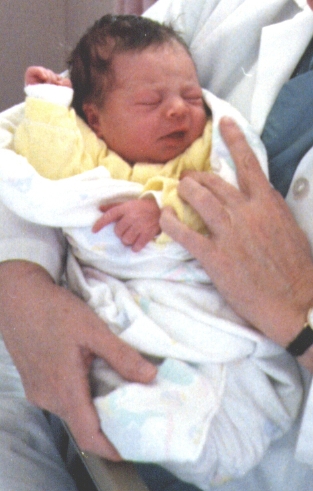
babygirlfifteen years ago today I gave birth to my only child, my daughter. It was a difficult pregnancy, as I went into premature labor at twenty-six weeks when she weighed about two and a half pounds. In 1989 there was very little chance of survival at that stage and I spent the next eight weeks in a perpetual state of high alert. With the help of the midwives and the medical staff at the University of Michigan hospitals I managed to hold on to her until just two weeks shy of my due date.

She came into the world on May 5 at 9:10 in the morning, by c-section, rounded and pink and squalling, five pounds, twelve ounces.

Three years from this spring she'll be graduating from high school and getting ready to go off to college. This great adventure, this raising of a daughter, will enter a new phase and we will watch and worry from afar, and assure each other that she is doing well, that she will turn to us when she needs us, that we made the most of her childhood and adolescence, and most of all, that she'll come home to see us not because she needs to, but because she likes us, and wants to. That's my wish, on her birthday.

May 4, 2004

how to be right, and alienate your reader

In part because of my academic background and area of specialization, I have paid a lot of attention to the evolution of the term 'politically correct'. In the seventies it was used to describe something
"conforming to a body of liberal or radical opinion, especially. on social matters, characterized by the advocacy of approved causes or views, and often by the rejection of language, behaviour, etc., considered discriminatory or offensive..." (OED)
but it didn't take long for the term to become so overextended. By the late eighties, to say somebody was 'politically correct' (usually with a sneer) was to accuse the speaker of parroting extreme liberal views without critical thought (whether or not that was true; the phrase was -- and is -- still used as a way to silence debate.)

For my part, I like to think that in most situations it's just good common sense to avoid language that is exclusionary or biased -- unless I'm hoping to evoke negative reactions. There's a good chapter about these issues in a book by Deborah Cameron called Verbal Hygiene. Great book, terrible title.

So what does this have to do with writing fiction? A lot, unfortunately. First, in historical terms, it's sometimes impossible to use the right historical lexical items because your readers -- those of them who don't know the language history, and even those who do -- would find it so disturbing that they'd lose track of the story. You can have a nasty antagonist use any kind of slur and get away with it, but you can't have a protagonist use any of the eighteenth century terms for natives of Africa without causing real problems for your reader. Nor can you simply use modern day terms, because they will stand out like proverbial sore thumbs. So what do you do?

It's generally possible to structure dialogue to evade the most problematic lexical items. Coward's way out? Maybe. But to me this is one of those damned do/don't things. Either you alienate your reader, or you commit anachronism. To use an example which is not quite so incendiary as most, consider the word girl.

In today's world, a male executive who refers to his assistant as 'his girl' is (a) clueless (b) insensitive (c) sexist (d) deliberately provocative or (e) all of the above. "I'll send my girl to get us coffee." -- Now there's a sentence you'd put in the mouth of a character you don't much like, or want your readers to like. But what if you're talking about the year 1898? What would it mean then, in terms of how to read the character? For most readers, the answer to that question doesn't matter, because they can't get beyond their initial reaction.

The point (and I do have one) is that it's hard to be historically and socially true to the language because your reader is stuck in her own time and place, and lacks the references she'd need to interpret. You'll have to concentrate on other kinds of details to establish character, and keep a dictionary close to hand.

Another thing: Stephanie at Sillybean has pointed us to LanguageHat who points to this online database of magazines (Annual Register (1758-78), Blackwood's Edinburgh Magazine (1843-63), Gentleman's Magazine (1731-50), Notes and Queries (1849-69), Philosophical Transactions of the Royal Society (1757-77), and The Builder (1843-52)) made available by Oxford. There is nothing so good as reading newspapers of the time you're writing about to get a sense of the language.

May 3, 2004

avoiding language anachronisms

This topic has come up now and again, in posts about Gone with the Wind and more recently, Deadwood. It's a technical and creative issue at the same time, and quite a tricky one, especially for people writing historical fiction or telling stories from the past on the screen.

The novelist has to find the balance between historical accuracy and the reader's comfort level. There are extremes. On one end you might say that accuracy is everything, and damn the reader's comfort; at the other, you might toss concerns about language accuracy out the window, and operate much in the way of Star Trek, where everybody understands everybody else, regardless of species or background, and nobody ever bothers to explain how that might be. Putting science fiction aside for a moment (although I keep meaning to write about language issues in Farscape, and will sometime) everybody has examples to share from novels and films that really stumble on language accuracy. Even really good writers mess up this way now and then; it's almost impossible not to. Shakespeare had bells tolling in ancient Rome; Dorothy Dunnett once had her character Lymond proclaimed neurotic (in 17th century Scotland long before Freud was ever born). I read a novel (the title of which I'm blocking out) set in 15th century England where the main character tries to calm down a woman in distress by assuring her that the battle ahead of him is a piece of cake. In a comment to one of my posts about Deadwood, somebody pointed out that they used the word trenchmouth, which was coined in WWI.

The problem with lexical anachronisms is that they potentially destroy the fictive trance you work so hard to establish for your reader. It's like ice water on the back of your neck on a hot day; you can't not notice.

So how to avoid this mistake? One thing you can do is check idiomatic words and phrases for their place and time of origin. The Oxford English Dictionary is the usual place to do this, although it has some limitations. First, it's too expensive for most people to own and even if you did invest, the hard-copy version is always out of date; second, it's too expensive for most people to access on-line ($29.95 a month or $295 annually) unless you have library priviledges at a college or university that subscribes; third, (and most important) it's limited to written language usage.

A word exists in the OED's version of language history only once it has been written down. It should be clear that for most of the history of the English language, usage was not recorded anywhere at all, and so it's hard to know when or where particular coins were actually used. On the other hand, the versatility and utterly amazing scope of the OED's on-line search engine makes it useful in so many other ways, its limitations seem less important. You can, for example, search for whole phrases and idiomatic expressions. The next time I've got access to the on-line version, I'm going to see if they have the earliest citation recorded for 'bald as an egg' and while I'm at it, I'll look up 'piece of cake' to see when it was first used, in writing, to mean 'without problem or difficulty' (I'm guessing it evolved from 'easy as pie' used in the same way). What I know for sure is, none of my characters, who inhabit the early 19th century, would have any idea what it means to say such a thing, and keep those words out of their mouths.

Of course, the more recent the setting of your story, the harder it becomes to check for origin and usage. I've got a steel sieve of a mind when it comes to remembering when certain phrases were in use. I know 'cool' was used when I was in high school, went out of vogue for a very long time, and then came back in, but I'd be afraid to put it in the mouth of a character in the year 1989 without checking, first. Slang associated with particular social groups has a very short shelf life, and can trip you up badly. There are dictionaries, of course, but they are out of date even before they are published, for the most part, and the OED can't keep up with the incredible flexibility and creative power of spoken language.

There's another, far stickier matter having to do with language anachronisms that I'll look at (briefly) tomorrow.

May 2, 2004

sara laughs

Just a brief entry today, mostly to answer a question somebody asked me at the writers conference I just attended in Gig Harbor. This person wondered if the name of this website (which is also the name of my corporate entity; I've been a teeny tiny little S-corp for a good while) has to do with a bible story. Apparently there is such a story in the bible, with a Sara, who laughs.

The answer is, no. Absolutely, no. Nothing to do with the bible, or anything religious. I am firmly, unapologetically agnostic, and on the few occasions I consult the bible is has to do with research for something I'm writing. Agnostic, if that word has you worried, only means that I acknowledge my own limitations. I see no evidence of any kind of higher power, but admit the possibility exists, if only because the universe is so large and (for the moment at least) unknowable. I do believe, very strongly, in the separation of church and state. I believe in freedom of religion and (very specifically) in freedom from religion. I choose the latter. If that's clear, now, I'll tell you where the name SaraLaughs does come from:

I had to come up with a corporate name, back when the first novel came out oh so long ago now, and I didn't want to use SaraDonati, Inc. Why? I dunno. It just didn't sound right or feel right. So I was thinking about Sara as a kind of alterego and it occured to me that she's always laughing when I consult her. The name popped into my head, and from there jumped onto paper, and thus you have SaraLaughs, Inc. and saralaughs.com

So I'm back home, as I said, and I see quite a few comments are waiting for me. I'll try to answer most or all of them tomorrow.