" /> storytelling: September 2004 Archives

take me to the front page of the tttt weblog | back to the current weblog

« August 2004 | Main | October 2004 »

September 30, 2004

bookgroups

This evening I met with a local bookgroup, something I haven't done much lately. These requests come in cycles, it seems. This group was mostly teachers, women between thirty and fifty-five, well read and prepared with lots of interesting questions. It was very pleasant, and I left feeling nostalgic for the days when I actually belonged to two different bookgroups.

Except bookgroups never work for me. I'm way too opinionated, and unwilling to read things that don't fall into my sphere of interest. I suppose a bookgroup is too much of a busman's holiday for me, and thus will never work, no matter how much I like the people involved. Maybe I could start my own group, anybody willing to read the books I put on the list -- but then there's another name for that: a classroom.

I'm not nostalgic for teaching and I don't romanticize it. I do have good memories of a handful of students from my past, and I remember the thrill that comes from seeing a whole group of people -- some of whom are resisting -- understand something new, all at once. What a phoneme is. The difference between learning language and child language acquisition. The universality of syntactic structure. Epiphany, metaphor, show/tell. There are magic moments in teaching, but I find I can do without them at this point in my life. And while I am a good teacher, when I chose to teach, I am also a strict one, and I don't think that will get any better with age. In fact, if I kept on teaching I'm sure I'd turn into one of those curmudgeonly old professors with a reputation for being irascible, demanding, but (hopefully) fair. I was well on my way there when I stopped teaching four years ago.

This has been one of those crazy weeks where I'm out doing something every evening. I'm going to see to it such frivolous gadding about stops, and right away. With any luck I'll be blogging about more interesting topics soon.

September 28, 2004

backtracking

Homestead (which I wrote under my real world name) seems a long time ago, and in fact it is about eight years since I finished it. These days I'm remembering more clearly what it was like to work on Homestead, because while Tied to the Tracks is very different in tone, subject and approach, I'm finding that I run into the same craft issues that I did writing Homestead. These are problems that don't apply to the Wilderness novels, for some reason I can't really pinpoint.

With Homestead I would get stuck for days until I realized that I had been trying to force the narrative in a direction that didn't really work. Once I identified the spot where I had gone wrong (which usually meant admitting that I was being manipulative, and that I couldn't ignore the fact that the characters were protesting), I fixed it, and things moved on.

Tied to the Tracks is working the same way. I inch along slowly, and often have to backtrack and reassess and rewrite. And just now, at this very moment, I realize why this is happening. It doesn't happen with the Wilderness novels because I know those characters so well. It's very rare that I misstep with them, whereas the TTTT characters are still new to me in most ways. I'll never know them the way I do the Wilderness people, because once this novel is finished (and I'm at 65,000 words in a 100,000 word novel) they'll go on about their lives and I won't be sticking my nose in anymore.

Should this realization make me more comfortable? I'll think about that, but right at this moment, it does not.

September 27, 2004

a note about avatars

Every once in a while I get a technological tic, and decide I must immediately figure out how to make my webpages dance the hula, or teach the ipod to say comforting things when I'm feeling low. I'm pretty good at knowing at first glance if the technological demands are beyond the amount of time and energy I can dedicate, in which case I (1) give up and decide I never did like inanimate talking objects; or (2) I pay somebody else to do it for me.

Some time ago, maybe a month, I ran across a website where you could register your avatar. You know, those little pictures people put up under their names on discussion boards and the comment section of blogs. The idea was that you registered your avatar and then whenever you posted on an enabled board or blog, your avatar would automatically be included. I like my avatar, you understand. I'm proud of my avatar, I admit it. So I gave in to foolish pride and jumped on the bandwagon. I followed the directions carefully, uploaded the avatar, made the changes I needed to make to various templates... and it didn't work. So I futzed with it for maybe an hour total, and then gave up. As I said, I usually know when to throw in the towel.

Now, a month later, suddenly the avatar is popping up in various places -- mostly (but not always) when I respond to a comment on my own weblog. And here's the problem: having given up on the whole idea, I now cannot find the original website where the whole thing got started, so I can't turn the darn thing off or make any adjustments to the way it displays. Thus, if you see Einstein popping up in unexpected places, that's the reason. The technology gods are paying me back for my hubris.

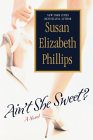
Ain't She Sweet -- Susan Elizabeth Phillips

coverFirst: I listened to this as an audiobook, and I'm going to evaluate the book separately from the reading.

The book is, for my money, probably going to be my favorite Susan Elizabeth Phillips. It's funny and sweet, but it's also quite thoughtful. It's a twist on Cinderella and her stepsister -- because you don't know which one is which, and by the end, you're still debating. In a good way. Can they both be Cinderella, with dashes of stepsister? Pretty much, because the main female characters (Sugar Beth, the former high school beauty queen of Parrish, Mississippi, now down on her luck) and Winifred (her half sister by her father's open relationship to another woman) are complex in the way they see themselves, each other, and the world. In the end I liked Sugar Beth the best, because she comes a long way, learns a lot, but doesn't lose her edge.

The novel is very atmospheric, full of southern smells and sights and sounds (I'll get to more about this in a minute) and does a great job of capturing the good and bad of small town life. I highly recommend it for anybody who likes a well done love story. Unless you've got a lot of biased, preconceived notions about romance, you should read this book. Thus, my score: ****+

Now about the audio. The reader is Kate Flemming, and she knows her way around a variety of southern accents. Flemming reads Sugar Beth with just the right amount of vinegar; I don't think I would have liked Sugar Beth quite so much if I had been reading rather than listening. Really.

The problem is Flemming's reading of Colin Byrne, the main male character. A successful author, once Sugar Beth's reviled high school English teacher -- she got him fired by telling a lie after he proved that a man could be immune to her charms. Colin is supposed to be the son of an Irish mason, a boy with ambition who managed to get an education beyond his social standing and pulled himself up by the proverbial bootstraps. I don't believe there's ever a mention of where he went to university, but it's clear that he worked for what he's got, and re-cast himself. And then Kate Flemming goes and reads him with an outdated posh upper class accent.

There are lots of examples of current day upper-class English accents out there. Colin Firth in What a Girl Wants jumps to mind, along with a dozen other examples from modern movies. But this Colin Byrne talks like an overdone Basil Rathbone circa 1930, all glottal creak (which is, in fact, a technical term) and plummy vowels. I kept thinking it was a joke, that there would be some explanation in the story of why he affected such an outlandish accent, but nope. It was so overdone it almost stopped me from listening to the book, but the story pulled me along and I learned to ignore it. I think I would have liked the character Colin Byrne a lot more if he hadn't sounded like such a dweeb of a throwback.

Please note that I do have some grounds for making such judgments -- my husband is a Brit with the kind of educational background that Colin Byrne is supposed to have. I played a bit of the audiobook for him so he could hear the character, and he burst into laughter.

But. In the end Flemming does such a great job with the other characters, I had to give the audiobook *** stars.

why we should be good to dogs. and kids.

Robyn sent me a link to this article in a New Zealand paper about two separate incidents of very young children abandoned by abusive alcoholic parents. Both these boys were then taken in and nurtured by dogs. Both cases in Russia.

Aside from the tragedy, you've got to admire the fact that the human species is so capable of making links to whatever living creature will help with survival. (Also from Robyn, ever observant, more (a lot more) on feral children.)

I once considered the idea of a feral child character for the Wilderness books. While I do like the music in Disney's oh so jolly version of a feral child's life, I still found it disturbing (as I find most Disney movies disturbing just below the surface). I'd rather let the topic go than run the risk of trivializing child abandonment.

PS I'll be putting up a slew of book and movie reviews over the next few days, fwiw.

September 26, 2004

odds and odder ends, including scolding publishers and mean readers

One of the many Jennifers pointed me to this article on the ABC site about authors who write weblogs. Pros, cons, the usual -- but the bit that really caught my attention was the publishers weighing in.
At Farrar, Straus & Giroux, where one prominent author, Shirley Hazzard, doesn't even own an answering machine, president Jonathan Galassi says he doesn't pay much attention to blogs.

"Maybe we're behind the times," says Galassi, who publishes such award-winning authors as Hazzard, Susan Sontag and Jonathan Franzen. "I just think there are too many words out there already. I hope our writers will be spending their time writing their books, not their blogs."

This both makes me laugh and irritates me. What is the relationship between the publisher and the author, anyway? Teacher to student? Parent to child? Galassi shaking his finger at his authors (now Shirley, get back to writing stuff I can sell ) galls me.

The truth is, publishers won't or can't invest the money necessary to bring an author and his/her work to the public's attention. Ask any published author (below the level of Stephen King) and you'll hear about the trouble with marketing these days. So authors hire outside public relations people (which I haven't done) or go to market-it-yourself seminars (which I haven't done) or arrange their own book tours (ditto) or just sit by and wring their hands while a newly published book gets lost in the thousands of other books published every year. A weblog is one way to reach out to readers, and thus I write.

Other reading: by way of Old Hag I found author/columnist Amy Sohn's website. Have a look at her angry letters section. Dogdamn, there are some mean people out there. I'm bookmarking it so that I can read it whenever I'm thinking of complaining about my reviews. (Which have been very good for the new novel, she added hastily).

The observant RobynBender sent me this link to Things My Girlfriend and I Have Argued About, the writings of Brit Mil Millington about Margret, his significant other. Go over there if you need something funny to read. For example:

The TV Remote. It is only by epic self-discipline on both our parts that we don't argue about the TV Remote to the exclusion of all else. It does the TV Remote a disservice to suggest that it is only the cause of four types of argument, but space, you will understand, is limited so I must concentrate on the main ones.

1) Ownership of the TV Remote: this is signified by its being on the arm of the chair/sofa closest to you - it is more important than life itself.

2) On those blood-freezing occasions when you look up from your seat to discover that the TV Remote is still lying on top of the TV, then one of you must retrieve it; who shall it be? And how will this affect (1)?

3) Disappearance of the TV Remote. Precisely who had it last will be hotly disputed, witnesses may be called. Things can turn very nasty indeed when the person who isn't looking for it is revealed to be unknowingly sitting on it.

4) The TV Remote is a natural nomad and sometimes, may the Lord protect us, it goes missing for whole days. During these dark times, someone must actually, in an entirely literal sense, get up to change the channel; International Law decrees that this, "will not be the person who did it last" - but can this be ascertained? Without the police becoming involved?

September 24, 2004

Farscape

farscape_pkw_120x600The four hour miniseries

Farscape:

The Peacekeeper Wars

is just around the corner, you realize this, right? On

Sci-Fi Channel

October 17 & 18

9 pm (8 pm central)

I've been beating my brains trying to figure a way I can talk y'all into watching it, as I would love to be able to say I got dozens of new viewers to give it a chance.

Would you take my word for it? If so: great storytelling. Fantastic. Turn on the television, or if you don't have Sci-Fi, go visit a friend who does. Make them sit down, too.

Not enough?

Bribes are highly underrated, in my view of things. Signed bookmarks? The first chapter of Queen of Swords? What kind of bribe would make you turn on the Sci-Fi channel and sit in front of it?

Speak to me, please. I'm open to suggestions.

books on the back burner

Once in a while, as you will have noticed if you read this weblog regularly, I worry that I'm done writing. I have panic episodes where I wonder how I'll find the money to pay my publishers back the advances they've given me. Other times I wonder if I'll be able to find the time to write all the various stories that are bubbling in the back of my subconscious. Because there are more than a few of them.

In addition to novels which I am actually contracted to write (Queen of Swords, Tied to the Tracks, Pajama Jones) there's the screenplay Nuns with Guns I wrote with my friend Suzanne that we need to turn into a novel. And there are other stories not quite so close to the surface. These are stories that pop up without a lot of fanfare or notice, and when they do I spend some time observing the details and thinking about them before they get sucked back into my subconscious for more gestation. There's a novel in me somewhere about a person I went to high school with whose life didn't turn out the way she expected it to, in a big way. I've got vivid images of a few scenes of that one, but only a few. Then there's the Volvo story, which has been stuck at the 1/3 mark for a couple years now, but recently reared up unexpectedly and presented me with a solution to the roadblock that's been in the way.

Then there is the huge project of writing about my father's family. This would be creative non-fiction, documenting and filling in the blanks by means of empathy and imagination. The cousins all know that I'm planning on doing this, because I've interviewed them, or most of them. The cousins are a colorful bunch, loud and opinionated and affectionate and profane. Two years ago at a family get together in Florida about six of us sat down together and talked about the aunts and uncles and various family legends, mysteries, feuds and scandals. Whenever I talk to one of them (as I did to Tommy, last night) they ask how it's coming along, to which I always say: it's percolating. Or: I've got to invest the money in having somebody do some archive work for me in Italy. Both things are true.

My father was one of ten kids, spread out over seventeen years, so we've got this situation you run into in big families where I have first cousins with kids older than me. Tom is two years older than me, the first son of my first cousin Benny. He's also the one who recorded the group interview and edited it into a cohesive whole. I got the DVD in the mail the other day and I've been thinking about it ever since, the stories waiting to be told. By me.

Tom and Benny and Richard and Georgie and all the rest of them each have their own idea about what it will mean to have me write the family history. Some of them have the idea that Puzo will have to make way for my version of the Lippi family history. It's true that there's a lot of drama there, and a lot of potential. All you have to do is look at the family history written by Uncle Luigi Alfonso in 1927. An excerpt from a contemporaneous (and very colorful) translation:

GENEALOGICAL HISTORY OF THE LIPPI FAMILY FROM 16th CENTURY TO THE PRESENT TIME

[...] Carlo rendered himself notorious through his killing of the Padrone of Stella [Cilento], Antonio Cesare Ventimiglia. The said incident occured during the rule of Giuseppe Buonaparte [1] over the kingdom of Naples (about 1807), inasmuch as it is said that as he was about to deliver the fatal shot he exclaimed "Signore, Giuseppe Buonaparte sends you this!" Although this killing occurred in the presence of others, Carlo received no punishment from the law, perhaps largely due to the political powers in control at the time, and also perhaps due to the assistance received from the public.[...]

I just hope I get around to writing it while most of the generation is still alive.

The other book that I may or may not write someday has to do with my more immediate family history, which is dramatic in a different way. A therapist once told me that I'd never completely resolve my anger toward my mother if I didn't take the step of writing about it, which leads me to a dead end, because as I told her, I'm not particularly interested in getting rid of my anger. It has served me well these many years, my own personal power station propelling me along. I like my anger. It is my friend. And really, does the world need another memoir about a spectacularly bad mother-daughter relationship, alcoholism, family dysfunction and abuse? Isn't that all old hat? Looking back at it I recognize the story there -- because there is one -- but I can't imagine anybody would really want to read it unless I spiced it up by throwing in some wire hangers or an affair, JFK or Elvis or somebody else people like to read about.

So maybe my anger has slipped away from me a little bit when I wasn't paying attention. Certainly I'm not sure I could find the energy to excavate the sixties, and anyway, there are other books waiting to be written.
September 23, 2004

characterization & cheating

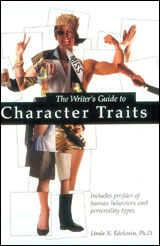
edelsteinBrowsing in the bookstore I came across this: The Writer's Guide to Character Traits by Dr. Linda Edelstein. (Hardcover   ISBN: 0-89879-901-5 $18.90). In less than three hundred pages you get (just for starters):
• Profiles of 20 adult personality types, from adventurers and eccentrics to conformists and creatives
• Child and adolescent types, including descriptions of mild to extreme developmental disorders
• Typical personality traits associated with 46 different careers ranging from astronauts to social workers
My question is, does this cookbook approach really work for anybody? I'd be interested to hear from an author (if anyone would admit this) who has successfully constructed characters with a book like this. It just seems way too simplistic, or maybe I'm just too much of an A personality to take one person's word on such a wide range of topics. For example, I'm working (in a very preliminary way) on the first stages of a character for a novel I haven't started yet. This woman is agoraphobic. At the moment I know only very basic things about agoraphobia, but I'll learn a lot more before I launch into writing for real. I can't imagine how a paragraph in a how-to book could possibly be enough.

I started thinking about this in more depth after reading Joshua's post on the complexities of post traumatic stress disorder. If you ask the average joe on the street for a definition of PTSD you'll probably get some vague response about Vietnam vets and violence. You'll get that response because vets/violence is the only aspect of PTSD the media has chosen to bring to your attention. But if you want to write a character who deals with PTSD and you care about things like reality and depth and complex characterization, you're going to need to really look into this stuff, and dig far deeper than the six o'clock news. Joshua's post touches on a lot of really interesting aspects of PTSD in a way that makes it clear that he's thought about the issues. If he choses at sometime to write a story or novel about somebody whose life is complicated by PTSD, I imagine he'll pull it off because he's put in the work.

Now you might be wondering if it's really important, and isn't it possible to cut a few corners, now and then? Do you have to get an MD to write a story about a surgeon? Do you need to climb Everest to write about the maniac people who trudge up there trying to get by without oxygen?

There are places you can cut corners, sure, but characterization isn't one of them. You don't need to know how to perform bypass surgery to write about your surgeon, but you sure do need to understand what makes him visit chatrooms every free minute, where he tells everybody he's a janitor who breeds cockatoos as a hobby. When it comes to the inner workings of the character's mind, cutting corners is not a good idea, because believe me -- readers will put up with a lot, but they will call you on it if you fumble PTSD or pretend you know what it is to be the hearing child of Deaf parents. And rightly so.

September 22, 2004

an exception to my own rule, and writing stuff

When I started this weblog I decided I would stay away from politics. There are a lot of blogs out there that do politics exclusively and much better than I could, and I figured that I should stick to the original idea: to write about writing.

I'm making a short exception today, to point to thisTalkLeft post, which provides the entire draft of a proposal

calling for a reinsatement of the draft--for men and women--ages 18-34, not just to those who might qualify for active military duty, but for those with skills the Government finds helpful in war--linguists, medical workers, etc. Just about everyone.
There's more information on the Alliance for Security website. A lot more, all of it disturbing.

The media isn't paying much attention to this topic, but I hope the rest of us will. For the record: I am not in principle opposed to any military draft; I am opposed to a draft put in place to fight preemptive wars declared on false grounds.

On other fronts, I need to go write. Things are moving, and so must I.

September 20, 2004

first lines

The first lines of a novel or short story are an invitation written in shorthand. Here's an example:
I am living at the Villa Borghese. There is not a crumb of dirt anywhere nor a chair misplaced. We are alone here and we are dead.

Tropic of Cancer | Henry Miller

The first few lines of a novel have to draw the reader in and hold her captive, which makes those sentences the hardest and most important sentences to write. Browsing in a bookstore I might read the first lines or first paragraphs of twenty novels in a half hour. Twenty different authors + twenty opening lines = days and days of work, but it only takes me minutes to make decisions on whether or not I will read the rest of the book. I'm looking for evidence that I'm in the hands of a real storyteller. Somebody with a voice, and vision.

I've said before that I'm not crazy about first person narratives, but these days it seems like I can pick up a dozen novels one after the other and they are all in first person. I keep wondering when this fashion will pass. I am rarely so struck by a first person narrative that I'll buy the novel, but there are exceptions. Tropic of Cancer is such an exception. I actually remember reading this opening line many years ago, because it made such an impression on me; it was exotic (Villa Borghese), with strong imagery, and there is that shock of listening to a dead man tell a story.

Here's an example of an opening done with dialogue which works (for me) like magic. From Dickens' Hard Times:

NOW, what I want is, Facts.
In this case it's the comma and then the capitalization of Facts that makes me sit up and pay attention. People who talking in capital letters are bound to be interesting. Something very different:
In the days when the spinning-wheels hummed busily in the farmhouses -- and even great ladies, clothed in silk and thread-lace, had their toy spinning-wheels of polished oak -- there might be seen in districts far away among the lanes, or deep in the bosom of the hills, certain pallid undersized men, who, by the side of the brawny country-folk, looked like the remnants of a disinherited race.

Silas Mariner | George Elliot

To start with this sounds like a traditional story in a traditional setting, saved from the curse of the ordinary by use of interesting details (thread-lace, polished oak). It's the last part of the sentence, the juxtaposition of the expected (brawny country-folk) with the unsettling (remnants of a disinherited race) that pulls me in.

Another example:

The schoolmaster was leaving the village, and everybody seemed sorry.
I'm wondering if anybody recognizes this? I'll spill the beans if nobody wants to speak up. I'm also wondering why the sentence has always stuck in my head. The only explanation I've got is the use of the word seemed. With that one word, a world of possibilities opens up before us, and the story might take us to any of them.

And for something completely different, sometimes pure shock value works. Here's an example:

Three men at McAlester State Peniteniary had larger penises than Lamar Pye, but all were black and therefore, by Lamar's own figureing, hardly human at all. His was the largest penis ever seen on a white man in that prison or any of the others in which Lamar had spent so much of his adult life. It was a monster, a snake, a ropey, veiny thing that hardly looked at all like what it was but rather like some form of rubber tubing.

Dirty White Boys | Stephen Hunter

I like Stephen Hunter's books about Earl and Bob Lee Swagger (I went into some detail about the series here). I had read a few of them before I picked up Dirty White Boys. Maybe I was taken in by his opening because I already liked and trusted the author -- I knew enough to give Hunter a chance, and my reaction was tempered by that. Thus a warning: an opening like this, calculated to shock on multiple levels (sexual imagery, racism, crime) might backfire if you don't have the skill to pull it off. Especially if you aren't Stephen Hunter.

In summary, first sentences really hard. Wickedly hard, for me at least. But once that first sentence is solid on the page... the rest of the damn novel still has to be written.

September 19, 2004

if you want a signed copy of the new book (or an old one)

I have had a lot of email lately regarding signed copies of Fire Along the Sky, so I checked in with Village Books, and here's the skinny:

Village Books would be happy to take credit card orders over the phone, at which time they'll arrange to have the book signed (by me) when I read there tomorrow (or really anytime; I live ten minutes away) and mailed to you.

VILLAGE BOOKS IN HISTORIC FAIRHAVEN
1210 Eleventh Street
Bellingham, WA 98225
Tel: (360) 671-2626
Fax: (360) 734-2573
[email protected]
They do have an on-line order form, but it's pretty slow in my experience and it's probably more efficient to just telephone.

Shipping costs in the continental US: five bucks. They have the rest of my books in stock too, in softcover, if there's any interest. Shipping, etc, would have to be discussed with them directly, but this is something they do all the time.

If you do call them to reserve a copy of FaS, make sure to say how you want it signed -- if you want it personalized, or if my signature alone will do. For purposes of collection it's best not to have the book personalized, but I'm happy to write whatever you want. Within reason.

I'm in the middle of writing a very big and complicated scene with too many people, but I'm going to go back and dive in again.

September 16, 2004

Tuckerising?

Jena has a post about Peter Watts, an author who is raffling off a spot in his next novel to benefit the Philadelphia Public Library. Apparently this process of naming a character after a specific person is called Tuckerising. Except I can't find any references to the term. Anybody want to fill me in?

I have never based any character on a living person.

Now that the lawyers have stopped reading, I'll amend that statement: some of my characters are amalgams of people I have known, which makes them fictional. Some of these amalgams are positive; some certainly are not. But Tuckerising confuses me. I suppose for fun I could name a character after somebody I know: Pokey Bolton, Robyn Bender, Sister Mary Ellen, JoLynn Mutschinsky, Ellen Turner, Winnie Chambers, Nini Fink -- all names out of my present or past. But why would people actually pay for raffle tickets for such a dubious honor, unless it's solely to support the good cause behind it? While you're explaining Tuckerising to me, maybe you can fill me in on this, too. Please.

On another note, can anybody tell me what Coca Cola Cake tastes like? I'm curious, but not curious enough to actually make one.

September 15, 2004

since that worked so well...

Thanks to everybody who let me know about The Trouble with Angels. It seems like people in their thirties or older have a pretty good chance of knowing it, so I'll keep the reference. For those of you who haven't seen it, it is out on DVD.

It seems like they bring out another dozen old movies on DVD every week, but if there's rhyme or reason in the order, I can't figure it out. I was pleased to find TwA on DVD, but there's a whole list of other movies I own on VHS and would like to buy on DVD, if only they were available. Two that come to mind right away are Yanks (1979) and Reds (1981).

Yanks was directed by John Schlesinger and had a stellar cast -- a young Richard Gere as one of the thousands of soldiers sent to England for training before the Normandy invasion -- Vanessa Redgrave, William Devane, Rachel Roberts, Tony Melody. My parents-in-law, who were in their early teens during the war in England and who have very high standards when it comes to films that deal with this period, loved this movie for the details. I liked pretty much everything about it, but especially the love story. Unfortunately it's still not out on DVD, and my VHS tape has seen better days.

coverReds is also a movie I like a lot -- in fact there are some elements of it that I adore -- but some elements don't work for me at all. It's a fictionalized account of the life of John Reed, who was a radical American journalist and early member of the Communist party. He's best known for his non-fictional account of the Russian revolution (Ten Days that Shook the World is available on-line as a free etext through Project Gutenberg, here). This film adaptation of his story stars (and was directed by) Warren Beatty at the height of his box office appeal. The rest of the cast is pretty spectacular, with the exception of Diane Keaton as Louise Bryant. But in spite of her performance (which reminded me of Annie Hall; all her performances do) the rest of the cast really did keep the movie well above water. In addition to Edward Herrmann as Max Eastman; Jerzy Kosinski as Grigory Zinoviev; Jack Nicholson as Eugene O'Neill; Paul Sorvino as Louis Fraina; Maureen Stapleton as Emma Goldman, the first hour of the movie really struck me for the short interviews with the people who actually knew John Reed and Louise Bryant and who were active during the period in question, in journalism or politics.

These interviews really make the movie, in my opinion. They include everybody from an irrascible older Henry Miller (People fucked back then just as much as they do now. We just didn't talk about it as much), Dora Russell, Scott Nearing, Rebecca West, Will Durant, George Seldes, Dorothy Frooks, to the comic genius George Jessel.

The movie is beautifully filmed and edited, the scenes in Russia during the revolution most especially well done, and the ending (highly fictionalized) moving.

When this was shown in the theaters in 1981, it was with an intermission. (They used to do that with long movies. I remember intermissions for The Sound of Music and My Fair Lady, for example.) I saw Reds in Evanston, Illinois when it came out. When the lights came up at intermission time, one old lady sitting right in front of me turned to her companion and said, "You know dear, I don't think they're Republicans or Democrats." I had to bite my lip to keep from bursting into laughter.

I really liked this movie for many reasons (not least the fact that it made me learn more about the history of the time and events in question) but again, it's not available on DVD.

September 14, 2004

quick question

Imagine you're reading a novel and you run across a reference to an old movie called The Trouble with Angels.

Hayley Mills as Mary Clancy, June Harding as Rachel Devery, Rosalind Russell as Mother Superior, 1966. Hayley Mills is the trouble maker ("I've got a scathingly brilliant idea").

Does this mean anything to you, or would you be totally in the dark? I may not be a practicing Catholic, but I still love this movie and I'm wondering if anybody else remembers it, at all.

things come together

Sometimes all it takes is the right sentence, and everything flows. Today the scene that has been stuck in my craw dislodged itself and out came 1,500 words. Now I'm going to go play with fabric.

September 13, 2004

anniversary

I've been writing this blog for a year, which I never really thought would happen. I started the whole thing with a warning that I'd probably stop abruptly, as every attempt to keep a journal (and I've tried many times) has failed miserably. But here I am still.

There were other reasons I hesitated to start. The whole egocentric nature of the business worries me, to be truthful, but I thought if I stayed away from topics other than writing (including my personal life, for the most part) I might be able to avoid sounding self absorbed and witless. Have I succeeded in fooling everybody? Don't answer that.

My sense is that most people who write weblogs do go away, eventually. They get bored, or run out of things to say, or something else intrudes and makes it impossible. Just now I'm in a slower period myself. I may run out of steam, but I'll try to hold on as long as I can.

A few housekeeping matters. I've made some changes in the right hand column. First you'll see that the post office has returned to the little village of Fairhaven and so you can, if you really want to, write to me. I can't send out signed bookplates because that turned out to be so overwhelming. I do apologize about it, but I know if I start that up, I'll just disappoint people and feel guilty, and really, that's not the idea. I can sign whole books, if you want to go to the trouble of sending them -- but you'll have to include a return envelope and enough postage, too. Most people aren't that keen to get a signed copy so I'm not worried about being overwhelmed. Someday maybe I'll be able to hire an assistant (this is one of my daydreams) who will make sure things are filed neatly and do all the bookkeeping so I don't panic when the accountant calls and manage the bookplate requests. She'll look like Aunt Bea and make lemon bars and cluck when I have a cold.

I've also put in a little dohicky (this is, in fact, the technical term) which serves up an excerpt from the entry of a year ago (if there is one) and thus I am reminded to tell you that Farscape is coming. Really. The four hour miniseries called The Peacekeeper Wars will air on the SciFi channel October 17 and 18. This is a tremendous victory for the Faithful, who began the campaign to bring the show back the moment the premature cancellation was announced. So watch it, okay? Because excellent storytelling is a rarity on television and deserves to be supported. If I could think of a way to bribe a million people to watch it, I would do it. Lemon bars, anyone?

September 11, 2004

getting sidetracked

one way my anxiety presents, in as far as writing is concerned, is finding ways to write which don't really move the novel along. If I find myself working on acknolwedgements, I'm in trouble. Author's notes, ditto. This particular novel, though, has presented a entirely new and exciting method for writing while not-writing, and that is this: I find myself creating documentation for my fictional world of Ogilvie, Georgia. The initial thought was that I'd have a small narrative at the beginning of each chapter, anecdotes minor characters relate about their memories of one of the central characters, a Flannery O'Connor-Eudora Welty-Zora Neale Hurston kinda old woman literary lion. I was working on that when the wonders of writer's anxiety kicked in and I thought, hey. What would the AAA guide say about Ogilvie? And as there is a private Ogilvie College (fictional) in the fictional Ogilvie Georgia, what would the college guides say about it? Which meant that I had to go read AAA guides and college guides, of course. In the spirit of getting it right. But of course I couldn't cite those kinds of publications, so I had to make up new ones. Of course.

Remember when I said that writing a contemporary novel would free me of the long research hours that go into all the Wilderness novels? Ha.

I have been researching the history of the Catholic church in the south, southern food and habits, the way a documentary film is put together, the difference between shooting on film or digital video, what goes on in the editing suite, the flora and fauna of the Georgia coast south of Savannah, the history of railroads especially in that area, and Jim Crow laws. Because, really, I need to know these things. Really.

There is an upside to all this. While I'm obsessing about details, my subconscious is still working. Today while I was looking at old AAA guides my subconscious served up a question. Why is it Angie cares so little about clothes? Where does this come from? Why is it important? Does she have to be careless or unconcerned about her clothes? In a scene I wrote yesterday she was wearing a bra with two safety pins holding up the straps and lime green boxers decorated with poodles, a gift from one of her co-workers. I said to her, why draw attention to yourself this way? What about plain old white underwear? To which she said, nope. It's the poodles, or nothing. As I didn't want her naked in this scene, I left the poodles. This is a fairly unusual characteristic for a female primary character in a novel that has a love story at its center: the woman doesn't care about clothes. She doesn't care about them so much that she wears the same t-shirts and shirts for years as long as they are clean and mended. Her idea of getting dressed up is a simple black dress she has had since she went to grad school. She can't be bothered to go shopping. What money other women spend on clothes she puts aside for new camera equipment or sometimes to buy a piece of original art, all of which is rich in color and abstract, or black and white photography.

John, on the other hand, is meticulous and has excellent and classic taste; he's never taken in by a fad, and there's nothing pretentious about the way he dresses. He's not particularly bothered by the fact that Angie doesn't pay a lot of attention to clothes. He likes the smell of her skin and the fact that she doesn't own a bottle of perfume.

These are things I know for sure, but the why, that hasn't presented itself yet. I have this sense Angie's mother will tell me more. I'll have to get the two of them on the phone and listen in.

September 10, 2004

my investment in reading

ipodI finally gave in to temptation and bought an iPod. I also have a subscription to audible.com (surprisingly affordable) -- which came with a coupon for a hundred bucks off the iPod. From audible I can download a book a month for no additional charge.
This is a wonderful thing for people like me, for whom multitasking is the default state and anything else feels wrong. So far I've listened to Black House by Stephen King and Peter Straub (unabridged! 23 hours!) and The Devil in the White City by Erik Larson and Can You Keep a Secret by Sophie Kinsella -- and I've got a considerable list of books I'll be downloading as soon as they come out. I listen in the car, while walking, on the treadmill. I was a little nervous about such an expensive but small piece of machinery at first, but now I'm more comfortable using it, and the interface with my beloved mac is so painless, there was no learning curve at all.

I do love technology, I admit it. In our family, I'm the one who moons over big flat screen theater systems and tivo and home office machines that do everything but de-pip your orange juice. My husband is the voice of reason, which is good. Otherwise we'd be technologically untouchable, but broke.

September 9, 2004

editing

I'm at that crucial juncture where I've got more than half a book done and I need serious input from my editor, except I can't ask her. My experience has been that it's a very bad idea to get the editor involved at a crucial juncture, no matter how much you might actually need her. Because the editor is the one who bought the book; s/he went to the editorial board and publisher and pitched the book you wrote, sold them on it, fought for the money, and presented the package to you (or better said, to your agent). So the editor has a vested interest in the book, and cannot be objective. It's also just plain hard to send a half manuscript to somebody who has ventured their reputation on your ability to write the damn thing when you're feeling fragile.

Here's what the cover letter would look like:

Dear Editor:

Why did I ever think I could write this book? Better asked, why did you think I could? Because here I am more than half way through it and nothing seems right. The characters strike me as insipid and unbelievable, the plot sucks, and I can't write a harmonious sentence to save my life. Obviously I'm done writing, forever.

PS thanks for the great advance.

Possible responses, as I imagine them:

Dear Writer: Crickey, you're right. It is crap. I see no hope. Send back the advance, today. With 5% interest.

Dear Writer: This is the most beautifully written, funniest, most insightful and moving piece of fiction I've ever come across. It's finished. Here's a million dollar bonus and a first class plane ticket to come to Manhattan so we can celebrate.

Dear Writer: It needs more (sex/violence/insight/character development); now don't bother me until you fix it.

Dear Writer: Stop whining and get back to work.

None of this is what I want to hear, really. There's no editor in the world who can tell me what I need to hear, which is something along these lines:
Dear Writer: Breathe deep. You've done this before. You've done this many times before. You can do it again. I'm not going to read what you sent because you're not really ready for me to read it, are you? I thought not. I have total faith in your ability to pull this off. What you need right now is a massage, and an afternoon with a good book and a box of chocolate. Tomorrow you'll look at this manuscript and know what's right and, if anything, what needs to be fixed. It will all happen. And if not, you have two advanced degrees and lots of other interests, right?
Towards the end there my inner demon editor got hold of the keyboard again, but that's the general idea. In a nutshell: you're alone when you write, and you have to live with it. Pardon me while I go try to gather my senses and see if we have any chocolate in the house.

September 7, 2004

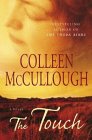
The Touch -- Colleen McCullough

coverMcCullough has produced some very thoughtful work in the past. Tim and An Indecent Obsession are novels that deal with difficult subject matter deftly and with insight, but this novel doesn't work for me, at all. It is poorly done soap opera, trite, predictable, and just plain unbelievable for the most part. The dialogue is often so stilted that I was embarrassed by it.

The story concerns Elizabeth, who at age sixteen is sent from Scotland to Australia to marry a cousin twenty years her senior, one who has made a fortune for himself in mining and engineering. She takes an instant dislike to him, which carries over to their sex life. Her dislike of sex is so extreme that I wondered, for a short time, if McCullough was going to deal with the matter of lesbianism in the late 19th century. That would have been interesting, at least. Instead Elizabeth spends ten years bearing two daughters, learning how to spend money, and making friends with her husband's business partner and long-time lover, Ruby, all the while avoiding him. Alex is a man of his place and time -- less than enlightened, fixed in his ideas, controlling. He plans for his first daughter (who is speaking, unbelievably, in complex sentences with subordinate clauses at age eleven months) to marry Ruby's son by a Chinese prince when he (Lee) comes back from being educated in England.

The fact that Elizabeth and Lee will fall in love is telegraphed early and often, and thus the story has to devolve into a parody of itself. Which is really too bad. I had hopes for this novel, but I found myself speed reading to get it over with. I have given it one star because McCullough does do her research, as always, and provides great period detail.

White Doves at Morning -- James Lee Burke ****+

This might best be called creative non-fiction, as Burke has written a novelized version of his own family history and an ancestor, Willie Burke, the son of Irish immigrants who settled in New Iberia, Louisiana. Willie Burke -- impulsive and idealistic -- is drawn into the Civil War with his best friends, despite his doubts about the cause and his dislike of slavery. The story moves back and forth between his experiences (including the bloody battle at Shiloh) and what's going on in New Iberia, where women and a few men who have evaded fighting for one reason or another continue to fight wars of their own. Abigail Dowling, a nurse from Boston, is an abolitionist who is not well loved by the local patriarchy, but she struggles to carry on. The pivotal character is a slave called Flower, the daughter of a slave woman and the plantation owner. Flower's struggle to maintain some semblance of dignity and independence (from her father/owner as well as from the abolitionists) is sensitively portrayed, without sliding into the realm of the sentimental.

I have a low tolerance for Civil War novels; I think I overdosed on them some years ago, and so it takes an unusual story to really capture my attention. This one did, although I will also say that I wonder how far Burke went in his fictionalization and idealization of an ancestor with such enlightened sensibilities.

Taking Liberties -- Diana Norman ****+

This novel is a sequel to Norman's A Catch of Consequence, previously reviewed here. We pick up the story of Makepeace Burke's life, and find that she hasn't got any more mellow with age; she's driven, and she drives everyone around her, though with a basic goodness of heart and the best of intentions. In this novel she sets out to find her eleven year old daughter, who was on board an American ship sunk by the British (this is the War of 1812, and sea travel is dangerous). At the same time a new character -- Lady Diana Stacpole, recently widowed and glad to be free of a cruel husband of twenty years -- is looking for the son of an old friend, a sailor who was taken prisoner from the same ship that carried Makepeace's daughter. These two women could hardly be more different, and in fact they rub each other the wrong way immediately. There's considerable humor here, and a lot of insight about the way women get along, or fail to.

Beyond the wonderful character development, there's a lot of plot: kidnappings, pirates, smugglers, chase scenes, prison breaks. I love complex plots, but here I had the sense that Norman was sometimes juggling too many eggs at once (and who am I to say something like this, given the multiple, interwoven plots of my own books? And yet, that's how I see it.)

All in all this is an excellent novel with great characters who find their way through a thicket of challenges to come out changed to a lesser degree (Makepeace) or a greater one (Diana). It's huge fun, and very engaging.

Vanity Fair -- screenplay by M Faulk & J Fellowes **

See this movie for the wonderful costumes, fantastic historical detail, and photography. See if it you like Reese Witherspoon; see it for the other beautiful people. Don't see it for the acting, which is barely adequate in the best cases and overblown in the worst (Gabriel Byrne, what happened?). Absolutely do not see it for the plot, which sags in the middle like a mattress in a by-the-hour-motel. I don't know where the blame lies (Mira Nair, the director, has done some great work in the past), but that doesn't really matter. The bottom line is, there's no energy, no wit, and no reason to see what should have been an insightful social commentary but ended up a soggy romance.

what to read

I'll be doing book signings/readings for Fire Along the Sky later this month, for anybody who might be in the area: on Monday, September 20 (7:30 pm) at Village Books in Bellingham; and on Wednesday, September 22 (7:00 pm) at Third Place Books in Lake Forest Park.

Usually I read for about a half hour and then take questions. I have no idea yet what passage I'm going to read, and I'd be open to any suggestions y'all may have.

Seattle Times review

It's a good one. Here's the link, and the review too:
Great news for Sara Donati fans: It is time once more to immerse yourself in her richly imagined world. It's been two long years since "Lake in the Clouds," the third novel in her Wilderness series about frontier life in upstate New York (beginning with "Into the Wilderness"). Now the fourth book, "Fire Along the Sky," advances the fortunes and trials of the Bonner family and their friends -- and enemies -- as the War of 1812 threatens all they hold dear.

In the new book by Donati (the pen name of Bellingham resident Rosina Lippi), the focus shifts from the heads of the Bonner clan (Nathaniel, a famous hunter, and his strong-willed wife, Elizabeth, a teacher) to the younger generation. It's a complicated cast of characters. Nathaniel has fathered five children by three women; the youngest three of the five children are Elizabeth's. Then there are all the subsidiary characters, most of them familiar from previous novels in the series (Donati gives a two-page list of the primary characters as a preface).

Do you need to know the previous books in order to enjoy "Fire Along the Sky"? It's probably not necessary -- but the more you know about Donati's world, the better you understand the complicated motivation, history and interaction of these well-drawn characters. References to earlier betrayals, romances, disagreements and disasters will strike a chord in the longtime Donati fan that may be less resonant in first-timers.

There's a lot to enjoy here. Donati keeps the plot moving at a terrific pace; there are deadly dangers, harrowing journeys, tense confrontations, life-and-death struggles. The day-to-day minutiae of frontier housekeeping and provisioning are regularly jolted with shocks of all kinds: warfare, abduction, drowning, unexpected pregnancy, violent death.

Her characters compel the reader's attention. In the opening pages, the newly widowed Scottish noblewomen Lady Jennet voyages to Montreal in quest of young Luke Bonner, the man she originally wanted to marry. Then Luke's half-sister (and half-Mohawk) Hannah returns after a long absence -- without her husband or her son. It takes most of the book to discover what has happened to them, and why Hannah, a talented healer, is unable to speak about the tragedies that have befallen her family.

Then there are the Bonner twins, Daniel and Lily, who spend much of the novel estranged from each other: Daniel wants to go off to war but is seriously wounded and imprisoned in a Canadian stockade. Lily is a gifted artist who doesn't always make wise personal choices; she is in love with a married man who is unworthy of her.

And there are fascinating villains. Jemima Kuick, a viciously amoral woman who wreaked considerable havoc in earlier books, returns for a stunning blow against the little society of Paradise. This character just might be Donati's argument for the existence of absolute evil; Jemima is so willfully horrible that she's too good to kill off (and Donati seems to be positioning her for a return in a subsequent installment of this saga).

Donati's strong women characters are the heart of her books. They don't just sit around and stir the gruel or knit the socks. They go charging off to infiltrate an enemy camp, operate on wounded soldiers, rescue kidnapped hostages. They speak their mind, often so bluntly that it's a wonder there wasn't more warfare on the frontier. Young girls or wise octogenarians, these are characters that tug at the reader's imagination. After four "Wilderness" books, these women seem as real as your own neighbors.

Melinda Bargreen is The Seattle Times' classical-music critic.

September 6, 2004

books -- by other people, too

I've posted some questions in the discussion forum about Fire Along the Sky, in case anybody would like to get involved in a more detailed discussion. These are just a few issues that interest me, for anybody who has the time and energy.

While I was in London I went into Foyle's on Charing Cross Road. Foyle's is one of the last big independent bookstores on Charing Cross -- I'm sorry to say that Border's has been on the rampage over there, too, eating up independents like so many bonbons. My great fear is that Border's will insinuate itself into the lovely space across from Trinity College, Cambridge, where there is now a great bookstore called Heffer's. My huband was a fellow at Trinity, so we could have got married in the chapel if I hadn't been too shy (which in retrospect I regret).

At Foyle's (and Heffer's) I spent a lot of time looking for historical fiction. For some reason the Brits like it more than Americans do, and I have never come home without a half dozen novels that look interesting, but are unlikely to be published over here. This time I got the sequel to Diana Norman's A Catch of Consequence (which I reviewed last year). The sequel is called Taking Liberties and it's very good, but then everything of hers that I've come across really is worth reading. I also got (but have barely started) a novel called Voyageurs by Margaret Elphinstone, which is about a young man who comes from England in the early 1800s to search for his sister who has been lost, and is now living among the Ottawa.

While I was gone I also read James Lee Burke's White Doves at Morning, which I liked tremendously. Burke normally writes contemporary mysteries (his Dave Robichoux series is highly regarded by critics and readers both), so this historical novel about the Civil War in Louisiana was a departure from him. It's based in part on his own family story, and it's extremely compelling. I'll be posting a full review sometime soon. I hope.

September 5, 2004

clarification, and questions

First, please excuse what may have seemed like an overreaction to Nancy's kind words about looking forward to the next book in the series. I plead jet lag, and a virus. Second, I did start working on Queen of Swords as soon as Fire Along the Sky was finished -- I just haven't been working on it lately. I've got maybe 250 manuscript pages, and I'll be going back to it relatively soon.

Generally I work on two projects at once. When one bogs down for whatever reason, I can work on the other. For the last two months I've been working primarily on Tied to the Tracks because that story has been cooking -- which only means that things are flowing well for that story, at this moment. That will change. It always does. Then I'll go back to New Orleans where Hannah is in a bit of a pickle at this moment. The reason the story bogged down for me is that a few new characters have just showed up, crucial characters to say the least, and I don't have a handle on them yet. So I hope that puts everybody's mind at ease.

Thank you all very much for taking the time to give me your reactions to Fire Along the Sky. I really, really appreciate feedback at this stage especially. I hope others will jump in. I'd be really pleased if people felt comfortable giving me specifics -- what parts of the story they liked particularly, which characters had their attention, and also what didn't quite work for whatever reason. I will answer questions, if you have any, where possible. Finally, for those who haven't read the book and still intend to, I expect there will be some spoilers in the comments to this post, so you might want to stay away.

When I left for Europe I still hadn't summarized my thoughts about the excursion into writing sex scenes -- which I still intend to do. I also read a couple of interesting books while I was gone, which I'll review in the next few days.

September 4, 2004

oh no

This always happens, and I know it's a compliment, but believe me, this makes any author's heart fall. A posting from Nancy B:
I just finished Fire Along the Sky, and feel empty. I have nothing to look forward to now! When will Queen of Swords be ready?
I really don't even know how Fire Along the Sky is being received, yet. This month I will get nothing done on the next book in the series at all. It's like having a new baby in intensive care, really. Will it be okay? Is it healthy? Why don't I hear more details from the doctors? And while you're chewing your fingernails in real anxiety and worry, somebody taps you on the shoulder and says, wow, that's a beautiful kid. When are you going to have another?

So I do appreciate the sentiment, really, but I have no answer for you. Not unless you can provide me with a real prognosis for this newest production I'm worried about.

I'm off to a wedding half way across the state, but tomorrow I have plans for a longer post.

September 1, 2004

a word on the creativity of reviews

Writemeastory (down there in NZ) has posted asking about a review that refers to Hannah's 'final act' of bravery and what exactly is meant by final, and if she should be braced for something awful. The short answer is: don't worry. Hannah survives.

Thus far it looks as though the review gremlins have decided to be nice to Fire Along the Sky, which of course is great news, wonderful news, I'm very happy-- but. It's pretty much always the case that reviewers get something factual wrong. No matter what reviewers say, Nathaniel Bonner is not half Mohawk, nor was he raised by the Mohawk; Hannah's actions in the new book are not final, in any way. There are a dozen other mythologies perpetrated by reviewers, the biggest of which is an early review which stated that ITW was a 'sequel to Last of the Mohicans' -- which it is not, was never meant to be, could not be. I never claimed such a thing, but I've been paying for that reviewer's opinion ever since, because I get all kinds of critical comments based on the idea that it was meant to be such a sequel.

Thus, while I look for reviews and hope for good ones, I'm no longer surprised or even upset by the factual errors, and you shouldn't take anything in a review as gospel.

On other fronts, I'm having trouble opening up comments on older posts (I closed them all while I was away), but I'm still working on it. I'm also pretty jet lagged, but here's good news: my internet connection has stopped being wonky (DNS server was having fits, so I changed it). Bear with me for a short time while I get back up to speed.

Fire Along the Sky is available

The new book is out. I have no idea how it's doing as (1) I can't get hold of my agent (2) I can't get hold of my editor (3) my internet access is up the spout. So post if you've got a copy, and let me know where you found it -- I'd appreciate it.

Edited to add: FaS will be published in New Zealand and Australia on September 30.

gearing up

I'm home again, dealing with piles of mail and I'm sure (if our computer network would wake up) piles of email. I dunno. Nothing's ever easy, but I really wasn't ready to deal with a persnickity internet connection first thing, not when there are bills to pay and so forth. And of course the family network administrator is still in England. Not only in England, but out at the pub with his Dad, so I can't get any quick first aid advice from him. But never mind. I'm back, and I'll be posting regularly as soon as I get things sorted. In case anybody is still there, reading.