" /> storytelling: July 15, 2004 Archives

« July 14, 2004 | Main | July 16, 2004 »

July 15, 2004

Wrongful Death -- Baine Kerr *****

I don't usually like courtroom dramas, or at least I haven't got a list of ones that worked especially well for me. Beyond To Kill A Mockingbird, of course. I do read such novels once in a while, but they often don't stay with me for very long. Baine Kerr is an attorney who has written two novels. When I read Harmful Intent I knew right away that I was in the hands of a wonderful writer, somebody with an ear for language and the ability to make characters come alive as they moved through the story. So I went read his second novel, Wrongful Death, as soon as it came out.

Wrongful Death is different in tone from Harmful Intent, and it took me a little longer to get into it. I had to stop myself from reading quickly and really concentrate on the first ten pages. I have rarely invested my reading time so well. Wrongful Death is about things as diverse as personal injury law and the Bosnian war-crime tribunals, mother-daughter relationships and forensic pathology. Kerr pulls it all together with such flair, you can only sit back in amazement and admiration. The final section of the novel takes place in court, and I doubt anyone will ever write a better trial sequence.

What is best about this novel, though, is Kerr's absolutely wonderful rendering of three very different women, each so clearly drawn and so distinct from the other that you hear their voices without trying. The next time I hear somebody claiming that men can't write women, I'll hand them this book.

Wrongful Death deals with terrible tragedy, human weakness and grief, but it is, in the end, hopeful. It has my highest recommendation.
The Enemy -- Lee Child ****

It always takes me a little while to get back into one of Lee Child's Jack Reacher novels, simply because the syntax is so spartan, which is appropriate. Jack Reacher is the toughest of the tough guys, an ex MP adrift, running into trouble on a regular basis. This particular novel is written in first person (Child drifts, much like his character, back and forth). I prefer the novels in the series that are written in third, and Die Trying is still my favorite of them all.

This is actually more of a prequel, in which we go back to Reacher's last days as a military cop and the final case he investigates. For the first time we get a better look at his family history, and high time -- I like backstory, and this is a good one. It's especially welcome because Reacher is anything but introspective; his quick mind and flair for reading people and situations is always focused outward. Although he does not see himself this way, he has always struck me as a man looking for a way to connect but without the tools to do that. I like this addition to the series because it does in fact give us a better look at the Reacher who prefers not to be seen.

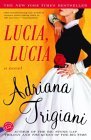
Lucia, Lucia -- Adriana Trigiani ***

Lucia, Lucia is a novel told in first person about the only daughter of a very close, very loving Italian family in Greenwich Village in the fifties.

In fact, this novel reminded me a little of those sweet, sad, sentimental movies of the era. A good daughter of a good family wants to break out of the life that's been set up for her; she makes some good decisions and some very bad decisions, and thus it goes.

I've been thinking about this for days, and my conclusion is this: it's next to impossible to get any complexity or depth or subtlety into a story of a life if it's told in first person, present tense. Present tense works best in scenes that are action-driven, and that's not what we've got here. First person is by definition limiting, so we never get out of Lucia's sanitized, idealized memories, and thus Trigiani has small number of tools to work with. She does attempt to fix this by adding on a present day story at beginning and end about a young neighbor (the audience for her story) but that doesn't quite work either.

Trigiani's readers are many and loyal, and they will disagree with me, but this novel struck me as hollow, stiff and more than a little artificial. That's unfortunate, because she did have some interesting characters to work with.

reader's circles

Would somebody explain reader's circles to me? What I understand from the website is this: a reader's circle is not a book club. It seems to be much more loosely organized, and bigger. I'm having a hard time imagining how a reader's circle actually works, and why they would work at all. Anybody have experience with this?

Book clubs I get. Book clubs are very popular in my part of the world, and in theory I like everything about them. I like getting together with people to talk about a specific book, and establishing friendships that way. But, (confession coming) I have never lasted in a book club for very long. I always get impatient with the books chosen, and most usually I can't make myself read something to meet a book club deadline if I have no interest in it. As book clubs are by necessity a democratic kind of institution, I'm just not book club material.

It has been pointed out to me that this has to do with the fact that I taught for a long time (and my classrooms were not models of democracy, I'll admit that: my style was more of a benevolent monarch). Thus, book clubs don't feel right because somebody else is setting the syllabus. Which was a gentle way of saying that I'm too controlling. Or too stubborn or independent or lazy. Any or all of the above.

Maybe I should go back to teaching?

Nah.

reviews

I'm trying to catch up on book reviews, and will be posting a number of them over the next few days.