" /> storytelling: July 2004 Archives

take me to the front page of the tttt weblog | back to the current weblog

« June 2004 | Main | August 2004 »

July 31, 2004

product

If you read books on writing, you'll find a whole slew of opinions on the matter of productivity. Some say that writing is a business like any other; you don't feel like working, tough. Sit down and get it done. Others say that to force things is to put a stop to all creativity. Annie Dillard wrote a whole series of essays on the painful nature of getting words down on the page. In contrast, people like Stephen King and Joyce Carol Oates seem to be able to spit out thousands of words a day without ever pausing (of course they pause. of course. but these two represent that small portion of the population of writers who produce constantly).

I have always told students, and I will say here again, that there's no one way, no magic formula, and only one way to measure the effectiveness of one approach over another: if you get the story down, then it is right for you.

My own process is opaque for me, at best. I feel things cooking beneath the surface, sometimes. There's a bit of a mental itch, the sense of somethng coming to fruition, and then it erupts, in a small way or a larger one. At that point it has to be put down on the page, or it will dissipate. In a really good stretch I write between ten and fifteen double spaced pages a day. More usually I'm happy if I get three or four solid pages down. Sometimes it's only two. Sometimes those two pages are so painfully won that I wonder why I ever thought I could write another novel, or anything at all.

Just now I'm in a productive period, where the story is boiling over and I'm putting out about fifteen pages a day. In bed late at night, too weary to read, I have the urge to get the laptop and continue writing. While I'm driving sentences are snaking through my head. Images jump into view. My fingers twitch; I write with my finger in the air, and don't even realize I'm doing it. This was first brought to my attention by my husband, who refuses to sit on my right at the movies because I write on his hand the whole time.

Mostly I just let this happen and try not to analyze it too closely. Even writing about it in this limited way makes me wonder if I'm quite balanced at times like these, but hey. Love me, love my dog.

July 29, 2004

tip-toeing

There's a point you get to, sometimes, when writing down the story is like drinking from a very delicate, very full cup. You know you're fortunate to have such riches, and yet there's the sense that things could go wrong if you misstep. The glass will crack, and everything will seep away and you won't be able to get it back. These over-filled cup times are few and far between, and thus all the more precious. My mind is mostly with the story, and I can't afford, really can't afford, to let it wander too far off. So I'm writing. I'm in that rare space, breathing deep. More soon.

July 28, 2004

contest update, and the happy muse

Just about two and a half weeks until the drawing for the signed first edition of Fire Along the Sky, and there are 108 people on the list. Please go sign up if you'd like to be included in the drawing.

Robyn posted some interesting links about emotion and facial expression, and now I have to go track down the Ekman books. Will report back.

Every once in a while the muse smiles and waves her hands and the story just -- flows. Like a river at high water, just now, and am I complaining? Not a bit. I'm just treading very softly, lest I upset her somehow. Excuse me while I go write.

July 27, 2004

more on facial expressions

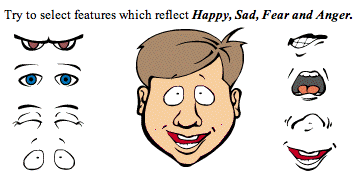
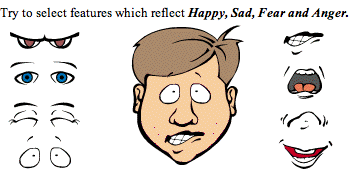
I've posted about this at some length before, but now I've stumbled on a few more websites about the analysis of facial expressions which have given me a way to think about this more concretely. First there's a portal to a database on the analysis of facial expression in Japanese females, but simpler and easier to play with is this site that allows you to change a simple set of features to see what happens.embarrasseduneasysurprise

All this is an offshoot of the perennial problem of describing a character's reactions. You can use the short hand: his expression gave away his surprise, or you can try to be more descriptive: his eyes bulged and his brows climbed half way up his forehead.

The second one is clumsy; the first one is empty. Also, without considering what the mouth is doing, you don't know what kind of surprise we're talking about: happy, unwelcome, embarrassing. This first mouth looks embarrassed to me, lopsided, teeth flashing. The second one looks like a happy surprise on the basis of the wide smile, but it's also uneasy.

I really do have to start making notes of how this is handled whenever I'm reading. It would be a useful database, and I think quite a revealing one.

July 26, 2004

friend crush update

If you'll remember, we seemed to come to the conclusion that men didn't get friend crushes. Well, Scalzi is the first documented example thereof, in this post about Noreascon and the panels he's scheduled on there. Read down, it's about three quarters of the way. Any other sightings of the elusive Male on Female Friend Crush, please do record them here.

July 24, 2004

I've told you a million times not to exaggerate

...and to watch the generalizations, too. I wrote this:
... don't shove things in [the readers'] faces. Let them watch the characters act and interact, and if you've done your job right, they will figure the important stuff out for themselves.
It has been pointed out to me that this is an idealization. Not every reader will read closely, or carefully; some readers dislike nuance, and want their stories straight up. Others will skip great passages looking for sex scenes or fight scenes or dialogue. Some read for plot alone. The perfect reader doesn't exist, of course, and that's why some people say you write for yourself alone.

I think it's true that any author can only write to their own understanding of story. What makes a good story for me personally is what I put down on paper in the hope that it will work for a wider audience, but of course it's not going to suite everybody.

For example. I'm not a big fan of Hemingway. For a whole variety of reasons, his stuff just doesn't work for me, and what that means is only this: I'm not the right reader for his work. I'm also not the right reader for Bronte (don't yell. I just have never warmed to The Sisters), for Dan Brown, or for most of the minimalists. I am the right reader for Austen, Dickens, Monro, Morrison, Garrett, Helprin, Kinsale, Crusie, Ivory, and dozens of others. I want to like Virginia Woolf, but I usually fall asleep over her stuff. Her failing? Absolutely not.

As a reader, you walk along the long buffet and pick and choose among the things that appeal to your particular tastes. Because others tell you that James Joyce is nutritious and good for you doesn't mean he'll delight your palate. Because that huge bowl of marshallow fluff streaked with chocolate, gummy bears, and pure sugar comes with a big sign that says no nutritional value doesn't mean that you might not really enjoy a serving.

Can you educate your palate? This is a question that some with answer with a strong affirmative, but I think it's a difficult task. People with truly eclectic tastes are those, I think, who were exposed to a wide range of story types in their childhood. After a certain age, you can force a person to read and analyze Greek tragedies or Proust or John Donne, but I think it's pretty rare for an adult to develop a true new craving. While it's true that there's a landscape larger than the one you see, after a certain age it becomes harder and harder to put on your traveling shoes.

So when I write about 'the reader' I'm writing about 'my ideal reader' -- a theoretical construct, my personal Harvey.

July 23, 2004

the very first copy

...of the first hard cover editon of Fire Along the Sky arrived here today. It's always a bit like seeing a baby for the first time, that same rush of relief and joy and utter terror.

I won't get more copies for another couple weeks at least, but let me take this opportunity to say: sign up if you're interested in winning a signed first edition, because I'm drawing the name out of the hat (box) on August 15. There are 94 entries thus far; if there are 200 entries by the fifteenth, I'll draw a second name and give away a second book. Here's the link to the contest entry. I will send the book anywhere in the world the winner happens to be, airmail.

compliments, comments, signed books & Scalzi

I'm not good with compliments. All of my adult life I've struggled with accepting them gracefully, and mostly I still fail. So let me say, while I love it when readers comment here and really appreciate the effort and time that takes, I would be so much more comfortable if comments didn't contain compliments about my work. This isn't to say I don't appreciate the generous and kind things y'all have to say -- I do. But I worry that somebody may have the idea that a compliment is the necessary price of admission. Really, not. I am always very much aware that not everyone will like what I write, and that's okay with me. This is part of the reason that I rarely quote my own work to demonstrate a point I'm trying to make about the technicalities of writing. I have this horror of showing off, which I believe was ground into me by the nuns. I felt the need to make this clear, but most probably I've confused you.

I'll try to gather myself together for more on backstory tomorrow; in the meantime, Catherine wrote in response to the series of posts on characterization and backstory:

If I finish a book and want to know “more” and not just “what happens next”, then I know the author has truly engaged me in the world he/she created. Pacing and the amount of detail can correlate, but one doesn’t necessarily have slow the other down, if done correctly. I think that is sort of what you were driving at yesterday...
That is what I was trying to say, but Catherine managed with far fewer words, and very clearly. So you should be reading the comments, because there are some excellent contributions you'll be missing otherwise.

On a different matter, I've had a few inquiries lately about signed books:

I have destroyed two paperbacks of Into the Wilderness, from reading and re-reading, and lending to many people. Is it possible to obtain a hard back copy? how about a signed one?
This gets a little complicated, because (1) the hard cover edition of ITW is out of print and (2) I don't currently have a post office box. This is because the very quirky, very cute sub-station nearest me (which was located, quite charmingly, in an old fashioned hardware store) has closed and not yet been relocated. There's a rumor it will reappear soon in the gas station store, which is also quite quirky and and while not charming, at least interesting, but until that happens, I can't be reached by mail.

In the meantime, here's my suggestion. You could contact Village Books (my local independent, a store very good to authors in the area) by email. If they happen to have the book you want, I believe they'd be willing to mail it to you. You'd just have to ask them to contact me, because I'm always happy to stop by there to sign books. I will also be doing a reading/signing at Village Books in early September.

Or you could just wait until the post office box situation is sorted out. At that point it will be possible to mail me books to sign, as long as sufficient postage is included to return it to you. In the meantime, you can probably track down a hard cover copy of ITW or any of the other books by means of the various used book websites... except I just checked, and it looks like such copies are pretty rare. This is a shocker, $190 for a first edition first printing, unsigned. Wait here while I go collect my senses. Edited to add: the very helpful Stephanie just left a comment with info on isbn.nu . I had no idea this service existed, and I'm very impressed. Thanks, Stephanie. Here's the direct link she provided:

isbn.nu makes short work of a hardcover search.

I realize this has been a fairly complicated answer to a simple question, so I'll summarize: when I have a post office box again, it will be possible to send me books to be signed. It may also be possible to get signed copies through Village Books. As far as obtaining copies of hard cover books now out of print, it may take some searching to find an affordable copy.

And a final note in this rather scattered post: Scalzi's quick analysis of the presidential candidates is both very funny and sadly right on the money.

July 22, 2004

the gentle art of nuance & backstory

I like to think of this as a basic commandment: never underestimate your readers; treat them with respect, and they'll stick around.

That means, in part, that you don't shove things in their faces. Let them watch the characters act and interact, and if you've done your job right, they will figure the important stuff out for themselves.

Maria Capstone was 87 but she was still sharp as a tack.

Boring, and a cliche, too. Try this:

In the ten seconds the Maguires spent wondering if they should offer to help the dignified old lady with her groceries, Mrs. Capstone had already hatched a plan to separate the newlyweds from their savings.

Maria liked to gamble.

Maria Capstone could get a craps game going in a nunnery. ***Joshua at Noematic gets the credit for this, he came up with it during a brain storming session in one of my creative writing classes.

As you may well have figured out by now, this is the same old "show don't tell" thing you'll hear every writing teacher spout. Because like most cliches, it's true.

So then, how does this fit in with backstory? When do you provide information, and when do you let the reader extract information on their own?

I would love to say there is a magic formula to figure this out, but I fear this is one of those areas where the magical, mystical 'inner ear' does the work. That is, it's a matter of experience and practice and rhythm. I find that I often feel the need to set out a smorgasbord of information, some direct, some of it quite nuanced, right up front. These are the opening paragraphs of a novel that's been in progress for quite a long time:

For a few months now, Kate Buongiovanni has been wooing a car thief.

Nobody would think it of her. Kate strikes most people as a woman of more persistence than daring; subdued by good fortune, all her sharp edges worn away by contentment. Happily married, successful in a business she loves, money enough to buy what she likes: Mephisto walking shoes, Peruvian sweaters, Dakota pottery; her kitchen walls, hand stenciled, are hung with antique copper molds in the shape of roosters, half moons, leaping fish. She pays handsomely for housecleaning and ironing. A boy from down the street mows the lawn, stacks the firewood; they have an accountant, a broker, an attorney. She is on a first name basis with the fund raisers at Planned Parenthood, Amnesty International, CASA.

And yet Kate contemplates the larcenous heart. She puts a great deal of thought into attracting a car thief: on a Friday afternoon she drives into downtown Trenton and leaves the car on a side street, gift-wrapped children's books (Where the Wild Things Are; Curious George; The Borrowers) piled on the driver's seat. Unlocked. The window rolled down a few inches.

The books disappear along with the tire gauge and a half pack of mints, but the car is waiting for her when she comes back. On her next solo trip (The Phantom Tollbooth; Half Magic; Harriet the Spy) Kate ties a hank of red yarn to the key in the ignition, but even such a bold invitation goes unanswered. It seems that nobody is desperate enough to take on this crate of a car, this thirty year old, mustard-colored Volvo with a temperamental clutch and thirty thousand miles.

Under other circumstances she would talk to Mike about this challenge, but the fact is this: her husband loves this monument to automotive engineering as another man might love a senile and smelly dog, and Kate loves her husband.

There's a lot of very direct information here, but also (I like to think) a great deal just below the surface about Kate's personality, her ability to deal with conflict and her tendency toward ambivalence, her relationship with her husband, the way she sees the world. The choices people make are a prime source of information about them.

This is, of course, my approach. It's not the only one; it may not work for every reader, or even for most readers, and I can only describe the way this develops for me in a very rough way. This is why some people claim that writing can't be taught. I would ay that some things about writing can't be taught, and this balance between providing backstory directly and nuancing backstory is probably one of them.

Edited to add: part of this post is recycled from a much older post.
July 21, 2004

backstory and minor characters

There were some interesting comments to yesterday's post regarding how much effort should go into describing minor characters. One point raised had to do with the concept of backstory.

If this term is unfamiliar to you, it just means the sum total of the character's experience prior to the time to story begins. A thirty three year old woman with a degree in biology, a failed marriage, a dying mother and a winning lottery ticket has a tremendous amount of complicated backstory that makes up her personality, her point of view, and the way she will react to the situations you put her in. You created her, so you have to know all about her; you know far more about her than you will ever share with your readers. That's the key: you know, but you don't tell unless it's crucial to moving this particular story along.

For example, maybe this character of yours with the winning lottery ticket (let's call her Naomi) is going to have a rough go of it because she has always been someone who likes routine and order and dislikes surprises. You could just tell your readers that, but you're writing a story and not a case history. You could let your readers see that Naomi always eats the same thing for breakfast: cornflakes, two percent milk, a teaspoon of sugar, a cup of mint tea, a banana. Every day. Day in, day out. You could show them how she organizes her books and cds by title, author, genre, color, size. You could have her interacting with a very troubled, very crazy extended family.

All these things could work, and you might use them. It's easier to pick and chose with a main character, because everything is potentially important.

But what about Naomi's massage therapist? She goes to see this guy once a week every week, same time. It's her one luxury. She talks to him the way some people talk to a therapist, and he provides feedback. His name is Jorge, he's very good at his job, he's a nice guy, he's funny. How much of his backstory do we need? Do we need to know he had a twin sister who died young, and who he misses a great deal? How about his home life, his relationship with his landlord, his politics? If you're writing this story you need to know these things, but you have to be selective about which details you supply for your reader.

Part of the issue is that in reading a story, the reader takes an active part in making it come alive. You may describe your main characters, but the picture you've got in your head of Naomi is going to be very different from the one your readers put together. This is why people are usually disappointed when films are made into movies, because it's impossible to meet the expectations of all the readers.

This is a big topic and not one to be dissected quickly, but if it's of interest to those of you who write, I'll pick at it a little more.

July 20, 2004

how much do you want to see?

I've been thinking a great deal about the introduction of characters into an already flowing narrative. Something that I'm never quite sure of is how much detail is the right amount. We all know (you all know) that the right detail makes a passage, and the wrong details will drag that same passage into the nether regions of hell. Any detail provided has to work on a couple of levels: so the reader can see the character and also get a sense of who s/he is as an individual, and as an actor in the narrative.

I am often tempted to spend more time on very minor, very fleeting characters than I really need to. I don't like glossing over anybody, though of course I do it from time to time; it's unavoidable. But what about people who have a small role to play and then move tidily to the background to provide atmosphere? How much do you want to see?

It's also important to remember that the details provided tell the reader as much about the person observing them (the POV character) as they do about the person being observed. Here's a raw piece of dialogue which contains the introduction of a minor character.

"You better pay attention to the game. Tab's about to steal second."

"You know Tab?"

"He's been over to the house. I know all these guys, except the ZZ Top type playing shortstop."

"ZZ Top?"

"The beard."

"Ah. That's Wyatt Horton. Minored in low-end hallucinogens when he was at Ogilvie back in the day, been teaching English at the high school the last ten years. He's supposed to be a good teacher."

"According to who?"

I haven't give you any underpainting here (no indication of body language or tone), but a lot comes through anyway about all three characters -- the two talking, and the one they are talking about. The most factual information is about Wyatt, of course. you know that he's a big guy with a long flowing beard to his waist (if you know who ZZ Top is, which one of the speakers doesn't, and what does that mean?). You know (if you've been reading along in the novel) that he went to an exclusive private college and experimented with drugs while he was there. You know that he looks something like a biker or a backwoodsman, but in fact he teaches high school English, and has made a success of it. You also have a bit of a sense of the town he lives in. It's probably not an expensive suburb of Chicago or Indianapolis, because it's harder to imagine this particular teacher in a school there. You know that people who have a history aren't necessarily run out of town. You know that it's a small enough place that most people know most people, but big enough to be home to an exclusive private college.

What you don't know is, of course, a lot. You don't know if Wyatt's got classic good looks or terrible acne scars or if he's bald. You don't know if he has halitosis or a Boston accent or a taste for expensive wines. Do you need to know these things? Will they add anything to the story, or to the experience of reading the story?

This is the kind of thing I struggle with all the time. I try to err on the side of not too much, but reserve the right to go back and provide more detail. When I'm reading, I like to have a good description of characters. Major characters especially, but also minor characters. When an author takes the time and effort to make me really see the flight attendant or the clerk or the mayor whose droning on at the podium, I feel taken care of. I'm in the hands of a good storyteller, and I can relax and let it flow.

This is my take on things, but I wonder about other people's preferences.

July 19, 2004

Agent Wimpy & Chekov

Lannalee posted a wonderful bit in the discussion forum about a troupe of performers who ... I suppose the quickest way to describe it is this: make havoc and art on the streets of New York. Here's Lannalee's original post; here's the link to the Improv Everywhere troupe; and here's the page about their Chekov performance/stunt. The reason I love this so much is that I have never read a biography of Chekov, and now I've got a crush on him on the basis of the description they provided from Payne's Images of Chekov:
"[...] the actor, the mimic, the clown, who would amuse himself by going to a hotel with a friend, pretending to be a valet, and proclaiming in a loud voice all the secret vices of his master, until the whole hotel was in an uproar.  He adored buffoonery.  He liked putting on disguises.  He would throw a Bokhara robe round his shoulders and wrap a turban round his head and pretend to be some visiting emir from the mysterious lands of the east.  On a train journey he was in his element.  If he was traveling with his mother he would pretend she was a countess and himself a very unimportant servant in her employ, and would watch the behavior of the other passengers toward the bewildered countess with the wide-eyed wonder and delight.  He had the trick of making a walk in the country an adventure in high drama.  Everything excited him."
What Improv Everywhere did was, they got a guy who looked like the elderly Chekov and staged a reading at Barnes and Noble... and they pulled it off; the audience went right along with the idea that they were listening to Chekov read his own work. In the end they did get escorted out of the store; then they went on to do a signing in the park to see what would happen. Read it, you'll be glad you did.

This makes me sad (as I often am) that I don't live in Manhattan.

July 18, 2004

substantive?

Surely I didn't promise substance today. I must have been hallucinating the time to write. Instead I give you one of my favorite diversions, poorly written headlines that are far more amusing than they were meant to be. You've seen these before. Here are some of my favorites.

Grandmother of Eight Makes Hole in One
Police Begin Campaign to Run Down Jaywalkers
Drunk Gets Nine Months in Violin Case
Chef Throws His Heart into Helping Feed Needy
Arson Suspect is Held in Massachusetts Fire
Ban On Soliciting Dead in Trotwood
Lansing Residents Can Drop Off Trees
Local High School Dropouts Cut in Half

Some of these from Enjoy The Music, and the link from Language Log. There's a nicely put together summary of classic transformational grammar structural rules and trees here. Syntactic theory moved beyond this stage a log time ago, but it remains a useful tool. Linguists use headlines like the ones above to demonstrate structural issues. Editors could use this kind of basic syntactic mapping, too, as seen here. But I don't think most of them do. Just a guess.

July 16, 2004

contest

82 entries so far -- and a month until the drawing.

tomorrow a long(er) entry about something more substantive.

July 15, 2004

Wrongful Death -- Baine Kerr *****

I don't usually like courtroom dramas, or at least I haven't got a list of ones that worked especially well for me. Beyond To Kill A Mockingbird, of course. I do read such novels once in a while, but they often don't stay with me for very long. Baine Kerr is an attorney who has written two novels. When I read Harmful Intent I knew right away that I was in the hands of a wonderful writer, somebody with an ear for language and the ability to make characters come alive as they moved through the story. So I went read his second novel, Wrongful Death, as soon as it came out.

Wrongful Death is different in tone from Harmful Intent, and it took me a little longer to get into it. I had to stop myself from reading quickly and really concentrate on the first ten pages. I have rarely invested my reading time so well. Wrongful Death is about things as diverse as personal injury law and the Bosnian war-crime tribunals, mother-daughter relationships and forensic pathology. Kerr pulls it all together with such flair, you can only sit back in amazement and admiration. The final section of the novel takes place in court, and I doubt anyone will ever write a better trial sequence.

What is best about this novel, though, is Kerr's absolutely wonderful rendering of three very different women, each so clearly drawn and so distinct from the other that you hear their voices without trying. The next time I hear somebody claiming that men can't write women, I'll hand them this book.

Wrongful Death deals with terrible tragedy, human weakness and grief, but it is, in the end, hopeful. It has my highest recommendation.

The Enemy -- Lee Child ****

It always takes me a little while to get back into one of Lee Child's Jack Reacher novels, simply because the syntax is so spartan, which is appropriate. Jack Reacher is the toughest of the tough guys, an ex MP adrift, running into trouble on a regular basis. This particular novel is written in first person (Child drifts, much like his character, back and forth). I prefer the novels in the series that are written in third, and Die Trying is still my favorite of them all.

This is actually more of a prequel, in which we go back to Reacher's last days as a military cop and the final case he investigates. For the first time we get a better look at his family history, and high time -- I like backstory, and this is a good one. It's especially welcome because Reacher is anything but introspective; his quick mind and flair for reading people and situations is always focused outward. Although he does not see himself this way, he has always struck me as a man looking for a way to connect but without the tools to do that. I like this addition to the series because it does in fact give us a better look at the Reacher who prefers not to be seen.

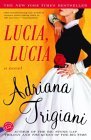
Lucia, Lucia -- Adriana Trigiani ***

Lucia, Lucia is a novel told in first person about the only daughter of a very close, very loving Italian family in Greenwich Village in the fifties.

In fact, this novel reminded me a little of those sweet, sad, sentimental movies of the era. A good daughter of a good family wants to break out of the life that's been set up for her; she makes some good decisions and some very bad decisions, and thus it goes.

I've been thinking about this for days, and my conclusion is this: it's next to impossible to get any complexity or depth or subtlety into a story of a life if it's told in first person, present tense. Present tense works best in scenes that are action-driven, and that's not what we've got here. First person is by definition limiting, so we never get out of Lucia's sanitized, idealized memories, and thus Trigiani has small number of tools to work with. She does attempt to fix this by adding on a present day story at beginning and end about a young neighbor (the audience for her story) but that doesn't quite work either.

Trigiani's readers are many and loyal, and they will disagree with me, but this novel struck me as hollow, stiff and more than a little artificial. That's unfortunate, because she did have some interesting characters to work with.

reader's circles

Would somebody explain reader's circles to me? What I understand from the website is this: a reader's circle is not a book club. It seems to be much more loosely organized, and bigger. I'm having a hard time imagining how a reader's circle actually works, and why they would work at all. Anybody have experience with this?

Book clubs I get. Book clubs are very popular in my part of the world, and in theory I like everything about them. I like getting together with people to talk about a specific book, and establishing friendships that way. But, (confession coming) I have never lasted in a book club for very long. I always get impatient with the books chosen, and most usually I can't make myself read something to meet a book club deadline if I have no interest in it. As book clubs are by necessity a democratic kind of institution, I'm just not book club material.

It has been pointed out to me that this has to do with the fact that I taught for a long time (and my classrooms were not models of democracy, I'll admit that: my style was more of a benevolent monarch). Thus, book clubs don't feel right because somebody else is setting the syllabus. Which was a gentle way of saying that I'm too controlling. Or too stubborn or independent or lazy. Any or all of the above.

Maybe I should go back to teaching?

Nah.

reviews

I'm trying to catch up on book reviews, and will be posting a number of them over the next few days.

July 14, 2004

the amazon review game

Robyn emails in response to my post about reviews with a link to waxy.org's approach to amazon reviews:
Here's a fun game... First, look up the most popular and critically-acclaimed books, movies, and music on Amazon. Click on "Customer Reviews," and sort them by "Lowest Rating First." Hilarity ensues! It's the Amazon.com Knee-Jerk Contrarian Game!
Waxy provides examples of one star reviews of books, movies, and music he loves, and they really are funny. Then his readers get in the game and post their examples of funny one-star reviews. Walt provides this one star review of the DVD release of Lawrence of Arabia:
I bought this DVD as a way to show off my new DVD player to my family. I had seen the movie several times in the theater, and knew its bright colors would be beautiful on my TV screen.
To my horror, I saw that Columbia had seen fit to alter a masterpiece. Yes, the film came complete with those horrific black bars at the top and bottom of my screen, which obscured about half of the picture. I've seen those bars on the "artsy" videos on TV, and I sometimes enjoy them. But this is a classic work of art! You don't try to make it "hip" and "relevant" with modern touches. It would be like adding a moustache to the Mona Lisa.
Until Columbia drops the act and releases "Lawrence of Arabia" without those bars, letting us see all of the picture, stay away.
Waxy also provides a link to Justine Larbalestier's weblog entry on how to turn bad Amazon reviews into an entertaining afternoon's reading, but before you go off reading that, here's the one star review of Ann Patchett's The Magician's Assistant (one of my very favorite novels) that made me snort and then, yes, laugh.
I wanted to like this novel, but I just couldn't. Like all of Patchett's other works, this one is boring and hard to read. After I bought the book and read it, I felt like I had been tricked by an evil magician. I felt like an unwilling participant at a magic show--the lady who gets sawed in half. The plot is jerky and lackluster; it's predictable and rather dull. The characters are slippery and distant. There is no energy, no rabbit out of the hat. It's a one woman show where the magic is missing. It deserves a zero but the marks don't go quite that low.

the unlit lamp & the ungirt loin

Just about six weeks or so before a new book comes out, I start thinking about reviews. Because they are coming. They are coming from places like Kirkus and Publishers Weekly and Booklist. My publisher and editor will read them. They will be sent to me. They will end up on Amazon, bad or good, scrupulously fair or dripping with venom, as the first thing a potential buyer reads.

The reviews can be limp with distaste or bristling with sarcasm or even positive -- but one thing is pretty constant: I almost always have the really strong sense that the reviewer didn't really read the book beyond a casual skimming. Here's the thing: reviews -- even mean spirited ones, even nasty ones -- would be easier to take if the process were less opaque. The big places who exist primarily to produce reviews (Kirkus, for example) do so anonymously. The books are farmed out like so many little lambs, and the reviewers are paid far less than the cost of a rib roast for a review. They are often frustrated writers and students of writing.

Being reviewed by PW is a little bit like being sewn (blindfolded) into a sack with a very unstable bipolar person who may, or may not be, on meds, but who certainly has a weapon.

I know this sounds like the mewling of a disgruntled mother after her baby has failed to win the beauty contest. After all, I didn't have to write the book, and I didn't have to go find an agent or let her sell it or take the money. Reviews are part of the process and the price.

So it's time to gird my loins. That phrase always strikes me as particularly funny -- as a kid it gave me a mental image of a sirloin wrapped in bacon (there's a theme here, I notice, blood and meat and cutting) -- so to cheer myself up I went over to the OED. This is part of the entry under loins:

2. Chiefly Biblical and poet. This part of the body, regarded    a. as the part of the body that should be covered by clothing and about which the clothes are bound; so, to gird (up) the loins (lit. and fig.), to prepare for strenuous exertion.

    1526 TINDALE Matt. iii. 4 This Jhon had his garment off camels heer and a gerdell off a skynne aboute his loynes. 1535 COVERDALE Prov. xxxi. 17 She gyrdeth hir loynes with strength. 1605 SHAKES. Lear II. iii. 10 My face Ile grime with filth, Blanket my loines. 1667 MILTON P.L. IX. 1096 Some Tree whose broad smooth Leaves together sowd, And girded on our loyns, may cover round Those middle parts. 1742 COLLINS Ode Poet. Charac. 21 To gird their blest prophetick loins. 1753 SMART Hilliad I. 27 Her loins with patch-work cincture were begirt. 1833 L. RITCHIE Wand. by Loire 17 It was necessary, therefore, to gird up our loins and walk. 1855 BROWNING Statue & Bust, The unlit lamp and the ungirt loin. 1877 BRYANT Odyss. v. 280 And round about her loins Wound a fair golden girdle. 1880 MRS. E. LYNN LINTON Rebel of Fam. II. v, He was standing like the impersonation of masculine punctuality with loins girded.

How about that patch-work cincture? And I particularly like the Browning quote: the unlit lamp and the ungirt loin. Because when somebody at Publishers Weekly decides to teach an uppity author a lesson, you need some time in a dark room to recover, and tend to the wounds.

July 13, 2004

used books, yet again

There's an interesting article at the NYT (you have to register to read it, but registration is free) on the on-line used book phenomenon specifically in conjunction with Amazon.

I've touched on this issue before, but never in depth -- and I'm not going there now, either. But I would hope that people inform themselves and think about the impact on the author before they make their buying decisions. Points to consider:

1. the only sale that counts, as far as the publisher is concerned, is the first one. If copy x is sold ten times, that's nine readers whose buying decisions don't count for anything. And before you ask: of course the story is the thing, and of course kind and thoughtful and generous reader feedback is wonderful and gratifying. But those things don't pay the rent.

2. If an author doesn't sell well enough, there will be no more books from that author, which will leave all booksellers (new and used) -- and the readers -- in the lurch. Not to mention the author, who will have to rededicate him or herself to short-order cooking or bookkeeping or whatever else it is that does pay the rent.

Do I have a fair, thoughtful solution to this problem? Nope. Please do let me know if you come up with one.

July 12, 2004

spoilers

Many of my readers have written to say they never read excerpts from forthcoming novels I post here. They want no hint of what's going to happen.

I suspect these are the same people who, when they see a baby on the ultrasound screen turn their faces away because they want to be surprised at the birth on the boy/girl question. These are the people who do not hunt for hidden presents and certainly don't carefully unwrap and then re-wrap them; this kind of person likes surprise parties. These are, in a word, saintly people, and I have nothing in common with them.

I am a spoiler connoisseur. Others seek out fine wines or elusive first editions; I look for spoilers.

I respect everyone's right to be saintly, really, but I don't understand how it's possible to not want to know, right now. I would gladly read the scripts for the entire new season of Deadwood. Reading the scripts would not take anything away from my enjoyment when I finally get to sit down and watch these shows. How the actors and directors and photography people bring it to life is going to be enough of a surprise. In the same way, reading the end of a novel first doesn't hurt my enjoyment of the rest of it. I like knowing where I'm going, so I can enjoy the ride. I may have read Pride and Prejudice fifty times -- but every time I enjoy it just as much, and maybe, possibly, more. Because I know whole passages by heart doesn't matter. Will Darcy finally get round to actually approaching Elizabeth? Oh, the agony. Oh, the suspense. So you see, spoilers really, really don't matter, except in this way: I want to know. Now.

Call me names if you like; they are all true. I'm a spoiler slut. It would be pretty hard to bribe me with money, but to the person who whispers in my ear hey! you! wanna know all about Farscape: The Peacekeeper Wars? -- in that person's hands, I am putty.

Before you ask, no, I won't tell you what happens in Fire Along the Sky. Yes, I am an inconsistent spoiler slut. I will not tell you because I'm afraid you don't actually really want to know. So no spoilers for you. Unless you've got something interesting to whisper in my ear, of course.

mwahahahahaha.

July 11, 2004

contest update

Quite a few new entries today on the contest, and some small squeaks of concern. Heidi, you only entered once, so don't worry. Also an entry from Switzerland-- near my old stomping grounds-- so I have to say: gruetzi. We've also got Jerusalem and lots of readers from Down Under. Haven't seen entries from many of the people who did try for the ARC (the northern Europeans staying out of this one?) but maybe they'll still jump in. There's more than a month til the drawing.

Here's an idea: if it hits two hundred entries, I'll pull two names out of the hat and give a signed first edition to both of them.

Picasso

I have always meant to read a biography of the man, but maybe this very wonderful quote (snurched from Red's website) tells me really all I need to know:
There are painters who transform the sun to a yellow spot, but there are others who with the help of their art and their intelligence, transform a yellow spot into the sun.

-- Pablo Picasso

July 10, 2004

my bad

While on the basis of this weblog you might think of me as unflinching when it comes to expressing my opinions, the truth is, I don't often let my inner cranky woman out. Really. If I do sometimes write scathing reviews, nine times out of ten I delete them, because, well. That's just not what this weblog was supposed to be about. Once in a while, though, I allow myself a modified rant, but then I also put it in the list to the right called my bad. This is to keep me from indulging my inner cranky woman too often, and also, it's a kind of truth in advertising thing. Other authors may come here looking for some word about themselves (it's a professional hazard, that kind of curiosity) but unless they show up in that list, they have no reason to be mad at me (and if they are on that list, I don't particularly care if they are mad at me).

I have been critical of Dan Brown's The DaVinci Code, you'll notice, and every once in a while somebody posts a comment to that review to let me know I'm not alone in my real dislike of every. little. thing. about that novel. It's good to have pals in crankiness, so I thank those people. I especially thank Shelly, who sent me a link to Dave Barry's column on TDC called 'The DaVinci Code, Cracked'. It made my day. Thanks, Shelly.

contest update

So far about fifty people have signed up for the drawing for a free signed first edition of Fire Along the Sky. Don't forget to throw your hat in the ring (or, actually, the hat box) . There's info and a link to your right. Give 'er a world, as my father was wont to say.

July 9, 2004

very, very good Farscape news

chrichtonblueFirst of all, the miniseries Farscape: The Peacekeeper Wars has finally been scheduled for Sunday, October 17.
Yaaaahoooo.

Second, there will be a 'teaser' (is this new media speak for preview?) of the miniseries during the Season Eight premiere of Stargate SG-1 on Friday, July 9, at 9/8C (yes, that's tonight.)

Yes, I'm pleased. Yes, I am a middle-aged woman making a point of proclaiming, publically, that I really like and admire this science fiction drama, this excellent adventure in storytelling, and that it deserves to be watched. You could watch it too. You'd be in good company:

And despite the cliché of science-fiction fans as teenage boys, viewers of "Farscape" are mostly adult professionals. Almost uniquely among science-fiction shows, it draws equal numbers of men and women. And a roll call of fans online turned up plenty of doctors, fire-fighters, counselors, teachers and so on — in addition to the predictable number of software engineers.[...]"In my day job I help run a psychiatric center," [Charlotte] explained. "Any random month, we're dealing with close calls and human misery: abused kids, well-armed ex-husbands, breathtaking stupidity. If it's a trainwreck or a meltdown, I'm one of the people who get called. At the end of the week it's a nice reward, to be able to relax into "Farscape." It isn't my usual thing; it wouldn't have caught my attention if my husband hadn't sat me down in front of it. But those characters resonate for me, in a powerful and refreshing way. They know that friendship, decency, kindness and wit help keep you going — but so do silliness, good sex and black leather pants."
"Don't Mention the F-Word", by Clare Sainsbury

July 7, 2004

eggcorns & mondegreens & dialogue

There is an interesting post on Language Log (one of a series of posts in various places) on what the LL folks are calling 'eggcorns'. I guess the easiest way to define 'eggcorn' might be simply: a reinterpretation of any given word that is first heard and assimilated on the basis of the spoken language alone. "Eggcorn" for "acorn" is an example; "wheelbarrel" for "wheelbarrow" is another. This is related, of course, to the mondegreen phenomenon where whole phrases are misheard and recast ("... and deliver us some e-mail ..." instead of "... and deliver us from evil ...").
In his LL post, Mark Liberman quotes Geoff Pullum on eggcorns (also on Language Log):

It would be so easy to dismiss eggcorns as signs of illiteracy and stupidity, but they are nothing of the sort. They are imaginative attempts at relating something heard to lexical material already known. One could say that people should look things up in dictionaries, but what should they look up? If you look up eggcorn you'll find it isn't there. Now what? And you can't look up everything; sometimes you think you know what you just heard and you don't need to look it up.
I find that in writing dialogue, I am sometimes tempted to use eggcorns. There is something endearing about them. My father, whose first language was Italian, had a lot of eggcorns: Mr. Lanious for 'miscelleanous' as in I put aside forty dollars for Mr. Lanious this month; doggydog for 'dog eat dog' as in It's a doggydog work out there, you better watch out. I'm telling you. Children produce a lot of eggcorns in the process of language acquisition, and again when they are taught to recite prayers, songs or other material by rote without explanation of meanings that might be beyond them. ('Jose, can you see?' for 'Oh say can you see?')

It's usually a bad idea to give in to the impulse to use eggcorns in dialogue, because mostly they will come across as contrived or mawkish. I've got an example I'm hesitating to produce. It's in Barbara Kingsolver's The Poisonwood Bible; I like Barbara Kingsolver's work and I don't want to pick at this one infelicity, but it's there in a letter written by a young girl: an eggcorn that (for me) disrupted the narrative flow completely. The problem is, I think, that the eggcorn draws attention to itself and away from the story and the character. Thus I add eggcorns to my list of things to avoid in writing dialogue:

adverbs;
dialectal (or supposedly dialectal) spellings;
info-dumping;
anachronisms;
the overuse of quotation marks and (dog forbid) exclamation points; and
eggcorns and mondegreens.

July 6, 2004

writerly habits, and the confounding nature of summer

I have confessed, elsewhere, about my obsessive behaviors around writing, for example, about my devotion to my laptop. (To paraphrase the lovely Viggo as Frank Hopkins in Hidalgo: Mister, you can say whatever you like about me, but don't talk trash about my iBook.)

In addition to my devotion to my computers, laptop and desk top, I am also bound by some odd kinetic energy link to green chairs. There is one in our front room (a recliner that has seen better days). There is another green chair in our little library-type room. This one is an arm chair, grass green, which I have painted with cherries here and there. I write in one or the other of these chairs, depending on the muse's whim.

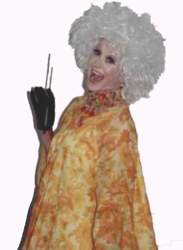
phyllisdillerThe muse (are you old enough to remember Phyllis Diller?) you must understand, is not easy; she's very particular, and she does not think much of sharing. The green chairs are hers, and she's most likely to insist on the one in the front room exactly when husband or daughter are in there watching the Simpsons or car races or something else equally important to them, but of no interest to her. She just wants me to put myself in that chair, and get to work. But what about the cherry chair? I ask her. In the library? Surely--.
No, sez she, and most decisively. Get Those People out of the room where my chair resides, and sit in it.

Now that girlchild is out of school for the summer, things are worse. Husband is most likely to be doing his own work in his office, but girlchild is unpredictable, and she has as little patience with the muserly demands as the muse has with her. Really mama, sez she. Isn't that just an excuse to get what you want?

But that's not what I want. What I want is to go play with paint and fabric and thread. I want to lie down on the comfortable recliner on the deck and read, with the puppy boys on one side and a gallon of Cherry Garcia on the other. I want to have a long talk on the phone with the writing staff of Farscape, or maybe even better, I want them all to come over for pizza and beer, and we'll sit around and watch favorite episodes and discuss narrative structure and plot dynamics and Aeryn's eyebrows. Those are the things I want, but the muse won't have any of that. She's standing at my elbow just now, tapping her foot.

And the girlchild just vacated the front room, so I better go now while the going's good.

July 5, 2004

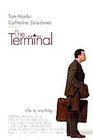
The Terminal -- screenplay by Sacha Gervasi ***

TheTerminalI suppose the big question about this movie is, was Spielberg trying to make a deep movie, one with many layers of meaning, or simply a comedy? But then I've always told creative writing students that what they intended is irrelevant -- it's what the reader/viewer takes away from the final product that matters. So. The final product.

This is a polished, well acted, quite funny movie about an absurd situation: a man called Viktor Navorski arrives at JFK from a fictitious eastern block country. While he was in the air, a revolution broke out at home, leaving him stateless and without a valid passport, and thus, he's told by Frank Dixon, the really unlikeable head of immigration (Stanley Tucci seems to be making a career out of playing unlikeable men), that he's stuck in the terminal until the governments work things out and he can be issued a new visa. Product placement was no big challenge in this movie. Victor asks the head of security 'what do I do now?" and gets the answer: "there's only one thing to do here -- shop".

This is, of course, great material for comedy. You've got a man who barely speaks English, who has no money, but who is personable and resourceful, and he's got to survive on crackers and ketchup in the middle of the consumer excess of the international terminal. While Victor is finding ways to feed himself and get along with the employees (food service workers, maintenance people, security guards) he's also fending off Frank Dixon's increasingly frantic moves to get him out of the terminal and onto somebody else's turf -- which would involve detention someplace a lot less pleasant than Gate 63.

Allegory? Sure. The terminal is the idealized US -- glitzy, clean, prettily packaged, all about buying stuff and going places. Outside the terminal is the real world, but Victor's got many obstacles to overcome before he gets there. Victor (who is on a quest) has to cross the bridge into the real world, but Dixon the technocrat/ troll under the bridge is there to stop him. Dixon throws riddles and challenges Victor's way, all of which Victor handles with a native wit and easy adaptability. It's at this point that the allegory gets the best of Spielberg, whose instincts always fail him, it seems to me, in the last part of any movie he makes. In this case, Victor is charming enough to carry most of the load.

PS: Biggest mistake? Sticking in a half-baked, poorly resolved romance. Really, really didn't need Catherine Zeta Jones.

a request

If you're planning on buying a copy of Fire Along the Sky, please be sure to tell your local bookseller. Bookstores only pre-order as many books as they think they might really be able to sell, and strong advance numbers for Fire Along the Sky would be a big boost, especially if y'all want more of the series. All you have to do is go in and say,
Excuse me, when is Fire Along the Sky by Sara Donati coming out? And will you have it in stock?
You can do this over the phone, too. Or by email. Also a good thing to ask your local library if/when they are going to order it.

This all assumes, of course, that you actually are going to read it. Note: If I committed the sin of emoticons, I'd use one here.

July 4, 2004

grandpa Charlemagne

The mathematical study of genealogy indicates that everyone in the world is descended from Nefertiti and Confucius, and everyone of European ancestry is descended from Muhammad and Charlemagne

"The Royal We" (April 2002) The Atlantic Monthly
The fourth of July always makes me think about genealogy, because I had ancestors running around the east coast in 1776, and I like to wonder what they were up to that summer, where they were, what they thought when they heard what the continental congress was up to. This is the stuff of historical fiction, as far as I'm concerned. The most interesting stories come out of considering the people who didn't make it into the history books.

I have spent a good amount of time on genealogy research, which I consider an off shoot of both my addiction to the history of the masses and my compulsive questing for new stories. One of things that has always bothered me is the simple mathematical improbability of the whole venture, genealogically speaking. My husband, the mathematician, tells me that my 10x great grandparents (a couple of whom I can actually name) number 1,024 individuals. That's right. You have, I have 1,024 great great great great great great great great great grandparents. So I can say with some certainly that I'm descended from the Witch of Wallingford -- Winifred King (tried for witchcraft the *third* time in 1697, but again got away intact) -- but really, what does that mean? There were another thousand people around who were also my ancestors, half of them in Italy at that point in time.

There's a great article in The Atlantic Monthly. (citation above) which made me laugh out loud, because it addressed this rather obsessive thought of mine directly. It's about a mathematician who started mucking around in genealogy. Here's a good bit:

In a 1999 paper titled "Recent Common Ancestors of All Present-Day Individuals," Chang showed how to reconcile the potentially huge number of our ancestors with the quantities of people who actually lived in the past. His model is a mathematical proof that relies on such abstractions as Poisson distributions and Markov chains, but it can readily be applied to the real world. Under the conditions laid out in his paper, the most recent common ancestor of every European today (except for recent immigrants to the Continent) was someone who lived in Europe in the surprisingly recent past—only about 600 years ago. In other words, all Europeans alive today have among their ancestors the same man or woman who lived around 1400. Before that date, according to Chang's model, the number of ancestors common to all Europeans today increased, until, about a thousand years ago, a peculiar situation prevailed: 20 percent of the adult Europeans alive in 1000 would turn out to be the ancestors of no one living today (that is, they had no children or all their descendants eventually died childless); each of the remaining 80 percent would turn out to be a direct ancestor of every European living today.
Note the sentence I've highlighted: In other words, all Europeans alive today have among their ancestors the same man or woman who lived around 1400.

Now, who was that person? A woman married three times, bearing sixteen children, who then died of exhaustion at age 40? Of course she (I'm thinking of this person as a woman, I'm not sure why) had no idea that this remarkable sentence would ever be written about her, and she most probably she would have smacked the person who told her so, and soundly. A woman with sixteen children would have very little patience with soothsayers and fortune tellers. She'd say, forget the illusions of grandeur, bub, I got a houseful of hungry kids here and my husband is down at the pub again. Or: mother to millions? Hey, I've got my hands full as it is. Or: that and a copper ha'penny will buy me a loaf of bread.

And what language would she use to berate the time traveler who came to see her? Breton? Tuscan? Frankish?

Is your head spinning? Mine is, but in a good way.

July 3, 2004

more on crushes, and something personal

There are some very interesting comments to the posts about friend/girl crushes; for example, Pam asks this question:
Are friend/girl crushes only unrequited? From the direction of discussion, it sounds like that's part of the description. Are the posters just not telling whether they consummated the crush?
I'm not sure about this. My first sense is, that if someone actually gets up the courage to approach the object of a crush, the dynamic shifts. The whole thing is fueled by admiration and fear of rejection (if I've read things correctly), so overcoming the fear means... what? For the most part, I think the object of the crush isn't aware of it, or isn't supposed to be aware of it... and if s/he is, and is drawn in, then is it still a crush? Color me confused, but curious about what y'all might have to say.

Now I'm going to be a mother, right here, and talk about the girlchild's test scores. How cliched. How gauche. How.... sweet? I'm not a mommy-dearest mother, really, or a June Cleaver, or even Rhoda's mother, although that comes painfully close.

What's the difference between an Italian mother and a Rotweiler?
Eventually, the Rotweiler lets go.

I've stuck my motherly excesses down in the 'continued' section, so you can have a look if you like, and otherwise go on your way and forgive my exuberance.

Girlchild's results of the nationally administered Iowa Test of Educational Development (percentile rank):

Core Total (vocabulary, reading, quantitative thinking skills): 95%
Composite (add in social studies, science, topical reading): 97%
There's a whole lotta 99% on the list of subtests.

She's so pleased, it's just a thrill to see her blush when she reads the report.

July 2, 2004

I know it when I see it.

There are a number of terms that are used a widely, but defy easy definition. Example: one of the Supreme Court justices supposedly said of pornography "I can't define it, but I know it when I see it." Ethan Canin once said the exact same thing about the term overwriting in my hearing.

There are other terms that fall into this category. My favorite is post-modernism, which is a word so laden with excess baggage that I have seen people develop a sudden cough and leave the room in a hurry rather than deal with it. I was thinking about this because I'm writing a scene at a party where academics are mixing with non-academics, and the P word comes up. If you can imagine a slightly drunk, very opinionated, very intelligent car salesman with a chip on his shoulder interrogating academics, you'll have an idea of what I'm trying to accomplish. i may end dumping the scene but it's quite amusing to work on it at the moment.

As a part of my research, I'm contacting friends and acquaintances out of my academic past. The conversation goes like this:

Me: Quick! In one sentence, define post-modernism!
A1: One sentence?

Me: Quick! In one sentence, define post-modernism!
A3: That's a tall order.

Me: Quick! In one sentence, define post-modernism!
A4: Christ, this is like my recurring nightmare about my doctoral exams.

Even when people have lots of time to reflect and write, pithy definitions seem to elude them. Examples:

Postmodernism is a complicated term, or set of ideas, one that has only emerged as an area of academic study since the mid-1980s. Postmodernism is hard to define, because it is a concept that appears in a wide variety of disciplines or areas of study, including art, architecture, music, film, literature, sociology, communications, fashion, and technology. It's hard to locate it temporally or historically, because it's not clear exactly when postmodernism begins. (from the University of Colorado's English department website)
There are a hundred examples like this. There are far fewer easily approachable actual definitions, and none of them are short. Here's part of one that I found pretty accessible (written by James Morley, but found on this website at the University of Virginia:
1. premodernism: Original meaning is possessed by authority (for example, the Catholic Church). The individual is dominated by tradition.

2. modernism: The enlightenment-humanist rejection of tradition and authority in favour of reason and natural science. This is founded upon the assumption of the autonomous individual as the sole source of meaning and truth--the Cartesian cogito. Progress and novelty are valorized within a linear conception of history--a history of a "real" world that becomes increasingly real or objectified. One could view this as a Protestant mode of consciousness.

3. postmodernism: A rejection of the sovereign autonomous individual with an emphasis upon anarchic collective, anonymous experience. Collage, diversity, the mystically unrepresentable, [this is part of Nietzsche's aesthetic philosophy, where Apollonian forces (harmony, restraint, etc) are necessarily at odds with the Dionysian forces (impulse toward disorder, irrationality, and spontaneity]. Dionysian passion are the foci of attention. Most importantly we see the dissolution of distinctions, the merging of subject and object, self and other. This is a sarcastic playful parody of western modernity and the "John Wayne" individual and a radical, anarchist rejection of all attempts to define, reify or re-present the human subject.

One of the best places to get straight forward (but not always uncontroversial) information continues to be wikipedia.org, where you'll find a great deal on postmodernism, with lots of links to necessary side definitions:
Postmodernism is an artistic, philosophical, and cultural movement or condition, said to arise after modernism. Whereas modernism is thought to be the culmination of the Enlightenment's quest for an authoritatively-rational aesthetics, ethics, and knowledge, postmodernism is concerned with how the authority of those would-be-ideals (sometimes called metanarratives) are subverted through fragmentation, consumerism, and deconstruction. Jean-François Lyotard famously described postmodernism as an "incredulity toward metanarratives" (Lyotard, 1984). Postmodernism resists monolithic universals and encourages fractured, fluid and multiple perspectives.
So I decided to approach this from a different angle.

Me: Quick! Give me an example of something you'd call the ultimate in postmodernism!
A1: Ed Norton's character in Fight Club.
Me: The guy who beats himself up?
A1: That's the one. He says: everything is a copy of a copy of a copy. That's post-modernism, right there.

Me: Quick! Give me an example of something you'd call the ultimate in postmodernism!
A2: Seinfeld.
Me: Seinfeld?
A2: A show about a show about nothing.

Me: Quick! Give me an example of something you'd call the ultimate in postmodernism!
A3: Being John Malcovich.

I didn't get a chance to hear an explanation of that last example, but I assume it has to do with the way the movie questions reality and identity.

Thus, I have a direction for this scene I'm working on, and it's promising.