We are All Welcome Here - Elizabeth Berg
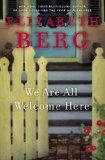 The author recorded the audio version of We are All Welcome Here herself, which is always a gamble. It mostly paid off. The only voice which didn't seem right to me was the first person narrator. She did a much better job with the secondary characters.
I've been thinking about this novel a lot. Domestic drama like this can easily sink into the melodramatic abyss. You've got a quadraplegic woman struggling to keep afloat financially; her husband left her when she came down with polio -- at nine months pregnant -- and the only help he offered was to get the baby adopted. A real peach of a guy.
The daughter (Diana) narrates. She's thirteen when the novel begins. Much of the story is about her relationship with her mother, with Peacie, the black woman who has cared for them both since Diana's birth, and Peacie's husband; with her best friend. It's about poverty and how weary it makes people. It's about the sixties, segregation, voting rights, racism. It's about Elvis Presley.
Berg is juggling a great deal, but mostly she pulls it off. I see two real flaws in this novel. The characterization of Diana's mother, who is a stereotypical wise and quietly suffering disabled person; she stays upbeat and positive in the worst of situations, never speaks out of anger or irritation, is constantly reading and ambitious for herself and her daughter's education.
She really is too good to be true. I kept waiting for her to scream at somebody. Just once. To say something small or thoughtless. There is one very small moment when she finally speaks her mind to a lazy and dishonest caregiver, but it's really not enough to rescue her from stereotype.
The other problem is the last chapter which wobbles precariously. My sense is that Berg wants to leave these characters in a good place, but a lot of very bad things have happened. So there's a bit of magic there, of the authorial kind. I can't say more without giving too much away, but I can say this: I was very moved by the last few scenes, though the whole time I was also aware of the heavy handed nature of the resolution. It still worked for me on some (sentimental) level.
There's nothing wrong with sentiment, with emotion, with happy endings. I'm just not sure about the way Berg produced them, in this instance.