" /> storytelling: February 2006 Archives

take me to the front page of the tttt weblog | back to the current weblog

« January 2006 | Main | March 2006 »

February 28, 2006

Beth made me do it*

It's all her fault, really it is. Because she asked us, her loyal readers, if we remembered the first romance we ever read. So I posted a comment about that. The basic facts:

When: circa 1975
Where: Austria
What: a book called Kalifornische Sinfonie, translated into German from English. I remember the author's first name was Gwen. I remember quite a lot about the story.

So after that my curiosity was not going to let it go. I hopped over the Amazon Germany and was I shocked to find it, immediately, on the basis only of the title and the author's first name. This isn't the cover I remember, but it's definitely the same book.

Finding the German edition made it possible to track down the original title.
Jubilee Trail is still in print, as are all of Gwen Bristow's novels. Unfortunately they've redesigned the cover.

I think the original (1950) cover is wonderful. I can say with absolute certainty that if I ran into that cover in a bookstore today, I'd be forced to pick it up and walk to the cash register.


As it is, I put a more recent edition on hold at the library, along with The Diary of Mattie Spencer by Stella Dallas. I read this one too, a long time ago, and remember it vaguely.

As a teenager I had a real weak spot for stories of women in dire circumstances traveling west. Mrs. Mike, for example. Most women my age have fond memories of Mrs. Mike. I'm really wondering how these novels will strike me, so many years later.

NOTE; the formatting on this post is wonky. That's not Beth fault, but I can't figure out what's wrong. I hope you'll muddle through somehow.

Amazon author pages & Piper protests

So Amazon has started this new thing called, simply enough, an author's blog. Here's the link to mine. The idea is to write a little something for the readers who have purchased one of that author's books in the past. If you have ordered something of mine from them, you should see my first post over there when you go to the main page. I don't intend to post there very often, but when something big happens I'll put up a few sentences.

Now here's the thing. If you're not interested in this newest author-post marketing doodad, you can turn it off. You can control which author posts you get and if you get any at all.

My first post has been up for only two days and one nice thing is that it has directed some readers to this weblog who didn't know about it before. Of course, there's always room for the less enthusiastic readers to voice their opinions. Ms. Piper, for example, who took the opportunity to be the first to leave a comment. A Piper protest. A declaration of negative Pintent. Never, never again shall she read any of my work. And why? Because there was a discussion of a review here. She took exception to the review, and to the discussion of the review, and specifically to me.

Listen, people. I hope you like my stories and look forward to the next one. I hope you recommend them to friends who you think might like them, too. But if you find yourself publically admonishing another author because that person encouraged discussion? Step back, please. Reconsider.

UPDATE: Amazon deleted Ms. Piper's proclamation of protest, and I deleted my response to it.

duty to the customers? readers? public?

Bookseller Chick has an interesting post on the subject of bookshops that don't stock particular books or otherwise isolate books the owners/operators find distasteful. I've been thinking about it now for a while and it seems to me that there's an underlying question:

Does a bookseller have an obligation to her customers? And if so, what's the nature of that obligation?

In any business the idea is to make money. A bookseller is no different. Talking for a moment here about an independent bookstore, the owner has (1) a limited amount of space and resources (2) a customer base to keep interested (3) her own opinions and priorities.

What independent bookseller can stock everything? Is it better to stock a lot of one thing or a little of everything? If I go into a bookstore looking for Faulkner or Byatt or Crusie and they don't have it, what conclusions do I draw from that?

It depends on what happens when I ask. The bookseller who says, I'm sorry I don't have that in stock, can I order it for you? -- that's somebody I can strike up a conversation with. I may not agree on his or her reasons for not stocking romance, but as long as she's polite and as long as she recognizes she's going to lose some potential customers, really, she's met all her obligations, as far as I can see.

If I owned a small bookstore there are books I wouldn't stock. I can name two titles: American Psycho, and The Anarchist's Cookbook. They have a lot in common, these two books. You want to blow something up, you want to torture women to death? You want at least to read about these things -- that's up to you, but I'm not going to stock the books. If you ask me, I will check with other booksellers and the library to see where you can find it, but that's the extent. If you ask me why, I'll say simply that I have made a decision based on my own principals and priorities.

And that would be my right, just as it's the anarchist's right to go find the book someplace else and never come into my bookstore again.

Of course, if I limit my stock to books about civil war reenactment and dominoes, I will go out of business, and that will be entirely my own fault.

My two cents.

Sheena's dad's cat

Sheena was not only good enough to put herself on the Frappr map, she also included a photo of herself and a very handsome cat called Tiger. Lanna Lee put up a photo. I put up a photo (okay, kinda). Pam put up something too. Be brave! Show us your face, or your dog, or something else important to you.

Come on, cheer me up. Lots of photos will give me energy to write. Yup. It's true. Or at least, that's my story. And I'm sticking to it.

February 27, 2006

why didn't I think of this before?

Look at you, commenting madly. All it took was the promise of an ARC or two. And see, it wasn't painful, was it?

On the other hand, now I'm vaguely worried that you'll all be expecting me to respond to every comment. Which you know, won't work if I'm going to get any writing done.

So today I did write, though not as much or as fluidly as I'd like. Sometimes words just come, and other times they stick. Sticky, sticky day.

February 26, 2006

names, and the resurrection

Carolyn needed some encouragement to call me by my first name, so I thought this might be a good time for a short riff on the subject.

Even a rudimentary search at Amazon will establish that I publish under three names. I have always used Rosina Lippi Green in academic situations, and for academic publications. When I was teaching at the university I asked students to call me by my first name, or if they were uncomfortable with that, Professor Lippi or Professor Green. I would answer to any of those, but not to Dr. Lippi, because while I have a PhD, I fear being asked to perform a miracle when the guy at the next table has a heart attack. When I'm filling out forms, I pick Ms over Miss or Mrs.

A short story regarding my twenty year struggle with my various names.

When the Girl Child was four, she started a two year kindergarten program. Every evening at the supper table we got elaborate stories of her day's dramas. This was also the period when we were going through the death-and-dying discussions. She'd ask the same question in about a hundred ways (does everybody really die? am I going to die? are you? when? can't I wake up again?) and we always answered in the same way, calmly. Yup, everybody dies, but no reason to get your knickers in a twist (this from the Mathematician). Years and years and years and years away. When you're really old and you've had a good life and you're tired and ready, that's when you'll die. (Discussions about early death, sickness, accidents, all that we saved for later.) And still the Girl Child did not like this at all. At odd times I'd hear a wailing: But I don't want to be dead forever!

So back to the supper table one evening after an eventful day at kindergarten. Girl Child is telling a story about something that happened on the playground when she stops in midsentence. She stands up suddenly and looks at us with the most serious expression, all j'accuse!, out of thin air.

Sez she: There was a guy... what was his name? [flinging out her arms to a crucifix type pose] You know, the dead one!

Me: You mean Jesus?

She: Yes! He was dead and then he wasn't dead anymore!

This was delivered in a jubilant, aha! tone. Here, you parental types, here is counter evidence to your thesis, now what say you to that?

So we asked her where she had heard about Jesus, and it turned out that a kid in her class, we'll call him Joe, had spent much of the playground time trying to save souls for Jesus. The living-forever clause really got the Girl Child's attention, and now she was all disappointed that we weren't jumping on the bandwagon.

She: Don't you believe that he died and then he wasn't dead anymore?

Me: Not the way you mean, no. Sorry.

Mathematician: Nope.

She: Well I believe it!

Mathematician: You have to make up your own mind about those things.

She: I've maked up my mind!

You're wondering where names come into this story. Here we go.

The next day when I took her into her classroom at school, I ran into Joe's mother in the hall. She stopped me to tell me how very put out she was with me. She had been trying to call me every day for a week, and we never answered the phone. (This was when we didn't have an answering machine even.) No wonder, I told her. I work. I'm at the university all day long, and do you want my office number there? This flustered her because she had to drop her plan to bully me into coming into the classroom to take down and wash the curtains (which she subsequently pressed on another mother), but she dug in and took up my next transgression:


She: My Joe tells me you asked him not to call you Mrs. Green.

Me: That's right. I don't answer to Mrs. Green.

She: We are trying to raise him to be polite.

Me: That's lovely. To be polite he should call me Rosina, or if you really don't like that idea, Ms Lippi will do.

She: What's wrong with Mrs. Green?

Me: And of course he could call me Professor Lippi Green, but that's a mouthful.

She: What's wrong with Mrs. Green?

Me: I don't know anybody by that name. It's certainly not me.

She: Aren't you legally married?

Me: How kind of you to inquire. Yes. I am in fact legally married to the father of my child. Anything else I can help you with?

She: I'm just trying to understand why Joe can't call you Mrs. Green.

Me: I've got a lot of names for him to chose from, but that's not one of them.

She: We're just trying to do the right thing.

Needless to say we never came to any kind of compromise. I refused to let her give me a new name, and she refused to let her son traffic with us. The Girl Child didn't mind because Joe wasn't one of her bestest friends anyway. We were sort of sorry to lose the interesting theological discussions at the supper table, but then you can't have everything. What you can have, what I held onto, is the right to name myself.

So if you were wondering what to call me, just stick with first names (you have a choice of two, count 'em, two!). That's what I'll answer to.

Strikes-the-Sky, and more questions about Queen of Swords

I have had a lot of questions about Strikes-the-Sky, like this email from another Sara:

I only recenty read your series of books about the Bonner family -- something I enjoyed beyond words. But I feel a deep need to know exactly what happened to Strikes-the-Sky. Though his character took up relatively few pages, he was important, and now he's still a very significant part of Hannah's past and psyche. What exactly happened? And are you going to publish that story at some point?

Thank you so much for helping me understand!

Yes. In Queen of Swords you will hear in detail about Strikes-the-Sky and what happened to him. Not early in the book, but you will hear. Really QoS is about Hannah coming to terms with her past and what she wants for herself. Things get really rough for her for a while, but (as my agent said, when she finished reading), the resolution makes it all worthwhile.

To summarize answers to the questions I get most often about Queen of Swords:

While this novel focuses on Hannah, Luke and Jennet, there is a correspondence going on with the folks back home in Paradise, and through the correspondence you will hear familiar voices and be kept up to date. And you will see a couple of them, briefly.

Luke does find Jennet (this happens quickly, in the first few pages that have been made public here and elsewhere), and she does survive her abduction.

Beyond those two points, let me say this: in a few month's time there will be ARCs for Queen of Swords. I'll try to snag enough copies that I can give away two here.

February 25, 2006

the map is back: new and improved

I have missed the map. You, most likely, didn't even notice it was gone.

So now here's Frapper, free service, good ole Google maps. You can go over there an put yourself on the Storytelling map by clicking here:

Put yourself on the map

procrastination

Here's a bit of irony:

When I'm really procrastinating about writing, I might even decide it's time to clean up my desk. Which is no small matter, let me tell you. My desk is a giant magnet that draws everything to it. That sock you're missing? Probably on my desk somewhere.

But now taxes loom before me. This means I have to open Excel (gasp), sort through all the accounts, and figure out where I spent Saralaugh's money this year. Because my accountant is waiting for all this stuff. Because the IRS wants to know, in detail, what money came in and what money went out and where and why and how. You're thinking I should have been keeping track throughout the year, and yes, that would have been a good idea. Every year at this time I think just that, but then I don't.

So here's the odd thing. I'm procrastinating about writing, but what's sitting front and center on my desk? Tax stuff. Now, I want to make clear my personal stance on taxes: I want to pay them. I want to pay what I owe, no shenanigans. I'm not nuts about the hunk of that money that goes into Bush's war, but I close my eyes and imagine all my tax dollars are going into social services and infrastructure.

But first I have to sort through tons and tons of receipts and notations and bank statements... or I could go write another few pages.

There's no place to hide, I tell you. No place at all.

February 24, 2006

little bitty contest: ARC of Tied to the Tracks

see the announcement box at the top of the page

February 23, 2006

shy characters

Here's something odd. Usually male characters are more difficult to get in touch with, and I have no problem connecting to female characters. Curiosity and Elizabeth and Angeline all babble to me when I'm working on their stories. Nathaniel will talk to me now, but it took a long time for the relationship to mature.

Pajama Jones is the exception to the rule. John Dodge is very talkative, very willing to have me hitch a ride in his head. Julia Darrow? Not so much. Just yesterday she started to open up. Now, Julia has some issues, but I didn't think she'd be so tentative with me.

Fiction: something new around every corner.

February 22, 2006

a kinda question, but off topic. so ignore this if you like.

I don't follow Seattle politics much, because (1) Seattle is two hours away and I rarely go there (2) it's infuriating.

But yesterday I happened to hear part of a NPR discussion with callers-in about a hot button topic in Seattle. Apparently the Sonics want to have their stadium (if that's the right word) renovated, and they want the city to pay for it through taxes. The guy who owns Starbucks owns the Sonics. Apparently we haven't been drinking enough lattes; he needs our tax dollars.

So people are calling in expressing their opinions, and the host is playing devil's advocate (or maybe he's just an idiot, who knows), when one guy -- strongly against the plan to pay for the stadium, even though the Sonics are threatening to move -- is asked a question. The host says: So do you object to public money being spent on the opera house and the symphony and museums too? (No, was the answer.) Host: Well, how is that different?

At this point I was yelling at the radio, but nobody heard me. So let me rephrase the question, which has been nagging at me ever since. Then it will out of my head (and maybe in yours, but hey, you're still reading).

What's the difference between a private, for-profit, elitist sporting enterprise which pays its players millions and millions of dollars a year and charges admission to watch men chase a ball up and down a court (on the one hand) and public, non-profit, cultural-educational institutions where salaries and benefits are miniscule in comparison (on the other)?

Why is this not a no-brainer?

No more politics on the radio for me. Bad for the blood pressure.

February 21, 2006

Over at LibraryThing

Thingamabrarians-1... a lot is happening. Tim has been introducing new features right and left. Some of them still need tweaking, but on the whole? Amazing. Just amazing.

If you have a look at the works page (a 'work' is composed of all editions of a particular book) for Pride and Prejudice, you can see the potential. There are (or will also be) Author Pages which will assemble information on the individual's body of work. As I said, there are still some small problems but it's getting better every day.

There's a Google discussion group for people who are interested LibraryThing, its use and potential and future. One of the regulars on that board is Bob (he's got a public library catalog too). Bob came up with the moniker of Thingamabrarians for those of us who are very involved.

Click on the Thingamabrarian and his dog if you want to have a look at my library catalog. then clicking on 'tags' will take you to another screen, and if you click on 'tag cloud' you'll see how things are distributed for us as a household.

One of the most interesting thing to do in LibraryThing is to explore tags, to see how people catagorize various books. There are some funny ones, some insightful ones, and many that mean something to nobody but the person who coined them.

February 20, 2006

some questions and some answers re: the next novel in the series

I had a very kind email today from C.S. in England:

Dear Sara

I would just like to email you to say that I think the 'Into the Wilderness' series is just simply fantastic. I have only recently discovered them but have now read (and re-read) all 4 four books and have loved every one. I am now desperate for Queen of Swords! I have read a plot summary of the book on Random House's website which tells me that the main focus is the Luke/Jennet/Hannah story. But I have two burning questions though which I would be so happy if you could answer: are Elizabeth/Nathaniel/Lake in the Clouds mentioned in the new book or is it completely the Luke/Jennet story? And, is the Queen Of Swords the end of the series or are you planning on writing any more?

As a UK resident, I am planning on pre-ordering the book so that it can be shipped to me straightaway!

Thank you so much for transporting me to a world of adventure and romance!

So let me answer the two questions:

1. While Queen of Swords is primarily about Hannah, Luke and Jennet, you will see something of [two other main characters] at some point. Also, there are lots of letters exchanged so even if you don't see some people directly, you certainly hear their voices and know what's going on with them.

2. It had seemed until very recently that this might be the last novel in the series, as publishers are very wary of historical fiction these days an not so keen about investing in it. However, Bantam raised the topic of another novel in the series and so we're pursuing that conversation. It won't be quick, I have to warn you, but at this point I can say that it is likely to happen, one way or another.

I'm so glad C.S. has enjoyed the story thus far. For some reason unclear to me, the books haven't done nearly as well the Brits as it has with the crowd Down Under or here in the States. But I'm ever hopeful that more people will discover the novels, as C.S. did.


a little perspective would be nice

I like most of Margaret Atwood's work; The Handmaid's Tale is on my list of 100 favorite novels. When I met her a few years ago (backstage at the Orange Prize ceremony in London) I liked her too. She was funny and engaging. So I'm wondering why this bit of news about her is so irritating to me.


The Raw Feed reports
that Atwood has invented a robotic hand called the Long Arm. This invention will sign her name. So imagine this: you get in the car, on a train or bus and travel to some bookstore or event specifically because you'd like to get your copy of [insert title] signed. You wait in line. When you reach the front of the line you find a mechanical hand, and a video screen. She's sitting at home in Canada watching her Long Arm sign her name for you. A face in a box, a mechanical hand.

I know the woman writes sci-fi, but this just strikes me as silly. I do like to get my books signed by the author when possible, sure. Having a book signed by a hunk of metal just isn't the same thing. And why go to all this trouble? The reasons to do this that come to mind are not complimentary.

you know what I did last weekend

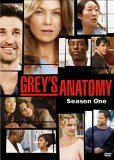
I gorged on Grey's Anatomy. Really gorged, but you know what? I don't regret a minute of it. It occured to me sometime after the tenth episode I watched in a row that the reason the show works so well for me (and possibly, in general) is that I'm equally engaged by all the storylines. The central character (Meredith Grey) and her conflicts -- yes, I really love all that. But I'm not disappointed when the story turns in a different direction, because I want to know more about all the rest of them, too. Not that I like them all; Christina infuriates me but I'm still oddly drawn to her.

Now I've got to get down to work, because I'm trying to write a difficult scene. I don't have so much trouble writing attraction or conflict dialogues, but this kind of pivotal scene where a relationship takes a turn -- aiaiaiai.

Robyn just sent me a link that I wish I had had years ago. EH.Net is a joint venture of historical economists at Miami University and Wake Forest, and where exactly where these people when I was writing Dawn on a Distant Shore? Part of what they do is to figure out relative values over time:

Calculate present value of money from 1257-present day This currency converter produces present-worth values for money through history, using a wealth of different systems. It applies to the UK and US, and depending on the method used, you can get price and value comparisons all the way back to 1257.

In 2004, $1.00 from 1900 is worth:

$22.37 using the Consumer Price Index

$19.02 using the GDP deflator

$108.01 using the unskilled wage

$149.07 using the GDP per capita

$575.24 using the relative share of GDP

EH.Net also has a feature called Ask the Professor:

Professors who have done research in Economic History are volunteering to assist others interested in learning more about the field.

This makes me happy. For which I will not excuse myself; I am a historical novelist, and we are a nerdy lot.

February 18, 2006

the story's the thing

I feel kind of sad for people who won't watch television, because for all the awful stuff, there is some wonderful storytelling. The Mathematician and I have a standing Friday night date for take-out Indian food and the Sci-Fi Channel, most particularly Battle Star Galactica. Which we discuss in detail. We watch House together and Lost. Recently we watched all of Firefly on DVD, and we have regular Farscape marathons, too. And out of simple solidarity, I have watched dozens and dozens of Simpsons episodes with him. I admit I laugh right along with him, though mostly I am uneasy about the Simpsons. I couldn't tell you why.

The Mathematician is fond of saying that if I fall for a show from the first episode, it's doomed. This has been the fact in the past. Homefront, Sports Night, My So Called Life -- I really adored these shows, and they were short lived. Farscape kind of fits into this pattern, as I didn't start watching until the third season.

All this lead up, and why? Because I'm watching Grey's Anatomy now, and somebody here recommended it. The Mathematician has resisted thus far. Apparently House is enough medical storytelling for him. But I love Grey's Anatomy. Or better said, I'm in the stage where I become completely enamored of the characters and want more more more. More background, more secrets, more conflict, more of everything. There are some wonderfully conflicted love stories embedded in the greater story about surgical interns, which of course is always going to make me happy.

The only fly in the ointment is the fact that ABC hasn't made the older episodes available through iTunes, as it has done for Lost. Which means I am reduced to begging friends and in some cases, friends of friends, to borrow recordings.

And here's the icing on the cake: the people who write Grey's Anatomy have a weblog called Grey Matter, and they really do let you in on the creative process. The idea for the show and the pilot were the work of Shonda Rhimes, who is now head writer and executive producer. She writes great weblog posts about what goes into her stories, which in the end is not all that different from other kinds of storytelling.

February 17, 2006

booknerd contemplation

It is probably no surprise that I am somebody who thinks a olot about books -- and not just what's inside them. The story is my main interest, but it doesn't stop there.

Just about everything about books intrigues me. Book and cover design, typesetting and typefaces, publishing history in general and editorial history in particular. So for example I have more than one edition of Pride and Prejudice, some of them quite odd and old picked up at flea markets.

I was in college before I started to think much about different editions of the same book. Tom Sawyer was Tom Sawyer, whether he appeared on pulp paper or in a hideously expensive leather bound volume. It made no difference to me which edition I read, as long as it wasn't abridged. Then I started taking literature courses and my outlook changed. I remember when I was told for the first time that I could only use the critical edition to write a paper, and the idea caught my attention right off. A critical edition is one that has been put together by a scholar who specializes in the work of the author in question. A good critical edition is true to the original, earliest editions, and will include notes on the original manuscript as well. For example, if the author kept changing one sentence back and forth from edition to edition. There will also be cultural and contextual notes -- what was going on in the world when the book was being written, how it was received, how it fit into the author's career and life.

All that and more belongs in a good critical edition. And after so many years of higher education, I am a footnote junkie. I do love me a big overstuffed detail ridden critical edition.

Some fifteen years ago or so I started noticing how big bookstores and publishers in general put out new editions of the classics on a regular basis. I remember once being in a store where a table was stacked with copies of Dickens, Austen, Cooper, and every other big name you can think of. Three bucks each or six for fifteen dollars. Printed on the worst kind of paper, shoddily put together. When my daughter was a little younger she used to pick up these books and ask for them, and she was always surprised when I refused.

I don't buy used books -- if the book is in print, and the author is alive, I buy it new. that's a solidarity thing and also just plain common sense. If we are to survive as scribblers, we've got to support each other. On the other hand, I feel no obligation to buy new when it comes to authors who are dead for hundreds of years (unless it's a critical edition, in which case the editor deserves to earn something). So when the Girl wanted a copy of the Odyssey, I went to a good used book store and looked until I found an edition from 1950, solidly put together, good quality paper, no obvious short cuts in production or editing.

Now publishers will tell you that they put out the classics in cheap form to make them available to a greater audience, but I don't believe that. I think it's an attempt to boost the bottom line, and in this day and age when publishers struggle, I can see why they'd try this. I still don't think it's right, but I can see it as a business decision. So if the Girl needs a copy of Jane Eyre or Adam Bede or the complete works of Voltaire, I will go find her a critical edition, often used. Which critical edition depends on the circumstances, but if you're really interested have a look at Bookworm's post on this question. She looked at four paperback critical editions of Jane Eyre: Penguin Classics, Modern Library Classics, Oxford World's Classics, and Norton Critical Edition.

February 16, 2006

website wobbles

We've been moving domains around, shuffling them and dealing and shuffling again. I'm trying to get the various domain names in a row, all on the same server and working in tandem.

Or better said, the Mathematician is trying to do all this. Because my mind turns off once you get into the technicalities.

This is kind of a long process, only half done at the point. You'll notice missing images and broken links. I'm making a list, but I'm not going to fix them until all the heavy hauling is done. So fair warning.

An Imperfect Lens | Anne Roiphe

This is what historical fiction can -- and should -- be.

In 1883 cholera comes to Alexandria in Egypt. In France, Louis Pasteur is an old man, infirm, unwilling to travel and so he sends a team of scientists he has trained to try to identify the infectious agent behind cholera -- the necessary first step in stopping the epidemic. In that team are Louis Thuillier, a young man who wants to prove himself; Edmond Nocard, a veterinarian; Emile Roux, an odd man but much liked; and a young assistant called Marcus. In Alexandria they must deal not only with the French consul, but also with some competition from the German scientist Robert Koch, who has a head start on them in searching for the cause of the disease. And there's a local doctor, a Jew whose family has been in Egypt for centuries. The doctor has a daughter who is on the brink of a suitable engagement.

To all this you have to add the most important character, the disease itself. Roiphe wrote this novel in omniscient voice in order to follow the disease through its life cycle, which she does with such vivid, evocative images that I often found myself rereading paragraphs just out of admiration.

So you've got multiple conflicts: socioeconomic, cultural, religious/scientific, romantic. You've got scientists who understand (for the first time in history) the true nature of infectious disease in one of the dirtiest, poorest cities in the world and a disease that kills horrifically in a matter of hours. You've got a young scientist and a young woman who would normally never cross paths, who are thrown together in the pursuit of a cure. You've got Germans versus Frenchmen, an age-old rivalry. The superstitions of the older generations and their distrust of the new science. Somehow or another, Roiphe balances it all and tells an incredible story, one that I will be thinking about for a long time.

In its bones, this is a true story. Roiphe takes people and events and reimagines them into something truly wonderful. I suspect it may be one of the best novels I read this year.

February 14, 2006

iesus nah, des git as noed


I don't think I've ever said much here about the years I lived in the Alps. It was a long time ago, so long it's almost hard for me to imagine. In the summer of 1973 I went to Austria with the American Field Service exchange program (which still exists, and functions) and stayed with a family in the village of Andelsbuch in the middle Bregenz Forest in the northern part of Vorarlberg, Austria's western most province. I was hoping there would be a high rez map of Vorarlberg at Google Earth but a huge swatch of central Europe, including all of Vorarlberg and the entire country of Liechtenstein are still low rez. So here's a dopey little map instead.

The short version of this story is that I got so interested in the dialect spoken in the Bregenzerwald that I ended up studying linguistics, writing a dissertation on variation and change in a specific dialect of a specific village (Grossdorf), getting a PhD, and going off to teach linguistics and German at the university level. Eventually I ended up writing Homestead. I guess it must be clear that along the way I learned both (what I think of as) book German and various dialects of Swiss German. Swiss German is a bit of a misnomer as this group of dialects (which I'll start calling Alemannic at this point, to warn you) is spoken in south-western Germany, western Austria, and all of German speaking Switzerland.

Why am I telling you all this. Because today I was listening to dialect stories recorded by a woman from Mellau, really gorgeous stuff that simply could not be translated either into book German or English, which always makes me a little sad. You will never hear the story of how the Mellauer and the Auer, in their endless inventive taunting of one another, ended up inventing yodeling. It's a good story. So I was listening and feeling a little homesick for the Bregenz Forest. As a result I went to look up the author (Reinhilde Hager) to see if she had a website. Which she does not (unless she married since the recording was made, in which case I don't know how to look her up). But I did find something that made my jaw drop, and that that there is a wiki for Alemannic.

If you go look at the Alemannic wiki, you probably won't get very far because it is actually written in Alemannic. The equivalent might be if there were a wiki written entirely in Chaucerian English, which would also most probably give you severe pause.

I almost got teary, reading through the Alemannic Wiki. Of course the dialect represented there is not exactly the one I speak; if you're going to write down a language, you've got to take some steps toward standardizing spelling, at least. But it's very close, and it felt like running into an old friend on the street.

I don't get the opportunity to speak Waelderisch (my particular variety of Alemannic) very often, and I'm a little rusty -- but not very. I can read it without a problem and when I listen to the recorded stories, I'm right back there, thinking in it. If I got on a plane tomorrow it would take me maybe three days to get back where I was. Which leads me to a linguistics topic which may be of interest. Anybody ever hear of the black box, universal grammar, the critical period, and the distinction between language learning and language acquisition? Because it's interesting stuff.

February 13, 2006

Tied to the Tracks publicity stuff

I just got this from the publicity people at Putnam:

We would appreciate a selective list of appropriate people to whom we might send either bound galleys for advance comment or bound books for possible review. (These may be critics, feature writers, columnists, personalities, other authors or prominent individuals who may be interested in your book to the extent of wanting to comment on it or give it exposure.) Please attach the list to this questionnaire

A while ago I asked here about this. A half dozen or so people who fit the profile emailed and asked to be included ont he list. And now I can't find those darn emails, which I put away carefully. So if you wrote to me then and said you wanted to be on the list, please email me again, rosinalippi AT pobox DOT com. Include contact/mailing information and I'll forward it to the publicity people. I haven't asked them directly, but my sense is that if you have a well established book review website, your name can be included.

February 12, 2006

Plainsong | Eventide by Kent Haruf

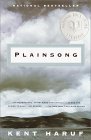
I never posted here when I read Plainsong, because it's one of those books that defies description. Minimalist prose style -- simple sentence structure, no extended descriptions -- which is something that usually I'm not so keen on. But the story in Plainsong is compelling, because the characters are. The novel is set in a small town in rural Colorado, and it follows various people who live in that town through about a year. The stories, which seem separate from one another, gradually intertwine.

So I really liked Plainsong, though I didn't stop to write about it here when I first read it. I'm writing now because I just read Eventide. Which is a sequel to Plainsong, something I didn't realize or I probably would have read it sooner. The same characters (or most of the same characters) deal with whatever life hands out, starting with the two old brothers who have run a ranch together for all their lives, moving onto a feckless couple who live in a broken down trailer with their two kids and can't cope. Period. I'm not sure how Haruf made me like and care about some of these characters -- especially the brothers -- but he did, so much so that when I finished Eventide I was immediately wondering if he was going to write a third novel. He doesn't tie all the loose ends up, and while some characters end up in a good and hopeful place, others do not. And I'll continue to wonder about them until (and if) he tells more of the story.

Thriller writers have more fun


Sarah Weinman points to this upcoming conference for writers and readers of thrillers, where there will be a mock trial of one of my favorite fictional tough guys, Jack Reacher. Lee Child, who writes the novels, will be standing in for Jack, who is off someplace beating up bad guys.

confusing the readers

A comment that came in today:

I have read all the Sara Donati books. Just finished "Fire Along the Sky" and the beginning of Queen of Swords. I am just wondering why Luke Scott Bonner and Hannah Bonner became Luke Scott and Hannah Scott. I thought this was the story of the Bonners. Why confuse the readers?

If I do something like this (and by the way, if Hannah is called Hannah Scott, it's only an assumption made by somebody else who knows her brother), there is always a reason. Think for a minute about where the characters are, what is going on in the world at large, and about the dangers of the situation.

Though it may seem at times as though I sit up late thinking of ways to be confusing, in fact if I'm up late it's for the opposite reason. Or because I can't put a book down. See the next post.

February 10, 2006

pretty picture, interesting faces


From one of Dorothy Dunnett's covers. I am so tempted to write thought bubbles.

February 9, 2006

let's call it tact

A few days ago somebody (Smart Bitches? Alison? Beth?) had a post about building references to 9/11 into a storyline, and how very delicate a proposition that is. Apparently somebody (and again, my memory is leaking) read a novel where there was a reference to somebody who died in September of 2001, and didn't clarify until late in the story that it was not in connection with the hijackings.

So I've been thinking about this, and I realized that without much thought I have avoided this problem completely. Parts of Tied to the Tracks take place in Manhattan and northern Jersey in about 1998; the rest takes place in northern Jersey and Georgia in 2003. No mention or reference to 9/11 at any point. And it never occured to me to try to build that in. Was this good sense on my part? Sensitivity or cowardice? The short answer (from my perspective) is that the topic is not one I want to pick up in passing. It's too big and painful to be used in a casual way, so I didn't use it at all. I suppose in fifty years it might be possible to do that, in the same way that there is a shorthand in place now to make it clear that a character survived the holocaust. But not now.

The only novels I have read that dealt directly with 9/11 are Jim Fusilli's Terry Orr novels (I reviewed one of them here). Terry Orr and his daughter live in a house less than five minutes walk from the Twin Towers, and all of the novels in the series deal to some extent with that event and its aftermath. Fusilli pulled this off with great sensitivity and in a non-intrusive, thoughtful way. I think he was able to do that in part because he himself is from that part of Manhattan. I am not, and so I leave those stories to the people who lived them.

And now I just realized why I stay away from any mention of the topic at all, and it's pretty simple. My fear is that no matter how carefully I approach it, I will end up either trivializing the events or exploiting the emotions that are still so raw and close to the surface when we (all of us, everywhere) think of that day.

Of course, it's also impossible to set any story any place in the days immediately following 9/11 and not mention it. You couldn't start a story like this:

Dorothy gave birth to her seventh child at eleven in the morning on September 11 at Manhattan General and checked herself out of the maternity ward less than an hour later, taking nothing with her but a pack of cigarettes, two thousand three hundred twenty two dollars in cash laboriously saved up, and the lunch they had brought her, wrapped in a pillow case.
The reader is going to have questions, but probably not the questions you'd hope for. You'd want: what's up with Dorothy? Post partum depression? Leaving her family for somebody else? Going to jump off a bridge? If so, why the lunch sack? Instead of those questions the reader is thinking: 2001? Was this 2001? And if it wasn't 2001, why that date? Why pick that date of all dates? What's the relevance? Did Dorothy leave the hospital because she feared for the rest of her children, and how they were coping with the panic and fear of the attack? Was her husband a fire fighter on duty?

If the answers to that second set of questions is no, there's no connection between this story and the 9/11 attacks, the reader is most likely going to feel manipulated, and with good cause. It's in very bad taste, just plain tacky, to flash that date just to get attention. So the only solution (for me, of course -- everybody will figure it out for themselves) is to stay away completely. In fifty years time maybe I'll rethink that (cough) but that's my policy for the time being.

February 8, 2006

true story

Our good friends Thor and Penny are a little unorthodox, each of them in a distinct way. Thor has a road kill license because he's a paleontologist. Rotting animals are his thing. Their house is full of partial and whole skeletons, and their freezer offers up such goodies as dead badger, zebra head (the nearest zoo calls him when something dies) and other, less identifiable bits and pieces. The other thing about Thor is, he lives so much inside his head that you're never sure if he's heard you.

Penny is a wonderful, kind, generous person with a passion for education and the complete inability to understand any concept of time. We always tell Penny things are going to start a half hour before they do, and she's still always wandering in after everybody else, usually with a wonderful story and oh, am I late?

About five years ago Penny decided she wanted to give Thor a suprise birthday party. At our house, which was fine. I shook the details out of her and went ahead with things, and then on his birthday we put together an elaborate scheme to get him to our house at exactly six, no earlier. It really was a good plan, but we forgot to reckon with Thor. 'Elaborate plan' and Thor = trouble.

At 5:30 somebody yelled, Thor's here! And we all went nuts, running around, nowhere near ready. So Thor comes in and everybody yells SURPRISE and he's so touched and happy and pleased, except:

his birthday isn't until tomorrow.

I turned to Penny. Penny shrugged. Oh, said Penny. Did I get the date wrong again?

I tell you this story because today is the mathematician's birthday. It is stories like this one that horrify him. The mathematician would rather stick a fork in his eye than have to show up at a surprise party in his honor. So instead of a party we're going out to dinner, and I'll be back here to tell you some other completely irrelevant story tomorrow.

February 7, 2006

The Wheelman, Duane Swierczynski

I was really grumpy after I finished this novel for two reasons. First, it kept me up until really late because I couldn't let the story go, and second, I was astounded at the ending and quite unsettled.

So I did something I hardly ever do, I emailed the author and demanded a few answers. Those of you who have emailed me over the years wanting to know what's up with one of my characters: you see, it happens to me too. Go ahead, submerge yourself in Schadenfreude, soak in it until your fingers get all wrinkled.

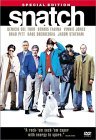
Duane (who has a good website*) was kind enough to email me back and not answer my question. That is, he didn't answer it in such a way that the answer was clear anyway. And now I'm satisfied, and I recommend this novel to anybody who likes gritty, noir type stories that lean toward the absurd in terms of humor. I keep thinking of the movie Snatch (one of my favorites; Jason Statham as Turkish, Vinnie Jones as Bullet Tooth Tony, Benicio Del Toro as Franky Four Fingers and Brad Pitt as a Pikey, really, what more could you want in a movie?). This novel has that same kind of energy and quirkiness, all quick turns and odd characters. But Duane isn't nice to his characters, so if you're soft hearted, this might not be the book for you.

Oh, and: the cover is great, too.

*just read on Duane's website that he's got a new two book deal, so congratulations to him, and I hope he writes faster than I do.

those nuts at Amazon.com

What will they think of next? Now you can click on text stats for any book and find out things like average syllables per word, words per sentence, and a lot of other numbers. Also, a frequency map of the hundred most used words. The one for Homestead looks like a primary school spelling page. My favorite stats:


Title..............Words per $...............Words per ounce

The Stand
Stephen King.......51,406.....................26,994

Homestead
Rosina Lippi........5,799......................6,981

Into the Wilderness....?.........................?

Possession
A.S. Byatt..........18,049....................11,844

They don't have text stats available (yet?) for the Wilderness books, which is too bad because I was quite curious. If/when they get around to providing those stats, believe me, I'll let you know. As it is, you can see that Homestead doesn't give you good value in terms of dollar:word ratio. And I worked so hard on it.

Sniff.

February 5, 2006

bookplates


Martinbrown2
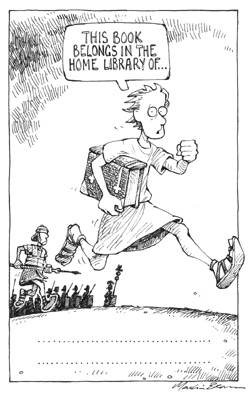
Today I came across My Home Library a website dedicated to bookplates, particularly to bookplates done for children's books by illustrators. For example, this one by Martin Brown. If you go to the site you can download it for free as long as you use it only for your own, non-commercial purposes. There are hundreds of them at My Home Library.

I love bookplates, but I never put them in books; I never write anything in a book, either. But I do have a small collection of bookplates, and I love the ones on this website.

to pursue the topic a little further: accents in NYC

Kenzie asks:

My mother was born and raised in New York City. She claims she can tell what block somebody grew up on based on their accent. I don't have her Kreskin-like powers. (e.g. knowledge of when the fridge door opens when she isn't in the room, knowing to the penny how much groceries will cost with tax even! If you throw miscellaneous things in the cart when she isn't looking, etc.) I was wondering if accents really are that pronounced in NYC that her claim is valid? Is this just a New York thing, can people do the same in Chicago? Boston? Montreal isn't the same that way; you can tell what city/ville a person is from, but neighbourhoods now are a horse of a different colour, they all start to blend after a while...

It depends to some degree on your mother's generation, but yes, in general there is a lot of diversification in NYC that distinguishes people on the basis of neighborhood, ethnicity, socioeconomics, and religion. Those neighborhoods have been there for a long time in American terms, and for a long time there was very little mobility within the city. So your mom probably can tell quite a lot from an accent. But it's a very complex topic. Have a look at the Telsur Project at Penn, that will give you an idea. There are links to work on NYC in particular, as well.

People have this idea that language is becoming more homogenized due to the media, but in fact the exact opposite is true. Language varieties over space (dialects, if you prefer) are becoming more distinct from one another in the United States. If you're really interested and want to see a lot of maps, here's a pdf of chapter eleven of the Phonological Atlas of the United States. Be warned that the discussion is highly technical and the maps take some studying, but they will give you an idea of the great range of language diversity in the U.S.

Oh and: there is a very, very distinct Chicago accent. A number of them, as a matter of fact.

February 4, 2006

The Great Vowel Shift

There is a very good website that explains the Great Vowel Shift (with audio). Not as entertaining as my after dinner party trick, but it does a great job.

My shorter, highly simplified (and rather boring, presented this way) explanation if you aren't interested in the bells and whistles:

Sometime around 1400 the long vowels of English began to shift upward, which means basically that the degree of opening of the mouth narrowed. Means nothing to you, right? Never mind. If you speak American English, say the word father. That first vowel is an open vowel. Probably the most open vowel in your personal phonemic inventory. Now say the word ink. That is a close (or closed) vowel. If you say the vowel in father and the vowel in ink, you've got the extreme of open and closed for most varieties of American English (for the back vowels; there are also front vowels).

Backing up: about 1400 the long vowels began to shift unless they were followed by two distinct consonants. So the the vowel in the world house changed, but the vowel in the word husband did not; once both were pronounced with a sound you might write as ooo. Lots of pairs like this: goose/gosling, wife/midwivery. (Note we are not talking about spelling, but the sounds of the words as they are spoken.

Note: language change is always happening. It's a natural process, and nothing to get upset over. The Great Vowel Shift was a series of language shifts that took place over a very long period of time -- and in fact, never quite finished or caught on in some places. A good many varieties of English spoken in northern Great Britain never participated in the GVS, so in Scotland you are likely to hear hoose for house. The GVS is one of the reasons that written English is so strange; the spellings we use today were set down before the GVS, and for the most part, we never updated our orthography. You see this in many other parts of the language beyond the GVS. For example, the word night. Before 1400 (and still today in some parts of Scotland), this word would be pronounced neeeecht, where the ch is a very throaty fricative. We still write the fricative (night) though it passed out of the spoken language for most of the English speaking world a long timea go.

That's it, in a nutshell. I really do suggest the other website, the audio examples make it all much clearer.

point of view slippage

It has been a while since I've posted anything on craft, but over the last few days I've been thinking a lot about POV.

In every discipline there are some concepts which are particularly hard for students to absorb. In linguistics there's the concept of the phoneme, or, on the syntactic level, the passive. I run into really intelligent people who are confused and frightened by the passive. On a few occasions I have used a napkin in a restaurant to do my little passive spiel, and almost always it's like coaxing somebody out on a high wire with no net. Once that's been managed, I sometimes trot out my second party trick, which requires another napkin: the great vowel shift, or the house/husband goose/gosling puzzle.

Back to POV. In introductory creative writing classes it's often simply explained with who's the camera? -- which character's head are we in (assuming third person limited POV), through whose consciousness is this scene being filtered?

Lately I've been noticing a lot of sloppy POV work. A scene opens with the POV character coming into a house where he's never been before, meeting a person he wants to like. The details of what we as readers see can't go beyond what that character sees and perceives. Which depends, in turn, on the character's powers of observation, what's on his mind, his background, and whether he got enough sleep last night.

There's a famous writing exercise by John Gardner that goes something like this: character walking down a hill in a small city towards a bay. The weather is bright and warm. Describe the town and street from this character's POV...

1. a woman who has just got a promotion she worked hard for
2. a teenager whose brother was just arrested for drug dealing
3. a man who has been spiraling deeper and deeper into depression
4. a five year old child on his or her way to the library with a parent

Each of these people will experience the street and the town differently. Of these four, only one is likely to notice, for example, that the crocus are coming up on the lawn outside the post office.

In the last couple days I've read passages in published novels where tough guys have observed things so counter to the characterization that I was pulled out of the story. Of course, a big bad detective could take note of the fact that the dead woman is wearing lilac pedalpushers, but then at some point you have to show me that he grew up doing his homework at the back of his mother's dress shop, and has a quiet interest in watercolor. Otherwise it's clear that the female author is observing and pushing her big bad male character to do the same. That's classic author intrusion.

At different times, different POV approaches are fashionable among writers. First person narratives really had a strange hold on novels for a while there, but I think (I hope) that's relaxing a little. Ann Patchett's Bel Canto, which won a lot of literary prizes and was widely read, is written in omniscient. I can't remember the last contemporary novel I've read in omniscient POV. I was quite shocked, and then I settled down into the story and I admired the chance she took (which paid off).

Really, all you have to do is this: decide what approach you're going to take, and stick to it. And hope for an editor who reads closely enough to catch this kind of slip.

very, very shiny


Is this not a gorgeous cover?

Bernard Shaw's The Intelligent Woman's Guide to Socialism and Capitalism, first edition, published 1928 by Brentano's.

This copy is up for auction at PBA Galleries, a place where I allow myself to browse for no more than an hour, every Saturday.

February 3, 2006

hello big brother

Joshua of Strip Mining for Whimsy points to an article in The Nation which scares the hell out of me. The opening paragraph:

The nation's largest telephone and cable companies are crafting an alarming set of strategies that would transform the free, open and nondiscriminatory Internet of today to a privately run and branded service that would charge a fee for virtually everything we do online.

To be honest, I figured this would happen sooner or later. The earnings potential is just too big to ignore, and of course the telecommunications industry is unhappy about the fact that we're all communicating with each other without tithing them in the process. The fact that we pay for telephone and cable access isn't enough, as far as they are concerned.

The internet is transforming the way things work at a very basic level, and it makes the big corporations very nervous for more reasons than just lost revenues. We talk about them and the government and the relationship between two, and they can't control it or manipulate it to their own ends.

The question is, what can be done to keep the internet independent of commercial control. I hope somebody smarter than me has some good ideas.

February 2, 2006

various recent books I might have loved, but then didn't

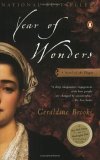
This novel slid away from me. I liked the narrative voice, the historical detail, the setting. I liked the main character, a young woman who tells us about the year in which her small village isolates itself in an effort not to spread the plague. It's a very hard year.

My problem with the novel is how the main male character -- not a romantic interest for her, but the minister married to the woman who becomes her best friend -- does a one hundred and eighty degree turn suddenly, and with very little warning. Or really, it's not so much that he turns out to be something different than what we are led to believe for 3/4 of the novel, but how that was accomplished.

It's hard to say much about this without giving away a great deal, so I'll finish with a generality: when you tell a story, you've got to earn the crisis. In this case it felt slightly off to me, a little disingenuous, and hurried. For that reason (at least in part) the last chapters and resolution struck the wrong note.

***********************
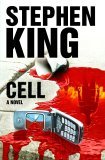
King has been writing for a long time. He's mellowed in some ways. One thing that jumps out about this novel immediately is its length. Which is about average for a novel these days, someplace over 300 pages. For him, this is a very short novel.

This is another case where I liked the premise, the characters, the execution, and then things slowly fall apart. The story starts with an upheaval of huge proportions. One day out of the blue somebody (who is never established) grabs hold of the whole cellular phone network and sends out a Pulse (as they call it later) that basically strips the person who hears it down to the core. Everything is gone except rage. Chaos ensues; people, terrified, pick up their cell phones to call the police. Things get out of hand.

The main character wants to get back to his son, and to do that he has to travel a good distance and face down lots of challenges along the way. In terms of storyline, classic. A lot you can do with this -- a lot King has done before. To his credit, this doesn't feel very much like The Stand (although there are some echoes), but it also doesn't quite reach its potential. The final confrontation kind of sputters there on the page and never really comes to life.

The last scene, on the other hand, was perfectly handled.

**************************'
Maybe I do love this novel. I certainly stayed up reading it until the wee hours, because I was so engaged with the characters and so worried about them.

It's funny, full of interesting characters who interact with each other in engaging and enraging and magical ways. But to pull off this story, Lorna Landvik had to do some really awful things to her characters, and I found it hard to cope. I'm still angry about Thor, Patty Jane's husband. I can't say more than that, because really, I'm hoping you'll all go out and read it and agree with me. So I can sit here and make disapproving noises to myself.

Note: I have said here, you have read in many other places, that it's not the novelist's job to be nice to the characters. Story arises out of conflict. Conflict involves pain of one kind or another. But in this case? I protest. Even given the resolution, I still protest. On the other hand, I'll probably read it again, which means that this novel does what it's supposed to do: it made me feel something, it made me think.

So go read it please and come back here and tell me how right I am.

February 1, 2006

a few numbers

In seven days, the Mathematician's birthday will be upon us.

This is post number 932. The next comment will be number 3,197.

On this day in 1989, I was in the hospital in preterm labor. I was 27 weeks pregnant at the time. The Girl's estimated weight was 1 pound 3 ounces. Luckily she stayed put for a while longer.

I have 2,185 books cataloged (so far); compare this to the fact that I have 1,604 individuals in my family genealogy file. In that file the earliest documented ancestor was Gilles du Puy, born 1370 in Peyrins, DrĂ´me, France. Of my female ancestors, the one who lived the longest (that I know of) is Maritje Cuddebeck, born 2 Aug 1696 in Kingston (formerly Wildwijk & Esopus), Ulster County, New York. She died in Sandyton, Sussex County, New Jersey, aged 99 years. My uncle Lou was born a hundred years ago next month, but he's long gone.

There are 6,032 paragraphs in Queen of Swords (or, if you prefer, 210,000 words). There are 3,923 paragraphs in Tied to the Tracks (106,900 words).

And now, back to work.