" /> storytelling: December 8, 2005 Archives

« December 7, 2005 | Main | December 9, 2005 »

December 8, 2005

Brokeback Mountain

B
rokeback Mountain, if you're not aware, was originally a short story by Annie Proulx in her collection Close Range: Wyoming Stories. Now it's a movie, directed by Ang Lee, screenplay by Proulx and Larry McMurtry. And (according to my daughter and her friends, who cannot wait for this movie) a stellar cast.
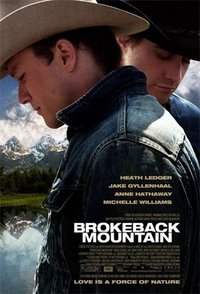
Brokeback Mountain
I listened to the story in audio format when I was driving through Wyoming, and so for me the two will always be linked. The natural architecture of Wyoming, the high plains and mountains, lends itself to storytelling of a particular type. It was almost hypnotic, the combination of words and scenery, and a story that is, in a word, tragic.

My daughter loved the story, is determined to love the movie. Her biggest concern is that people won't give it fair consideration because of the subject matter, which has to do with two cowboys who fall in love in a time and place when it was next to impossible for them to share any kind of life together.

But there are some indications that people are going to be more open minded than she expects them to be. I heard an interview with Willy Nelson, the original cowboy of all cowboys. Of course the interviewer asked him about his thoughts on a gay cowboy movie, and he smiled -- kindly -- and said: "I've been working on a new song. It's called Cowboys are Frequently Secretly Fond of Each Other. "

Whether you go to see the movie or not (I will be going with my daughter and -- at last count -- 19 of her friends), I recommend the short story. Annie Proulx is one of the few truly distinctive stylists writing today, and this is one of her strongest works.
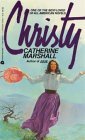
Christy, Catherine Marshall

This novel, first published in the sixties, is Catherine Marshall's attempt to capture her mother's experiences teaching school in rural Appalachia almost a hundred years ago. It's told in first person, which was a brave thing to do for any daughter, trying to see through her mother's eyes.

I first read Christy when I was a teenager, and it made a great impression on me, and before you ask: I didn't realize that there was a television program based on the novel, and I have never seen it.

If you go searching for information about Marshall and this work of hers, you'll find that she was a devoted Christian, the daughter and wife of ministers. As I remember this novel, it wasn't primarily about religion or faith, although there is a major character who is Quaker. That character (Alice Henderson) was so finely drawn that I went and looked up more about Quakers as after finishing the novel.

Mostly this novel is about the community of people in the most remote part of Appalachia, and it was that part of the story that really struck me. Now I have to say that it is many years since I read this novel and my memory may not serve, but it seemed to me that Marshall avoided stereotype and cliche. I'm going to reread Christy -- it's still in print -- and see how I feel about it now. I'll let you know.

solitude

I've mentioned Cary Tennis before. He's a psychiatrist (or maybe a clinical therapist, I can't remember at the moment) who has a column at Salon.com. He answers letters, and I've got more than one story idea from his column. [Edit: Joy has pointed out that Cary is neither a therapist nor a psychiatrist. He's a writer. More about him here.]

If you don't subscribe to Salon it may be hard to get to this particular letter , so the short version: A woman writes to ask about her need for solitude, and the fact that while she loves her husband and wants to be married, she feels a strong need to have her own, separate household.

This is part of Tennis's reply to her:

My job is to cultivate thoughts, to grow them from little niblets into fully developed structures. The thoughts take time to develop. They need to develop uninterrupted. They're delicate crystals built in the air, each part suspended by an act of consciousness; they're precarious, like data in RAM, if you will: A crash, or a power outage, or any interruption of the system that holds them in crystalline suspension, and the whole thing falls down and you have to start over.

So if there are people around it can be hard to do the job.

Not everyone is a writer by trade. But many people have the same problem: Identity, or consciousness, or well-being, can be a delicate crystalline structure as well; any interruption and the identity crashes. Consciousness becomes muddled. There are people who are not writers who nonetheless live in the imagination, whose identities and sense of the world are precarious structures. They read books and think about the ideas in the books. Or they wake up from a dream-filled sleep and want to think about the dreams, which hover on the edge of consciousness. So even having to say hello to another person in the morning can make the whole thing collapse.

This really is what it's like to write, for me. I live inside my head mostly, and have to force myself to go outside and interact with the real world. Intrusions are destructive. I can't have music on at home while I'm writing because it invades and distracts. Though for some reason I can go to Starbucks, where there is music and talk and noise, and completely retreat inside my head and stay there with no consciousness of what's going on around me.

Then again this may be nothing more than ego and self-aggrandising twaddle.