" /> storytelling: August 1, 2005 Archives

« July 31, 2005 | Main | August 7, 2005 »

August 1, 2005

why proofreading (yet again) is necessary

WhyOhWhy is any of this necessary? If it's all stored on a computer disc somewhere already proofread and then printed, bound and sold, why is there any reproofreading needed for another printing? Enlighten us non-writers.

Posted by: asdfg at August 1, 2005 04:54 PM

It's necessary because the manuscript was typeset for one configuration (hardcover) and had to be revised for another (mass market paperback). Errors can sneak in during this process. Lines or paragraphs go missing, stray letters creep in and make nests for themselves. Participles fall and dangle. All manner of chaos is possible.

This is also an opportunity to correct any factual or continuity errors. For example, some time ago there was a discussion of my lack of attention to Charlie LeBlanc's reproductive habits. I gave him a lot of children and then forgot that he had them. But at this moment I can't find that discussion, and so it's going to be hard for me to fix Charlie's predicament. Another example: a carefully written letter from a reader who informed me that I know diddly squat about eagles, had their nesting material all wrong, and should desist from writing about them until I mended my sloppy ways (and in fact, I did get the nesting materials wrong -- mea culpa).

And of course, this is the time for me to deal with anachronisms. If I knew where they are hiding, I would do that. However, if history repeats itself as it usually does, I will get six emails each outlining a different anachronism in great detail -- right after the paperback edition comes out, when it's too late to do anything about it. Which happened with Lake in the Clouds.

So, if anybody wants to say something about Fire Along the Sky, NOW would be the time.

modeling

One technique I have used with some success in advance writing classes is called, simply enough, modeling.

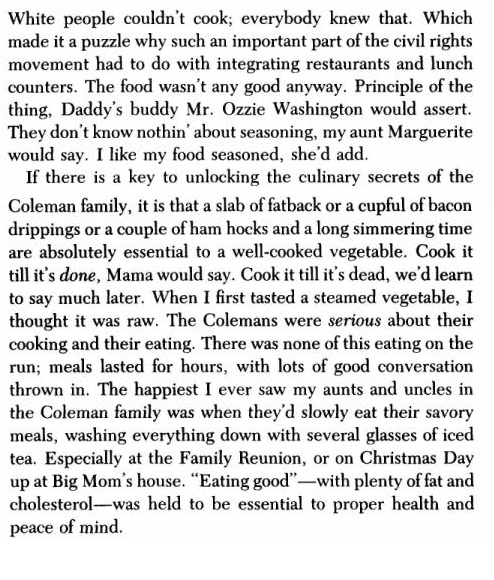
You take a strongly written, very short piece -- no more than two pages of a short story or chapter or non-fiction essay -- and you change the premise and the characters, but you keep the sentence structure and paragraphs and try to maintain the message. I had a lot of luck with an excerpt from Henry Louis Gates Jr.'s Colored People, a collection of essays. The part I used had to do with his recollections of family meals and cooking. (You can click on the thumbnail here to read the first paragraphs.)

Students were asked to shift the identity of the narrator to a fictional character and also to shift the ethnicity of the family and its location. I had students write about Polish families, Irish families, WASP-like families, often with great success.

When first confronted with a modeling exercise, students sometimes balk. It feels like cheating, they tell me. It feels like stealing. But in fact it's just an exercise, like playing Bach and Mozart to get yourself in a certain mindset if you compose music. By forcing yourself to use the form at hand, you are also liberating yourself to think in depth about the target issues: family conflicts, ethnic identities, public personas.

So I'm thinking now it might be useful to do some modeling on the basis of Peter's small speech. I'm wondering if I can recast that paragraph and have Peter become an elderly Italian woman insulted by her son's mother-in-law, or a young Korean immigrant who takes offense at a teacher's condescension. What will have to happen is, each line of the dialogue has to be examined for those markers that make Peter who he is, and transformed.

Stay tuned.