" /> storytelling: October 2003 Archives

take me to the front page of the tttt weblog | back to the current weblog

« September 2003 | Main | November 2003 »

October 31, 2003

falling onto the floor

The Chronicle of Higher Education is a publication I don't look at much these days, but in today's online issue there's an essay by Charles Johnson (author of Middle Passage and many other novels, essays and articles). It's called "A Boot Camp for Creative Writing." (Note: I don't know how long this link will work before the Chronical starts charging for looking at it, be forwarned.)

In this essay Johnson outlines his approach to teaching creative writing, both in theory and practice. It is rigorous, to say the least, and full of good thoughts and suggestions. Anybody who worked with him through this curriculum would certainly come out a better writer and thinker.

And still there are aspects to Johnson's approach which bother me. First and foremost: his reverence for John Gardner and all of Gardner's teachings. Johnson begins with this quote from his former teacher:

If our furniture was as poorly made as our fiction, we would always be falling onto the floor. -- John Gardner
I have, and appreciate, Gardner's books on writing. By all accounts he was a fantastic teacher; I'm willing to believe that, but this particular quote doesn't make that case. It's a general condemnation, and those always set my teeth on edge. On the other hand, it's true that Gardner's exercises, which Johnson has adapted for use as part of his own curriculum, really are excellent.

I'm always uneasy -- and, I have to admit it, suspicious -- when there's such an outpouring of unconditional love. There's a lot of it out there for Gardner; poke one of the big names (Johnson is a case in point, but he's in a crowd when it comes to Gardner adoration) and they'll tell you to read Gardner. Maybe the Emperor really is wearing new clothes.

Another odd thing: Johnson lists his requirements for excellence in writing fiction:

"1) a story with logically plotted sequences; (2) three-dimensional characters -- that is, real people with real problems; (3) sensuous description, or a complete world to which readers can imaginatively respond; (4) dialogue with the authenticity of real speech; (5) a strong narrative voice; (6) rhythm, musicality, and control of the cadences in their fiction; and finally, (7) originality in theme and execution."
I wouldn't quibble with this list, but I am confused by his demand for authentic dialogue and real conflicts, real people... to be followed up with the admonition that the serious writer should be reading the dictionary from A to Z .
"In class, I write a new word each day on the blackboard to see if students know it -- ullage, gride, yirn, or kalokagathia -- and give a "prize" (usually a copy of a literary journal) to the students whose fiction discussed that day exhibit the most delicious, perception-altering use of language."

This link between stiltified language and deliciousness I find odd.

Mostly I am bothered by Johnson's tenacious hold on the old-boy network; the works he cites (and this is not to say they might not be excellent, one and all) are homogeneous in a variety of ways. But it's a thought-provoking essay, and worth reading -- in my opinion.
Critical Space - Greg Rucka ****+

This most recent addition to the Atticus Kodiak series is (in my opinion) the best so far. The unusual premise for this main character -- he's a professional bodyguard -- might have been short-lived, but Rucka comes up with a twist that turns everything on its ear and promises the next book will be something special. The ballet theme was maybe a little bit of a stretch, hence the 4.5.

October 30, 2003

Farscape (what else?)

Farscape

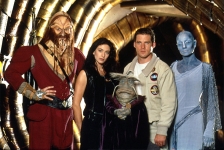
The first three seasons of Farscape are now available on videotape or DVD, so the question is: have you seen it yet? Want some suggestions on which episodes to watch first? I'd be happy to help. Already sliding into addiction? Stop by Watch Farscape or Farscape World and you'll see you're not alone: there are a lot of very smart, very discriminating people who are in the same boat.

"... the most irreverent, unpredictable, sexy, intelligent and exciting sci fi show on TV ... incredible chemistry ... some of the most vivid and compelling fantasy creatures ever created ... a joy to watch ..." - TV GUIDE
"... by far the best and most inventive SF TV show on the air at the moment ... Farscape has once again surpassed anyone's wildest hopes and expectations ..." - DREAMWATCH

trivia quiz

Seems like there is enough interest, so I'll take the poll down for now. More details to come.

busy, productive people

If you're looking for a website with a lot of information on research and craft issues, starting novels, building character or plot, I suggest you go have a look at Holly Lisle's site. It's awe inspiring. Like Holly, I am fortunate enough to be a full time writer, but I have no idea how she gets so much done.

Especially wonderful are the guidelines for submitting comments to her blog, which include something I had never run across before (but wish I had): Don Lindsay's fantastic List Of Fallacious Arguments.

short stories

I'm pretty exacting when it comes to short stories. Either they please me quick, or I bail out.

I want a plot. I want characters whose voices are loud and clear. They don't have to be likable, but they've got to engage my interest somehow. I want to be enchanted or amused or shocked or furious, all those things at once, if possible. Many classic short stories leave me cold, so don't be surprised that you won't find James Joyce on this list or (cough) Hemingway. Don't misunderstand: subtle is just fine and dandy, as long as it still comes with a plot attached. The list is in the Extended Body below.

Bovanne

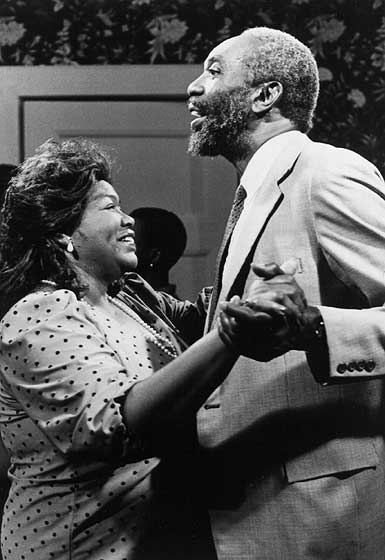
Of those stories I've mentioned, I would have to say that Bambara's "My Man Bovanne" is as close as it comes to perfect, in my view of things. This short story has been filmed as a part of the Issues of Aging Curated Video Collection (actors Theresa Merritt as Hazel and Bill Cobbs as Bovanne).

I'd be interested to hear from you if you know any of these stories and have an opinion. Oh, and: I've given you more than one place to find the story, if I have that information available.

ALLEN, WOODY. The Kugelmass Episode
New Yorker May 2 1977
Worlds of Fiction ed. Roberta Rubenstein & Charles R. Larson, MacMillan College Division 1993

ATWOOD, MARGARET. Rape Fantasies
The Harper Anthology of Fiction ed. Sylvan Barnet, Longman 1991
Fiction: A Longman Pocket Anthology ed. R. S. Gwynn, Addison-Wesley Pub Co. 1998

BAMBARA, TONI CADE My Man Bovanne
We Are the Stories We Tell: The Best Short Stories by North American Women Since 1945 ed. Wendy Martin, Pantheon Books 1990
The Harper Anthology of Fiction ed. Sylvan Barnet, Longman 1991

BAXTER, CHARLIE. Gryphon
Epoch 1985
American Short Stories (6th edition) ed. Eugene Current-Garcia & Bert Hitchcock, Addison-Wesley Pub Co. 1966

BLOOM, AMY The Story
The Best American Short Stories 2000, ed. E. L. Doctorow, Houghton Mifflin 2000 GODWIN, GAIL Dream Children
The Harper Anthology of Fiction, ed. Sylvan Barnet, Longman 1991

JACOBS, W. W. The Monkey’s Paw
Harper’s Monthly Sep 1902
Olden Tales ed. Bradford M. Day, Hillsville, VA: DayStar Press 1996

KING, STEPHEN The Reach AKA "Do the Dead Sing"
Yankee Nov 1981
American Short Stories (7th edition) ed. Eugene Current-Garcia & Bert Hitchcock, Longman 2001

OATES, JOYCE CAROL Extenuating Circumstances
Haunted: Tales of the Grotesque
New York: Dutton 1994

O’BRIEN, TIM The Things They Carried
Esquire Aug 1986
American Short Stories (6th edition) ed. Eugene Current-Garcia & Bert Hitchcock, Addison-Wesley Pub Co. 1966

MUNRO, ALICE Friend of My Youth
New Yorker Jan 22 1990
Short Fiction ed. Charles H. Bohner & Dean Dougherty, Prentice Hall 1999

ROSENFELD, STEPHANIE Grasp Special Comb and
in her collection of short stories: What About the Love Part Ballantine 2002

The Magician's Assistant - Ann Patchett

A novel about a woman who has lost her husband, and in the process of grieving learns more about him and herself than she ever imagined. Now, if somebody told me just that much about a novel, I wouldn't be in a rush to read it. Doesn't sound like my kind of story. But it is.

October 29, 2003

a sentence I wrote today

She fawned; there was no other word for it. It was distracting, and might even fool a man who hadn't grown up around southern women like her: a cross between Lucrezia Borgia and the Avon Lady. Bone and blood, with sugar on top.

from a work in progress © Sara Donati

October 28, 2003

really, really bad dialogue

This is, sad to say, from a published novel:

"And you, my sweet one," Moya said, running his finger lightly over her lips, "you're lovelier even than my dreams of you....Oh, my darling," he whispered, one hand caressing her face, his other arm holding her protectively, "I want to hold you, to feel your nearness. You're so dear to me, so truly precious. But..." His arm tightened. "As always, we've so little time." Ines pulled back gently from the circle of his arm. "You're right, of course, but be prepared when the time's finally ours." The light of mischief sparkled in her gray eyes.
quiz

Quiz Time (exchange papers with the person next to you for grading)

1. The author is married to a former Vice President. T/F
2. This excerpt is from a novel that was marketed as a romance. T/F
3. This is a fine example of the dangers of cliche, overworked and unnatural dialogue.
Answers:

1. Yup. The quote is from Embrace the Serpent. Authors: Marilyn T. Quayle and her sister Nancy T. Northcott, published in 1993 by Dove Books (and shame upon them)
2. Romance is (for the most part) an honorable genre, and this doesn't belong in it. Embrace the Serpent was published as a political thriller.
3. Yes, yes and yes.

October 27, 2003

on writing dialogue

As most of us aren't Tom Stoppard (in fact, I'd guess nobody reading this is Tom Stoppard, but do compare your face in the mirror to the picture to be absolutely sure), and as I get a lot of questions from people on the mechanics of writing in general and dialogue in particular, I thought I could put up a few points. Not all at once, but now and then. These are from my teaching notes.

(If it turns out that you are Tom Stoppard, we'll carry on without you. On the other hand, if you find this kind of thing interesting or of use, please let me know.)

Before beginning, a word to the wise in the form of an Italian proverb: Do not remove a fly from a friend's forehead with an axe. (I ask you, who but an Italian would think it necessary to state this?)

So here goes.

1. Dialogue must never convey information alone. It must accomplish more than one thing at once to earn its keep. It may: characterize, advance the action, provide exposition (introduce theme/characters), provide setting, foreshadow, convey information.

2. Conversely, a line of dialogue shouldn't do all those things at once because then it will probably slip over the line (or march proudly over the line, better said) into the realm called (so elegantly) info dumping. Here's an example (it's fun to make examples of info dumping; but then I'm easily amused).

"But Joan, you went to law school because you adore your mother who has a law degree from Yale and worked for two years in the Eisenhower administration as White House Council."

That is, never convey backstory in dialogue. Very tacky.

banter

Henslow
HENSLOWE
Mr. Fennyman, let me explain about the
{theater/writing/storytelling} business.
The natural condition is one of
insurmountable obstacles on the road
to imminent disaster.

FENNYMAN
So what do we do?

HENSLOWE
Nothing. Strangely enough, it all
turns out well.

FENNYMAN
How?

HENSLOWE
I don't know. It's a mystery.
from Shakespeare in Love, by Marc Norman & Tom Stoppard

October 26, 2003

head lice. no really.

Rosenfeld

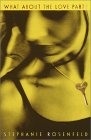
When I was fiction editor at the Bellingham Review (short stay; long story), I got a submission called "How I Went: (A Recipe for Lime Curd)". I did something very unusual: I called the author immediately to accept it, for fear that somebody else would take it first. The author is Stephanie Rosenfeld, and she was struggling to get started at that point.

That was 1999. Now she's got a collection of short stories out there and a new novel (Massachusetts, California, Timbuktu), both of which are on the top of one of my to-be-read piles. The one closest to the bed. Stephanie's stories are very good, but one of them has always stayed with me. It's called "Grasp Special Comb" and it's about a mother's reaction to her daughter's head lice.

When I was in school, nobody got head lice -- but there was a reason for that that had nothing to do with cleanliness. DDT was very, very effective at killing lotsa stuff, and messing around with DNA in general. We wised up about DDT and as it began to fade (which is a good thing, in spite of what I'm about to say) head lice made a reappearance. New, improved head lice. Stronger, 'cause they lived through the DDT holocaust. Those little buggers are tough, and pretty much any parent with a kid in school (any school; lice don't give a damn about tuition or national rankings) will deal with it at some time. It's one of those coming-of-age experiences, like pimples, that you really could do without.

I do blather on. Here's the long and the short of it: I read Stephanie's story just about the time I was first dealing with head lice who had moved in to our lives. It made me laugh and it made me sad, which is something she's very good at: digging down past the laughter. I highly recommend her stories. I'm sure I'll be recommending her novel too, once I've read it.

PS: Both "Grasp Special Comb" and "How I Went: (A Recipe for Lime Curd)" are in her collection.

What About the Love Part?: Stories
Stephanie Rosenfeld
Ballantine Books; (April 29, 2003)
ISBN: 0345448243
Another PS: If you're the parent of a younger child and you're panicking just about now, Don't. With some help, you'll get through this just fine if and when it comes your way. Go see the good folks at ... The National Pediculosis Association®, Inc. (NPA) "is the only non-profit health and education agency dedicated to protecting children from the misuse and abuse of potentially harmful lice and scabies pesticidal treatments.  .... Pediculosis provides an early opportunity to teach children responsible personal health behaviors --- lessons that become valuable as children mature into a world full of other behavioral health threats. Communities that promote head lice prevention programs demonstrate a commitment to health and wellness."

October 25, 2003

The Magician's Assistant, Ann Patchett *****

There's a book I wanted to say something about when I first started this blog, but I didn't. I think because I was afraid of somehow trivializing it. But I'm going to try now.

Somebody handed me The Magician's Assistant, or I probably would never have read it. It was one of those fateful, off hand gestures. She mentioned the book, and left it on my doorstep. I had nothing else to read just then (or nothing I wanted to read, more to the point) so I started it right away.

This novel is a work of art. Like any work of art, not everyone will appreciate it, but to me it is as close to perfect as a novel gets, in its own particular way. It's about a woman who has lost her husband, and in the process of grieving learns more about him and herself than she ever imagined. Now, if somebody told me that about a novel, I wouldn't be in a rush to read it. Doesn't sound like my kind of story. But it is. Might be yours, too.

One word of caution: it probably won't appeal to people who feel most comfortable defining 'family' in traditional terms.

I'm putting a short excerpt in the Extended Body (link below). Kitty, Sabine's sister-in-law, takes her to Wal-Mart. Sabine is a dyed in the wool Los Angelina, and this is a new experience for her. In this short scene (you only get a little of it here), you come to understand almost everything about Kitty's life and world.

excerpt The Magician's Assistant
Copyright Ann Patchett.
Harvest Books; (September 17, 1998)
ISBN: 0156006219

On the curb was a soda machine, all drinks a quarter. Kitty leaned in towards Sabine as they pushed open the glass-and-metal doors. The warm air smelled like popcorn and Coke. It smelled like a carnival wearing new clothes. An older woman in a blue tunic who seemed to be patterned on Dot, the same plastic glasses and gray curls, the same roundness, pushed out a shopping cart for them to take. She greeted Kitty by name.

"I buy books here," Kitty said. "I buy my shampoo and underwear and cassette tapes and potato chips, sheeets and towels and motor oil." There was something in her tone, so low and conspiratorial, that Sabine put her gloved hand over her mouth to keep from laughing out loud.

"Why?" Sabine said. "Why?"

October 24, 2003

book tours

Cindy asked a very good question in a comment:

don't you have book signings to sign books that people have purchased as a way of thanking them for buying your books? I think that's sufficient enough, don't you? Mostly, with the wonderful world of email, if I send an email it's thrill enough that you or webgenie Rachel respond. Sometimes books touch people and they want to reach out and ask questions because they become attached to the characters.

And of course she's right: I'm happy to sign books for readers whenever I can. It's a sincere compliment to know that someone might like the story so much that they would go to such trouble. I have a small collection of signed first editions, but only of books that have really meant something to me.

But tours are a complicated matter. They cost a lot of money, so the publishers aren't wild about them. Publishing is, after all, a profit-based business. If the numbers showed that reading tours brought in hundreds of new readers, I guess the publishers might be more willing to send authors out, but the opposite is the case. I have done readings for two people, and readings for a hundred, but the average is probably thirty. Send me to ten cities to read to, say, three hundred people (many of whom are already converts and loyal readers) -- you can do the arithmetic.

Reading tours are really hard on authors, too. Some authors do like them, but most don't. You see nothing but the inside of airplanes, hotels, bookstores, and book warehouses. You might do a couple radio interviews, or a couple interviews with journalists, you might just run from bookstore to bookstore. There's no time to think, much less write, so by the time you get home, whatever writing momentum you had is gone.

I am very thankful to my readers, really I am, and the best way to show my appreciation (as I see it) is to put everything I've got into writing the next one.

And by the way: made excellent progress this week, on both novels in progress.

blogg-ed books

Eventually I'll get the list thing working (books, movies, etc etc) but in the meantime, there's a substitute. In the right hand column you'll see a list of books. If you click on one of them, you'll end up at my page at All Consuming, a web service very kindly set up to help people keep track of book discussions on blogs across the internet. Anybody can do it -- go on over there if you're interested.

The first hitch is, to get the Javascript to work properly (that is, to put books on the list over here in the right hand column) I have to tag them all "currently reading". That's not the case, of course. What you'll see there are books I have already read and have written about here, or plan to write about here. Second hitch: it only handles books.

There is a very elegant little program written by Martin at Sundog SunPig which will do everything I want (books, movies, etc etc). Except I don't have the braincells to figure out how to set that up, and the Adorable Husband, who does indeed have that many braincells and more, will be a while getting to it.

Yes, that's us. 1986. Yes, you're right: I'm the pale, blue-eyed one; he's the one with a tan. Yup, I'm Italian; he's a Brit. I was born to break rules.

File this under: more than you probably wanted to know.

October 23, 2003

odd coincidences

I do have male readers; I know this, because some of them write to me. The letters page over on the main website contains some of those letters. However, I would guess that the proportion of female: male letters is pretty skewed toward the female, maybe 100:1. That's why it's very strange that I should get two emails from male readers in one day. Even more strange, they both are asking for something. Joe wants a signed photo:

I just thought I would write you an email telling you how much a fan I am of yours. I think you are one of the greatest authors I have ever seen. I read everything you write and whenever there is an article about you I always read it and save a copy of it. You are truly talented and one day I hope to be as good as an author as you. Keep up the great work and I hope to read many more of your writings in the future.

If you don't mind I would love to have an autographed picture of you to hang on my wall. I would really appreciate it.

While Billy is more straight forward:

can i have your autograph? well if i can my address is............

Hmmmm. I suppose this is as good a time as any to first, thank male readers who take the time to write. It's hard to reach out like that. It's hard for me too. I have written now and then to authors when a book has really influenced me (I had a nice little correspondence going for a while with Mark Helprin about his incomprable A Soldier of the Great War, for example). You sit down and try to say the right thing and you send it off, and most of the time you never know if it got where it was supposed to be going. Which is just fine, really, with me. I hope the authors and performers I've written to get the message I'm trying to send, which is a simple: I'm listening, I hear you, thank you. But I have to let it go, because there's nothing really I can do but put the thoughts out there in the world. Then again, if I'm writing to a male, I worry that somehow he'll think I'm yet another adoring female. Which I may be, but my adoration is well within appropriate limits. I always have the urge to add a PS: I'm happily married, in case you were thinking I might be contemplating a remake of Fatal Attraction.

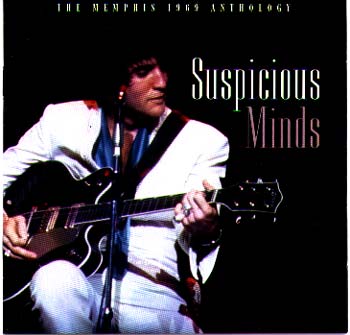
Suspicious Minds

So back to Joe, who has this idea that I might have autographed photos lying around, and to Billy, who will do without the photo. Why is Elvis Presley suddenly singing backup here?

So this is what I'll do: I'll write to them, or I'll ask the wonderful webgenie Rachel to write to them to say thanks for the email, but sorry, I can't send out autographs, and I don't allow cameras within two hundred feet.

At one point I did have a PO box, and people sent me envelopes, self addressed, stamped, and I sent back an autographed bookplate. But it got out of hand, and I was thinking that I'd have to hire somebody to help, and that felt like more than I could handle, so I stopped.

But now I'm wondering if I should try to set something up again. Maybe I'll do a poll. Yes, I will. Do you think Billy and Joe are legit? Would you want a way to get things autographed? Look for the new poll coming up soon. Or just post a comment here. What could it hurt?

October 22, 2003

friends gone missing & writing about horses

The hardest part and also the most rewarding in the writing of historical fiction is getting the details right; for that you need either a staff of research people, unlimited time, or helpful collaborators. While I was writing Into the Wilderness I had a great collaboration going with a few people I met on the research & craft board at Compuserve. It has been many years since I belonged to Compuserve, and I've lost track of most of those folks. It's the down-side of the internet, the way people drift away.

Kaera H. was one of the people who was most helpful to me (I don't know how helpful I was to her, but I tried), especially when it came to writing about horses. She had to steer me right many times, but it was always great when I finally got something right:

Me: "Richard was leaning out over the backs of the geldings, shouting to them, but they raced on, great gouts of ice and mush hurtling up from their hooves."
Kaera: This is terrific. I just had to highlight it because it's so perfect. Nothing like an idiot, shouting at the horses, feeding their hysteria -- expecting them to settle down. He totally lost it, right along with the horses! I loved it.

Don't know where Kaera disappeared to, but I still think of her and consult her old emails when I'm writing a bit about a horse -- as I was today. I wish her well and hope she's content, whereever she has landed.

movies

...I own, or should own, because I like them enough to re-watch each of them multiple times.

It was interesting to put this list together (observing my own idiosyncratic tastes; I'm sure it would be possible to draw all kinds of conclusions about me from the list), but because most readers won't care too much about this, I've put it in the extended body section of this entry (link below). Please note that there are some guilty pleasures in the list, and I'm not going to defend any of them.

I'm planning a list of favorite short stories, too, at some point (making the list leads me to re-reading them, which is a Good Thing as far as my own creative process goes) -- and I'll banish that list to the extended body (what a strange term; it evokes a lot of odd images) as well.

Aliens
A Room with a View
Blast from the Past
Bull Durham
Chaplin (1993)
Contender, The (2002)
Dirty Dancing
Elizabeth (1998)
Enemy at the Gate
English Patient, The
*Farscape
Fugitive, The
Ghost and Mrs. Muir, The (1947)
Goodwill Hunting
Groundhog Day
High Fidelity
Impromtu (Judy Davis, not widely known)
It's a Wonderful Life
Last of the Mohicans (Daniel Day-Lewis version)
*Lonesome Dove
Mansfield Park
Philadelphia Story, The
Pleasantville
*Pride & Prejudice
Reds
Rob Roy
Searchers, The
Sense & Sensibility (1996)
Shakespeare in Love
Strictly Ballroom
Shawshank Redemption, The
Time Bandits
Twelve Monkeys
When Harry Met Sally
While You Were Sleeping
Yanks (Richard Gere; bet you've never seen it)

*so it's not a movie. so sue me

October 21, 2003

fan fiction

... is the term generally used when people draw on an existing fictional characters and settings (in book, tv or film format) to write a story of their own.

There's a huge universe of fan fiction out there, writers and readers both. There are some very talented people writing Farscape fan-fic (more about that in another post); I know there are many websites where people post and read fan-fic for Friends (my daughter reads them on-line and tells me about those stories).

It's an interesting phenomena. As an author I approach it with equal measures of curiosity and trepidation. On the one hand it's tremendously flattering that the characters conceived and created in the author's mind have taken on such life that they go out into the world on their own and have new adventures. On the other hand, it's a little bit like knowing that you have a child out there dating somebody you don't know anything about. Anybody with kids knows that this is nightmare material.

In technical terms, fan-fic is probably a violation of copyright, but I have never heard of an author prosecuting, and in fact I think that would be stupid. If a few people get together to tell stories about Author X's people and places, and there's no attempt to sell or make money from those efforts, then I don't see that there's any problem. If a fan-fic writer tries to claim a character, of course, then things would get a little complicated and uneasy. All of the fan-fic I have seen, however, makes a great effort to establish who owns copyright, and that the stories presented are not meant to be any kind of infringement.

John Crichton

In fact, some authors and writers encourage a certain kind of fan-fic; that's why they sell action figures -- so we can sit at home and construct our own scenes between characters, the way we'd like to see them happen. And sadly, while the John Crichton action figure will never be John Crichton, role-playing is not unhealthy and might even be therapeutic for the... truly engaged viewer. Note I haven't used the 'f' word here.

A related but distinct area is screenwriting. Ann posted this query:

... would you mind if I practiced learning screenwriting skills by using your books? I would not be looking to sell the screenplay - just an exercise for myself.

The reason this is more complicated than simple storywriting is that the screenplay rights for the Into the Wilderness are under option to a producer, and thus they are not exclusively mine to make decisions about. Certainly if the deal begins to come together, it's very unlikely that I would have anything to do with the writing of the screenplay (or the casting of the actors, either). So if somebody has an idea for writing a few scenes from one of the novels and is doing so for their own enjoyment and as an educational exercise, I see no problem with that -- but that's about all it could ever be.


October 20, 2003

today's subliminal thought:


pull up a chair

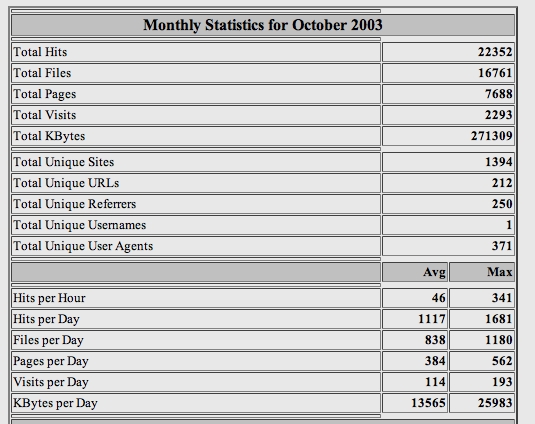
Many people are uncomfortable leaving feedback of any kind on webpages. I know that for a fact, because according to the statistics, there were (on average) 46 visits PER HOUR to this website so far this month. So let me say: I'm glad you're stopping by, lurker or not. I am curious about you, but I'll get over it.

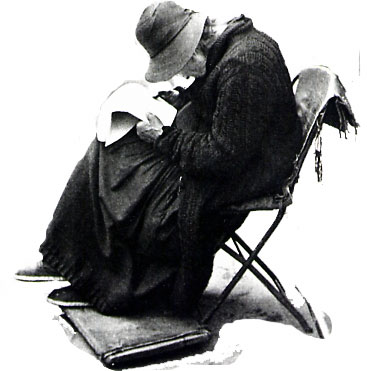
Now, just in case you think I'm getting way too technical, here's a photograph by André Kertész. When I look at this I see myself as an old woman.

October 19, 2003

Mystic River, Dennis Lehane *****

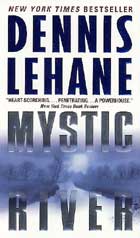
Mystic RiverDennis Lehane is one of my favorite modern authors. He has written an excellent series of detective novels (beginning with A Drink Before the War and ending... I hope not yet), but it is his two stand-alone novels (Mystic River and Shutter Island) that demonstrate what he is really capable of. They are very different from each other, and each one is amazing in its own way.

Mystic River has just come out as a movie and is getting very good critical reviews, but I'm almost afraid to see it. Though I'm sure I will, and soon.

October 17, 2003

map

australiajust so you know... the guest map (over there in the right hand column; just below the POLL) only accepts 100 entries and at this moment, it looks as though Australia & NZ are going to end up with first prize.
I should say: on a per-capita basis.

October 16, 2003

something a little different

wrongful death

I don't usually like courtroom dramas, or at least I haven't got a list of ones that worked especially well for me. Beyond To Kill A Mockingbird, of course. Can't beat that one. I do read such novels, but they often don't stay with me for very long. I couldn't recount the plot of any of Grisham novel, for example.

Baine Kerr is an attorney who has written two novels. When I read Harmful Intent I knew right away that I was in the hands of a wonderful writer, somebody with an ear for language and the ability to make characters come alive as they moved through the story. So I went out and got his second novel, Wrongful Death, immediately.

Wrongful Death is different in tone from Harmful Intent, and it took me a little longer to get into it. I had to stop myself from reading quickly and really concentrate on the first ten pages. I have rarely invested my reading time so well. Wrongful Death is about things as diverse as personal injury law and the Bosnian war-crime tribunals, mother-daughter relationships and forensic pathology. And Kerr pulls it all together with such flair, you can only sit back in amazement and admiration.

The final section of the novel takes place in court, and I doubt anyone will ever write a better trial sequence. What is best about this novel, though, is Kerr's absolutely wonderful rendering of three very different women, each so clearly drawn and so distinct from the other that you hear their voices without trying. The next time I hear somebody claiming that men can't write women, I'll hand them this book.

Wrongful Death deals with terrible tragedy, human weakness and grief, but it is, in the end, hopeful. It has my highest recommendation.

Wrongful Death
Baine Kerr
softcover edition: Jove (July 1, 2003)
ISBN: 0515135747

what I'm writing just now

In addition to hammering away at the first chapter of Queen of Swords, I've been working more seriously on a contemporary novel that I have had blocked out for some time. It's set at a (fictional) small private college in the south, and is as yet untitled. Or I should say as yet with many possible titles, the one I'm favoring at the moment is Tied to the Tracks.

Here's the blurb:

tracks
When Jo Mangiamele's struggling film company is hired to make a documentary about their writer in residence, it seems her luck has begun to turn. Except that the university where she must spend the year filming happens to be the very place where John Grant, a former boyfriend and perennial thorn in her side, is chair of the English department.

October 15, 2003

one star reviews

everybody gets them. I try to make them a learning experience, or at least I try to laugh at the worst of them.

Constructive criticism doesn't hurt; it's the stuff that writers need if they are really serious about their work. A lot of criticism out there is in no way constructive, and that sometimes does hurt, if I'm in the wrong mood or make the mistake of taking it too seriously. Amazon.com has caused a lot of writers some really bad moments, because of course the reader reviews are all anonymous and anonymity brings out the worst in some people.

Into the Wilderness has 192 reviews on Amazon, and ten of them are one star reviews. A few of those don't like the novel because I'm not Diana Gabaldon. A few more don't like it because Into the Wilderness isn't a proper sequel to Last of the Mohicans (of course, I never said it was; it's more of a retelling of Cooper's The Pioneers; a [careless] critic called it a sequel, and I've never heard the end of it). Others have managed to find some bodice ripping somewhere in it (maybe some edition I never approved, what do I know?) and object on that basis. Some find fault with my historical research. Here's the funniest one:

I was hoping Elizabeth would end up being a black bear's main entree, but no luck. Of course, with her amazing luck, she'd have brained him with one of her "boots" and eaten him for dinner. Oh, I forgot. Elizabeth is so ahead of her time, she's no doubt a vegan. [from Amazon]

There are, of course, many wonderful reader reviews on Amazon, very complimentary and encouraging. The point is that not every book is right for every reader. I'm not a huge fan of Hemingway but that's my fault, for the most part. I wouldn't put the blame on him. And what a boring place the world would be if we all liked exactly the same things.

Of course, editorial reviews are a different (and very complicated) matter altogether. More on that some other time.

October 14, 2003

heroes & their problems

Robyn, clever woman that she is, has pointed me to Doris Egan's essays. Doris writes science fiction, which of course I must now read because anybody who would write this particular essay: Why I Like Heroes With Unsolvable Problems is someone whose fiction I suspect I will like. Here's a paragraph:

"Dramatic structure most often asks the question, "How will they solve this problem?" Character asks, "How will they adapt to this problem?" And it's watching them attempt B while having to do A that evokes the flash of empathy in the audience -- that in fact makes "A" worthwhile. Because, after all, a mere court case or a murder is not enough -- we want to know how Sherlock Holmes will deal with this. Or Peter Wimsey or Fox Mulder or our boy Miles or Ally McBeal. We want the specifics, the style of this particular dance, the scent of the rose and not merely the dried petals.
We want a little bit of mess in the perfection of structure, and the hint that we have here a life that will go on after we close the book or turn off the television.
And that's why I like heroes with unsolvable problems. "

technobabble

the long and short of it is: the website wasn't cooperating with me for the last three days, so I couldn't post anything. Now it's back. Why? I have no idea. I don't dare look too closely. My theory is that computers are the modern day equivalent of the cantankerous gods of long ago. No sense in trying to figure them out, because they take all their joy in confounding human expectations.
More real stuff soon.

October 12, 2003

sidelined protagonist syndrome

Martin at Legends of the Sun-Pig has proposed a new term for one particular kind of plotting cheat: Sidelined Protagonist Syndrome. I may start a list of such terms.


fiction & genealogy & names

This is a letter I got from a reader recently:

I'm thoroughly enjoying your books [...] My ancestor William Markham was the first white man to befriend the Mohawks, or so they say in the family. I do know quite a lot about his grandson, Col. Wm Markham III who founded the small town of Rush south of Rochester and who built a lovely home in the area in 1794. I look forward to your new book.

I'm always really pleased when readers find personal connections to the historical context of the books. I do quite a lot of genealogy myself. On my maternal grandfather's line I have ancestors studded all over the east coast from the earliest days of the Dutch settlements in New Amsterdam -- many of the names I use in the novels come out of my family research.

witchcraftWinifred King Benham (known generally as the witch of Wallingford) was tried three times for witchcraft and was never convicted. She was also my nine-times great grandmother, and someday I will have to write about her.

One of the very best parts of research is the naming of characters. It's great fun to see if I can get the more outrageous names I run across in newspapers and histories to work for one character or another.

Oh and: if you've got a minute, please have a look at the map link in the right-hand column. According to the site statistics (over a thousand hits a month on this blog, imagine) people pop in from all over the world, and I'd like to see where y'all are on the map.

October 10, 2003

newspapers in research

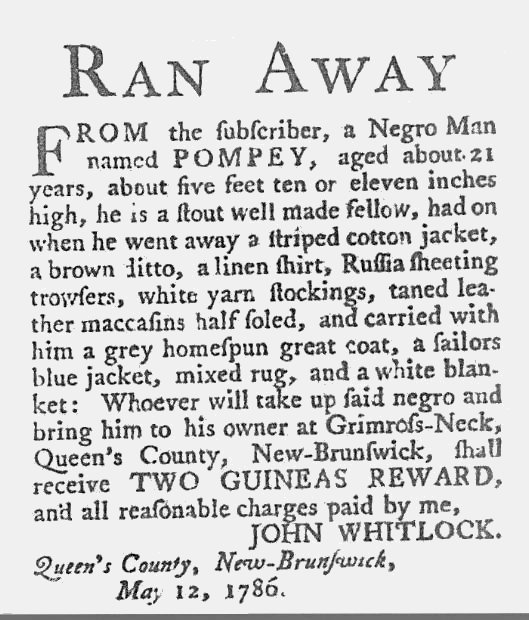
I have a collection of old newspapers that were published in the places where my stories are set. It's surprisingly inexpensive to buy (for example) an issue of an Albany or a Boston paper from the year 1814, and they are almost always in very good shape -- pages intact, if somewhat fragile.

My favorites are the advertisments, for the hundred different kinds of information they provide. The beginning of Lake in the Clouds uses my recasting of a couple dozen such ads in an attempt to set the stage for various storylines in that novel.

This is an ad from a Canadian paper dated 1786 (there was slavery all over the continent, something many people don't realize) offering a reward for the return of a runaway (click to enlarge). The details of clothing the young man was wearing are very useful to me when I'm trying to get a feel for a place and time. Such ads also make the facts of slavery much more vivid and undeniable.

One thing I like to do is to set up little mini-plots that span all the novels, and exist solely within newspaper references. The Mathers brothers and their marital woes are one such plot. This mention from Lake in the Clouds:

HEREBY BE IT KNOWN that Meg Mather, lawful wife of the subscriber, has eloped from her husband in the company of a Frenchman known as Andre Seville. She took with her the subscriber's infant son, a French Negro slave girl called Marie, and a mantel clock. A reward will be paid for return of the boy, the slave, and the clock, but a husband so maligned by such shameless and sinful behavior is glad to be free, and will give no reward, nor will he allow the wanton back into his home. He therefore warns all persons from trusting her on his account. He will pay no debts of her contracting. Jonah Mathers, Butcher. Boston Post Road.

And from Into the Wilderness:

"Lydia Mathers," Elizabeth read,

the wife of the subscriber, has eloped from her lawful husband in the company of one Harrison Beauchamp, known gadabout and suspected thief, taking with her a good pewter jug, twenty pound in coin, three silver spoons, a snuff box, the slave girl Eliza and her husband's good underclothes. By this notice her much injured husband thinks it prudent to forewarn all persons from trusting her on his account, being determined, after such flagrant proof of her bad behavior, to pay no debts of her contracting. I treated her well. Thy-Will-Be-Done Mathers of Canajoharee.

The Mathers continue in the same vein in Thunder at Twilight. I keep wondering if one of them will show himself more directly, but so far neither Thy-Will-Be-Done nor Jonah has come around a corner to surprise me in mid scene.

October 9, 2003

who the frell is John Sheridan?

Which Fantasy/SciFi Character Are You?

I'm an easy mark when it comes to silly tests, and this one told me that the science fiction character I most resemble is somebody called John Sheridan from Babylon 5.

I was hoping for Aeryn Sun, but no such luck.

Speaking of Aeryn... I've been thinking about the final episode of Farscape's third season, Dog with Two Bones and I've come to the conclusion first, that's it's one of the best hours of television I've ever seen; and second, (this is important) I couldn't bear to watch it again. It deals with loss in such a direct and raw way that I found it hard to put it out of my mind. Ben Browder and Claudia Black put so much into their performances it almost hurt to watch. This is not your typical cliff hanger: it goes way beyond dark.

first person narratives

There are fads in storytelling just as there are fads in clothes. A visit to any bookstore makes that clear; if you pick up a dozen new novels in a row a couple of things will ump out at you right away.

First person narratives are very popular just now, and have been for a while. The narrator tells the story to the reader, and thus we live in the narrator's head and see the story only from the narrator's limited point of view. I don't particularly like first person narration, for exactly that reason. I think of it as the Charlotte Brontë approach, or the Reader, I Married Him school. In addition to writing first person narration, Charlotte Brontë was quite nasty about Jane Austen's work. Thus my scorn. Sniff. Scowl. (Quotes from Miss B about Miss A in the extended entry below.)

Okay, so I'll admit there are many excellent first person novels out there. I just can't think of a single one at this moment.

Now here's the rub: the one place where first person narration works for me (in a limited way) is in epistolary form. If Character X writes a letter to Character Z, then I get to hear X's voice, and I learn a lot about the relationship between the two of them. I am very fond of doing this for my own characters. It helps me figure them out in a way nothing else can. If Curiosity sits down to write a letter her voice sounds very clear to me, more so than at any other time. If the character wants to write a letter, I am very pleased to take dictation.

In general I love novels that mix up forms. Third person narration interspersed with letters, newspaper reports and advertisements (there's another topic to write about here, old newspapers), legal documents. In my own work I don't often use poetry as I'm not very good at it, though once in a while I have made a small exception.

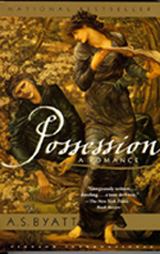
A.S. (Antonia) Byatt is a superior novelist and she also writes some of the very best literary criticism and analysis. For people interested in thoughtful, intense discussions about storytelling, her collected lectures are really worth reading. Otherwise I love her Possession: A Romance. Byatt is a former academic, and she dissects academia with laser-like precision in this novel. It's everything in one: a well-plotted mystery, an intriguing love story (times two), an academic satire, a wonderfully done historical, a clear and striking picture of the lot of women (and especially women artists and writers) in Victorian England, and an ode to the poetry of that period. How this book didn't get onto the lists of the century's best is beyond me. Stunning prose, and first class storytelling. Possession is a demanding novel, one that has to be read closely and re-read many times to get all the complexities, but it's so worth it. (I have also listened to it on tape, which was another wonderful experience).

Unfortunately, I can recommend the movie, which was a terrible disappointment.

From the wonderful Pemberley website, where all good Austen things are collected: Letter of January 18th 1848 to George Lewes (in response to his reply to the preceding): ``You say I must familiarise my mind with the fact that "Miss Austen is not a poetess, has no ``sentiment''" (you scornfully enclose the word in inverted commas), "has no eloquence, none of the ravishing enthusiasm of poetry"; and then you add, I must "learn to acknowledge her as one of the greatest artists, of the greatest painters of human character , and one of the writers with the nicest sense of means to an end that ever lived". The last point only will I ever acknowledge. ... Miss Austen being, as you say, without "sentiment", without poetry , maybe is sensible (more real than true ), but she cannot be great.''

October 7, 2003

Robyn sez

... that I forgot to put in the link to the main website and the reader's letters, as mentioned in my last post. And as usual, she's right. Here it is. But be forwarned, there are some big spoilers in these letters.

a longer post to come, later today.

October 4, 2003

letters from readers

kistler babies

I get a lot of email from readers. So much that I can't answer it all, so Rachel, my webgenie, does some of that for me. Once in a while I find the time to answer a handful of emails, and I read them all, just so you know that.

But here's the thing: it's hard to know what to say. I fall back on the old reliables: thank you, you are very kind or: I'm so glad you enjoyed it. There have been so few negative emails that I haven't had to come up with any kind of standard reply to them, but I suppose I could: I'm sorry to hear you were disappointed or you clearly aren't the right reader for these books or you're right, I'm not Diana Gabaldon. I'm very fortunate that I haven't had to put too much effort into that type of thing.

To be really honest, I feel a little strange taking credit for the books. Each of them feels so long ago and far away (and still, a part of me). As if somebody came up to me and said, wow, you have two hands. And I'd look down and sure enough, two hands. I should take some pride in that? They are just a part of me, parceled out in the genetic sweepstakes along with blue eyes, big feet, and an ear for language.

You take a year or two to write a book and then it goes off and if you're lucky, makes a place for itself in the world. Much like child bearing, where all the drama and pain fades with time until what you've got left over are a lot of memories, most of them not very reliable. And here's this incredible being running around in the world on its own terms, independent of you. True, once it was inside of you and might never have emerged if not for the dictates of simple biology and opportunity. And fate.

But there it is, making friends in some places and pissing other people off (critical reviews, ah, there's a topic for another day), and some of those people sit down and write to me: thank you, I really loved this book, the way people say to me: what a great kid you've got. (Because, of course, I do have a great kid. I'm more sure of that than I will ever be about any book.) And of course I'm thrilled when people recognize what a great kid I've got even while I'm thanking the fates (because I'm Italian enough still to worry about tempting them) for the good fortune of a healthy, happy, smart, beautiful daughter. Just as I'm very touched and truly pleased when somebody tells me a novel I wrote means something to them.

So if you write to me and don't hear back right away, or hear back from Rachel, please know that I read your email or your letter (which will get forwarded to me if you send it to Bantam) and you gave me a moment's confused but sincere pleasure.

Unless you're the guy who writes to lecture me about Treenie; if you're that guy, go away.

PS Some of the funniest or most moving emails are on the website, if you want to have a look. I suppose I might post one here now and then, or a question to be answered, on occasion. Or you could post a comment, below. Otherwise I'll just sit here babbling to myself. Perfectly okay with me.

October 1, 2003

Queen of Swords: research

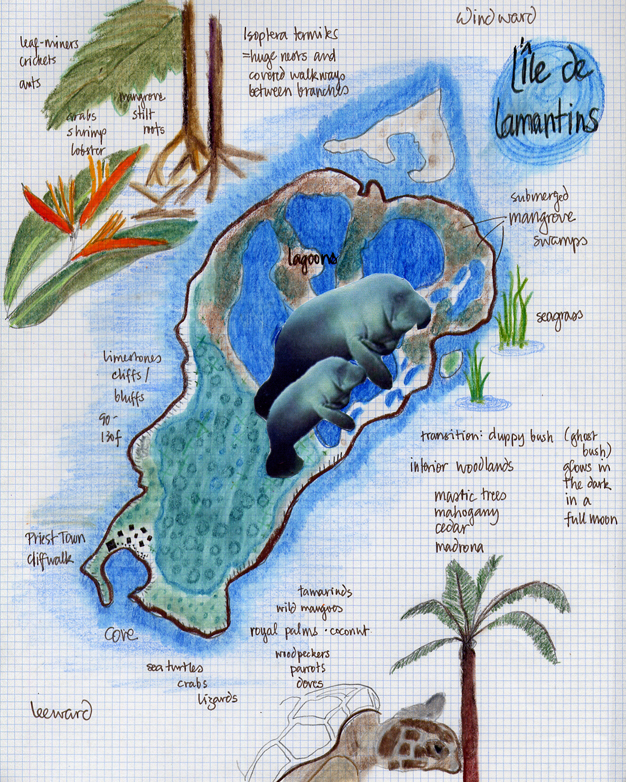
L'Île de Lamantines

Working on the setting for the first three chapters of the new novel, along with bits of dialogue and description and an overall plan. Coming together slowly. When a lot of action is dependent on geography I usually do some close sketches to keep myself oriented as I write. This is the rough sketch for the fictional island in the Antilles that I've been working with. It's called L'Île de Lamantines, or Island of the Manatees (click to expand, but be warned, the full sized graphic is big).

I add to the notes on the sheet as I come across details in my reading. When I'm finally finished with this it will be quite crowded with text.

another short excerpt Fire Along the Sky

Just in case you had the idea that this new novel is not about the Bonners themselves...there's another short excerpt below (see "continue reading" at the bottom of this entry).

That will be the last excerpt, but please know that while the younger Bonners (Lily, Hannah, Jennet) play a large role in this story, Elizabeth and Nathaniel are still central.

Excerpt: Thunder at Twilight. Forthcoming Bantam Books. Copyright Sara Donati. All Rights Reserved: no part of this text may be reproduced in any way without express written permission of the author.

Chapter 1

Early September 1812
Paradise, New-York State

Hot sun and abundant rain: Lily Bonner said a word of thanks for good summer and the harvest it had given them, and in the same breath she wished her hoe to the devil and herself away.

But there was no chance of escape. Even Lily's mother, whose usual and acknowledged place was at her writing desk or in a classroom, had come to help; everyone must, this close to harvest. The women must, Lily corrected herself: the men were in the cool of the forests.

She glanced up and caught sight of her mother, all furious concentration as she moved along, swinging her hoe with the same easy rhythm as Many-Doves. There were an army of two marching through the tasseled rows, corn brushing shoulders and cheeks as if to thank the women for their care.

For all their lives Mohawk women spent the best part of every summer day in the fields tending the three sisters: corn, beans, squash. But Lily's mother had been raised in a great English manor house with servants, and she had not held a hoe in her hands - white skin, ink stained fingers -- until she was thirty. Elizabeth Middleton had come to New-York as a spinster, a teacher, a crusader; in just six months' time she had become someone very different.

Lily understood a simple truth: the day came for every woman when she must choose one kind of life or another or let someone else make the choice for her. For some the crucial moment came suddenly, without warning and when least expected; others saw it approaching, pushing up out of the ground like a weed. It was an image that would not leave her mind, and so she had finally spoke about it to her mother, holding the idea out in open palms like the egg of an unfamiliar and exotic bird.

And how it had pleased her mother, this simple gift. She sat contemplating her folded hands for a moment, Quaker gray eyes fixed on the horizon and a tilt to her head that meant her mind was far away, reliving some moment, recalling a phrase read last week or ten years ago. When she spoke, finally, it was not with the quotation Lily expected.

She said, "There are so many choices available to you, such riches for the taking. The very best advice I can give you is very simple. You have heard me say it in different ways, but I'll put it as simply as I can. When it comes time to chose, try to favor the rational over the subjective."

At that Lily had laughed out loud, in surprise and disappointment. Who else had a mother who would say such a thing, and in such a studiously odd way? Other people were satisfied with quoting the bible and old wife's wisdoms, but Lily had a mother who preferred Kant to the proverbs. Who made decisions with her head when she could, and was convinced that in doing so, her other needs would be satisfied.

Certainly Elizabeth Bonner could point to even the most unconventional choices she had made in her life and argue that they were rational, and more than that: that she was happy with her choices. As most of the other women Lily knew were happy with the lives they had. Most, but not all. [...]