noble savages
What really distinguishes humans from other animals is our fascination with ourselves. It's almost embarrassing to think about, if you look at it hard enough. We sit around thinking about how we think.
Conceptions of human nature and intelligence shift and reform themselves based on new trends in psychology, sociology, medicine, and anthropology. Often these views are encapsulated in the majors religions of a time and place. There have been various Christian sects that believed that an individual's eternal fate was predetermined, and that no amount of good works could offset what the person was born to be. In the mid 20th century there was a lot of debate about the mind as a blank slate, a child born with no innate traits or knowledge and totally molded by his or her environment. In the eighteenth century Rousseau popularized the notion of the noble savage, in which humans are good when they come into the world, and become corrupted by civilization.
The noble savage idea led to all kinds of literary mischief. In this continent we got Fenimore Cooper's idealized and romanticized Indians, while Defoe sat over in England dreaming up Friday, who is probably the best known example of the noble savage in 18th century storytelling.
He is also something of a Magical Negro, put there to provide for Robinson Crusoe.
The wikipedia article on the noble savage includes a list of attributes:
- Living in harmony with Nature
- Generosity, fidelity and selflessness
- Innocence
- Inability to lie
- Physical health, disdain of luxury
- Moral courage
- "Natural" intelligence or innate, untutored wisdom
Which is reminiscent of the characteristics common to the Magical Negro in modern day storytelling, in print and on screen. So this is a long but positive yes to Lisa's question of a couple day's ago: it does look as if the concept of the noble savage is a precursor to the Magical Negro.
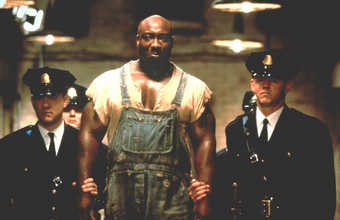
I wanted to look at two extreme examples of Magical Negros. And by that I mean, the Super Duper Magical Negro (to use Spike Lee's purposefully exaggerated term), and a more nuanced (but maybe just as negative) example, which is where Coffey of The Green Mile comes in.
If you haven't read The Green Mile or seen the movie version, you might be a little lost here. Also, there are spoilers.
The story is set in a prison in the rural South, circa 1935. Coffey is a very tall, very strongly build black man of indeterminate age. He's simple minded to the point that he remembers very little of his own history, he has no relatives and belongs to no community, he's empathetic and kind. He does indeed have a magical power, and that is if he touches someone, he can sense physical illness in them. He sees the illness, as though touch opens up the ability to look through flesh. He also sees something of a person's soul, the basic goodness or lack thereof. And finally, he can cure the illness he senses by drawing it out of the afflicted and into himself. He then expels it by opening his mouth and expelling what looks like a cloud of gnats that fades into nothingness.
Coffey has been convicted of raping and murdering two little girls, and he is brought to The Green Mile to wait for his execution. He seems to not fully understand the charges against himself, but he is docile as a prisoner, quiet and unassuming. He is brought in on a day when the head guard, a man called Paul, is in the grips of excruciating pain from a bladder infection. This is pre-antibiotics, remember, and a bladder infection could easily kill you. In the course of the story, Coffey cures Paul and performs other miracles, small and large. In the end he goes to his execution having taught Paul and the others a great deal about kindness and generosity and the nature of good and evil.
So sure, Magical Negro and/or Noble Savage. All the main markers are there. First question: could this story have worked as well if the main character were not black? Well, no. Because this is the deep south, and the year is 1935, and the blatant everyday fact of racism is crucial to the story. It's senseless to ask if there was any doubt of Coffey's guilt in the murders, because in that place, at that time, nobody would have paused to wonder. The circumstancial evidence (he is found crying over the bodies) is enough to send him to the electric chair; in fact, it's a miracle that he isn't strung up right then and there.
In many (but not all) cases, a Magical Negro character could easily be of another race. Friday could have been a French sailor stranded on the same island for twenty years, and perfectly suited to teaching Robinson Crusoe what he needed to survive. In all the current day movies, the Magical Negro role could easily have been taken by somebody of another race. But in The Green Mile, race is a central theme.
But John Coffey does depart from the stereotypical MN, and in a big way. Magical Negros are supposedly selfless, kind and gentle of spirit. They do not inflict harm; it is their role to teach. Revenge is not on the list of characteristics common to Magical Negros.
In this story, Paul sees Coffey for the gentle soul that he is, and begins to doubt he could be guilty of such heinous crimes. He is so concerned that he goes off to see the lawyer who was assigned to defend Coffey at trial. This is a pivotal scene in the novel -- and also a well done and eerily creepy scene in the movie. Paul sits down with the lawyer on his back porch, and the lawyer tells him he has no doubt that Coffey is indeed guilty. He tells a story about a family dog who had been loyal and protective and playful until the day he turned on the lawyer's eight year old son and bit him in the face. Sooner or later, he tells Paul, the animal will turn on you.
Now, this is disturbing to the extreme for any reasonable reader. The lawyer doesn't hesitate to compare a human being to a dog on the basis of his skin color, and he is as easy about putting the man to death as he was about shooting the dog. Paul's reaction is guarded, but he doesn't challenge the lawyer. He goes back home, unsure of how to proceed.
And here's the twist. Not everybody is kind and reasonable on The Green Mile. There's a sadistic guard with relatives in high places that Paul would like to fire, but can't. And there's a prisoner who is everything evil and disturbing. Each of these men does something incredibly cruel, something almost beyond belief. In the case of the guard, he purposefully mismanages an execution so that the prisoner -- a friend of Coffey's -- dies in the most prolonged, agonizing way possible. And the other prisoner is the man who actually raped and murdered the little girls. Coffey knows this because he has touched the prisoner, and he is filled with revulsion as he takes in his past.
For all his gentleness and his simple mind, Coffey plans and carries out a very elegant plan against both these men. Revenge of the most cunning and effective sort. And then he tells Paul -- who is willing to let him escape and disappear -- that he doesn't want to go on living. That he's tired of the misery in the world, and he wants to go on with the execution. And that happens.
Now, John Coffey certainly fits the description of the Magical Negro, but Stephen King couldn't leave it at that. He had to raise some doubt and some disturbing questions, and he did that by means of the lawyer's story. Paul (and the readers) reject the idea of the black man as an unpredictable animal out of hand, but then Paul never anticipates Coffey's actions against Percy (the sadistic guard) or Billy (the man who committed the crimes against the little girls).
A good story leaves you with something to think about. I doubt that Stephen King anticipated that a middle aged woman on the other side of the country would spend time considering John Coffey and the Magical Negro, but in my case, that's what happened. I don't think his characterization of Coffey was racist, in spite of the many Magical Negro features. I do think he could have done a little more to temper the MN characteristics, but then it was his story, and not mine. And I'm glad he told it.
I saw the movie, then read the book a few years ago. The movie was ok, but the book made me cry and stayed with me for a long time. I never felt that John Coffey was stereotyped. Sure there was racism, but that was a reality of that time and place.
It's strange to me that I never heard the plot lines of this book/movie. I've never seen it, just clips when it was nominated for Academy Awards. And I wouldn't have guessed the nature of the story or the racial overtones from those clips. Seems so long ago, I hardly remember what I saw, some prison scenes, Tom Hanks, the big black man, and that's it.
You've given me something to think about.
I've been following the discussion and taking it in, but I've got a few questions.
Is this an North American/British phenomenon? I don't know how race is perceived in other countries (without history of black slavery) and if it effects how the stories would be viewed.
Are MNs written exclusively by white authors?
Is it an attempt to make modern-fairy tales? Not flattering of course, but I can see fairy godmothers etc. in a similar light.
Lastly, what do you (anyone) think is the next step? Will the general public be so offended that MN cease to exist, or will other races be targeted?
Just Curious-
Soup
Fascinating discussion. I must admit, until I read your posts, I had never heard of the SDMN cliche. Being Asian however, I did notice that Asian characters tend to be stereotyped in movies. In many Hollywood movies, the Asian character is often protrayed either as a 'wise teacher' or 'evil villain'. There are very few movies that portray Asians as real, complex characters.
I'm not sure if the MN phenomenon exists in films made outside of Britain/US. But, in my experience of having watched many non-English language films, I would say that it is a stereotype that does not seem to appear in non-English language films. Which is not to say only English language films are the only ones with race stereotypes in them. In Asian films, you are not even likely to find a multi-racial cast. And if there is a character of a different race from the rest in the movie, that character is likely to be a minor, two-dimensional one or a (minor, two-dimensional) villain. Nobody complains about the lack of white characters in Asian movies though, never mind about stereotypes!
As for Coffey, I agree with your analysis. I haven't read the book, but I did watch the movie and I don't think Coffey counts as an MN. For the simple reason that his race, as well as his 'magical' abilities are central to the story. As a matter of fact, his character, rather than that of Paul, is the one that's central to the story. In most stories featuring an MN, it's the white character who's central to the story. If the MN did not exist, some other character, or some other plot device could have been found to achieve the same object. In Green Mile, Coffey IS the story.
Doh,Rosina made my points about Coffey's actions against Percy and Billy already! That movie and "Shawshank Redemtion" were two good examples of that time and place. Shawshank Redemtion,hmmm...
I've let my elephant stay in the room all weekend, and he won't go away. The Wikepedia definition of noble savage also fits the Christian version of Jesus. Before you posted it I was already thinking about these MN's being, hmmm how shall I say it, literary versions of a Jesus figure. Even Jesus became important when viewed as "other," that is, by Romans, Franks, etc. rather than by his fellow Jews. I think the DaVinci Code brouhaha was, to a large extent, the notion of descendents of Jesus, going against the MN tradition of "Kill off the MN so he won't go forth and multiply." Now how many people have I offended?
Not me. Not offended in the least. It's an interesting parallel, I'll have to think about it.
Tourist help, please! Daughter #2 wants the 2 of us to spend a week in/around Seattle next month. I only know it rains a lot. Do you have suggestions for sightseeing?